wayground logo

Free Printable Worksheets

Font size

S
M
L
XL
Worksheets

Crescendo to Crisis 2025 Remediation

Total questions: 111

Worksheet time: 3hrs 43mins

Name
Class
Date
1.

For the Industrial Revolution to happen, it was necessary for this revolution to occur first. (Be specific)

a)

The 2nd Agricultural Revolution

b)

The Digital Revolution

c)

The French Revolution

d)

The Renaissance

2.

Where do most experts agree that the Industrial Revolution began and why?

a)

In the United States, due to technological innovation.

b)

In Britain, due to access to coal, colonial trade networks, political stability, capital for investment

c)

In China, due to early advancements in agriculture and metalworking.

d)

In Germany, due to its strong education system and skilled labor force.

3.

Who “stole” the plans for a factory and took them back to the US to help start the IR?

a)

Samuel Slater

b)

Alexander Graham Bell

c)

Thomas Edison

d)

Benjamin Franklin

4.

What is it called when one person purchases multiple farms and closes production for commercial use only?

a)

Enclosure Movement

b)

Urbanization

c)

Land speculation

d)

Commercial farming

5.

What is the direct result of the process described of the enclosure movement?

a)

Urbanization

b)

Decrease in urban population

c)

Expansion of the feudal system

d)

Reduction in rural employment opportunities

6.

Identify inventors/creators during the IR.

a)

James Hargreaves

1.

Spinning Jenny

b)

Eli Whitney

2.

Cotton Gin

c)

Henry Bessemer

3.

Steel

d)

James Watt

4.

Steam Engine

e)

Marie Curie

5.

Radioactivity

7.

Louis Pasteur discovered bacteria leading to what major medical breakthrough?

a)

Development of antibiotics

b)

Discovery of penicillin

c)

Invention of the microscope

d)

Introduction of antiseptics

8.

What medical advancement is Edward Jenner associated with during the IR?

a)

The invention of the stethoscope

b)

The discovery of penicillin

c)

The development of the smallpox vaccine

d)

The introduction of antiseptic surgical methods

9.

Mass production of _________ drives the 1st IR.

a)

textiles

b)

automobiles

c)

computers

d)

steel

10.

What resource is the main source of energy during the 1st IR?

a)

Coal

b)

Wind

c)

Solar

d)

Hydroelectric

11.

Steel was made cheaper using what process that holds the name of its inventor?

a)

Bessemer Process

b)

Puddling Process

c)

Blast Furnace

d)

Open Hearth Furnace

12.

What advancement was made in the “methods of production” during the second industrial revolution?

a)

Automation

b)

Use of steam engines

c)

Development of digital technology

d)

Invention of the printing press

13.

The aristocracy and landed gentry generally follow what type of viewpoint/"ISM"?

a)

Capitalism

b)

Conservatism

c)

Socialism

d)

Liberalism

14.

What class of people is often associated with Liberalism? What economic policy?

a)

Professional Class, Capitalism

b)

Working class, Protectionism

c)

Upper class, Mixed economy

d)

Middle class, Communism

15.

Many Shelly’s “Frankenstein” is often associated with what 19th century ISM highlighting the need to look outside of science for answers to the human condition?

a)

Romanticism

b)

Realism

c)

Modernism

d)

Existentialism

16.

Match the author/proponent with the ISM

a)

Marry Wollstencraft

1.

Feminism

b)

Adam Smith

2.

Liberalism

c)

Karl Marx

3.

Socialism

d)

Metternich

4.

Conservatism

e)

Mazzini

5.

Nationalism

17.

What is the biggest difference between socialism and liberalism?

a)

Socialism advocates for government control over production and distribution, while liberalism emphasizes individual freedom and market economy.

b)

Liberalism advocates for government control over production and distribution, while socialism emphasizes individual freedom and market economy.

c)

Socialism and liberalism both advocate for the same level of government control over the economy.

d)

There is no significant difference between socialism and liberalism.

18.

What type of rights are often associated with conservatism?

a)

Natural rights

b)

Cultural rights

c)

Inherited rights

d)

Environmental rights

19.

What type of rights are often associated with liberalism?

a)

Inherited rights

b)

Natural rights

c)

Cultural rights

d)

Economic rights

20.

Identify “liberal/radical revolutions” and “conservative/modified” revolutions.

Categorize the following

French Revolution

Haitian Revolution

American Revolution

Glorious Revolution

Liberal/Radical
Conservative/Modified
21.

Which 19th century “ISM” transcends all classes of people?

a)

Capitalism

b)

Socialism

c)

Nationalism

d)

Romanticism

22.

Mary Wollstonecraft and John Stuart Mill are often associated with which famous 19th century “ISM.”

a)
feminism
b)
socialism
c)
capitalism
d)
communism
23.

What were Klemens von Metternich's goals at the Congress of Vienna?

a)

To establish a balance of power in Europe

b)

To promote democratic governments across Europe

c)

To expand the Austrian Empire

d)

To support the spread of the Napoleonic Code

24.

What countries are in the “Holy Alliance”?

a)

Russia, Austria, and Prussia

b)

France, Spain, and Portugal

c)

United Kingdom, Italy, and Germany

d)

China, Japan, and South Korea

25.

To enact social change, what group of people must conservatives and/or liberals move on their side?

a)

Politicians

b)

Moderates

c)

Media personalities

d)

Business leaders

26.

This Italian philosopher would promote Nationalism heading into the unification of Italy.

a)

Giuseppe Garibaldi

b)

Giuseppe Mazzini

c)

Camillo Benso, Count of Cavour

d)

Victor Emmanuel II

27.

What was the result of the Reform Act in Great Britain?

a)

Expanded the electorate for the House of Commons

b)

Reduced the powers of the House of Lords

c)

Abolished the monarchy

d)

Established a republic

28.

Aside from their military prowess, what key area does Prussia succeed in more than any other European power during the second half of the 19th century?

a)

Industrialization

b)

Cultural development

c)

Scientific advancements

d)

Diplomatic relations

29.

During 19th Century Revolutions, generally speaking, what two things do the countries/populations want?

a)

Independence and Religious Freedom

b)

Economic Stability and Military Power

c)

Rights and/or Representation

d)

Technological Advancement and Educational Reform

30.

Identify at least one reason why Great Britain did not encounter the same revolutions as other countries in the 19th Century.

a)

Weak political system

b)

Economic prosperity

c)

Lack of a middle class

d)

Lack of Reform

31.

In 1886, which western country was the last to “end” the practice of slavery?

a)

United States

b)

Brazil

c)

Canada

d)

Spain

32.

Small deadly conflict fought between Russia & a coalition of European powers (Britain & France) that would foreshadow WWI?

a)

Crimean War

b)

Russo-Japanese War

c)

Franco-Prussian War

d)

First Balkan War

33.

What famous figure emerges from this war, helping improve many areas of health care?

a)
Amelia Earhart
b)
Florence Nightingale
c)
Marie Curie
d)
Rosa Parks
34.

As a result of many failed revolutions & conflicts, Europe (along with other parts of the world) saw a mass immigration to what new, budding world power?

a)

The British Empire

b)

The Ottoman Empire

c)

The United States of America

d)

The Russian Empire

35.

In 1861, the Russian Czar emancipated what class of people in Russia?

a)

Nobility

b)

Serfs

c)

Merchants

d)

Military Officers

36.

What is the single most important political event of the 19th century?

a)

The American Revolution

b)

The Unification of Germany

c)

The American Civil War

d)

The Abolition of Slavery

37.

Which of the following are reasons why Germany was not united until 1871?

a)

Economic disparities and religious differences

b)

Lack of military power and external invasions

c)

Political fragmentation and opposition from Austria and Prussia

d)

Geographical barriers and linguistic diversity

38.

What famous political strategy does Otto von Bismarck use to succeed as a Minister of Prussia?

a)
Realpolitik
b)
Fictionpolitik
c)
Unrealpolitik
d)
Fakepolitik
39.

How did Bismarck say he would unify Germany?

a)
Through peace and diplomacy
b)
Through 'blood and iron'
c)
By holding a national referendum
d)
By forming alliances with neighboring countries
40.

Bismarck used "Kulturkampf" or __________, to limit the power of the church in Prussia/Germany.

a)
cultural war
b)
religious conflict
c)
ideological battle
d)
cultural struggle
41.

How do Karl Marx and Friedrich Engels define political power in their book, "The Communist Manifesto?"

a)
Political power is the organized power of one class for oppressing another.
b)
Political power is the result of individual freedom and autonomy.
c)
Political power is the absence of class struggle.
d)
Political power is solely determined by economic wealth.
42.

What is the ultimate goal of Karl Marx and Frederick Engels according to their book "The Communist Manifesto?"

a)
Establish a monarchy with absolute power
b)
Create a society based on social hierarchy
c)
Establish a classless society with collective ownership of the means of production.
d)
Promote individual ownership of the means of production
43.

Explain the concept of Social Darwinism and how it will affect African and Asian countries.

a)

It promotes the idea that certain nations or races are inherently superior and destined to rule over others.

b)

It has no significant impact on African and Asian countries.

c)

It encourages technological innovation in developing countries.

d)

It leads to increased cooperation between developed and developing nations.

44.

Movement for the re-establishment and the development and protection of a Jewish nation in what is now Israel?

a)

Zionism

b)

Socialism

c)

Communism

d)

Fascism

45.

Anti-semitic or Anti-Jewish movement in Russia that resulted in the mass execution of Jews?

a)

The Pale of Settlement

b)

Pogroms

c)

The Protocols of the Elders of Zion

d)

Bolshevik Revolution

46.

French female scientist, who is a pioneering expert in the field of radiation?

a)
Marie Curie
b)
Florence Nightingale
c)
Rosalind Franklin
d)
Ada Lovelace
47.

Define Jingoism.

a)
A term used to describe extreme individualism
b)
A form of pacifism promoting non-violence
c)
A political ideology advocating for global unity
d)
Extreme patriotism, often favoring an aggressive, warlike foreign policy.
48.

Who would have the largest colonial empire amongst all European Nations?

a)
France
b)
Spain
c)
Portugal
d)
United Kingdom
49.

What would be the driving force behind New Imperialism?

a)
Religious motives and spreading Christianity
b)
Technological advancements and innovations
c)
Political stability and diplomatic relations
d)
Economic gain, access to raw materials, new markets, and strategic military advantages
50.

Japan and the US would work to expand their power by dominating the __________ ocean.

a)
Atlantic
b)
Indian
c)
Arctic
d)
Pacific
51.

What three new world powers begin to assert their dominance on the world stage through Imperialism?

a)

Germany, US, Japan

b)

France, Spain, Portugal

c)

United States, Russia, China

d)

Britain, Netherlands, Belgium

52.

What famous conference hosted by the Germans is set to help European countries partition or divide up Africa?

a)

Berlin Conference

b)

Vienna Conference

c)

Munich Conference

d)

Geneva Conference

53.

Many Europeans were taught that they should “civilize” people of color. What was this called?

a)

Colonialism

b)

The White Man's Burden

c)

Manifest Destiny

d)

Cultural Assimilation

54.

Identify the book written by Alfred Thayer Mahan, that would be a leading cause for the build up of Naval Arms during the late 19th and early 20th centuries

a)

The Influence of Sea Power upon History

b)

The Art of War

c)

War and Peace

d)

The Great Game

55.

After the Franco-Prussian war, part of France is annexed into Germany. This part of France is called (a)   .

Choose from the below words
Alsace-Lorraine
Normandy
Brittany
Aquitaine
56.

What country believes that they are the “protector of the slavs?”

a)

Russia

b)

Germany

c)

United States

d)

China

57.

As we head towards the end of the 19th century, what country is now upsetting the balance of power in Europe?

a)

France

b)

Germany

c)

United Kingdom

d)

Italy

58.
The Agricultural Revolution in Britain . . . For a century and a half, from 1688 to 1832, the British government was substantially in the hands of [well-to-do] landowners—the “squirearchy” or “gentlemen of England.” The result was a thorough transformation of farming, an Agricultural Revolution without which the Industrial Revolution could not have occurred. Many landowners, seeking to increase their money incomes, began experimenting with improved methods of cultivation and stock raising. They made more use of fertilizers (mainly animal manure); they introduced new implements (such as the drill seeder and horse-hoe); they brought in new crops, such as turnips, and a more scientific system of crop rotation; they attempted to breed larger sheep and fatter cattle. An improving landlord, to introduce such changes successfully, needed full control over his land. He saw a mere barrier to progress in the old village system of open fields, common lands, and semi collective methods of cultivation. Improvement also required an investment of capital, which was impossible so long as the soil was tilled by numerous poor and custom-bound small farmers. . . . Identify one change in the methods of food production that occurred during the Agricultural Revolution in Britain, according to the authors of A History of the Modern World.
a)
New technology to increase efficiency
b)
Use of the open field system
c)
Even distribution of farmland to small farmers
d)
Breeding more smaller sheep
59.
The Agricultural Revolution in Britain . . . For a century and a half, from 1688 to 1832, the British government was substantially in the hands of [well-to-do] landowners—the “squirearchy” or “gentlemen of England.” The result was a thorough transformation of farming, an Agricultural Revolution without which the Industrial Revolution could not have occurred. Many landowners, seeking to increase their money incomes, began experimenting with improved methods of cultivation and stock raising. They made more use of fertilizers (mainly animal manure); they introduced new implements (such as the drill seeder and horse-hoe); they brought in new crops, such as turnips, and a more scientific system of crop rotation; they attempted to breed larger sheep and fatter cattle. An improving landlord, to introduce such changes successfully, needed full control over his land. He saw a mere barrier to progress in the old village system of open fields, common lands, and semi collective methods of cultivation. Improvement also required an investment of capital, which was impossible so long as the soil was tilled by numerous poor and custom-bound small farmers. . . . Identify one effect of the actions taken by wealthy landowners described in the passage.
a)
Decrease in the amount of food produced on farms in England
b)
Enclosure Acts and consolidation of small farms into large ones owned by a few farmers
c)
Wealthy landowners lost the money they invested in farming innovations
d)
Small farmers gained power in Parliament
60.
What concept is being discussed in the quote below?
a)
Communism
b)
Capitalism
c)
Mercantilism
d)
Democracy
61.
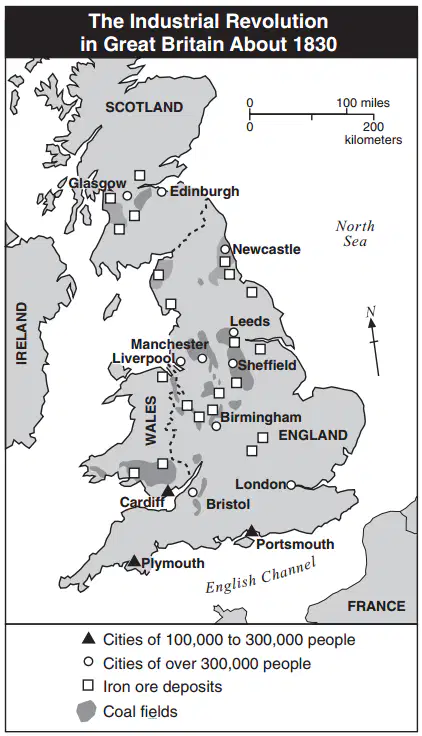
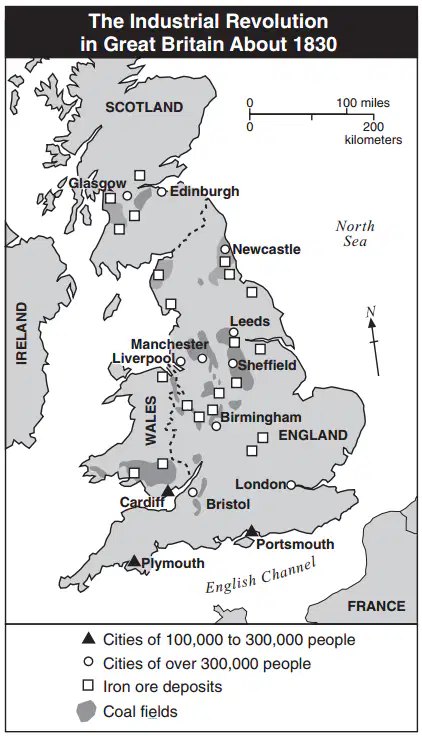
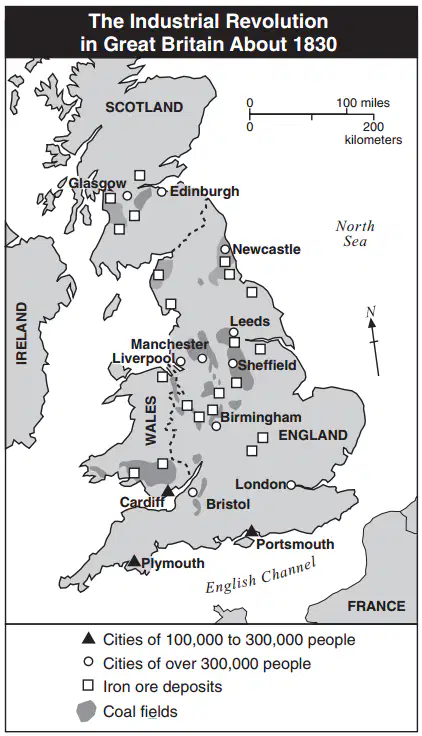
Which conclusion is best supported by the information on the map?
a)
England’s natural resources led to the growth of industrial cities.
b)
In 1830, England had an unfavorable balance of trade.
c)
Great Britain’s prosperity unified the people.
d)
People emigrated from Great Britain because of pollution.
62.
Identify one cause of the historical development depicted in the map.
a)
Socialist organizations promised land and a good wage to those who moved to industrial cities.
b)
The British government paid people to move to cities.
c)
Agricultural innovations made it easier for farmers to hire more people.
d)
Coal powered steam engines powered factories that employed many people in England.
63.
Identify one effect of the historical development depicted in the map.
a)
The Glorious Revolution
b)
Overcrowded and polluted cities
c)
Higher employment for farmers
d)
England invaded France
64.
In comparing the advantages of England for manufactures with those of other countries, we can by no means overlook the excellent commercial position of the country — intermediate between the north and south of Europe; and its insular situation [island location], which, combined with the command of the seas, secures our territory from invasion or annoyance. The German ocean, the Baltic, and the Mediterranean are the regular highways for our ships; and our western ports command an unobstructed [clear] passage to the Atlantic, and to every quarter [part] of the world. Source: Edward Baines, History of the Cotton Manufacture in Great Britain Based on this document, identify one advantage of England’s geographic context.
a)
England is in the Mediterranean Sea.
b)
England is an island located near trade routes.
c)
England is a part of mainland Europe.
d)
England has highways for transporting goods overland.
65.
The Wealth of Nations carries the important message of laissez faire, which means that the government should intervene as little as possible in economic affairs and leave the market to its own devices. It advocates the liberation of economic production from all limiting regulation in order to benefit the people . . . Source: Introduction to a re-publication of Adam Smith’s The Wealth of Nations According to Martin Perry, what role did Adam Smith believe the government should play in the economy?
a)
The government should regulate businesses to make sure they use safe practices.
b)
The government should restrict which businesses are allowed to open.
c)
The government should make very few laws that affect businesses.
d)
The government should play a role in helping businesses make as much money as possible.
66.
The Wealth of Nations carries the important message of laissez faire, which means that the government should intervene as little as possible in economic affairs and leave the market to its own devices. It advocates the liberation of economic production from all limiting regulation in order to benefit the people . . . Source: Introduction to a re-publication of Adam Smith’s The Wealth of Nations Which of the following effects did Adam Smith’s ideas have in England in the 18th and 19th centuries?
a)
Workers unionized for better pay.
b)
Governments passed laws to prevent child labor.
c)
Theorists predicted that the population would outgrow the nation’s food supply.
d)
Industrial leaders gained in wealth and power.
67.
. . . Steam-engines furnish the means not only of their support but of their multiplication. They create a vast demand for fuel; and, while they lend their powerful arms to drain the pits and to raise the coals, they call into employment multitudes of miners, engineers, ship-builders, and sailors, and cause the construction of canals and railways: and, while they enable these rich fields of industry to be cultivated to the utmost, they leave thousands of fine arable fields free for the production of food to man, which must have been otherwise allotted to the food of horses. Steam-engines moreover, by the cheapness and steadiness of their action, fabricate [produce] cheap goods, and procure [acquire] in their exchange a liberal supply of the necessaries and comforts of life, produced in foreign lands. . . . Source: Andrew Ure, The Philosophy of Manufactures: or, an Exposition of the Scientific, Moral, and Commercial Economy of the Factory System of Great Britain, published in 1835. According to Andrew Ure, what was one effect of the use of steam engines in the 19th century?
a)
Greater employment
b)
Slowed industrial growth
c)
An increase in the price of goods
d)
Food scarcity
68.
. . . Steam-engines furnish the means not only of their support but of their multiplication. They create a vast demand for fuel; and, while they lend their powerful arms to drain the pits and to raise the coals, they call into employment multitudes of miners, engineers, ship-builders, and sailors, and cause the construction of canals and railways: and, while they enable these rich fields of industry to be cultivated to the utmost, they leave thousands of fine arable fields free for the production of food to man, which must have been otherwise allotted to the food of horses. Steam-engines moreover, by the cheapness and steadiness of their action, fabricate [produce] cheap goods, and procure [acquire] in their exchange a liberal supply of the necessaries and comforts of life, produced in foreign lands. . . . Source: Andrew Ure, The Philosophy of Manufactures: or, an Exposition of the Scientific, Moral, and Commercial Economy of the Factory System of Great Britain, published in 1835. What is Andrew Ure’s point of view regarding steam engines?
a)
Steam engines do more harm than good because of pollution.
b)
Steam engines could lead to conflict with other countries.
c)
Steam engines benefit society because they lead to industrial growth and improvements in the quality of life.
d)
Steam engines lead to poorly made goods.
69.
“It was a town of red brick, or of brick that would have been red if the smoke and ashes had allowed it; but as matters stood it was a town of unnatural red and black like the painted face of a savage. It was a town of machinery and tall chimneys, out of which interminable serpents of smoke trailed themselves for ever and ever, and never got uncoiled. It had a black canal in it, and a river that ran purple with illsmelling dye. . . .” — Charles Dickens, Hard Times Which innovation most directly contributed to the conditions described in the passage?
a)
Printing press
b)
Crop rotation
c)
Seed drill
d)
Steam engine
70.
“It was a town of red brick, or of brick that would have been red if the smoke and ashes had allowed it; but as matters stood it was a town of unnatural red and black like the painted face of a savage. It was a town of machinery and tall chimneys, out of which interminable serpents of smoke trailed themselves for ever and ever, and never got uncoiled. It had a black canal in it, and a river that ran purple with illsmelling dye. . . .” — Charles Dickens, Hard Times Which problem is the subject of this passage?
a)
economic inequality
b)
urban pollution
c)
lack of child labor laws
d)
voting reform acts
71.
“. . . A place more destitute of all interesting objects than Manchester, it is not easy to conceive. In size and population it is the second city in the kingdom, containing above fourscore thousand [80,000] inhabitants. Imagine this multitude crowded together in narrow streets, the houses all built of brick and blackened with smoke; frequent buildings among them as large as convents, without their antiquity, without their beauty, without their holiness; where you hear from within, as you pass along, the everlasting din of machinery; and where when the bell rings it is to call wretches to their work instead of their prayers, . . . ” — Robert J. Southey, Letters from England, 1807 What is Robert J. Southey’s point of view of Manchester, England in 1807?
a)
Urbanization has improved the lives of those living in Manchester.
b)
Government intervention can solve Manchester’s issues.
c)
An increase in factories in Manchester has decreased the quality of life for people who live there.
d)
The minimum wage should be raised for factory workers in Manchester.
72.
“. . . A place more destitute of all interesting objects than Manchester, it is not easy to conceive. In size and population it is the second city in the kingdom, containing above fourscore thousand [80,000] inhabitants. Imagine this multitude crowded together in narrow streets, the houses all built of brick and blackened with smoke; frequent buildings among them as large as convents, without their antiquity, without their beauty, without their holiness; where you hear from within, as you pass along, the everlasting din of machinery; and where when the bell rings it is to call wretches to their work instead of their prayers, . . . ” — Robert J. Southey, Letters from England, 1807 The conditions described in this passage occurred during the
a)
Age of Discovery
b)
Renaissance
c)
Industrial Revolution
d)
Green Revolution
73.
“I don’t know how old I am. . . . I began to work when I was about 9. I first worked for a man who used to hit me with a belt. . . . I used to sleep in the pits that had no more coal in them; I used to eat whatever I could get; I ate for a long time the candles that I found in the pits. . . .” — E. Royston Pike, 1896, adapted from Hard Times, Human Documents of the Industrial Revolution What was one thing that happened in response to the conditions described in this passage?
a)
Marx wrote The Communist Manifesto
b)
Garibaldi organized the Red Shirts
c)
Charles Darwin developed The Origin of the Species
d)
Atatürk joined the Young Turks
74.
“I don’t know how old I am. . . . I began to work when I was about 9. I first worked for a man who used to hit me with a belt. . . . I used to sleep in the pits that had no more coal in them; I used to eat whatever I could get; I ate for a long time the candles that I found in the pits. . . .” — E. Royston Pike, 1896, adapted from Hard Times, Human Documents of the Industrial Revolution Identify the best use of this document for a historian.
a)
To determine why mine owners employed children.
b)
To study the long term effects of working in mines on child labors
c)
To find out how much money mine owners saved by hiring children rather than adults
d)
To understand the conditions child laborers experienced
75.
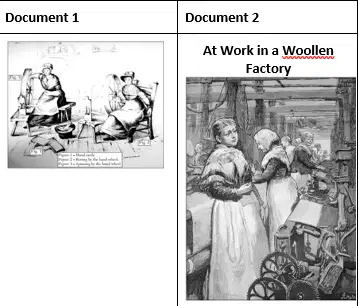
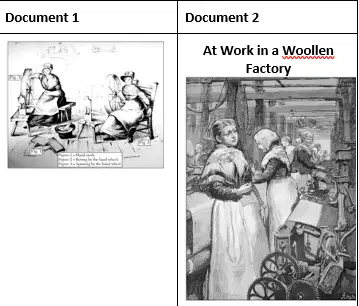
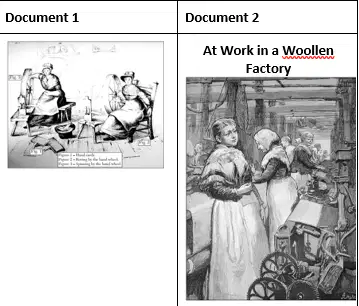
Identify the turning point most closely associated with the changes depicted in documents 1 and 2.
a)
Industrial Revolution
b)
Meiji Restoration
c)
Russian Revolution
d)
World War I
76.
Based on these pictures, what is one change in the way cloth was produced in England in the 1800s?
a)
More cloth was produced in a shorter period of time.
b)
Working conditions were more comfortable.
c)
Cloth was produced at home.
d)
The process for producing cloth was safer.
77.
What was one effect on society that resulted from the change depicted in documents 1 and 2?
a)
More young women worked in factories than men.
b)
Young women lived with their parents for most of their life.
c)
Young women moved from rural to urban areas.
d)
Young women married at a younger age.
78.
This is an excerpt from William Cooper’s testimony before the Sadler Committee in 1832. Sadler: When did you first begin to work in mills? Cooper: When I was ten years of age. Sadler: What were your usual hours of working? Cooper: We began at five in the morning and stopped at nine in the night. Sadler: What time did you have for meals? Cooper: We had just one period of forty minutes in the sixteen hours. That was at noon. Sadler: What means were taken to keep you awake and attentive? Cooper: At times we were frequently strapped. Sadler: When your hours were so long, did you have any time to attend a day school? Cooper: We had no time to go to day school. This is an excerpt from the testimony of Joseph Hebergam to the Sadler Committee. Sadler: Do you know of any other children who died at the R Mill? Hebergam: There were about a dozen died during the two years and a half that I was there. At the L Mill where I worked last, a boy was caught in a machine and had both his thigh bones broke and from his knee to his hip . . . . His sister, who ran to pull him off, had both her arms broke and her head bruised. The boy died. I do not know if the girl is dead, but she was not expected to live. Sadler: Did the accident occur because the shaft was not covered? Hebergam: Yes. A historian would find these documents most useful for
a)
understanding the lives of the upper middle class in the 19th century
b)
depicting struggles that faced 19th century farmers
c)
examining the effects of pollution in 19th century cities
d)
depicting 19th century factory life
79.
This is an excerpt from William Cooper’s testimony before the Sadler Committee in 1832. Sadler: When did you first begin to work in mills? Cooper: When I was ten years of age. Sadler: What were your usual hours of working? Cooper: We began at five in the morning and stopped at nine in the night. Sadler: What time did you have for meals? Cooper: We had just one period of forty minutes in the sixteen hours. That was at noon. Sadler: What means were taken to keep you awake and attentive? Cooper: At times we were frequently strapped. Sadler: When your hours were so long, did you have any time to attend a day school? Cooper: We had no time to go to day school. This is an excerpt from the testimony of Joseph Hebergam to the Sadler Committee. Sadler: Do you know of any other children who died at the R Mill? Hebergam: There were about a dozen died during the two years and a half that I was there. At the L Mill where I worked last, a boy was caught in a machine and had both his thigh bones broke and from his knee to his hip . . . . His sister, who ran to pull him off, had both her arms broke and her head bruised. The boy died. I do not know if the girl is dead, but she was not expected to live. Sadler: Did the accident occur because the shaft was not covered? Hebergam: Yes. What action was taken as a result of testimonies like those in these documents?
a)
Child labor laws were passed
b)
Slavery was abolished
c)
Invention of the steam engine
d)
World War I
80.
This is an excerpt from William Cooper’s testimony before the Sadler Committee in 1832. Sadler: When did you first begin to work in mills? Cooper: When I was ten years of age. Sadler: What were your usual hours of working? Cooper: We began at five in the morning and stopped at nine in the night. Sadler: What time did you have for meals? Cooper: We had just one period of forty minutes in the sixteen hours. That was at noon. Sadler: What means were taken to keep you awake and attentive? Cooper: At times we were frequently strapped. Sadler: When your hours were so long, did you have any time to attend a day school? Cooper: We had no time to go to day school. This is an excerpt from the testimony of Joseph Hebergam to the Sadler Committee. Sadler: Do you know of any other children who died at the R Mill? Hebergam: There were about a dozen died during the two years and a half that I was there. At the L Mill where I worked last, a boy was caught in a machine and had both his thigh bones broke and from his knee to his hip . . . . His sister, who ran to pull him off, had both her arms broke and her head bruised. The boy died. I do not know if the girl is dead, but she was not expected to live. Sadler: Did the accident occur because the shaft was not covered? Hebergam: Yes. Which statement best describes the Sadler Committee’s purpose in collecting testimonies like the ones written above?
a)
To figure out how to get factory workers to be more efficient.
b)
To test the education levels of factory workers.
c)
To estimate how much cloth British factories produced in 1832.
d)
To inform the government and public of the conditions that children experience in factories.
81.
“. . . They [the Communists] openly declare that their ends can be attained [achieved] only by the forcible overthrow of all existing social conditions. Let the ruling classes tremble at a Communist revolution. The proletarians have nothing to lose but their chains. They have a world to win. Working men of all countries, unite!” — Friedrich Engels and Karl Marx, Communist Manifesto, 1848 The views expressed by Engels and Marx in this passage were developed in reaction to the
a)
unification of Germany
b)
Commercial Revolution
c)
Congress of Vienna
d)
Industrial Revolution
82.
“. . . They [the Communists] openly declare that their ends can be attained [achieved] only by the forcible overthrow of all existing social conditions. Let the ruling classes tremble at a Communist revolution. The proletarians have nothing to lose but their chains. They have a world to win. Working men of all countries, unite!” — Friedrich Engels and Karl Marx, Communist Manifesto, 1848 The views expressed by Engels and Marx in this passage most directly influenced
a)
Vladimir Lenin
b)
Mohandas Gandhi
c)
Adam Smith
d)
Napoleon Bonaparte
83.
What is the evidence provided in the text to support the claim that the working class believes in the need to become the ruling class?
a)
The working class believes that by using their political power, they can gradually take control of all capital from the bourgeoisie and centralize the means of production under the control of the State.
b)
The working class wants the ruling classes to fear a Communist revolution.
c)
The working class believes they have nothing to lose except their chains and have a whole world to gain.
d)
The document ends with a call for workers of all countries to come together.
84.
According to the text, what is the main goal of the working class?
a)
To increase overall productive capacity and lead to a society where class divisions disappear.
b)
To oppress the ruling class and establish a dictatorship of the proletariat.
c)
To bring all classes together to be harmonious
d)
To achieve their objectives through the violent overthrow of the existing social order.
85.
According to the document, what is the role of the government in a society where the working class becomes the ruling class?
a)
To maintain control over all capital and means of production.
b)
To oppress the ruling class and establish a dictatorship of the proletariat.
c)
To ensure the freedom and well-being of each individual.
d)
To increase overall productive capacity and lead to a society without class divisions.
86.
Flora Tristan was a 19th-century French activist and a member of the lower working class. In 1843, she wrote The Workers’ Union. . . . 1. Consolidation of the working class by means of a tight, solid, and indissoluble [indivisible] Union. 2. Representation of the working class before the nation through a defender chosen and paid by the Workers’ Union, so that the working class’s need to exist and the other classes’ need to accept it become evident. 3. Recognition of one’s hands as legitimate property. (In France 25,000,000 proletarians have their hands as their only asset.) 4. Recognition of the legitimacy of the right to work for all men and women. 5. Recognition of the legitimacy of the right to moral, intellectual, and vocational education for all boys and girls. 6. Examination of the possibility of labor organizing in the current social state [social conditions]. 7. Construction of Workers’ Union palaces [buildings] in every department, in which working-class children would receive intellectual and vocational instruction, and to which the infirm and elderly as well as workers injured on the job would be admitted. 8. Recognition of the urgent necessity of giving moral, intellectual, and vocational education to the women of the masses so that they can become the moral agents for the men of the masses. 9. Recognition in principle of equal rights for men and women as the sole [only] means of unifying humankind. Source: Flora Tristan, The Workers’ Union Identify an effect of the actions taken by activists in the late 1800s who would have shared Tristan’s point of view as expressed in this passage.
a)
Universal suffrage
b)
Education laws requiring children to attend school
c)
Less government regulation on businesses
d)
More government spending on the military
87.
Flora Tristan was a 19th-century French activist and a member of the lower working class. In 1843, she wrote The Workers’ Union. . . . 1. Consolidation of the working class by means of a tight, solid, and indissoluble [indivisible] Union. 2. Representation of the working class before the nation through a defender chosen and paid by the Workers’ Union, so that the working class’s need to exist and the other classes’ need to accept it become evident. 3. Recognition of one’s hands as legitimate property. (In France 25,000,000 proletarians have their hands as their only asset.) 4. Recognition of the legitimacy of the right to work for all men and women. 5. Recognition of the legitimacy of the right to moral, intellectual, and vocational education for all boys and girls. 6. Examination of the possibility of labor organizing in the current social state [social conditions]. 7. Construction of Workers’ Union palaces [buildings] in every department, in which working-class children would receive intellectual and vocational instruction, and to which the infirm and elderly as well as workers injured on the job would be admitted. 8. Recognition of the urgent necessity of giving moral, intellectual, and vocational education to the women of the masses so that they can become the moral agents for the men of the masses. 9. Recognition in principle of equal rights for men and women as the sole [only] means of unifying humankind. Source: Flora Tristan, The Workers’ Union Which claim is best supported by the evidence in this passage?
a)
Laws were created in 19th century France that addressed Flora Tristan’s concerns.
b)
Working class people in 19th century France had few issues they were concerned about.
c)
Workers rights were violated by some business owners in 19th century France.
d)
(Unions existed in Great Britain and the United States in the 19th century.
88.
. . . The need of a constantly expanding market for its products chases the bourgeoisie over the whole surface of the globe. It must nestle everywhere, settle everywhere, establish connections everywhere. . . . — Karl Marx and Friedrich Engels, The Communist Manifesto, 1848 In this excerpt Marx and Engels describe some of the reasons for
a)
imperialism
b)
urbanization
c)
deforestation
d)
desertification
89.
“Not by democracy or liberal standards will our goal be achieved but by blood and iron. Then we will be successful, no nation is born without the traumatic experience of war.” —Otto von Bismarck This statement was used to justify a policy of
a)
ethnocentrism
b)
militarism
c)
containment
d)
appeasement
90.
“Not by democracy or liberal standards will our goal be achieved but by blood and iron. Then we will be successful, no nation is born without the traumatic experience of war.” —Otto von Bismarck This statement is most closely associated with German
a)
nationalism
b)
democracy
c)
isolationism
d)
Christianity
91.
. . . Therefore, if we so ardently desire the emancipation [unification] of Italy — if we declare that in the face of this great question all the petty questions that divide us must be silenced— it is not only that we may see our country glorious and powerful but that above all we may elevate her in intelligence and moral development up to the plane of the most civilized nations. . . . Source: Camillo di Cavour, 1846 This quotation from Camillo di Cavour is most closely associated with Italian
a)
exploration
b)
nationalism
c)
imperialism
d)
neutrality
92.
. . . Therefore, if we so ardently desire the emancipation [unification] of Italy — if we declare that in the face of this great question all the petty questions that divide us must be silenced— it is not only that we may see our country glorious and powerful but that above all we may elevate her in intelligence and moral development up to the plane of the most civilized nations. . . . Source: Camillo di Cavour, 1846 According to Camillo di Cavour, what would be one positive result of Italian unification?
a)
Italians could answer petty questions.
b)
Italy would defeat Germany.
c)
Italy would silence other nations.
d)
Italy would become respected by other nations.
93.
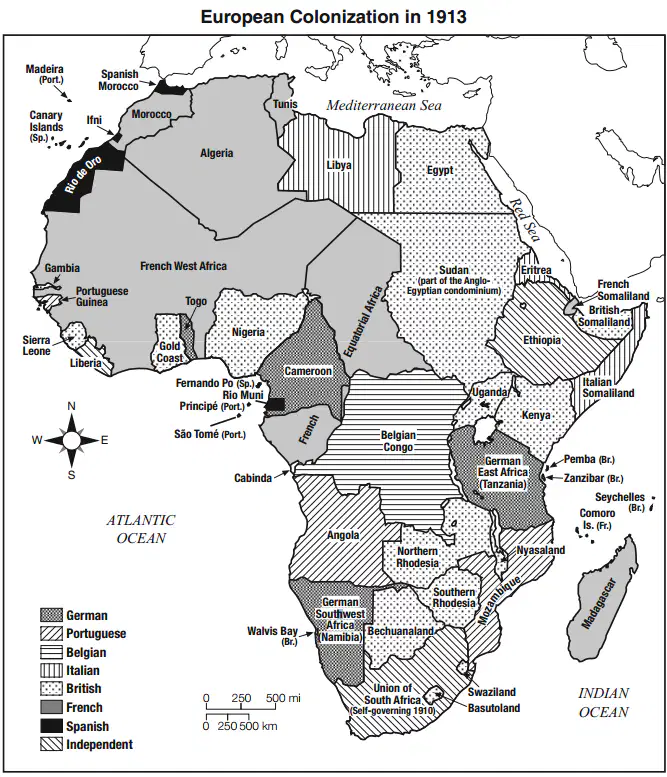
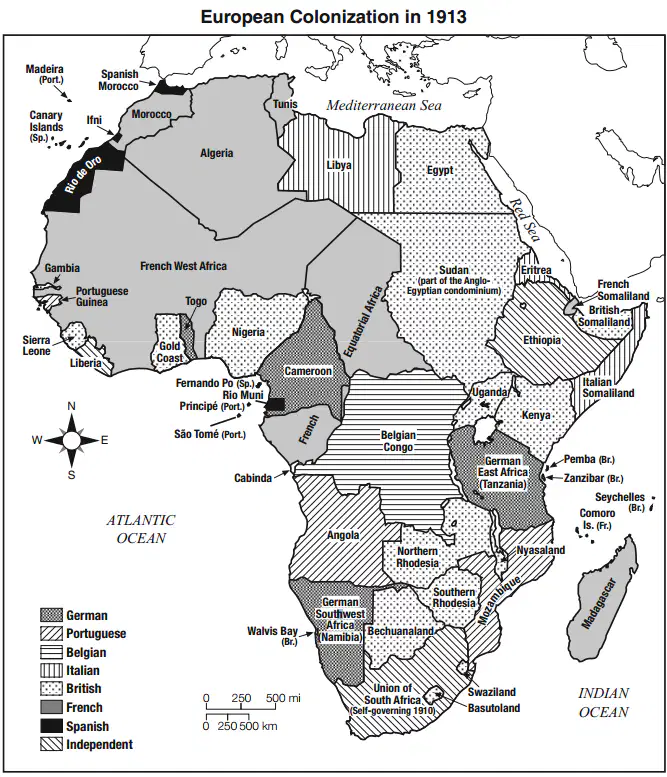
Many of the political divisions shown on this map were directly related to the
a)
Meiji Restoration
b)
Opium Wars
c)
Berlin Conference
d)
Boer War
94.
Which claim is best supported by the evidence included in this map?
a)
In 1913, European countries controlled most of the territory in Africa.
b)
In 1913, European countries controlled all of the territory in Africa.
c)
By 1913, European countries built extensive railroad systems in sub-Saharan Africa.
d)
In 1913, European countries ruled territory in Africa with the consent of the Africans who lived there.
95.
According to the text, how has sea power impacted global politics?
a)
It has only impacted military affairs.
b)
It has had no impact on economics or politics.
c)
It has far-reaching consequences, impacting not only military affairs but also economics, politics, and the overall strength of a nation.
d)
It has only impacted the geopolitical landscape.
96.
What is a key objective for nations seeking to enhance their power and influence?
a)
To control the weather
b)
To control trade routes and access to valuable resources
c)
To establish diplomatic relations with other countries
d)
To create new technologies
97.
What is the main idea of this passage?
a)
Sea power has been closely tied to conflicts between nations throughout history.
b)
The history of sea power is limited to military strategies and battles.
c)
The pursuit of dominance at sea has no impact on economics, politics, or the overall strength of a nation.
d)
Sea power has significant implications for a country's economic well-being, as well as its military and political power.
98.
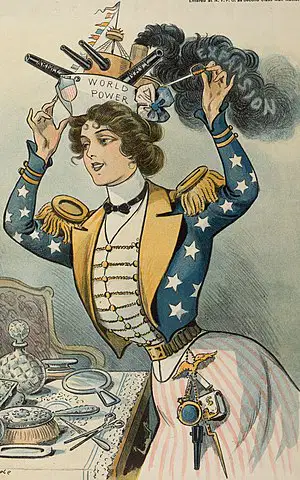
Choose the best answer as the main idea of the picture?
a)
Growing power of Imperialism
b)
White Man's Burden
c)
Understanding of different cultures
d)
Racist ideologies of the author
99.
Choose the best answer as the main idea of the picture?
a)
The US is a world power
b)
The US must expand
c)
The US must use their Navy to fight.
d)
The US can only expand by being a Naval power
100.
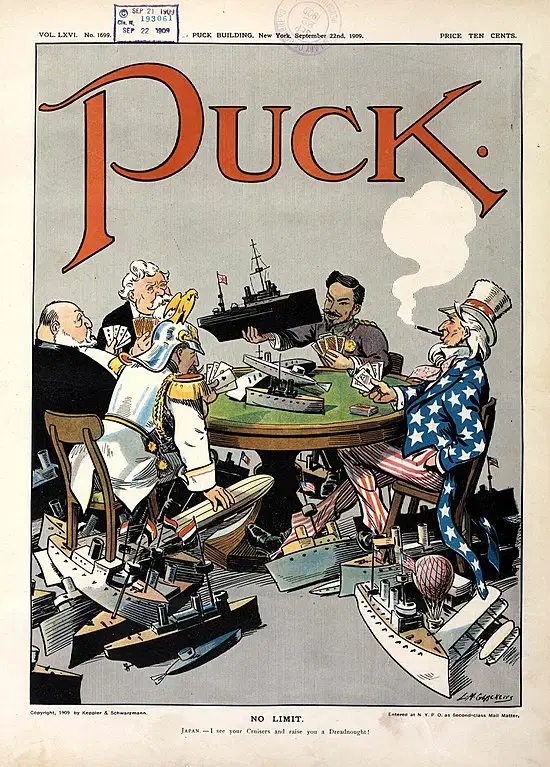
Choose the best answer as the main idea of the picture?
a)
Militarism
b)
Alliances
c)
Trade
d)
Industrialization
101.
Rudyard Kipling was a British short-story writer, poet and novelist. Considered one of the most popular writers in Britain during the late 19th and early 20th centuries, Kipling eventually won the Nobel Prize in Literature. Kipling was born in Bombay, India in 1865. During this time India was under British control and many young British families lived in colonies like India. His poem, White Man’s Burden was published in a popular American magazine. The White Man’s Burden. “Take up the White Man’s burden— Send forth the best ye breed— Go, bind your sons to exile To serve your captives’ need; To wait, in heavy harness, On fluttered folk and wild— Your new-caught sullen peoples, Half devil and half child. . . .” — Rudyard Kipling, 1899 This stanza from Kipling’s poem is most closely associated with the belief that it was the duty of Western colonial powers to
a)
learn from the people they conquered
b)
teach their colonies how to produce manufactured goods
c)
civilize the people they controlled
d)
welcome less developed countries as equals
102.
Rudyard Kipling was a British short-story writer, poet and novelist. Considered one of the most popular writers in Britain during the late 19th and early 20th centuries, Kipling eventually won the Nobel Prize in Literature. Kipling was born in Bombay, India in 1865. During this time India was under British control and many young British families lived in colonies like India. His poem, White Man’s Burden was published in a popular American magazine. The White Man’s Burden. “Take up the White Man’s burden— Send forth the best ye breed— Go, bind your sons to exile To serve your captives’ need; To wait, in heavy harness, On fluttered folk and wild— Your new-caught sullen peoples, Half devil and half child. . . .” — Rudyard Kipling, 1899 An historian would find this poem most useful to understand
a)
a point of view that opposed Kipling’s claims
b)
a point of view concerning imperialism supported by some Europeans
c)
the economic reasons the Europeans supported imperialism
d)
the effects of Kipling’s poem in the 20th century
103.
Rudyard Kipling was a British short-story writer, poet and novelist. Considered one of the most popular writers in Britain during the late 19th and early 20th centuries, Kipling eventually won the Nobel Prize in Literature. Kipling was born in Bombay, India in 1865. During this time India was under British control and many young British families lived in colonies like India. His poem, White Man’s Burden was published in a popular American magazine. The White Man’s Burden. “Take up the White Man’s burden— Send forth the best ye breed— Go, bind your sons to exile To serve your captives’ need; To wait, in heavy harness, On fluttered folk and wild— Your new-caught sullen peoples, Half devil and half child. . . .” — Rudyard Kipling, 1899 Based on this poem, which action would Kipling have most likely supported?
a)
The British shared equal power with Indians in the colonial government in 1899.
b)
The British used child labor in textile factories in India.
c)
The British established coal mines in India.
d)
The British established schools in India to teach Indian children English and British culture.
104.
Jawaharlal Nehru (1889-1964) was a politician who fought for Indian independence from Great Britain and became the country’s first prime minister. . . . The Chief business of the East India Company in its early period, the very object for which it was started, was to carry Indian manufactured goods—textiles, etc., as well as spices and the like—from the East to Europe, where there was a great demand for these articles. With the developments in industrial techniques in England a new class of industrial capitalists rose there demanding a change in this policy. The British market was to be closed to Indian products and the Indian market opened to British manufactures. The British parliament, influenced by this new class, began to take a greater interest in India and the working of the East India Company. To begin with, Indian goods were excluded from Britain by legislation, and as the company held a monopoly in the Indian export business, this exclusion influenced other foreign markets also. This was followed by vigorous attempts to restrict and crush Indian manufactures by various measures and internal duties which prevented the flow of Indian goods within the country itself. British goods meanwhile had free entry. The Indian textile industry collapsed, affecting vast numbers of weavers and artisans. The process was rapid in Bengal and Bihar; elsewhere it spread gradually with the expansion of British rule and the building of railways. It continued throughout the nineteenth century, breaking up other old industries also, shipbuilding, metalwork, glass, paper, and many crafts. . . . Based on this excerpt, which statement best describes the author’s point of view?
a)
British involvement in India benefited Indian manufactures.
b)
The East India Company’s goal was to enrich India’s economy.
c)
British policies destroyed Indian businesses by restricting who they could sell to.
d)
The British helped create a new class of wealthy Indians.
105.
Jawaharlal Nehru (1889-1964) was a politician who fought for Indian independence from Great Britain and became the country’s first prime minister. . . . The Chief business of the East India Company in its early period, the very object for which it was started, was to carry Indian manufactured goods—textiles, etc., as well as spices and the like—from the East to Europe, where there was a great demand for these articles. With the developments in industrial techniques in England a new class of industrial capitalists rose there demanding a change in this policy. The British market was to be closed to Indian products and the Indian market opened to British manufactures. The British parliament, influenced by this new class, began to take a greater interest in India and the working of the East India Company. To begin with, Indian goods were excluded from Britain by legislation, and as the company held a monopoly in the Indian export business, this exclusion influenced other foreign markets also. This was followed by vigorous attempts to restrict and crush Indian manufactures by various measures and internal duties which prevented the flow of Indian goods within the country itself. British goods meanwhile had free entry. The Indian textile industry collapsed, affecting vast numbers of weavers and artisans. The process was rapid in Bengal and Bihar; elsewhere it spread gradually with the expansion of British rule and the building of railways. It continued throughout the nineteenth century, breaking up other old industries also, shipbuilding, metalwork, glass, paper, and many crafts. . . . Which evidence best supports the claim made by Jawaharlal Nehru in this excerpt?
a)
An account book from a British textile company showing that they sold less to indians in 1920 than in 1880
b)
An account from an Indian metalworker stating that his shop had to close because he could not afford to pay British taxes required to sell his goods.
c)
A speech by the Prime Minister of Great Britain in 1910 proclaiming that the empire is losing more money that it ever has
d)
Maps of an Indian city showing that more shipbuilding and textile businesses existed during British rule than before it
106.
An Excerpt from the Treaty of Nanjing ARTICLE III. It being obviously necessary and desirable, that British Subjects should have some Port whereat they may careen and refit their Ships, when required, and keep Stores for that purpose, His Majesty the Emperor of China cedes [gives] to Her Majesty the Queen of Great Britain, etc., the Island of Hongkong, to be possessed in perpetuity [forever] by Her Britannic Majesty, Her Heirs and Successors, and to be governed by such Laws and Regulations as Her Majesty the Queen of Great Britain, etc., shall see fit to direct. Source: “Treaty of Nanjing (Nanking), 1842 What historical event led to the signing of the Treaty of Nanjing?
a)
Boer War
b)
World War I
c)
French Revolution
d)
Opium Wars
107.
An Excerpt from the Treaty of Nanjing ARTICLE III. It being obviously necessary and desirable, that British Subjects should have some Port whereat they may careen and refit their Ships, when required, and keep Stores for that purpose, His Majesty the Emperor of China cedes [gives] to Her Majesty the Queen of Great Britain, etc., the Island of Hongkong, to be possessed in perpetuity [forever] by Her Britannic Majesty, Her Heirs and Successors, and to be governed by such Laws and Regulations as Her Majesty the Queen of Great Britain, etc., shall see fit to direct. Source: “Treaty of Nanjing (Nanking), 1842 Based on the excerpt above, what did the British gain as a result of the Treaty of Nanjing?
a)
Unlimited coal resources
b)
An island to use as a port
c)
Control of all of Japan
d)
The right to make the Queen of Great Britain the Empress of China
108.
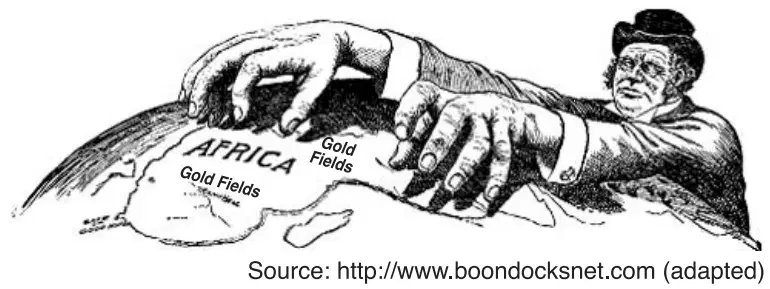
Based on this political cartoon, which statement best describes the author’s point of view?
a)
Africa was not affected by imperialism.
b)
Europeans wanted to spread Christianity in Africa.
c)
European countries colonized Africa for natural resources.
d)
African people welcomed European colonists.
109.
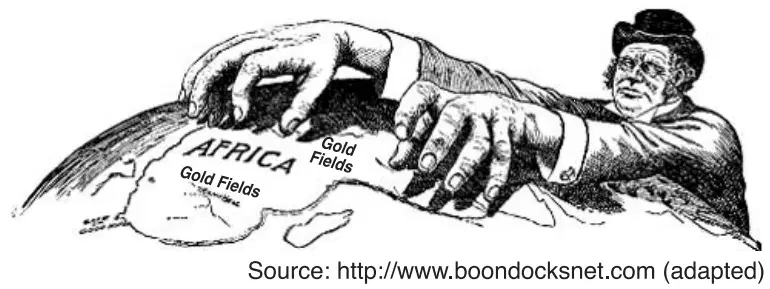
Which event was most likely the result of the action being taken in this cartoon?
a)
African and European states engaged in equal trade agreements.
b)
African people resented the presence of European powers on their land.
c)
Europeans helped establish democratic governments in African countries.
d)
The Industrial Revolution started in Great Britain.
110.
. . .As late as the 1870s, only 10% of the continent was under direct European control, with Algeria held by France, the Cape Colony and Natal (both in modern South Africa) by Britain, and Angola by Portugal. And yet by 1900, European nations had added almost 10 million square miles of Africa—one-fifth of the land mass of the globe—to their overseas colonial possessions. Europeans ruled more than 90% of the African continent. . . . — Saul David, “Slavery and the ‘Scramble for Africa,’ ” BBC British History in depth Which event most directly influenced the change referred to in this passage?
a)
outbreak of the Boxer Rebellion
b)
meeting of the Berlin Conference
c)
signing of the Munich Pact
d)
collapse of the Ottoman Empire
111.
. . .As late as the 1870s, only 10% of the continent was under direct European control, with Algeria held by France, the Cape Colony and Natal (both in modern South Africa) by Britain, and Angola by Portugal. And yet by 1900, European nations had added almost 10 million square miles of Africa—one-fifth of the land mass of the globe—to their overseas colonial possessions. Europeans ruled more than 90% of the African continent. . . . — Saul David, “Slavery and the ‘Scramble for Africa,’ ” BBC British History in depth Which of the these is considered a cause of the situation described in the passage?
a)
European desire for raw materials and technological and medical advances
b)
African desire to create new markets for manufactured goods
c)
The end of Apartheid in South Africa
d)
The Meiji Restoration