
 Worksheets
1409 - Lab 4 - Invertebrates and Vertebrates
Total questions: 15
Worksheet time: 8mins
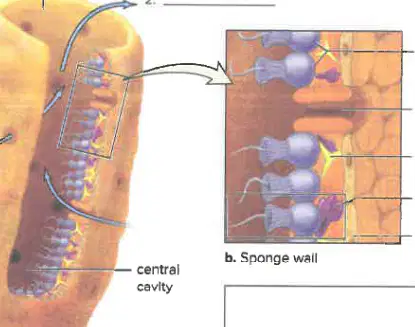
A sessile filter feeder is best described as:
An organism that remains attached to a surface and obtains food by filtering water.
An organism that moves actively to catch its prey.
An organism that produces its own food through photosynthesis.
An organism that lives inside another organism as a parasite.
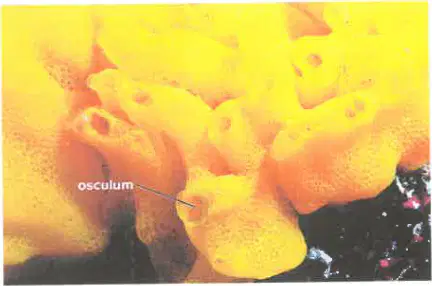
Which type of sponge has spicules of calcium carbonate?
Calcareous sponge
Bath sponge
Glass sponge
Radial symmetry can be a benefit to an animal because it allows the animal to:
Sense and respond to stimuli from all directions equally
Move quickly in one direction
Hide easily from predators
Digest food more efficiently
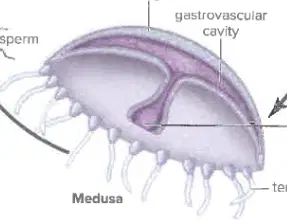
The two main body forms in the life cycle of a cnidarian are the _______ and the _______.
polyp, medusa
larva, adult
egg, sperm
planula, ephyra
It is advantageous for an animal to be hermaphroditic because:
it increases the chances of successful reproduction
it allows the animal to change its diet
it helps the animal move faster
it makes the animal immune to diseases
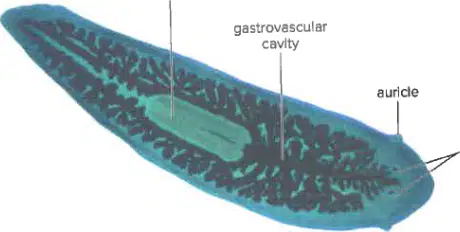
Which three types of cells must be present for flatworms to be able to respond to stimuli and move about?
Sensory cells, nerve cells, and muscle cells
Blood cells, bone cells, and skin cells
Fat cells, gland cells, and reproductive cells
Stem cells, epithelial cells, and immune cells
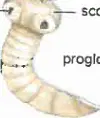
The function of a tapeworm’s hooks and suckers is to:
attach to the host’s intestinal wall
digest food for the host
produce eggs for reproduction
help the tapeworm move quickly
What is an incompletely lined body cavity called?
Pseudocoelom
Coelom
Acoelom
Haemocoel
What structure in a planarian digests food and ensures that nutrients get to all the cells?
Gastrovascular cavity
Pharynx
Nerve cord
Excretory pore
Animals in which the first embryonic opening becomes the mouth are called ________.
protostomes
deuterostomes
amniotes
cnidarians
Fill in the blank: In deuterostomes, the first embryonic opening becomes the ________.
anus
mouth
stomach
esophagus

Identify the mollusk labeled as a cephalopod in the diagram.
Chiton
Scallop
Snail
Nautilus
Match the following mollusk types with their characteristics:
Has a shell consisting of eight plates
Chiton
Has a body enclosed by a shell consisting of two valves
Bivalve
Contains marine, freshwater, and terrestrial species
Gastropod
Contains active marine predators with tentacles
Cephalopod
Sequence the organs in the digestive tract to trace the path of food from the mouth to the cloaca.
Mouth → esophagus → stomach → small intestine → large intestine → cloaca
Mouth → stomach → esophagus → large intestine → small intestine → cloaca
Mouth → esophagus → large intestine → stomach → small intestine → cloaca
Mouth → small intestine → esophagus → stomach → large intestine → cloaca
The term urogenital system refers to:
The combined organs of the urinary and reproductive systems
Only the organs of the digestive system
The organs responsible for respiration
Only the organs of the nervous system

