
 Worksheets
6th SS Spiral Review Units 1-4
Total questions: 139
Worksheet time: 1hrs 17mins
What does BC stand for in historical dating?
Before Christ
Before Century
Beyond Chronology
Before Civilization
What does BCE stand for?
Before the Common Era
Before the Current Era
Beyond the Common Era
Before the Christian Era
What does AD stand for?
After Death
Anno Domini
After the Discovery
Anno Domum
What does CE stand for?
Common Era
Christian Era
Current Era
Century Era
What does the term "circa" mean when used in historical dating?
Exactly at
About or approximately
After
Before
If a historical event is said to have occurred in "c. 500 BC," what does the "c." stand for?
Century
Circa
Completed
Commenced
How many years are in a decade?
10
100
50
20
Which of the following is the correct way to denote approximately the year 1500?
c. 1500
ca. 1500
Both A and B are correct
Neither A nor B is correct
Which term is used to denote a period of approximately 100 years?
Decade
Century
Millennium
Era
What is the significance of using BCE/CE instead of BC/AD?
It provides a more accurate historical timeline.
It is used to denote a different calendar system.
It offers a non-religious way of dating historical events.
It is only used in scientific contexts.
What challenges did the hunter gatherers face?
They struggled to survive
They struggled to find resources
They struggled to find things to hunt and gather
All of the above

Who were the earliest humans?
Hunter gatherers
Farmers
Cobblers
Bakers

If a person travels from place to place, without a permanent home, what are they?
Domesticated
Landform
Archaeologist
Nomad

What were the roles of men and women as hunter gatherers?
Men and women gathered food
Men hunted and women hunted
Men hunted and gathered
Men hunted and women gathered


Why did hunter gatherers migrate?
To make better tools
To explore the river valleys
To find food
To find better shelter


What was the primary lifestyle of people during the Paleolithic Era?
Farmers
Hunter-gatherers
Industrial workers
Merchants
What does the term "nomadic" mean in the context of the Paleolithic Era?
Settling in one place
Moving from place to place
Building permanent homes
Trading goods
Explain why people in the Paleolithic Era owned very few possessions.
They were not interested in material goods.
They had to carry everything they owned as they moved.
They had no knowledge of making tools.
They preferred to trade rather than own.
Describe the significance of the Neolithic Revolution.
It marked the beginning of the Industrial Revolution.
It was a major turning point in history due to the shift to agriculture.
It led to the discovery of fire.
It was the start of the Bronze Age.
How did the Neolithic Revolution change the way people obtained food?
People continued to rely solely on hunting.
People began to produce their own food through farming.
People stopped eating meat.
People relied more on fishing.
What were some of the challenges faced by hunter-gatherers in the Paleolithic Era?
Lack of water sources
Difficulty in finding food and dangerous living conditions
Overpopulation
Lack of trade routes
Analyze how the ability to control and store food supplies impacted Neolithic societies.
It led to a decrease in population.
It allowed for the development of permanent settlements and population growth.
It caused a decline in trade.
It resulted in less diversity in diet.
What might have been some reasons for the gradual transition from hunting and gathering to farming?
Sudden climate changes
Observations of plant growth patterns and the need for a stable food supply
Invention of the wheel
Discovery of new hunting tools
Compare the lifestyle of Paleolithic people with that of Neolithic people.
Both were primarily nomadic.
Paleolithic people were nomadic, while Neolithic people began to settle in one place.
Both relied heavily on agriculture.
Both had complex social structures.
Evaluate the impact of the Neolithic Revolution on human societies.
It had little to no impact on human societies.
It led to the development of complex societies and technological advancements.
It caused a decline in human population.
It resulted in the extinction of many animal species.
What technological advancements were made during the Neolithic Revolution?
Development of stone tools
Invention of the wheel
Creation of complex irrigation systems
Discovery of fire
How did the Neolithic Revolution affect social structures?
It led to the formation of egalitarian societies.
It resulted in the establishment of hierarchical societies.
It caused the dissolution of family units.
It had no impact on social structures.
What role did domestication of animals play in the Neolithic Revolution?
It provided a reliable source of labor and food.
It led to the extinction of wild species.
It had no significant impact on human societies.
It caused a decrease in agricultural productivity.
What is the primary reason early civilizations developed near rivers?
Rivers provided a source of entertainment.
Rivers were a source of fresh water and food.
Rivers were easy to cross.
Rivers were a barrier against enemies.
Explain why floods were beneficial to early civilizations.
They destroyed old crops, making room for new ones.
They deposited rich soil, which helped produce abundant food.
They provided a source of entertainment for the people.
They created natural barriers against invaders.
How did the development of stable food supplies impact early civilizations?
It led to the decline of trade.
It allowed populations to grow and cities to develop.
It caused people to move away from river areas.
It made people more dependent on hunting.
Compare the development of early civilizations in Mesopotamia and the Nile River Valley. What similarities can you identify?
Both were located in desert regions.
Both developed near rivers that provided resources.
Both relied heavily on trade with China.
Both civilizations were isolated from other cultures.
What strategic advantages did rivers provide to early civilizations besides water and food?
They were used for recreational activities.
They served as natural highways for transportation and trade.
They were used to build defensive walls.
They provided a place for religious ceremonies.
Analyze the role of agriculture in the growth of early civilizations. Why was it crucial?
It allowed people to focus solely on hunting.
It provided a stable food supply, enabling population growth and urban development.
It was a minor aspect compared to trade.
It was only important for religious purposes.
What was a common feature of the locations where early civilizations developed?
They were all located in mountainous regions.
They were all located near rivers.
They were all located in coastal areas.
They were all located in forests.
Evaluate the impact of geography on the development of early civilizations. How did it shape their growth?
Geography had little to no impact on their development.
Geography determined the resources available, influencing agriculture and trade.
Geography only affected their religious practices.
Geography was only important for defense purposes.
In which continent was Ancient Egypt located?
Asia
Europe
Africa
South America
Explain why Upper Egypt is located to the south and Lower Egypt to the north.
Because of the direction of the wind
Due to the flow of the Nile River
Based on the position of the sun
It was a random decision by the pharaohs
Describe the significance of the Nile River to the civilization of Ancient Egypt.
It was a source of entertainment
It provided water for agriculture and transportation
It was used for military training
It was a boundary marker
Predict how the absence of the Nile River might have changed the history of Ancient Egypt.
Egypt would have become a desert with no civilization
Egypt would have developed a different form of agriculture
Egypt would have relied on trade with other regions for survival
Egypt would have been a major maritime power
Identify the location of the Red Sea.
Identify the location of the Mediterranean Sea.
Identify the location of the Nile River.
Identify the location of the Nile River Delta.
Identify the area known as Lower Egypt.
Identify the area known as Upper Egypt.
How did the annual flooding of the Nile benefit Egyptian farmers?
It destroyed their crops, forcing them to innovate.
It deposited rich, dark soil on the riverbanks, enhancing fertility.
It provided a natural irrigation system for their fields.
It created new land for expansion.
Analyze how the construction of canals and the use of the shadoof (shaduf) impacted Egyptian agriculture.
They allowed Egyptians to control the flooding of the Nile.
They enabled Egyptians to irrigate fields far from the river.
They helped Egyptians to build larger cities.
They provided a means of transportation for goods.
Predict how the absence of the Nile River might have affected the development of Egyptian civilization.
Egypt would have developed as a maritime power.
Egypt might not have developed a civilization as advanced as it did.
Egypt would have relied more on trade with neighboring regions.
Egypt would have focused on mining and metallurgy.
What strategic advantages did the Nile River provide to ancient Egypt in terms of defense and trade?
It served as a natural barrier against invasions and a trade route.
It was a source of precious metals and gems.
It provided a direct route to the Indian Ocean.
It was a place for religious ceremonies and gatherings.
The ancient Egyptians managed the (a) of the Nile by using (b) . They used the (c) deposited by the river to nourish their crops. They used a (d) to draw water from the banks of the river.
flooding
irrigation
silt
shadoof
cataracts
hose
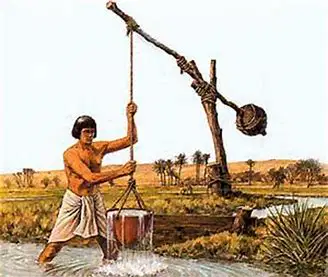
What was the purpose of this innovation?
It allowed people to gather water for irrigation.
It stopped flooding.
It allowed people to filter water for drinking.
It helped people move water to cities for bathing and sanitation.

This is an example of an Ancient Egyptian calendar. What was its purpose?
It allowed people to know when to celebrate the pharaoh's birthday.
It showed people the important religious holidays and celebrations.
It allowed people to know when to plant, harvest, and expect flooding from the Nile.
What was the role of the pharaoh in ancient Egyptian society?
A religious leader only
The most powerful person in Egypt
A farmer
A merchant
Describe the relationship between Egyptian social classes and religious beliefs.
Social classes were based on wealth alone
Social classes were strongly tied to religious beliefs
Social classes had no connection to religion
Social classes were determined by military power
Analyze how the role of government officials and priests supported the pharaoh.
They collected taxes for the pharaoh
They represented the pharaoh through their work
They fought in wars for the pharaoh
They built monuments for the pharaoh
Evaluate the impact of being born into a social group on an individual's career in ancient Egypt.
It allowed for easy career changes
It usually meant continuing in the same jobs as their parents
It had no impact on career choices
It encouraged exploration of different professions

Who would the people of Egypt blame if crops did not grow or if disease struck?
the farmers whose small villages were unclean
the mummies whose ka was distrubed
the pharaoh who was both ruler and god
the dynasty that was in power

This group of people made up about 80% of the population of Egypt.
Nobles & Warriors
Priests & Scribes
Artisans & Craftsmen
Peasants & Enslaved People
Of these four groups, which was the lowest social class? (a)
priests
scribes
artisans
government officials
What was life like as a peasant? Select all that apply
They had the fewest comforts.
They lived in plain houses of mud bricks.
They spent most of their lives working
They were able to become government officials
What was one duty of a scribe?
to farm rice
kept written records
lead armies
run elections
What type of religious belief did the ancient Egyptians primarily practice?
Monotheism
Polytheism
Atheism
Animism
Why did ancient Egyptians want to be buried with their prized possessions?
To show their wealth to others
To use them in the afterlife
To protect them from thieves
To donate them to the gods
Explain why the pharaohs were buried in elaborate tombs.
To ensure they were remembered by future generations
To display their power and wealth in the afterlife
To protect their bodies from decay
To provide a place for their families to visit
How did the belief in the afterlife influence the burial practices of ancient Egyptians?
It led to the construction of simple graves
It encouraged the building of large pyramids and tombs
It resulted in cremation being the preferred method
It led to the abandonment of burial rituals
Analyze the significance of the Great Pyramid at Giza in the context of ancient Egyptian beliefs.
It was a symbol of the pharaoh's power and a gateway to the afterlife
It was a place for public gatherings and celebrations
It was used as a military fortress
It was a center for trade and commerce
Compare the roles of different gods and goddesses in ancient Egyptian religion.
All gods and goddesses were responsible for the same aspects of life
Each god or goddess had specific roles, such as Ra for the sun and Horus for kingship
Gods and goddesses were only symbolic and had no real roles
Only pharaohs were considered gods
Evaluate the impact of religious beliefs on the social structure of ancient Egypt.
Religious beliefs had no impact on social structure
They reinforced the pharaoh's authority as a divine ruler
They led to the abolition of the pharaoh's power
They caused constant social upheaval
What reasoning might ancient Egyptians have used to justify the burial of pharaohs with elaborate treasures?
To ensure the pharaohs' wealth was not wasted
To provide the pharaohs with the necessary items for a prosperous afterlife
To prevent the treasures from being stolen by enemies
To display the pharaohs' wealth to neighboring countries
Who was the first female pharaoh of Ancient Egypt?
Cleopatra
Nefertiti
Hatshepsut
Nefertari
What was one of the main achievements of Hatshepsut during her reign?
Building the Great Pyramid
Establishing trade partnerships
Writing the Book of the Dead
Inventing hieroglyphics
Explain why Ramses the Great is considered a significant pharaoh in terms of military achievements.
He built the first Egyptian navy.
He expanded the borders of Egypt through military conquests.
He invented new weapons for the Egyptian army.
He was the first pharaoh to use chariots in battle.
Why is Tutankhamun, despite his short reign, one of the most famous pharaohs today?
He was the first pharaoh to rule Egypt.
His tomb was discovered largely intact, providing insights into ancient Egyptian life.
He conquered many lands during his reign.
He was the longest-serving pharaoh.
Describe the significance of the discovery of Tutankhamun's tomb in 1922.
It was the first tomb found in the Valley of the Kings.
It provided a wealth of information about ancient Egyptian burial practices and daily life.
It contained the largest amount of gold ever found in a tomb.
It was the only tomb found with a mummy inside.
What challenges did archaeologists face when discovering Egyptian tombs?
Most tombs were underwater.
Most tombs had been looted.
Most tombs were in pyramids.
Most tombs were sealed shut.
Identify the pharaoh known for being a great military strategist and expanding Egypt's borders.
Akhenaten
Ramses the Great
Thutmose III
Amenhotep III
How did Hatshepsut's trade partnerships impact Egypt's economy?
They led to the discovery of new lands.
They greatly improved Egypt's economy by increasing wealth and resources.
They caused economic decline due to over-reliance on foreign goods.
They had no significant impact on the economy.
What was the writing system used by the Ancient Egyptians?
Cuneiform
Hieroglyphics
Latin
Sanskrit
Which of the following is a famous architectural achievement of the Ancient Egyptians?
The Colosseum
The Great Wall of China
The Pyramids
The Parthenon
Identify the material used by Ancient Egyptians for writing that is similar to paper.
Clay tablets
Papyrus
Parchment
Bamboo strips
How did the Rosetta Stone contribute to our understanding of Egyptian hieroglyphics?
It contained a dictionary of hieroglyphics.
It had the same text in three different scripts, allowing translation.
It was a guidebook written by the Egyptians.
It was a collection of hieroglyphic stories.
Describe the process of making papyrus in Ancient Egypt.
Papyrus was made by weaving reeds together.
Papyrus was made by pressing and drying layers of papyrus plant stems.
Papyrus was made by carving into stone.
Papyrus was made by melting and molding clay.
Explain why the Sphinx is considered an architectural achievement.
It was the tallest structure in the world for centuries.
It combines a lion's body with a human head, showcasing advanced sculpting skills.
It was used as a tomb for pharaohs.
It was built entirely from gold.
Analyze the significance of the pyramids in Ancient Egyptian society.
They were used as marketplaces.
They served as monumental tombs for pharaohs, reflecting their power and religious beliefs.
They were built as defensive structures.
They were used for agricultural storage.
Discuss how the discovery of the Rosetta Stone changed the study of Ancient Egyptian history.
It provided a complete history of Egypt.
It allowed scholars to finally translate and understand Egyptian hieroglyphics.
It revealed the location of hidden treasures.
It showed that Egyptians had no written language.
Evaluate the impact of papyrus on the development of writing and record-keeping in Ancient Egypt.
It had no significant impact.
It allowed for more durable and portable record-keeping compared to stone or clay.
It was only used for religious texts.
It was primarily used for artistic purposes.
What reasoning might the Ancient Egyptians have had for building the pyramids in a triangular shape?
The triangular shape was easier to construct.
The shape symbolized the rays of the sun, which was important in their religion.
It was the only shape they knew how to build.
The shape was chosen randomly.
What was the geographical relationship between Egypt and Nubia?
Nubia was to the north of Egypt
Nubia was to the south of Egypt
Nubia was to the east of Egypt
Nubia was to the west of Egypt
Which title did Nubian leaders adopt from the Egyptians?
Emperor
Pharaoh
King
Sultan
What is one cultural attribute that Nubia adopted from Egypt?
Building skyscrapers
Building pyramids
Building castles
Building temples
Explain how cultural diffusion influenced the relationship between Egypt and Nubia.
It led to the complete assimilation of Nubian culture into Egyptian culture.
It resulted in Nubia adopting some Egyptian cultural attributes while maintaining its own identity.
It caused Egypt to adopt Nubian cultural practices.
It had no significant impact on their relationship.
Describe the nature of the trade relationship between Egypt and Nubia.
They traded only agricultural products.
They were exclusive trading partners with no other trade relationships.
They were trading partners, exchanging goods and resources.
They did not engage in trade.
Analyze why Egypt and Nubia might have become military rivals.
They both wanted to expand their territories into Europe.
They competed for access to natural resources.
They had a long-standing cultural rivalry.
They were influenced by other neighboring empires to fight.
What strategic advantage did Nubia gain by conquering Egypt?
Control over the Mediterranean Sea
Access to Egyptian wealth and resources
Expansion into the Arabian Peninsula
Alliance with the Roman Empire
How did the geographical separation of Egypt from its neighbors affect its relationship with Nubia?
It made Egypt completely isolated from Nubia.
It led to a unique relationship characterized by both cooperation and conflict.
It prevented any form of cultural exchange.
It resulted in constant warfare with Nubia.
What might have been a reason for Nubia to adopt the title of pharaoh for their leaders?
To establish a new form of government
To gain legitimacy and prestige similar to Egyptian rulers
To differentiate from Egyptian rulers
To signify a break from Egyptian influence
Predict how the relationship between Egypt and Nubia might have evolved if Nubia had not conquered Egypt.
They would have remained isolated from each other.
They might have continued as trading partners with occasional conflicts.
Nubia would have eventually been conquered by Egypt.
They would have formed a permanent alliance.
Put the changing relationship between Egypt and Nubia in the correct order
Egypt and Nubia were trading partners.
Egypt feared that Nubia was becoming too powerful.
Egypt conquered Nubia and ruled them for 450 years.
Egypt fell into a state of decline as Nubia became more powerful.
Nubia conquered Egypt.
Ancient Mesopotamia was located between which two rivers?
Mississippi and Rock
Tigris and Euphrates
Missouri and Wisconsin
Nile and Amazon
What did the Mesopotamians write on?
Dirt
Rocks
Paper
Clay tablets
The empires of Mesopotamia built _________________ to honor their gods.
statues
pyramids
ziggurats
roads
Who was the Babylonian King who created the earliest known collection of laws?
Sargon
Hammurabi
Eannatum
Nebuchadnezzar
What is the term for the writing system developed by the Sumerians that used wedge-shaped marks made in soft clay?
Writing
Monotheism
Cuneiform
Fertile Crescent
A city that governs itself and its surrounding territory.
City-state
Province
Empire
Mesopotamia
What is the system that supplies dry land with water through ditches, pipes, or streams?
Fertile Crescent
Polytheism
Cuneiform
Irrigation
Why was writing first invented?
To display laws
To communicate with foreign lands
To act as a form of entertainment
To keep record of business transactions
What is the name of the earliest piece of written literature that still survives today?
The Epic of Gilgamesh
The Ballad of the Babylonian Wars
The Elegy of Enkidu
Bad, Bad Leroy Brown
The people of Sumer practiced _____________, the worship of many gods.
polytheism
monotheism
Christianity
Catholicism
Why was Mesopotamia such a good area for growing crops?
The land was covered with heavy vegetation.
The rivers flooded, making it easier for planters to pull out weeds that might harm crops.
The area did not have any agricultural pests.
The rivers flooded and deposited rich soil (silt).
Which of the following civilizations invented the wheel?
The Babylonians
The Assyrians
The Phoenicians
The Sumerians
A __________ is a complex society that has cities, organized governments, art, religion, class divisions, and a writing system.
ziggurat
city-state
civilization
epic
Why is Sumer important?
It was the world's first civilization
It was the world's largest empire
It was where humans evolved
It was where fishing villages first developed
City-states provided protection to their citizens using...
irrigation systems
strong armies
good record keeping
walls around the city
Why did historians name the area Mesopotamia?
It has highly fertile soil.
It is bordered by rivers on two sides.
It contained the first unified nation.
A diverse group of people lived there.
What is primarily needed for the development of a civilization?
Architectural knowledge
Food production
Military power
Mineral resources
Which metal tool did the Sumerians invent that aided farmers?
Irrigation pipes
Lighter wagons
Strong plows
Farm fences
The Code of Hammurabi was carved into stone and placed around Babylon to...
Allow people to comment and change unjust laws.
Help visitors understand their customs.
Make sure everyone could see and follow the same laws.
Show his power for punishment over his people.
The Epic of Gilgamesh shows that gods/goddesses...
were remote and uninterested in humans.
behaved like humans but had superhuman powers.
were actually under the control of humans.
controlled human thoughts and actions.
The floods benefited Mesopotamia by...
Supplying fresh drinking water.
Providing highly fertile soil.
Removing waste-generated pollution.
Offering strong natural defenses.
Mesopotamia had a surplus of food because...
Everyone had some kind of agricultural job during the year.
They used metal tools and irrigation systems to increase crop yields.
Scientists developed hybrid crops that resisted diseases.
Trade networks brought grain and animal products.
When did the first cities develop in Mesopotamia?
Between 3000 BC and 4000 BC
To protect inhabitants of the city-state from attack
To improve and expand trade
A belief in many gods
Which statement best explains how social classes developed in ancient Mesopotamia? (GLE 6.6.1)
Job specialization allowed the government to set up a large organization to manage its population and territory.
Increased food production made it possible for people to specialize in different tasks, which created different levels of wealth.
The Phoenician.
People settled where crops could grow. The population grew. Villages and cities formed.
Which sequence of events shows how Mesopotamia developed?
Criminals are punished by the people they have wronged.
Increased food production made it possible for people to specialize in different tasks, which created different levels of wealth.
Job specialization allowed the government to set up a large organization to manage its population and territory.
People settled where crops could grow. The population grew. Villages and cities formed.
Which three major civilizations occupied the Fertile Crescent during Ancient Mesopotamia?
Seminoles, Sioux, and Fox
Sumerians, Babylonians, and Assyrians
Chinese, Japanese and British
Egyptians, Africans, and Spanish
True or False? The wheel was invented by the Mesopotamians.
True
False
True or False? The Mesopotamians invented the sailboat.
True
False

This picture shows an area known as...
Farming Curve
Fertile Crescent
Green C
Fertile Curve
Which of the following were members of the upper class in Mesopotamia?
Kings and priests
Artisans
Merchants and traders
Scribes
Why was Sargon important?
He united Babylon to create the first empire.
He united Mesopotamia and created the first empire.
He united Mesopotamia and made the first civilization.
He united Babylon and created the first civilization.
Building dams, channels, canals, and ditches to bring water to crops is called?
Irrigation
Nomads
Ziggurat
Scribes
What was the result of agricultural surplus?
Decline in wealth
Growth in population
Equality of social class
Reduction in trade
What helped Sumerian agriculture thrive?
Fertile soil and irrigation
Flooding and bronze tools
Mild climate and canals
Sandy coastal soil and iron tools
How did Hammurabi change Mesopotamian society?
He began seafaring trade.
He codified laws.
He introduced cuneiform.
He organized provinces.

