
 Worksheets
1D Kinematics Review with Freefall
Total questions: 52
Worksheet time: 1hrs 13mins


Find the total displacement in the 7 seconds of motion.
1 centimeter
0 centimeters
9 centimeters
12 centimeters

What is the displacement of a ball that is thrown straight up to a height of 20 m, and then falls back to its initial height?
0 m
20 m
40 m
-20 m
The unit for speed is:
m
m/s
m/s2
s
Kinematic equation can only be used when you have a constant ....
Position
Velocity
Acceleration
Time
An engineer is designing the runway for an airport. Of the planes that will use the airport, the lowest acceleration rate is likely to be 3 m/s2. The takeoff speed for this plane will be 65 m/s. All airplanes will start from rest. Assuming this minimum acceleration, what is the minimum allowed length for the runway?
v=vo+at
d=vot+1/2at2
v2=vo2+2ad
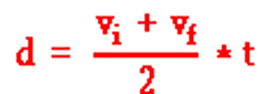
d=1/2(v+vo)t
A problem that asks "how long did it take" is prompting you for an answer measured in
distance in meters.
velocity in meters / second.
acceleration in meters / second^2.
time in seconds.
A problem that asks "how far did the object move?" is prompting you for an answer measured in
distance in meters.
velocity in meters / second.
acceleration in meters / second^2.
time in seconds.
Which would fall with greater acceleration in a vacuum-a feather or a hammer?
feather
hammer
they accelerate at the same rate
is the vacuum turned on?
Which of the following is a scalar quantity?
displacement
velocity
force
speed
What is a quantity that has only magnitude associated with it?
vector
dynamics
scalar
simple
A ball is dropped from a building. How fast is it traveling after falling for 1.77 s? (Hint: It's a free falling object)
14.76 m/s
17.35 m/s
18.91 m/s
20.03 m/s
The unit we use to measure time is ___.
m/s
m
s
m/s2
vi
velocity
initial velocity
final velocity
acceleration
d
distance / displacement
direction
velocity
acceleration
vf
velocity
initial velocity
final velocity
acceleration
a
velocity
distance
acceleration
accuracy
acceleration units
m/s
m/s2
m2/s2
m
Which of the following equations would you choose to calculate final velocity of an object traveling at a constant acceleration AND the known variables for time and initial velocity?
V= x/t
Dtotal = D1 + D2
Vf = Vi + at
S = D/t
The standard acceleration due to gravity (or standard acceleration of free fall),is the nominal gravitational acceleration of an object in a vacuum near the surface of the Earth. It is defined by standard as:
9.8 m/s.
9.8 m.
9.8 m/s2.
9.8 s.
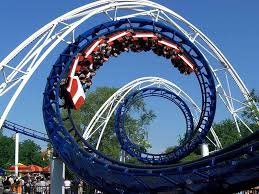
A man drops his camera off of the top of the oil derrick tower at Six Flags. Which of the following kinematic equations would he use in order to calculate the speed the camera was travelling when it hit the ground?
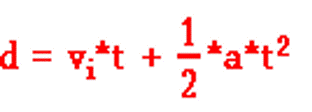
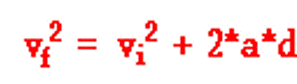
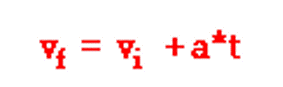
Juan is standing on the top observation deck of the Eiffel Tower in Paris at a height of 300 meters. He drops his cell phone. How fast will the phone be traveling when it hits the ground? Ignore the effect of air resistance.
9.8 m/s
76.68 m/s
149.76 m/s
46.99 m/s
If an object is in free fall for three seconds, how fast will it be falling?
9.8 m/s
19.6 m/s
29.4 m/s
39.2 m/s
Heavier objects free fall faster than lighter objects.
True
False
a = -9.8 m/s2
a = -9.8 m/s2
a = 0 m/s2
vi = 0 m/s
What is the speed of a car that traveled 0.2 km in 12 seconds?
64 m/s
166.6 m/s
16.66 m/s
0.16 m/s

A car is traveling to the right with a speed of 29m/s when the rider slams on the accelerator to pass another car. The car passes in 110 m with constant acceleration and reaches a speed of 34m/s. We want to find the acceleration of the car as it sped up. What equation should you choose?
v=vo+at
d=vot+1/2at2
v2=vo2+2ad
d=1/2(v+vo)t
A car starts from rest and accelerates uniformly over a time of 5.21 seconds for a distance of 110 m. Determine the acceleration of the car. Choose the appropriate equation.
v=vo+at
d=vot+1/2at2
v2=vo2+2ad
d=1/2(v+vo)t
Rocket-powered sleds are used to test the human response to acceleration. If a rocket-powered sled is accelerated to a speed of 444 m/s in 1.83 seconds, then what is the distance that the sled travels?
Choose the appropriate equation.
v=vo+at
d=vot+1/2at2
v2=vo2+2ad
d=1/2(v+vo)t
A car starts from rest and travels for 5 seconds with a uniform acceleration of -1.5 m/s2. According to information in the problem, what is the initial velocity of the car?
1.5
-1.5
0
5
A mom pushing a stroller starts from rest and accelerates at a rate of 0.5m/s2. The stroller travels 4.75m. Which equation would you choose to find the final velocity of the stroller?
Vf 2 = Vi2 + 2a x
V = distance/time
Vf = Vi + a t
a = Vf - Vi / t

