
 Worksheets
Senses and Olfaction
Total questions: 39
Worksheet time: 20mins
Which statement best defines sensation in the context of sensory systems?
Ability to perceive stimuli in the environment
Conscious awareness of stimuli received by sensory neurons
Reflexive motor response to a stimulus
Generation of hormones in response to stimuli
General senses include receptors distributed over large parts of the body. Which of the following are examples of general senses?
Touch
Sight
Pressure
Temperature
Hearing
Which receptor type primarily detects chemicals such as odors and taste?
Mechanoreceptors
Chemoreceptors
Photoreceptors
Thermoreceptors
Match each skin receptor with its primary function.
Merkel’s disk
Hair follicle receptors
Meissner corpuscle
Ruffini corpuscle
Pacinian corpuscle
Which statement correctly contrasts localized versus diffuse pain?
Localized pain is burning and slow; diffuse pain is sharp and rapid.
Localized pain is sharp with rapid action potentials; diffuse pain is burning or aching with slower action potentials.
Both localized and diffuse pain have identical action potential speeds.
Diffuse pain is sharp and pricking; localized pain is aching.
Which receptor category detects movement such as touch, pressure, and vibration?
Photoreceptors
Nociceptors
Mechanoreceptors
Thermoreceptors
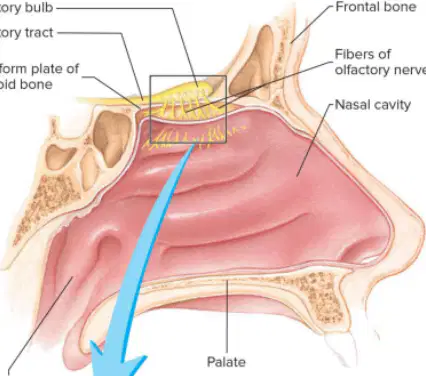
In human olfaction, where are the receptors located and approximately how many different smells can humans detect?
Inferior nasal cavity; about 1,000
Superior portion of the nasal cavity; about 10,000
Nasopharynx; about 100,000
Olfactory bulb; about 500
Which structure produces tears as part of the eye’s accessory systems?
Conjunctiva
Lacrimal apparatus
Extrinsic eye muscles
Iris
Select all statements that correctly describe taste buds or the taste process.
Each taste bud contains about 40 taste cells.
Taste hairs extend to the surface through a taste pore.
Taste cells send stimuli directly to the insula of the cerebral cortex.
Dissolved molecules bind to receptors on taste hairs to initiate action potentials.
Which list shows the five types of tastes identified in the material?
Sweet, Sour, Salty, Bitter, Umami
Sweet, Spicy, Salty, Bitter, Umami
Savory, Sour, Salty, Bitter, Astringent
Sweet, Sour, Savory, Bitter, Metallic
What is the primary role of the extrinsic eye muscles?
Focus light onto the retina
Help move the eyeball
Produce tears
Lubricate the cornea by blinking
Which accessory structures protect the eye from foreign objects and help lubricate it by blinking?
Eyebrows
Conjunctiva
Eyelids/Eyelashes
Lacrimal sac
The conjunctiva is best described as which of the following?
A thick muscle that elevates the eyelid
A thin membrane covering the inner surface of the eyelid
A cluster of glands behind the eyeball
The colored portion of the eye controlling pupil size
Which list correctly orders the three tunics of the eye from outermost to innermost?
Vascular, Fibrous, Nervous
Fibrous, Vascular, Nervous
Nervous, Fibrous, Vascular
Fibrous, Nervous, Vascular
What is the primary function of the cornea as described?
Protects internal structures and provides muscle attachment
Delivers oxygen and nutrients to the retina
Allows light to enter and focuses light
Regulates the amount of light entering the eye
Which structures are part of the vascular tunic? Select all that apply.
Choroid
Ciliary body
Iris
Sclera
Cornea
A person moves from bright sunlight into a dim room. Which statement best matches the role of the pupil during this change?
The pupil constricts because there is little light
The pupil dilates because there is little light
The pupil remains the same size because iris is inactive
The pupil constricts to focus light onto the fovea
Which statement accurately contrasts rods and cones?
Rods provide color vision; cones are more sensitive to low light
There are fewer rods than cones in the retina
Rods are photoreceptors sensitive to light and function in dim light; cones provide color vision
Cones are 20 times more numerous than rods
Where is the fovea centralis located and what is unique about its photoreceptors?
Near the optic nerve; contains only rods
In the center of the macula; contains only cones
In the sclera; contains both rods and cones
In the ciliary body; contains only blue cones
Which function is attributed to the pigmented retina?
Focuses light onto the retina
Keeps light from reflecting back inside the eye
Controls the shape of the lens
Converges to form the optic nerve
Light refraction in the eye refers to which process?
Absorption of photons by rhodopsin
Bending of light
Generation of action potentials in the optic nerve
Change in lens shape to focus images
Which pairing correctly matches a component of rhodopsin with its description?
Opsin — yellow pigment that requires vitamin A
Retinal — colorless protein in rhodopsin
Opsin — colorless protein in rhodopsin
Retinal — photosensitive pigment in cone cells
Which statements about color blindness are accurate? Select all that apply.
It is the complete loss of visual acuity.
It is the absence of perception of one or more colors.
Most forms occur more frequently in males and are X-linked genetic traits.
It is routinely diagnosed using the Ishihara Chart.
According to the overview of the ear, which are the three main divisions?
Pinna, cochlea, and auditory nerve
Outer ear, auditory canal, and tympanic cavity
External ear, middle ear, and inner ear
Malleus, incus, and stapes
Which structure is the thin membrane that separates the external ear from the middle ear?
Auricle
Oval window
Tympanic membrane
Basilar membrane
Which ossicles transmit and amplify vibrations from the tympanic membrane to the oval window? Select all that apply.
Malleus
Incus
Stapes
Cochlea
Eustachian tube
What is the primary function of the Eustachian (auditory) tube?
Transmit sound to the cochlea
Equalize air pressure between outside air and the middle ear
Produce endolymph
Vibrate against hair cells
In the cochlea, which fluid fills the cochlear duct and directly bathes the hair cells of the spiral organ?
Perilymph
Endolymph
Cerebrospinal fluid
Synovial fluid
Which membranes are correctly matched with the scala they line?
Vestibular membrane — lines scala vestibuli
Basilar membrane — lines scala tympani
Tectorial membrane — lines scala media
Tympanic membrane — lines external auditory meatus
Place the following steps of the hearing process in the correct order: A) Tympanic membrane vibrates and vibrations are amplified by ossicles to the oval window. B) Sound waves are funneled by the auricle into the ear. C) Waves in perilymph cause vestibular membrane and endolymph to vibrate. D) Sound travels through the external auditory meatus to the tympanic membrane. E) The oval window produces waves in the perilymph of the cochlea.
B, D, A, E, C
D, B, A, C, E
B, A, D, E, C
A, B, D, E, C
Which statement best describes the cochlea?
A bone attached to the tympanic membrane
A snail-shell shaped structure where hearing takes place
A membrane that separates the middle and inner ear
A tube that opens into the pharynx
Which event directly follows endolymph vibrations during the hearing process?
Displacement of the basilar membrane
Deflection of the tympanic membrane
Contraction of the stapedius muscle
Opening of the oval window
Static equilibrium is primarily responsible for which function?
Evaluating the position of the head relative to gravity
Detecting sound frequency
Coordinating eye movements
Sensing acceleration in any direction
Select all structures and functions correctly associated with dynamic equilibrium.
Semicircular canals
Changes in direction of head movement
Maculae in utricle and saccule
Detection of body position relative to gravity
Which statement best describes the vestibule in the context of balance?
It is part of the inner ear and contains the utricle and saccule
It is a swelling at the base of each semicircular canal
It houses the cupula within the ampulla
It is a gelatinous mass that floats in endolymph
Otoliths are characterized by which features?
Composed of protein and calcium carbonate embedded in a gelatinous substance
Move in response to gravity
Contain microvilli of hair cells embedded in the gelatinous layer that initiate action potentials when bent
Serve as the swelling at the base of semicircular canals
Match each term to its correct description.
Ampulla
Crista ampullaris
Cupula
The maculae are specialized patches of epithelium located in which structures and surrounded by what fluid?
Utricle and saccule; endolymph
Scala vestibuli and scala tympani; perilymph
Semicircular canals; endolymph
Cochlear duct; perilymph
In the semicircular canals, which structure directly contains the microvilli of hair cells and is displaced by endolymph movement?
Cupula
Basilar membrane
Otolithic membrane
Macula

