Wayground logo

Free Printable Worksheets

Font size

S
M
L
XL
Worksheets

Brain Review- Only questions

Total questions: 68

Worksheet time: 48mins

Name
Class
Date
1.

Damage this area and it may damage your HEARING.

a)

frontal

b)

parietal

c)

occipital

d)

temporal

2.

The ___________ lobe is associated with your SENSES and BODY POSITION.

a)

frontal

b)

parietal

c)

occipital

d)

temporal

3.

Damage this area and it may damage your VISION.

a)

frontal

b)

parietal

c)

occipital

d)

temporal

4.

Damage this area and you may have difficulty PLANNING, DECISION-MAKING, and SPEAKING.

a)

frontal lobes

b)

parietal lobes

c)

temporal lobes

d)

occipital lobes

5.

Your motor cortex can be found in the

a)

frontal lobes

b)

parietal lobes

c)

occipital lobes

d)

temporal lobes

6.

Your somatoSENSORY cortex can be found in the

a)

frontal lobes

b)

parietal lobes

c)

occipital lobes

d)

temporal lobes

7.

Your AUDITORY cortex can be found in the

a)

frontal lobes

b)

parietal lobes

c)

occipital lobes

d)

temporal lobes

8.

Broca's area helps

a)

produce language.

b)

understand language.

9.

Wernicke's area helps

a)

produce language.

b)

understand language.

10.

This term refers to the creation of NEW NEURONS.

a)

neurogenesis

b)

synaptic pruning

c)

reuptake

d)

depolarization

11.

This term refers to the ELIMINATION of old, unused neurons.

a)

neurogenesis

b)

synaptic pruning

c)

reuptake

d)

depolarization

12.

Our ___________________ allows us have HIGHER-LEVEL THINKING.

a)

association areas

b)

temporal lobes

c)

occipital lobes

d)

parietal lobes

13.

This is the brain's ability to rewire itself if damaged.

a)

plasticity

b)

neurogenesis

c)

synaptic pruning

d)

donuts

14.

The yellow parts?

a)

frontal lobes

b)

occipital lobes

c)

parietal lobes

d)

temporal

15.

The red parts?

a)

frontal lobes

b)

occipital lobes

c)

parietal lobes

d)

temporal lobes

16.

The blue parts?

a)

frontal lobes

b)

occipital lobes

c)

parietal lobes

d)

temporal lobes

17.

The green parts?

a)

frontal lobes

b)

occipital lobes

c)

parietal lobes

d)

temporal lobes

18.
Which Lobe?
a)
Frontal
b)
Parietal
c)
Temporal
d)
Occipital
19.
Which Lobe?
a)
Frontal
b)
Parietal
c)
Temporal
d)
Occipital
20.

Makes decisions, plans for the future, reasons, and carries out behaviors

a)

Frontal Lobe

b)

Parietal Lobe

c)

Occipital Lobe

d)

Temporal Lobe

21.
The corpus callosum
a)
Manages our understanding of speech and language
b)
cannot process messages sent from the left hand
c)
is a deep fissure in the cerebral cortex
d)
is a thick band of nerve fibres linking the two hemispheres of the brain
22.
Which of the following statements is true?
a)
Each hemisphere's functions are fixed and cannot be performed by the other hemisphere
b)
The right hemisphere mostly specialises in verbal functions, while the left hemisphere specialises in non-verbal functions
c)
Both hemispheres operate quite independently 
d)
We usually draw on both hemipsheres to perform most functions 
23.
Responsible for the interpretation of language/speech. 
a)
Broca's Area
b)
Werkicke's Area
c)
Premotor Area
d)
Visual Cortex
24.

If a person has difficulty producing speech due to a stroke they will most likely be diagnosed with

a)

Broca's Aphasia

b)

Wernicke's Aphasia

c)

Visual Agnosia

d)

Neglect Syndrome

25.

Stimulation at a point on which of the following may cause a person to report being touched on the knee?

a)

Motor Cortex

b)

Cerebellum

c)

Somatosensory cortex

d)

Temporal lobe

26.

The most noticeable difference between human brains and other mammalian brains is the size of the

a)

association areas.

b)

motor cortex.

c)

frontal lobe.

d)

visual cortex.

27.
By simply thinking about a move, which activates their brain cells, people may be able to move a robotic arm. This best illustrates
a)
hemispheric specialization.
b)
neurogenesis.
c)
constraint-induced therapy.
d)
neural prosthetics.
28.

The MOTOR SPEECH area is letter...

a)

A

b)

B

c)

C

d)

D

e)

E

29.

The AUDITORY area is letter...

a)

A

b)

B

c)

C

d)

D

e)

E

30.

The AUDITORY ASSOCIATION area is letter...

a)

A

b)

B

c)

C

d)

D

e)

E

31.

The PREFONTAL area is letter...

a)

A

b)

B

c)

C

d)

D

e)

E

32.

The PREMOTOR area is letter...

a)

A

b)

B

c)

C

d)

D

e)

E

33.

The SENSORY ASSOCIATION area is letter...

a)

F

b)

G

c)

H

d)

I

34.

The PRIMARY MOTOR area is letter...

a)

F

b)

G

c)

H

d)

I

35.

The PRIMARY SENSORY area is letter...

a)

F

b)

G

c)

H

d)

I

36.

The VISUAL area is letter...

a)

F

b)

G

c)

H

d)

I

37.

personality, intelligence, and executive function are all functions of the _____ area

a)

Prefrontal

b)

Premotor

c)

Sensory Association

d)

Primary Sensory

e)

Primary Motor

38.

Learned movements are stored in the _____ area

a)

Prefrontal

b)

Premotor

c)

Sensory Association

d)

Primary Sensory

e)

Primary Motor

39.

The _____ area interprets stimuli from different areas of the cerebral cortex.

a)

Prefrontal

b)

Premotor

c)

Sensory Association

d)

Primary Sensory

e)

Primary Motor

40.

Each spot of the ___ area moves a specific body part.

a)

Prefrontal

b)

Premotor

c)

Sensory Association

d)

Primary Sensory

e)

Primary Motor

41.

Each spot of the ___ area FEELS for a specific body part.

a)

Prefrontal

b)

Premotor

c)

Sensory Association

d)

Primary Sensory

e)

Primary Motor

42.

Each spot of the ___ area FEELS for a specific body part.

a)

Prefrontal

b)

Premotor

c)

Sensory Association

d)

Primary Sensory

e)

Primary Motor

43.

The ____ area allows for physical sight.

a)

Visual Cortex

b)

Visual Association

c)

Primary Auditory

d)

Auditory Association

44.

The ____ area makes sense of what you see.

a)

Visual Cortex

b)

Visual Association

c)

Primary Auditory

d)

Auditory Association

45.

The ____ area makes sense of what you hear.

a)

Visual Cortex

b)

Visual Association

c)

Primary Auditory

d)

Auditory Association

46.

The ____ area allows for you to HEAR.

a)

Visual Cortex

b)

Visual Association

c)

Primary Auditory

d)

Auditory Association

47.

The ____ area makes your mouth move to make speech possible.

a)

Sensory

Speech

b)

Motor Speech

c)

Sensory Association

d)

Primary Sensory

e)

Primary Motor

48.

The ____ area makes what you say make sense.

a)

Sensory

Speech

b)

Motor Speech

c)

Sensory Association

d)

Primary Sensory

e)

Primary Motor

49.
When a neuron is resting, the inside of the axon has a ____________ charge.
a)
positive
b)
negative
50.
When a neuron is not engaged in an impulse.
a)
Resting potential
b)
Action potential
c)
Neural potential
d)
Synaptic potential
51.
Neurotransmitters are released from the
a)
Dendrites
b)
Post-synaptic neuron
c)
Presynaptic neuron
d)
Axon
52.
In order for a neuron to have an action potential, the neuron must receive more
a)
excitatory neurotransmitters
b)
inhibitory neurotransmitters
c)
agnostic neurotransmitters
d)
antagonistic neurotransmitters
53.
Excess neurotransmitters in the synapse that goes back into the presynaptic neuron.
a)
Resting potential
b)
Reuptake
c)
Retroactivity
d)
Repolarization
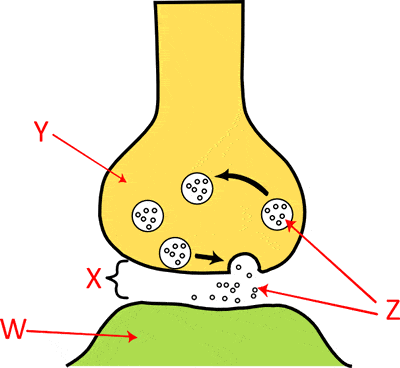
54.
W
a)
Axon Terminal Button
b)
Neurotransmitters
c)
Dendrite
d)
Synapse
55.
Y
a)
Axon Terminal Button
b)
Neurotransmitters
c)
Dendrite
d)
Synapse
56.

What do we call a nerve cell that is the basic working unit of the brain and nervous system?

a)

axon

b)

neuron

c)

dendrite

d)

neurotransmitter

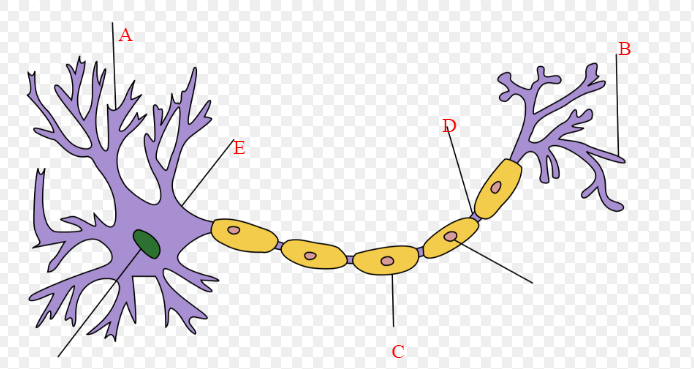
57.
A
a)
Dendrite
b)
Axon
c)
Axon Terminal
d)
Cell Body
58.

B

a)

Dendrite

b)

Axon

c)

Axon Terminal

d)

Cell Body

59.
Label the Neuron-What does the letter "A" represent?
a)
Axon
b)
Dendrite
c)
Axon Terminal
d)
Cell Body
60.
Label the Neuron-What does the letter "E" represent?
a)
Schwann Cell
b)
Node of Ranvier
c)
Axon Terminal
d)
Myelin Sheath
61.
What is the chemical used by a neuron to transmit an impulse across a synapse to another nerve cell?
a)
Neurotransmitters
b)
Synapse
c)
Threshold
d)
Impulse
62.
-70 mV is the measure of a
a)
Threshold Potential
b)
Action Potential
c)
Resting Potential
d)
End Point Potential
63.
When a membrane potential reaches +30mV, ________ channels open, ________ occurs, and ________ channels close.
a)
Sodium, depolarization, potassium
b)
Potassium, depoloarization, sodium
c)
sodium, repolarization, potassium
d)
postassium, repolarization, sodium
64.
The area between the pre-synaptic cell and the post-synaptic cell is termed the synaptic cleft.
a)
True
b)
False
65.
The sodium-potassium pump is involved in establishing the resting membrane potential. 
a)
True
b)
False
66.
Multiple sclerosis is an autoimmune disease in which the body's own immune system destroys the _____________ of the nerve axons. 
a)
Myelin
b)
Dendrites
c)
Axon Terminal
d)
Nodes of Ranvier
67.
The brain's supporting cells are called: 
a)
glial cells
b)
mitochondria
c)
neurons
d)
nuclei
68.
Nerve impulses within the neuron are sent in _____ form
a)
Electrical
b)
Chemical
c)
Electro-chemical
d)
Petrochemical