
 Worksheets
Unit 4 Test Review_PHS
Total questions: 81
Worksheet time: 41mins
Which statement best distinguishes civil law from criminal law in healthcare contexts?
Civil law addresses disputes between individuals or organizations, while criminal law involves offenses against society punished by the government.
Civil law always results in jail time, while criminal law only results in fines.
Civil law is optional for healthcare workers, while criminal law is only for patients.
Civil law is based on morals, while criminal law is based on contracts.
In a valid doctor–patient contract, who below is generally NOT legally able to sign due to legal disability?
A 30-year-old patient of sound mind
A minor
An emancipated adult
A healthcare provider's office manager
Which term refers to harmful actions such as fraud or invasions of privacy in healthcare?
Contracts
Torts
Accreditation
Registration
Which option is an example of invasion of privacy through spoken false statements?
Slander
Libel
Fraud
Accreditation
Which action represents libel in a healthcare setting?
A false statement written in a chart that harms a patient’s reputation
An unintentional medication error
A truthful verbal warning to a colleague
A patient refusing treatment
Ethical issues in healthcare are primarily defined by which of the following?
Criminal codes only
Morals and values
Insurance policies
Employment contracts
Codes of ethics in healthcare most directly serve which purpose?
Provide legal punishments for crimes
Guide professional behavior based on shared principles
Set hospital building standards
Replace all patient consent forms
Which law protects the privacy of protected health information (PHI)?
Affordable Care Act (ACA)
HITECH Act
HIPAA
Patient Self-Determination Act
The HITECH Act primarily relates to which area of patient rights?
Electronic health information and technology
End-of-life choices
Insurance coverage for preexisting conditions
Professional licensure
Which document or tool expresses a patient's wishes about medical care if they become unable to decide?
Living will
Employment contract
Insurance claim
Professional certification
A patient designates someone to make medical decisions on their behalf if they become incapacitated. This is known as which of the following?
Advance directive
Libel
Fraud
Registration
Which organization provides accreditation specifically for healthcare organizations, indicating they meet standards?
AHIMA
National Commission for Health Education Credentialing
Joint Commission
HITECH
What does professional registration indicate in healthcare?
Completion of an ethics course
Placement on an official list (registry) of qualified workers
Awarding of a degree by a university
Government licensure for criminal cases
Which statement about certification is accurate based on professional standards?
Certification is provided by hospitals only.
Certification is offered by professional associations such as AHIMA.
Certification is the same as accreditation of organizations.
Certification places workers on a government registry.
Educational programs in healthcare must be accredited because accreditation shows what?
That programs are free of cost
That an organization meets established standards
That students have passed state criminal checks
That graduates are automatically licensed
Which topic is the focus of the warm-up activity shown?
Nutrition planning for athletes
Ethical, safety, and legal challenges in healthcare
Advanced surgical procedures
Hospital finance and billing
Which question best targets legal knowledge needed by healthcare workers, as highlighted in the warm-up?
How do I calculate a patient’s calorie needs?
What laws affect how I handle patient information?
Which exercise strengthens the heart the most?
What color scrubs should I wear?
A student wants to act on the warm-up prompt, “What can you do to ensure that your interactions with patients are ethical, legal, and safe?” Which option best aligns with this goal?
Ignore workplace policies and rely on personal judgment
Follow codes of ethics, respect laws, and use safety protocols
Share patient stories on social media to educate others
Let untrained visitors assist with procedures to build trust
Which term describes the levels of authority within a healthcare organization that indicate who has responsibility and to whom others report?
Interdisciplinary team
Hierarchy
Referral network
Patient-centered care
What is the main purpose of an organizational chart in healthcare settings?
To list all employee names
To represent levels of responsibility and the flow of information
To show patient schedules
To record medical errors
In a chain of command, to whom do medical workers report?
Patients only
Government regulators
Those directly above them in lines of authority
Anyone available on the floor
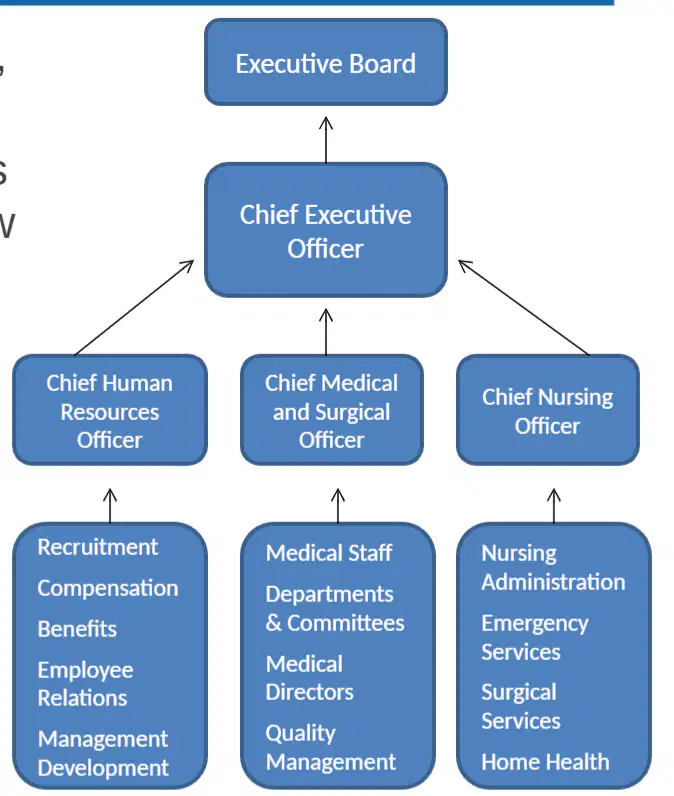
According to the hierarchy shown, which role reports up to the Executive Board?
Chief Executive Officer
Nursing Administration
Medical Staff
Recruitment
Which option best describes an interdisciplinary healthcare team?
A group of patients who share experiences
Departments working together to provide care
Only doctors working together
Insurance companies coordinating payments
Which members are part of a primary care team?
Only specialists
Doctors, nurses, and other health professionals
Billing staff only
Emergency responders only
How is secondary care usually accessed by a patient?
By walking into any clinic without paperwork
Through a referral to specialists
By calling the hospital CEO
By joining a community support group
Within a healthcare team, who makes the final decisions about care?
The chief nursing officer
The executive board
The patient
The laboratory department
Which statement best defines scope of practice for healthcare workers?
The list of personal goals a worker wants to achieve
All the skills healthcare workers are trained in and allowed to use
Any task a supervisor asks a worker to do
Only the tasks a worker prefers to perform
According to the material, what typically happens to a healthcare worker’s scope of practice as they advance in their career?
It narrows to fewer specialized tasks
It stays the same regardless of experience
It broadens as more skills are learned
It is replaced by administrative duties
Which scenario MOST likely violates scope of practice?
A nurse performs tasks they are trained and permitted to do
A medical assistant follows a written protocol
A student performs a procedure they are not trained or licensed to perform
A physician delegates tasks appropriately
Which phrase best describes malpractice as presented?
Any medical error with no patient impact
Actions that violate scope of practice or standard of care and result in reasonably expected injury
Only intentional harm done by a healthcare worker
Criminal acts prosecuted by the state only
Most malpractice results from which cause?
Negligence—an unintentional failure to complete duties of care
Fraud—an intentional deception
Assault—threatening a patient
Battery—unwanted touching
Malpractice cases are typically handled under which type of law?
Criminal law
Civil law
International law
Administrative law
Who may bring a civil suit in a malpractice case according to the material?
The hospital only
Any bystander
Patients
The prosecutor
Which example best illustrates negligence leading to malpractice?
A provider intentionally strikes a patient
A nurse forgets to carry out an ordered treatment, causing harm
A patient refuses treatment after being informed
A physician follows the standard of care
Which of the following is listed as a type of patient abuse?
Providing extra snacks
Verbal abuse
Allowing family visits
Scheduling regular checkups
What does neglect include according to the material?
Only financial harm
Only emotional harm
Physical and emotional harm
Only physical harm
Involuntary seclusion refers to which action?
Separating a patient for medical isolation with consent
Placing a patient alone without consent as a form of mistreatment
Allowing private time on request
Moving a patient to a shared room
Which statement about consequences of abuse is supported by the material?
Abuse is never a crime
Abuse may be a felony or misdemeanor, and felons are barred from work
Only fines are possible for abuse
Abuse always results in community service
False imprisonment may involve which action?
Offering a patient a choice of activities
Restraint or preventing a person from leaving
Documenting vital signs
Providing education about medications
Which option correctly distinguishes assault from battery in mistreatment?
Assault is unwanted touching; battery is a threat
Assault is a threat; battery is unwanted touching
Both are forms of verbal abuse
Neither relates to patient mistreatment
A healthcare worker locks a patient’s wheelchair brakes and stands in the doorway to keep the patient from leaving the room without a medical reason or consent. Which term best applies?
Negligence
False imprisonment
Involuntary consent
Sexual abuse
Which organization created the first Patients’ Bill of Rights in 1973?
American Medical Association
American Hospital Association
World Health Organization
U.S. Department of Health and Human Services
In what year was a national set of consumer rights and responsibilities in healthcare developed?
1965
1973
1998
2008
Which of the following is included in the national consumer rights and responsibilities?
Free healthcare for all
Participation in treatment decisions
Guaranteed cure for diagnosed illnesses
Lifetime coverage without premiums
Which term best describes the patient’s right to receive facts about their condition and care options?
Information disclosure
Mandatory reporting
Ethics board review
Physical privacy
Which right ensures patients can choose from different doctors and insurance options?
Confidentiality
Choice of providers and plans
Access to healthcare
Complaints and appeals
What does informed consent allow a patient to do?
Request a private room
Accept or reject treatment after receiving information
Obtain free second opinions
Share medical details in court
Which statement best defines privileged communication in healthcare?
Health workers must disclose all patient data to courts
Discussions with healthcare workers cannot be shared in court
Patients can record all conversations without consent
Families may access all records without permission
HIPAA primarily protects which aspect of patient care?
Billing accuracy
Privacy of information
Clinical outcomes
Surgical safety checklists
Which option shows respect for a patient’s physical privacy?
Discussing results loudly in a hallway
Leaving doors open during exams
Providing gowns and draping during procedures
Posting names and diagnoses on a public board
A nurse ensures a patient understands the risks and benefits before signing a form. Which concept is being applied?
Confidentiality
Informed consent
Mandatory reporting
Nondiscrimination
What is the most famous code of ethics in healthcare mentioned in the material?
Geneva Convention
Nuremberg Code
Hippocratic Oath
Belmont Report
Which group meets to discuss controversial cases in healthcare?
Hospital billing teams
Marketing committees
Ethics boards
Insurance appeals panels
Mandatory reporting is required in which type of situation?
Insurance disputes
Scheduling conflicts
Cases of abuse
Medication refills
A physician faces a choice where each option has moral pros and cons. This situation is best described as a(n):
Legal violation
Ethical dilemma
Standard procedure
Informed consent
Which right allows patients to raise issues when they believe care was inadequate?
Access to healthcare
Complaints and appeals
Respect and nondiscrimination
Privileged communication
Which set of protections primarily ensures patient safety in healthcare settings?
Employment laws and union rules
Licensure laws, standards of care, and the patients’ bill of rights
OSHA workplace posters and training videos only
Hospital visitor policies
Which agency provides guidelines for workplace safety and cleanliness in healthcare facilities?
CDC
OSHA (Occupational Safety and Health Administration)
FDA
CMS
According to employment laws mentioned, what is the minimum age required to perform certain healthcare jobs?
14
16
18
21
What legal protection do employees have when they report unsafe working conditions?
They may be demoted but not fired
They are protected by law from retaliation
They must report anonymously or face penalties
They can only report to hospital security
Before a procedure, what is a key step to avoid patient misidentification?
Ask the patient to state their favorite color
Verify patient identity
Assign a new wristband color
Confirm room number only
Which action best helps prevent medication mistakes?
Using only brand-name drugs
Double-checking prescriptions
Letting patients select their own dose
Skipping questions to save time
Why should healthcare workers check for medication interactions?
To reduce the number of pills dispensed
To prevent harmful effects when drugs are combined
To keep pharmacy costs low
To shorten hospital stays regardless of diagnosis
Educating patients about how to take a medication safely primarily aims to:
Improve patient satisfaction scores only
Ensure correct use and reduce errors
Encourage patients to refuse treatments
Replace the need for prescriptions
Which communication practice supports preventing medication errors?
Avoid asking patients questions to save time
Know patients and communicate with them
Rely only on electronic records
Use medical jargon exclusively
A nurse preparing to give a new medication reviews the prescription, checks for possible interactions with the patient’s current drugs, and explains the dosing schedule to the patient. Which safety areas are addressed?
Avoiding misidentification only
Worker safety laws only
Multiple strategies to avoid medication mistakes
OSHA cleanliness guidelines only
Which phrase best captures the main topic introduced in this section?
Diagnostic imaging techniques
Legal and Ethical Issues for Diagnostic Workers
History of healthcare careers
Treatment planning for patients
This section most likely focuses on rules and responsibilities for which group?
Surgical nurses
Diagnostic workers
Pharmacists only
Hospital administrators
Based on the title, which topic is most relevant to discuss?
How to interpret an MRI scan result
Licensure and certification requirements for diagnostic staff
How to schedule clinic appointments
Nutritional counseling for athletes
Which of the following best describes an ethical issue a diagnostic worker might face?
Maintaining patient privacy when handling test results
Choosing the fastest imaging machine
Selecting wall paint for the radiology suite
Deciding cafeteria menus
From the title, which regulation area is most likely included in the section?
OSHA safety standards for diagnostic settings
Architectural codes for new hospitals
Tax rules for nonprofits
Parking regulations
Which key concept aligns with the idea that diagnostic workers must not perform tasks beyond what they are legally permitted to do?
Evidence-based practice
Scope of practice
Continuing education
Patient advocacy
A new imaging technician wonders if they need state authorization to operate equipment. Which term from this section addresses that requirement?
Licensure
Nutrition
Billing
Triage
Which scenario best illustrates compliance with patient privacy in diagnostics?
Discussing test results only with authorized care team members
Sharing images with friends to get opinions
Posting anonymized images on social media without consent
Leaving printed results on a public desk
What is the most likely purpose of OSHA regulations for diagnostic workers?
To set safety standards that protect workers and patients
To determine patient co-pay amounts
To approve new pharmaceuticals
To design hospital logos
Which action would most likely violate a diagnostic worker's scope of practice?
Performing a scan as ordered by a licensed provider
Interpreting images and giving a medical diagnosis without authorization
Following radiation safety protocols
Documenting equipment checks
Why is certification important for diagnostic professionals?
It validates competency and can be required for employment
It replaces all safety training
It allows workers to set hospital policy
It eliminates the need for licensure
A student asks what legal requirement ensures only qualified individuals can provide diagnostic services in a state. Which term applies?
Licensure
Volunteering
Internship
Scheduling
Which of these best shows an ethical approach when handling diagnostic errors?
Ignoring the error to avoid blame
Promptly reporting the error following facility policy
Posting about the error online for feedback
Blaming the patient
In diagnostic departments, which practice helps meet both legal and ethical standards related to privacy?
Using secure systems to store and share results
Allowing open access to imaging archives
Talking about cases in elevators
Sharing passwords with coworkers to save time
Which topic from this section most directly guides safe use of imaging equipment?
OSHA regulations and safety protocols
Marketing strategies
Hospital cafeteria operations
Community fundraising

