
 Worksheets
Cellular Structure, Function and Transport — Test Review
Total questions: 25
Worksheet time: 13mins
Studying a picture of a cell taken with an electron microscope, you find that the cell has no nucleus and no mitochondria, but it does have a plasma membrane and a cell wall. You conclude that the cell is probably from a(n). (2pts)
plant
animal
bacteria
extinct organism
Which of the following organelles would you expect to find in plant cells but not animal cells? (1pt)
ribosome
chloroplast
mitochondria
endoplasmic reticulum
Which of the following is NOT a principle of the cell theory? (1pt)
All living things are made of cells.
Cells are the basic units of life.
Very few cells are able to reproduce.
All cells are produced from existing cells.
A particularly active cell, such as a muscle cell, might contain large numbers of. (2pts)
vacuoles
lysosomes
mitochondria
chromosomes
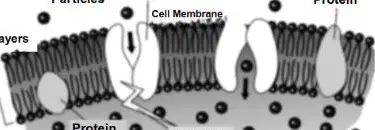
A cell membrane is composed of a double layer of lipids in which many kinds of proteins are embedded. Many of these proteins act like gates, allowing only certain particles to enter or leave the cell. When a particle has to go against its concentration gradient through one of these gates, energy is supplied by the cell to the correct protein to move the particle through the membrane. A sodium-potassium ion pump is an example of a type of carrier protein that used a large portion of the cell's energy to move sodium ions through the cell membrane. Which of the following best describes the type of cellular transport in the picture above? (3pts)
Active transport, it requires energy and moves from high to low concentration.
Active transport, it requires energy and moves from low to high concentration.
Passive transport, it does not require energy and moves from high to low concentration.
Passive transport, it does not require energy and moves from low to high concentration.
The organelle that breaks down lipids, carbohydrates, and proteins into small molecules that can be used by the cell are called. (1pt)
vacuoles
ribosomes
lysosomes
mitochondria
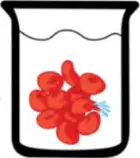
An animal cell that is surrounded by fresh water will burst because the osmotic pressure causes. (1pt)
water to move into the cell.
water to move out of the cell.
solutes to move into the cell.
solutes to move out of the cell.
Who used a compound light microscope to see chambers within cork and named them "cells"?
Robert Hooke
Anton von Leeuwenhoek
Matthias Schleiden
Rudolf Virchow
Which of the following best describes the relationship between the nucleus and the cytoplasm? (2pts)
The cytoplasm is a fluid that fills the inside of the nucleus.
The nucleus is a fluid and it mixes with the fluid cytoplasm.
The nucleus is an organelle that is surrounded by the cytoplasm.
The cytoplasm is an organelle that is usually found near the nucleus.
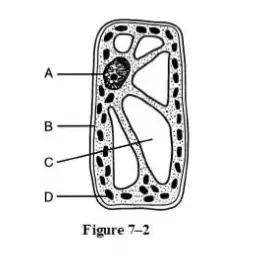
Which structure in the cell shown in Figure 7-2 below stores materials, such as water, salts, proteins, and carbohydrates? (2pts)
Structure A
Structure B
Structure C
Structure D
Which sequence correctly traces the path of a protein in the cell? (2pts)
ribosome, endoplasmic reticulum, Golgi apparatus
ribosome, endoplasmic reticulum, chloroplast
endoplasmic reticulum, lysosome, Golgi apparatus
ribosome, Golgi apparatus, endoplasmic reticulum
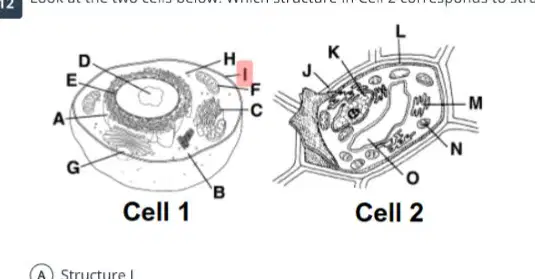
Look at the two cells below. Which structure in Cell 2 corresponds to structure I (highlighted below) in Cell 1? (2pts)
Structure J
Structure K
Structure L
Structure M
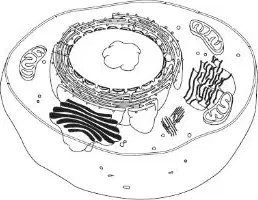
Which of the following conclusions could you draw about the cell in the drawing below? (2pts)
The cell is eukaryotic because it has a nucleus.
The cell is prokaryotic because it has a nucleus.
The cell is eukaryotic because it does not have a nucleus.
The cell is prokaryotic because it does not have a nucleus.
During diffusion, when the concentration of molecules on both sides of a membrane is the same, the molecules will (2pts)
continue to move across the membrane in both directions as seen in an isotonic environment.
move across the membrane to the outside of the cell as seen in a hypertonic solution.
move across the membrane to the inside of the cell as seen in a hypotonic solution.
stop moving across the membrane as seen in an isotonic environment.
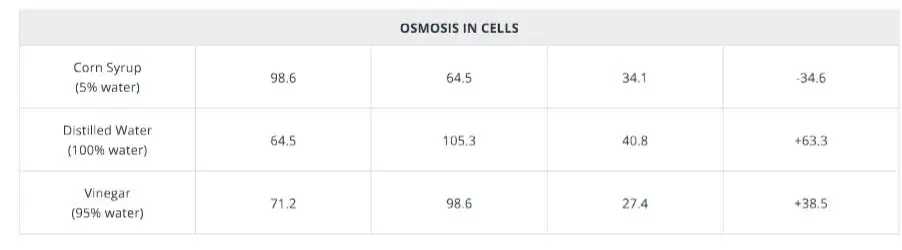
Cell Transport — Use the following passage and data table to answer the question. An osmosis investigation was conducted using chicken eggs to represent cells with semipermeable membranes. The mass of each egg was measured to determine how much water diffused into or out of the eggs. The eggs were first soaked in vinegar to dissolve the shell. Each egg was then placed in one of three different solutions for 24 hours. The table below shows the results of the investigation. Data table: Solution; Average Mass of Eggs Before Soaking (grams); Average Mass of Eggs After Soaking (grams); Difference in Average Mass (grams); Percent Change in Average Mass. Corn Syrup (5% water): 98.6, 64.5, 34.1, -34.6. Distilled Water (100% water): 64.5, 105.3, 40.8, +63.3. Vinegar (95% water): 71.2, 98.6, 27.4, +38.5. Based on the experiment, which of the following can be inferred about cells with semipermeable membranes? (3pts)
Substances other than water may also cross the cell membrane.
Substances other than water may block pores in the cell membrane.
Water enters the cell when placed in environments of high water concentration.
Water leaves the cell when placed in environments with a low concentration of solutes.
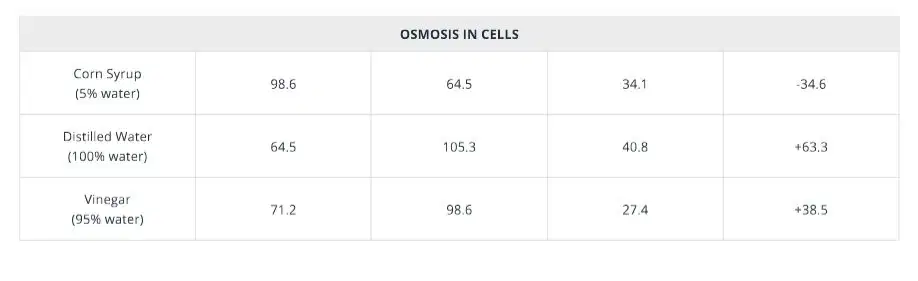
Cell Transport — Use the following passage and data table to answer the question. An osmosis investigation was conducted using chicken eggs to represent cells with semipermeable membranes. The mass of each egg was measured to determine how much water diffused into or out of the eggs. The eggs were first soaked in vinegar to dissolve the shell. Each egg was then placed in one of three different solutions for 24 hours. The table below shows the results of the investigation. Data table: Solution; Average Mass of Eggs Before Soaking (grams); Average Mass of Eggs After Soaking (grams); Difference in Average Mass (grams); Percent Change in Average Mass. Corn Syrup (5% water): 98.6, 64.5, 34.1, -34.6. Distilled Water (100% water): 64.5, 105.3, 40.8, +63.3. Vinegar (95% water): 71.2, 98.6, 27.4, +38.5. What is the independent variable in the osmosis experiment? (1pt)
The type of solution the eggs were placed in
The mass of the eggs before soaking
The percent change in mass of the eggs
The time the eggs were soaked
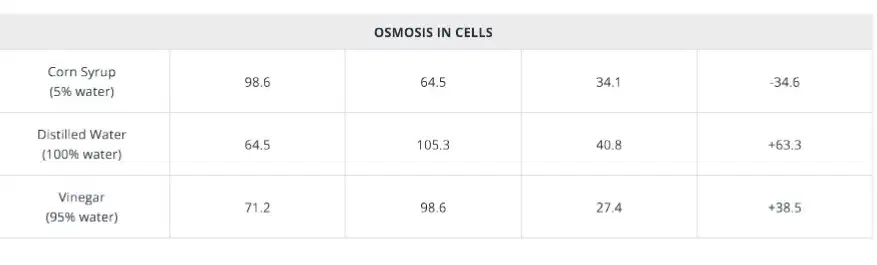
Cell Transport — Use the following passage and data table to answer the question. An osmosis investigation was conducted using chicken eggs to represent cells with semipermeable membranes. The mass of each egg was measured to determine how much water diffused into or out of the eggs. The eggs were first soaked in vinegar to dissolve the shell. Each egg was then placed in one of three different solutions for 24 hours. The table below shows the results of the investigation. Data table: Solution; Average Mass of Eggs Before Soaking (grams); Average Mass of Eggs After Soaking (grams); Difference in Average Mass (grams); Percent Change in Average Mass. Corn Syrup (5% water): 98.6, 64.5, 34.1, -34.6. Distilled Water (100% water): 64.5, 105.3, 40.8, +63.3. Vinegar (95% water): 71.2, 98.6, 27.4, +38.5. What prediction can be made if the eggs were placed in a solution with 50% water and 50% solutes? (3pts)
The eggs would gain mass.
The eggs would lose mass.
The eggs would maintain the same mass.
The eggs would dissolve completely.
What cellular function would be most affected if your cells had very few ribosomes? (2pts)
Producing enough energy for the cells.
Breaking down and reusing cellular materials.
Producing proteins needed by the cells and the body.
Moving substances into and out of the cells.
What advantage does a cell wall provide plant cells when they come in contact with fresh water? (2pts)
They provide support for the extra pressure exerted on the cell.
They allow the cell to easily burst due to the extra pressure.
Their phospholipids cannot support the pressure so they break apart.
The walls shrink and allow the plant cells to shrivel up.
Which of the following structures are involved in cell movement? (1pt)
cytoplasm and ribosomes
nucleolus and nucleus
cilia and flagella
microtubules and microfilaments
Which of the following organisms are prokaryotes? (1pt)
plants
animals
fungi
bacteria
Which type of microscope can produce three-dimensional images of a cell's surface? (1pt)
transmission electron microscope
scanning electron microscope
simple light microscope
compound light microscope
Which best describes the connection of the cell theory to the microscope? (2pts)
The invention of microscopes made the development of the cell theory possible.
The invention of electron microscopes caused scientists to determine the cell as the basic unit of life.
The development of the cell theory inspired people to improve existing electron microscopes.
The microscope was invented so that scientists could develop the cell theory.
Which correctly contrasts a prokaryotic cell and a eukaryotic cell? (2pts)
only prokaryotic cells can have a cell wall
only prokaryotic cells can have a plasma membrane
only eukaryotic cells can have ribosomes
only eukaryotic cells can have chloroplasts
Which is a disadvantage of a transmission electron microscope (TEM)? (1pt)
Images of cells and microorganisms can only be magnified 1000X.
The equipment used cannot directly view living specimens.
Electrons are transmitted through a specimen onto a fluorescent screen.
Thin slices of tissue are required for viewing cells with a TEM.

