

wayground logo

Free Printable Worksheets

Font size

S
M
L
XL
Worksheets

DNA Unit Review

Total questions: 29

Worksheet time: 15mins

Name
Class
Date
1.

What process did Griffith observe when he mixed heat-killed disease-causing bacteria with live harmless bacteria and injected that mixture into mice?

a)
replication
b)
transformation
c)
transcription
d)
translation
2.

Who’s work in X-ray diffraction led Watson and Crick to discover the structure of DNA?

a)
Erwin Chargaff
b)
Frederick Griffith
c)
Rosalind Franklin
d)
Hershey and Chase
3.

The ____ Experiment showed that viruses inject their DNA into host cells, proving once and for all that it is the genetic material.

a)
Watson-Crick
b)
Avery-Griffith
c)
Franklin-Chargaff
d)
Hershey-Chase
4.

According to Chargaff’s Rules, if there is 16% A,

a)
there must be 32% C
b)
there must be 16% T
c)
there must be 16% G
d)
there must be 34% T
5.

The 4 nitrogen bases found in DNA are ____.

a)
A, U, C, and G
b)
A, G, C, and D
c)
A, T, C, and G
d)
U, T, C, and G
6.

Which of the following is a nucleotide found in DNA?

a)
deoxyribose sugar + phosphate group + cytosine (C)
b)
deoxyribose sugar + phosphate group + uracil (U)
c)
ribose sugar + phosphate group + uracil (U)
d)
ribose sugar + phosphate group + thymine (T)
7.

Before a cell divides the DNA must copy itself by a process known as

a)
Replication
b)
Transformation
c)
Transcription
d)
Translation
8.

DNA replication results in two DNA molecules,

a)
each with two new strands.
b)
one with two new strands and the other with two original strands.
c)
each with one new strand and one original strand.
d)
each with two original strands.
9.

Which enzyme is responsible for “unzipping” or separating the nitrogen bases in DNA at the replication fork during replication?

a)
Helicase
b)
Polymerase
c)
Amino acids
d)
Uracil
10.

In a molecule of DNA, nitrogen bases are held together by _______.

a)
Hydrogen bonds
b)
Ionic bonds
c)
Covalent bonds
d)
Peptide bonds
11.

Which of the following are found in both DNA and RNA?

a)
Deoxyribose sugar, guanine (G) and adenine (A)
b)
Hydrogen bonds, ribose sugar and thymine (T)
c)
Phosphates, cytosine (C) and adenine (A)
d)
Uracil (U), hydrogen bonds and guanine (G)
12.

In an RNA molecule, adenine (A) pairs with _______.

a)
Thymine (T)
b)
Cytosine (C)
c)
Guanine (G)
d)
Uracil (U)
13.

Which type(s) of RNA is/are involved in protein synthesis?

a)
Transfer RNA and RNA polymerase
b)
RNA polymerase and messenger RNA
c)
Messenger RNA and transfer RNA only
d)
Messenger RNA, ribosomal RNA and transfer RNA
14.

Messenger RNA makes a copy of DNA in the process of _______.

a)
Transcription
b)
Translation
c)
Replication
d)
Transformation
15.

If the original DNA strand is ATCGCCTTA, what is the correct complementary strand of mRNA?

a)
TAGCGGAAT
b)
TUGCGGUUT
c)
UAGCGGAAU
d)
UACGCCAAT
16.

Proteins are made by joining chains of _________.

a)
Amino acids
b)
Nucleotides
c)
Genes
d)
RNA molecules
17.

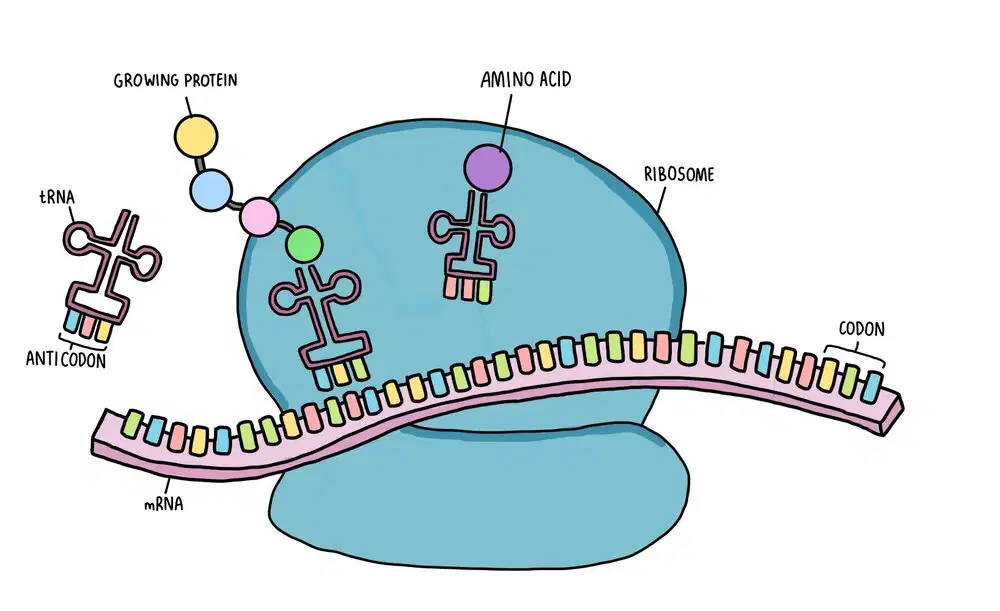
How many nitrogen bases (nucleotides) are needed to specify three amino acids?
a)
1
b)
3
c)
6
d)
9
18.

What process shown in the figure?

a)
transcription
b)
translation
c)
DNA replication
d)
transformation
19.

Where does Translation take place?

a)
in the nucleus
b)
in the mitochondria
c)
at the ribosomes
d)
transformation
20.

Genes (DNA) contain instructions for assembling or building _________________.

a)
purines
b)
proteins
c)
pyrimidines
d)
chromosomes
21.

Using your codon Chart, which of the following codons codes for the amino acid Proline?

a)
CAU
b)
CGU
c)
CCU
d)
CUU
22.

A mutation that involves a single nucleotide as in the following example, is called a(n) Original strand: ATG ACC TGA Mutated strand: ACG ACC TGA

a)
chromosomal mutation
b)
frameshift mutation
c)
point mutation
d)
translocation
23.

If the fifth nucleotide in the following mRNA molecule were mutated to a G, what would be the impact on the amino acid(s) in the sequence? mRNA: AUG GCG GAA

a)
The amino acid for the mutated codon would change, but the resulting protein most likely would not change.
b)
The amino acid would stay the same because the mutated codon codes for the same amino acid as the original codon, resulting in the same functional protein.
c)
The amino acid sequence would shift causing the coding of an entire new set of amino acids.
d)
The amino acid would change and probably change the protein.
24.

Segments of messenger RNA that do not code for proteins and are eventually cut out of the mRNA are called ____.

a)
introns
b)
exons
c)
genes
d)
transcripts
25.

Any substance that causes a mutation, such as chemicals, radiation, and pollution are called ____.

a)
proteins
b)
mutagens
c)
codons
d)
amino acids
26.

In which process does transfer RNA bring amino acids to the ribosome to build the protein?

a)
replication
b)
transformation
c)
transcription
d)
translation
27.

The backbone of a DNA molecule is made of which two substances or components?

a)
phosphate groups and ribose sugars
b)
phosphate groups and deoxyribose sugars
c)
nitrogen bases and ribose sugars
d)
nitrogen bases and deoxyribose sugars
28.

DNA is a double stranded molecule composed of repeating units known as ____.
a)
polysaccharides
b)
carbohydrates
c)
nucleotides
d)
phospholipids
29.

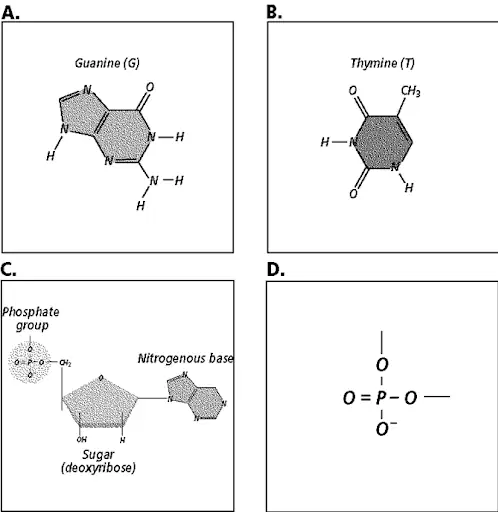
Which structure shown in the figure is a complete DNA nucleotide?

a)

A

b)

B

c)

C

d)

D
