
 Worksheets
Module 4 Review: Electrons in Atoms, Inspire Chemistry
Total questions: 27
Worksheet time: 27mins
What is the relationship between the frequency and wavelength of light?
A wave carries __________ from one place to another.
matter
Which type of electromagnetic waves have the shortest wavelength and the highest frequency?
Electromagnetic waves are all this type of wave:
Match the EM wave type with its characteristics
radio
long wavelength, low frequency
Microwave
used in cooking and communication
ultraviolet
can cause skin damage & kill bacteria
infrared
heat radiation, TV remote, night vision
gamma
high energy, short λ, 3-4 ft. wall stops
Describe Bohr's model of the atom.
A quantum of energy allows an electron to move ________________________
Define photon
What is happening with the electron when it gives off light?
The value of plank's constant is ?
6.636 x 10⁻³⁴
6.626 x 10⁻³⁴
7.11 x 10⁻³⁴
10.20 x 10⁻³⁴
What scientist and equation prove that particles have wave properties?
Louis de Broglie and his equation λ = h/mv.
Describe the photoelectric effect
Describe atomic emissions spectra and their use.
Atomic emission spectra are a set if frequencies of EM waves that are given off by elements and used for identifying elements
What is light made of?
Light is made of particles and waves
What is the maximum number of orbitals in each sub-level?
s
1
p
3
d
5
f
7
What is the maximum number of electrons in each sub-level?
s
2
p
6
d
10
f
14
What are the two ways that electrons spin?
clockwise and counter clockwise

What is the next atomic orbital in the series 1s, 2s, 2p, 3s, 3p, 4s

Which of the following have the lowest energy level?
4p6
3p6
3d10
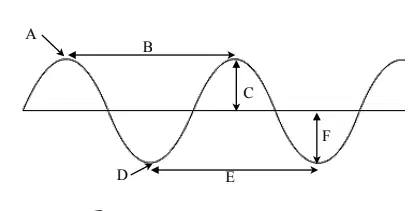
A
crest or peak
B or E
wavelength
C or F
amplitude
D
trough
horizontal straight line
line of origin
Match the vocabulary word with the definition.
frequency
the number of waves per second
electromagnetic spectrum
the range of all possible frequencies of electromagnetic radiation
Heisenberg uncertainty principle
speed & position of particle are unknown
atomic orbital
a region in an atom where there is a high probability of finding electrons
wavelength
the distance between successive peaks of a wave
Match the vocabulary word with its definition
Aufbau Principle
The rule that electrons occupy the lowest energy orbitals first.
Pauli Exclusion Principle
Maximum of 2 e-/orbital, opposite spins
Hund's Rule
E-'s must spin one way first
Electron Configuration
The distribution of electrons in an atom's orbitals.
Valence Electrons
The electrons in the outermost shell of an atom.
Match the following element to it's electron configuration
Lithium
1s2 2s1
Boron
1s2 2s2 2p1
Chlorine
1s2 2s2 3p6 3s2 3p5
Nitrogen
1s2 2s2 2p3
Calcium
1s2 2s2 2p6 3s2 3p6 3s2
Why do hot things glow?
The heat excites the electrons. They take a quantum leap to a higher energy level. When the e- cools off, a photon is emitted. The frequency of the photon corresponds to the wavelength of a certain color, depending on the element.
Describe the Quantum Mechanical Model of the atom.
The Quantum Mechanical Model describes electrons as wave functions having the probability of being in a 3D orbital.
What is the frequency of a wave in the electromagnetic spectrum if it has a wavelength of 3.00 x 10⁻² meters?
1.00 x 10¹⁰ Hz
5.00 x 10⁹ Hz
2.00 x 10¹¹ Hz
3.50 x 10¹⁰ Hz

Is this electron dot structure correct? Defend your answer.
No, the chemical symbol is incorrect. I should be an element from Group 13.
No, there should be two pairs of two dots on two sides of the structure.
Yes, the electron dot structure is correct. It has the correct number of dots on the proper sides of the correct chemical symbol.
No, it needs more electrons.

