
 Worksheets
MIS447 ML 1st Quiz
Total questions: 26
Worksheet time: 37mins
Furkan and Umut are a data analyst who want to understand how the amount of hours studied affects students' exam scores. What is the primary goal of linear regression in their analysis?
To predict future outcomes based on past data.
To classify data into distinct categories.
To model the relationship between variables.
To minimize the number of variables in a model.
Sıla is a data scientist working on a project to predict housing prices based on various features such as size, location, and number of bedrooms. She decides to use polynomial regression for her analysis. Which of the following is a characteristic of polynomial regression?
It requires a fixed number of data points.
It relies solely on linear terms for predictions.
It uses polynomial terms to model relationships.
It assumes a constant variance across all values.
Ajna studies for a math exam. She practices a lot of problems and scores very high on her practice tests. However, when she takes the actual exam, she struggles and doesn't perform well. What does it mean when Ajna's study method is overfitting?
A study method is overfitting when it generalizes well to new problems.
A study method is overfitting when it has high accuracy on both practice and actual exams.
A study method is overfitting when it performs well on practice problems but poorly on the actual exam.
A study method is overfitting when it learns the specific problems too well.
In a machine learning project, Ahmed and Barrow are tasked with developing a predictive model for customer churn. However, they accidentally include data from a future marketing campaign in their training dataset. What is this situation an example of?
Data leakage occurs when a model is trained on too few data points.
Data leakage refers to the process of cleaning data before analysis.
Data leakage in machine learning is the unintended use of information from outside the training dataset that can lead to misleadingly high model performance.
Data leakage is the intentional sharing of training data between models.
In a marketing campaign, Şevval wants to predict whether a customer will purchase a product based on their previous buying behavior. What is the output variable in her logistic regression model?
A continuous variable representing sales figures.
A discrete variable showing time intervals.
A nominal variable indicating customer preferences.
A categorical variable (binary outcome) representing probabilities.
In a machine learning competition, Maram is trying to classify different types of fruits based on their features. She is considering various methods to improve her model's accuracy. Which kernel is commonly used in Support Vector Machines that she might choose for her classification task?
Linear kernel
Polynomial kernel
Radial Basis Function (RBF) kernel
Sigmoid kernel
Wegdan is developing a new machine learning model to predict housing prices. To ensure her model performs well, she decides to split her dataset into training and testing sets. Why does she do this?
To increase data redundancy and improve accuracy.
To simplify the data processing and reduce complexity.
To enhance data visualization and interpretation.
To evaluate model performance and prevent overfitting.
Mohammed and Usman are preparing to train a machine learning model to predict house prices. Before they start, they know that scaling the data is important. What is the purpose of scaling data before training a model?
To convert categorical data into numerical values.
To ensure all features contribute equally and improve model performance.
To reduce the size of the dataset for faster training.
To eliminate outliers and improve data quality.
In a recent study, a group of researchers wanted to evaluate the effectiveness of a new diagnostic test for a disease. They classified the test results into true positives (TP), true negatives (TN), false positives (FP), and false negatives (FN). How do they calculate the accuracy of this diagnostic test?
Accuracy = TP / (TP + FP)
Accuracy = (TP + FP) / (TP + TN + FP)
Accuracy = (TP + TN) / (TP + TN + FP + FN)
Accuracy = (TP + FN) / (TP + TN + FP + FN)
In a recent study, a team of data scientists named Fareed and Esam Ahmed evaluated the performance of their machine learning model used for diagnosing diseases. They created a confusion matrix to analyze the results. What does this confusion matrix display?
A confusion matrix summarizes the model's performance metrics.
A confusion matrix visualizes the training data distribution.
A confusion matrix displays the counts of true positives, true negatives, false positives, and false negatives.
A confusion matrix shows the overall accuracy of a model.
In a data science competition, Melike is trying to predict house prices using various features such as size, location, and number of bedrooms. She is considering two different regression techniques: Lasso and Ridge regression. What is the main difference between Lasso and Ridge regression?
Lasso regression uses all variables with non-zero coefficients, while Ridge regression can eliminate some variables.
Ridge regression can set coefficients to zero, while Lasso regression keeps all variables in the model.
Lasso regression can eliminate variables (coefficients can be zero), while Ridge regression retains all variables (coefficients are never zero).
Lasso regression applies a penalty to all coefficients, while Ridge regression only penalizes the largest coefficients.
What is normalization in the context of data preprocessing?
Normalization is the process of scaling data to a specific range, usually [0, 1], to ensure uniformity in data preprocessing.
Normalization is the technique of aggregating data into larger groups.
Normalization is the process of removing duplicates from data sets.
Normalization refers to the conversion of data into a binary format.
Güray is a data scientist working on a machine learning project. He needs to improve the performance of his model. What does the term 'hyperparameter tuning' refer to?
The process of optimizing the parameters that are set before training a machine learning model.
The strategy of evaluating model performance after training.
The method of adjusting the weights during model training.
The technique of selecting the best dataset for training.
In a healthcare setting, a hospital is trying to evaluate the effectiveness of a new diagnostic tool for detecting a rare disease that affects only a small percentage of the population. Which metric would the hospital use to evaluate the model's performance on this imbalanced data?
Recall
F1 Score
Precision
Accuracy
In a medical study, researchers are evaluating a new diagnostic test for a disease. They want to understand how well the test performs at different thresholds for determining a positive result. What is the role of the ROC curve in evaluating model performance?
The ROC curve illustrates the trade-off between sensitivity and specificity across different thresholds.
The ROC curve is used to visualize the distribution of training data.
The ROC curve measures the accuracy of regression models.
The ROC curve indicates the number of false positives in a classification task.
In a data science competition, Yiğit is tasked with improving the performance of his machine learning model. He realizes that by creating new input features from the existing data, he can enhance the model's accuracy. What does the term 'feature engineering' mean in this context?
Feature engineering is the technique of cleaning data before analysis.
Feature engineering refers to the method of visualizing data distributions.
Feature engineering involves creating new input features from existing ones to improve model performance.
Feature engineering is the process of selecting the best model for a given dataset.
In a machine learning project, Güray is developing a model to predict house prices. He notices that the model performs exceptionally well on the training data but fails to generalize to new data. To address this issue, he considers using regularization. What is the purpose of using regularization in machine learning models?
To increase the complexity of the model and improve accuracy.
To prevent overfitting by adding a penalty for larger coefficients.
To reduce the training time of the model.
To enhance the interpretability of the model.
In a logistic regression model, what is the purpose of the sigmoid function?
To convert the predicted values into probabilities between 0 and 1.
To optimize the model parameters during training.
To transform the input features into a linear combination.
To calculate the loss function for the model.
In a machine learning project, Aylin is exploring the use of Support Vector Machines (SVM) for classifying emails as spam or not spam. What is the primary function of the hyperplane in SVM?
To optimize the training time of the model.
To increase the dimensionality of the dataset.
To separate different classes in the feature space.
To minimize the error rate of the model.
What is the purpose of using a kernel in SVM?
To increase the training speed of the model.
To visualize the data in two dimensions.
To reduce the number of features in the dataset.
To transform the data into a higher-dimensional space to make it easier to classify.

You want to create a polynomial regression model of degree 3 using sklearn. Which approach is correct?
Option A
Option B
Option C
Option D
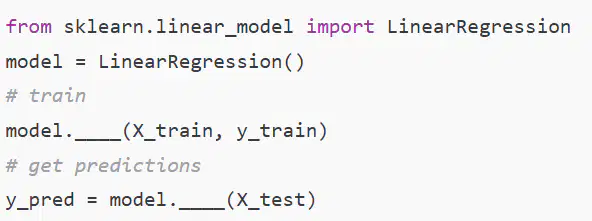
Fill in the blank with correct methods.
fit / predict_proba
fit_transform / predict
fit / predict
predict / predict

Fill in the blank with correct method.
dump
serialize
save
export
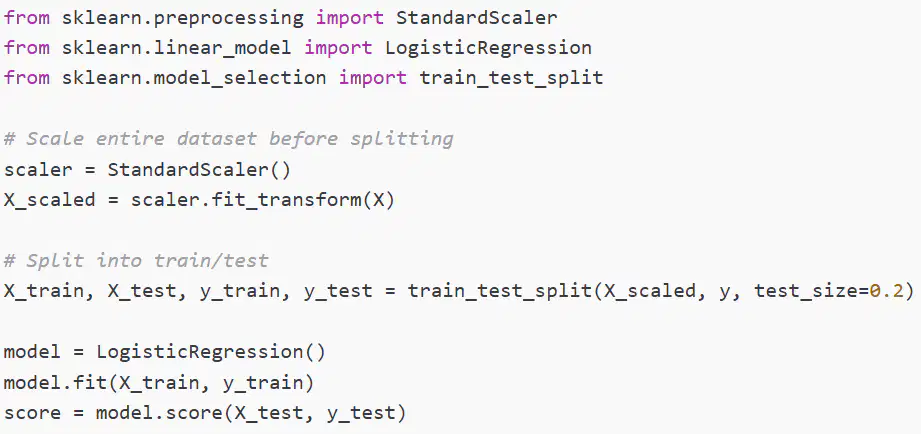
What's the critical error here?
A) StandardScaler should use MinMaxScaler instead
The random_state parameter is missing from train_test_split
Data scaling is applied before train/test split, causing data leakage
LogisticRegression needs solver parameter specified

Fill in the blank with correct parameter
linear
rbf
poly
sigmoid
Write your student id and name

