wayground logo

Free Printable Worksheets

Font size

S
M
L
XL
Worksheets

American Revolution

Total questions: 42

Worksheet time: 22mins

Name
Class
Date
1.
Why was the Battle of Saratoga most important in the Revolutionary War?
a)
Forced the British to withdraw from North America
b)
Ended the British threat to the South
c)
Guaranteed Canadian help for the colonists
d)
Convinced the French to support the Americans.
2.
The following quotes describe the conditions Washington's troops faced at...
a)
Trenton
b)
Valley Forge
c)
Yorktown
d)
Saratoga
3.
The man responsible for authoring most of the Declaration of Independence was
a)
George Washington
b)
John Hancock
c)
Thomas Jefferson
d)
Thomas Paine
4.
One of the main purposes for the Declaration of Independence was
a)
create a new colonial government
b)
detail the many grievances the colonists had against the king
c)
explain why the colonists ignored the Proclamation of 1763
d)
declare war on the British
5.
The last MAJOR battle of the American Revolution was the __________.
a)
Battle of Guilford Court House
b)
Battle of Yorktown
c)
Battle of Bunker Hill
d)
Battle of Lexington
6.
This treaty formally ended the American Revolution
a)
Treaty of Paris of 1783
b)
Treaty of 1776
c)
Treaty of Boston
d)
Treaty of Philadelphia
7.
Which of the following BEST describes the immediate result of Washington’s Crossing of the Delaware on Christmas 1776
a)
It led to the France recognizing American independence and allying themselves with the American cause
b)
It led to Washington first victory of the war and the reenlistment of many of his men
c)
It led to Washington being relieved of his duties as Commander-in-Chief of the Continental Army
d)
It led to the British surrender and the subsequent recognition of American independence
8.
The purpose of the Common Sense article was to
a)
Enlighten people who lacked intelligence in the colonies
b)
To convince colonists to make a treaty with the Natives for for trade
c)
It was an effort by George Washington to get the French to join the war
d)
To encourage colonists to support the Revolutionary war
9.
Who were the Minutemen?
a)
Leaders of the colonial communication network
b)
Wartime cooks who were able to provide meals to troops quickly
c)
A colonial volunteer militia who were on call for immediate action
d)
The official timekeepers for the Continental Army
10.
Who were the Hessians?
a)
German mercenaries hired by the British to help fight against the American colonists
b)
Privateers that worked to capture men and steal goods from colonial ships
c)
An elite British military group made famous by their skills in horsemanship
d)
Colonists that wished to stay out of the war entirely
11.
Military officer who betrayed the colonies
a)
Thomas Gage
b)
John Paul Jones
c)
Nathanael Greene
d)
Benedict Arnold
12.
General Cornwallis role in the Revolutionary War is important because
a)
he defeated Washington outside of New York City
b)
he led the British invasion of the colonies by way of Canada
c)
his invasion of Virginia eventually led to his being trapped in 1781 at the battle of Yorktown
d)
he abandoned the British Army to join the Colonial Army
13.
Which of these was the GREATEST contribution of Prussian military expert Baron von Steuben to the American war effort?
a)
He brought over much-needed supplies from Europe
b)
He trained and wrote a manual for the army at Valley Forge
c)
He donated large sums of money to the colonial war effort
d)
He led a group of soldiers into battle at Saratoga
14.
He was the commander of the Continental Army during the revolution.
a)
Horatio Gates
b)
George Washington
c)
Thomas Jefferson
d)
Charles Cornwallis
15.
Where was the first armed conflict(s) of the American Revolution?
a)
New York City
b)
Concord and Lexington
c)
Saratoga
d)
Bunker Hill
16.
What was the name of the British king during the American Revolution?
a)
James III
b)
William III
c)
Charles III
d)
George III
17.
This patriot made a daring ride to warn colonists that British soldiers were approaching.
a)
Paul Revere
b)
Sam Adams
c)
Patrick Henry
d)
Tom Brady
18.
Of the following people, who did not help write the Declaration of Independence?
a)
Thomas Jefferson
b)
John Adams
c)
Patrick Henry
d)
Benjamin Franklin
19.
Who fired the "shot heard 'round the world" at the Battles of Lexington and Concord?
a)
Colonists
b)
British
c)
It is unknown
d)
Both at the same time
20.
Which was not one of the parts of the Declaration of Independence
a)
Declaration of Rights
b)
Declaration of War
c)
Lists of Grievances
d)
Resolution of Independence
21.
Colonial naval officer who successfully captured a British ship even though his own ship was sunk. He is often referred to as the "Father of the American Navy"
a)
Davey Jones
b)
David Robinson
c)
John Paul Jones
d)
Nathanael Greene
22.
Who won the Battle of Guilford Court House?
a)
The British
b)
The Colonies
c)
Draw
23.
He was appointed commander of the Continental Army in the South by George Washington and later had parts of North Carolina named after him
a)
Sir Walter Raleigh
b)
Winston Salem
c)
Nathanael Greene
d)
Bill Durham
24.
What battle tactics did the Patriots/Colonists most successfully use during the American Revolution?
a)
European Line formation
b)
Trench warfare
c)
Raiding and pillaging
d)
Ambush/Guerilla warfare
25.
This early battle in the Revolutionary War and the American defeat there crushed American hopes in the Canadian territory
a)
Battle of Quebec
b)
Battle of Montreal
c)
Battle of Saratoga
d)
Battle of Bunker Hill
26.

Which event marked the official beginning of the American Revolutionary War?

a)

The Battle of Bunker Hill

b)

The signing of the Declaration of Independence

c)

The Battles of Lexington and Concord

d)

The Boston Tea Party

27.

Who was the primary author of the influential pamphlet 'Common Sense' that encouraged American independence?

a)

John Adams

b)

George Washington

c)

Thomas Paine

d)

Benjamin Franklin

28.

What was the main significance of the winter at Valley Forge for the Continental Army?

a)

It was where the British surrendered

b)

It was where the army endured hardship and received crucial training

c)

It was where the Declaration of Independence was signed

d)

It was the site of the first major American victory

29.

Who was the British general who surrendered at Yorktown, effectively ending major fighting in the American Revolution?

a)

General Gage

b)

General Howe

c)

General Cornwallis

d)

General Burgoyne

30.

What was the main reason France decided to support the American colonists during the Revolutionary War?

a)

To gain control of American territory

b)

To protect their own colonies in the Caribbean

c)

To weaken their rival, Britain

d)

To spread democracy

31.

Which act passed by the British Parliament imposed taxes on paper, paint, glass, and tea in the American colonies?

a)

Intolerable Acts

b)

Townshend Acts

c)

Sugar Act

d)

Stamp Act

32.

What was the main purpose of the First Continental Congress in 1774?

a)

To address colonial grievances and organize a boycott of British goods

b)

To declare independence from Britain

c)

To elect George Washington as President

d)

To draft the Constitution

33.

Which event directly led to the British Parliament passing the Intolerable Acts?

a)

The Boston Tea Party

b)

The Battle of Saratoga

c)

The winter at Valley Forge

d)

The signing of the Declaration of Independence

34.

Which foreign nation provided crucial military and financial support to the American colonists after the Battle of Saratoga?

a)

Portugal

b)

Spain

c)

France

d)

Netherlands

35.

What was the significance of the Battle of Saratoga in the American Revolution?

a)

It marked the end of the war

b)

It convinced France to support the American cause

c)

It was the first battle of the war

d)

It resulted in the capture of George Washington

36.

Compare the strategies used by the American forces in the Battle of Bunker Hill and the Battle of Saratoga.

a)

Both battles involved direct assaults on British fortifications.

b)

Bunker Hill involved defensive tactics, while Saratoga involved encirclement and attrition.

c)

Both battles relied heavily on naval support.

d)

Bunker Hill was a surprise attack, while Saratoga was a defensive stand.

37.
Surrounded by French and Continental armies, a large British army surrendered here.
a)
Saratoga
b)
Yorktown
c)
Bunker Hill
d)
Lexington and Concord
38.

Discuss the role of leadership in the American victory at the Battle of Saratoga.

a)

American leaders used effective communication and coordination to outmaneuver the British.

b)

American leaders relied solely on numerical superiority to win.

c)

American leaders had little impact on the outcome of the battle.

d)

American leaders focused on naval strategies to secure victory.
39.
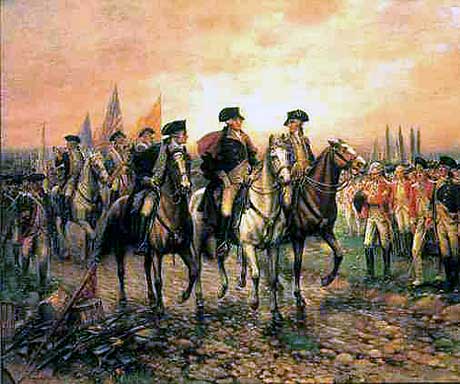
Which battle ended the American revolution?
a)
Battle of Lexington and Concord
b)
Battle of Saratoga
c)
Battle of Yorktown
d)
Battle of Trenton
40.
Location of winter encampment of the Continental Army which was a low point during the war.
a)
Valley Forge
b)
Monmouth
c)
Saratoga
d)
New York
41.
What was the outcome of the Battle of Yorktown?
a)
Cornwallis surrendered, ending the war.
b)
The warships were lost in a fierce storm.
c)
Washington withdrew rather than risk his army.
d)
Rochambeau's troops barely escaped alive.
42.
Who fired "the shot heard round the world?"
a)
the British
b)
the minutemen
c)
it is a mystery!