
 Worksheets
Abbreviations & Table of Contents
Total questions: 122
Worksheet time: 1hrs 1mins
What does the abbreviation 3Rs stand for?
Reduce, Reuse, Recycle
Refuse, Return, Repair
Report, Record, Respond
Reduce, Replace, Renew
Which abbreviation refers specifically to greenhouse gases?
GHG
GHFC
HCFC
GHV
CO2 in the abbreviations list stands for which term?
Copper oxide
Carbon dioxide
Cobalt dioxide
Combined oxygen
Select all abbreviations that are names of United Nations bodies or initiatives.
UN
UNGP
UNCTAD
UNEG
UNEP
Which acronym represents the Association of Southeast Asian Nations?
AMS
ASEAN
ASCC
AAN
AMS in the list of abbreviations means what?
ASEAN Member States
Advanced Manufacturing Systems
Asian Monetary System
Association of Member Sectors
ASCC stands for which community?
ASEAN Socio-Cultural Community
Asian Social Commerce Council
ASEAN Security Coordination Committee
Association for Sustainable City Councils
Which abbreviation is linked to consumer protection guidelines under the UN?
UNGCP
UNGP
UNGC
UNDP
Identify all abbreviations related to sustainable consumption concepts or goals.
SC
SCP
SDG
ICT
FLW
EPR is expanded as which policy concept?
Extended Producer Responsibility
Environmental Protection Regulation
Environmental Product Rating
Extended Public Resource
Which abbreviation refers to the European Union?
EU
UK
UN
KEITI
HCFC refers to which class of chemicals?
Hydrocarbon fuels
Hydrochlorofluorocarbons
Heavy chlorinated fluorides
Hydrofluorocarbon compounds
IPCC stands for what?
International Panel on Climate Change
Intergovernmental panel on Climate Change
International Partnership for Climate Control
Intercontinental Policy on Climate Change
Which abbreviations refer to countries or unions of countries? Select all that apply.
EU
UK
UN
ASEAN
AMS
What does GPP stand for in the list?
Green Public Procurement
Global Product Pricing
Government Policy Planning
Greenhouse Pollution Prevention
GVCs are best described as what?
Global Value Chains
Green Vehicle Credits
Government Value Committees
Global Voluntary Codes
KEITI is identified as which type of institution?
Korea’s Environmental Industry and Technology Institute
Kenya Environmental and Industrial Training Initiative
Korean Energy and Infrastructure Technology Institute
Korea Environmental Investment Trust Institution
NGO expands to which term?
Non-governmental Organization
New Government Office
National Growth Organization
Non-governmental Operation
UNCTAD stands for what?
United Nations Conference on Trade and Development
United Nations Council on Technology and Development
Union of Nations for Commerce, Trade and Development
United Nations Commission for Trade and Diplomacy
Which of the following pairs are correctly matched? Select all that apply.
FLW – Food Loss and Waste
GPP – Green Public Procurement
IRP – International Resource Panel
ICT – Inter-Regional Policy Council
CAA – Consumer Affairs Agency of Japan
The abbreviation COVID-19 refers to which phrase?
Coronavirus disease 2019
Coronavirus discovered 2019
Communicable virus identified 2019
Corona viral disease type 19
Which entry from the list refers to goals adopted globally for development?
SDG
SCP
SC
IPCC
Which abbreviations are specifically about consumption practices or policies? Select all that apply.
SC
SCP
FLW
EPR
GPP
According to the table of contents, which subsection appears under Related principles and ideas?
Systems and Lifecycle Thinking
Snapshot of ASEAN
Policy Implementation
Best practices on promoting SC
Which module introduces the concept of policy frameworks in AMS?
Module 1
Module 2
Module 3
Module 4
Under Module 1, which topic immediately follows the introduction?
Conclusion
Sustainable Consumption under the Sustainable Development Goals
Related principles and ideas
Sustainable Consumption in ASEAN
Which of the following is listed as a subsection discussing the end-consumer?
1.1.3.2
1.2.3
2.2.1
3.1
Which part of Module 1 discusses ASEAN as a regional platform?
1.2.1
1.1.2
1.3
2.1
The appendix focuses on what UN document?
UN Guidelines for Consumer Protection (2015)
UN Global Compact principles
UNFCCC Paris Agreement
UNESCO Education 2030 Framework
Which section in Module 2 covers the 'Introduction to Policy Cycle'?
2.2.1
2.1
2.3.1
2.4.1
In Module 2, 'Qualities of Sustainable Consumption policy-making' includes which subtopic?
Forward looking vision
Snapshot of ASEAN
Use of appropriate instruments
References
Which subheading in Module 2 corresponds to measuring progress?
2.3.2
2.2.3
2.4.2
2.5
Where in the contents is 'Systemic and integrated policy action – characteristics and approach' located?
2.3.3
1.1.3.3
3.5
4.1
Which section presents 'Best practices and Approaches'?
2.4
2.5
3.7
1.2
Under best practices, which country is specifically mentioned for 'Mandatory labelling for energy appliances'?
Singapore
Thailand
Japan
United Kingdom
Green Government consumption through Green Procurement is associated with which country?
Thailand
Singapore
Germany
Republic of Korea
Which sub-section deals with vertical policy integration in Japan, Republic of Korea and Germany?
2.4.2
2.4.3
2.4.4
2.4.5
The horizontal policy integration case study is about which initiative?
EU Sustainable Europe 2030
Japan Cool Biz
UK Zero Carbon Hub
UK Food Waste Reduction programme
Which subtopic references the transition management approach in the UK?
System innovation approach
Behavioural change – informed practice
Forward looking vision
Evidence base
The actor coalition case studies include which program? Select all that apply.
UK Food Waste Reduction programme
UK Marks & Spencer Plan A
Japan Cool Biz
EU Sustainable Europe 2030
Japan Cool Biz is listed under which theme?
Behavioural change – informed practice
System innovation approach
Horizontal policy integration
Policy Implementation
Which section likely contains a discussion period following case studies?
2.5 Discussion
2.6 References
3.1 Snapshot of ASEAN
1.3 Further Reading
What is the title of Module 3 according to the contents?
Tools and instruments used in influencing consumer behaviour
Best regional and international practices
Concepts and Principles of Sustainable Consumption
Use of appropriate instruments and tools in selected sectors
Which section in Module 3 focuses on challenges in ASEAN?
3.3 Current Challenges of promoting sustainable consumption in ASEAN
3.1 Snapshot of ASEAN
3.7 Best practices on promoting SC
3.9 References
Selecting appropriate tools and instruments for implementing policies appears under which section?
3.6
3.4
3.2
2.3
Which section number is assigned to 'Best practices on promoting SC' in Module 3?
3.7
3.5
2.4.7
4.1
Module 4 is titled what in the table of contents?
Use of appropriate instruments and tools in selected sectors
Future considerations for ASEAN
Policy Implementation
Sustainable Consumption in ASEAN
According to the Table of Contents, which topic begins Section 4.1 of Module 4?
Energy
Food
Plastic Waste
Consumer Electronics Sector
Which subsection under 4.1 immediately follows the Introduction?
Policy Priorities
Further Reading
Sustainable Consumption Challenges in the Food Sector
References
What is the listed page where Section 4.1 (Food) starts?
131
139
140
147
In Section 4.2, which item appears as 4.2.2?
Introduction
Sustainable Consumption Challenges in the Energy Sector
Policy priorities
Further Reading
Which section directly precedes 4.3 Consumer Electronics Sector?
4.1 Food
4.2 Energy
4.4 Plastic Waste
4.5 References
Which sequence correctly matches each main Module 4 topic with its starting page?
Food — 131
Energy — 140
Consumer Electronics Sector — 147
Plastic Waste — 152
References — 166
Under 4.3 Consumer Electronics Sector, which subsection number corresponds to Policy Priorities?
4.3.1
4.3.2
4.3.3
4.3.4
Where does the Further Reading following Section 4.3 appear to start?
139
151
158
159
Which item is NOT listed as a main Module 4 topic?
Food
Energy
Water Resources
Consumer Electronics Sector
For Section 4.4 Plastic Waste, which subsection focuses on challenges?
4.4.1
4.4.2
4.4.3
4.4.4
What page does the Further Reading after 4.4 begin on?
155
158
159
166
Which page is dedicated to 4.5 References according to the listing?
158
159
166
177
Which Appendices are listed in the Table of Contents for this section?
Appendix A
Appendix B
Appendix C
Appendix D
Appendix E
Match each Module 4 main section with its first listed subsection.
4.1 Food — Introduction
4.2 Energy — Introduction
4.3 Consumer Electronics Sector — Introduction
4.4 Plastic Waste — Introduction
4.5 References — Introduction
Which item is labeled as 'Policy priorities' (lowercase p) in the listing?
4.2.3 under Energy
4.1.3 under Food
4.3.3 under Consumer Electronics Sector
4.4.3 under Plastic Waste
Which Appendix starts on page 190?
Appendix A
Appendix B
Appendix C
Appendix D
Which Appendix is listed to begin on page 177?
Appendix A
Appendix B
Appendix C
Appendix D
On which page does Appendix D begin?
166
177
190
193
Which of the following pairs correctly matches a subsection label with the sector it belongs to?
Sustainable Consumption Challenges in the Food Sector — 4.1.2
Policy Priorities — Consumer Electronics Sector 4.3.3
Challenges with Plastic Waste — 4.4.2
Introduction — Energy 4.2.1
Further Reading — 4.5
Which page number is associated with the 'Further Reading' immediately following Section 4.1?
139
140
151
158
Which statement best reflects the commonly quoted definition of sustainable development used in this module?
Meeting current needs without compromising future generations’ ability to meet their own needs
Maximizing present economic growth regardless of environmental impact
Protecting nature even if social needs are unmet
Limiting development in all countries equally
According to the module, which dimensions are encompassed by the sustainable development definition? Select all that apply.
Temporal (present and future)
Social (human needs)
Environmental (resource use and quality)
Cultural heritage only
What is the primary aim of promoting sustainable consumption and production (SCP) within sustainable development?
Achieving short-term profit for businesses
Achieving long-term economic growth consistent with economic, social, and environmental needs
Eliminating all taxes on goods and services
Focusing only on national-level actions
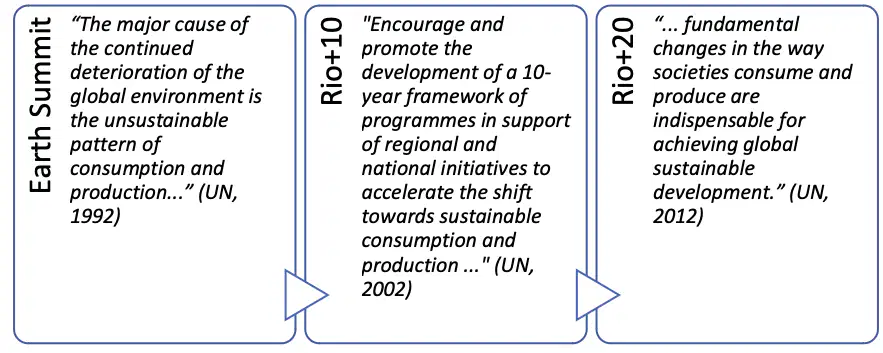
Based on Figure 1.1’s timeline of Earth Summits (Rio, Rio+10, Rio+20), which theme was repeatedly emphasized?
Maintaining current consumption patterns
The necessity to change unsustainable patterns of consumption and production
Reducing international cooperation
Prioritizing only developed countries
Which two UN General Assembly resolutions in 2015 shaped the current understanding of sustainable consumption? Select both.
Resolution advancing the 17 Sustainable Development Goals (SDGs) and the 2030 Agenda
Resolution establishing the Paris Climate Agreement
Resolution revising the United Nations Guidelines for Consumer Protection (UNGCP)
Resolution creating a new World Trade Organization treaty
According to the UNGCP principles quoted, who should take the lead in achieving sustainable consumption patterns?
Developing countries
Private companies only
Developed countries
Local governments only
Which activity is one way UNCTAD has exercised its mandate related to sustainable consumption, as described in the module?
Abolishing consumer protection laws
Preparing an Environment Module for ASEAN under a project on technical competency for consumer protection
Banning agricultural irrigation worldwide
Replacing the SDGs with new goals
In the context of the SDGs, what does Goal 12 on sustainable consumption and production emphasize?
Only increasing production to boost economic growth
Responsibilities and actions for Governments, businesses, and consumers to ensure sustainable patterns
Reducing cooperation among stakeholders
Focusing only on waste recycling without resource management
In 2012, which statement best compares Earth's biocapacity with humanity's ecological footprint per capita?
Biocapacity (2.8 gha per capita) exceeded the ecological footprint (1.7 gha per capita).
Biocapacity (1.7 gha per capita) was lower than the ecological footprint (2.8 gha per capita).
Biocapacity and ecological footprint were equal at 2.8 gha per capita.
No reliable estimate existed for either value.
Recent estimates reported that humanity needs how many Earths to support its current consumption?
0.8 Earths
1.0 Earth
1.56 Earths
2.5 Earths
Using the two world maps comparing 1961 and 2008 ecological footprints per capita, what overall trend is most evident?
More countries shifted to the lightest shade (<1 gha per capita).
Many countries moved toward darker shades, indicating higher gha per capita.
There was no noticeable change across decades.
Most countries had insufficient data by 2008.
Which tools are highlighted as ways to shift consumption patterns toward sustainability? Select all that apply.
Education and information campaigns
Recycling and reuse efforts by consumers
Strict criminal penalties only
Best practices and guidelines for business (soft law)
According to the text on consumer protection policies, which challenge can limit their effectiveness in promoting sustainable consumption?
Excessive coordination between departments
Policies automatically control how and what is consumed once infrastructure exists
Insufficient coordination between consumer and environmental agencies
A lack of interest from civil society only
What problem can arise when actions target only one stage of a product’s life, as explained under Systems and Lifecycle Thinking?
They always reduce total impacts across the lifecycle.
They risk shifting burdens—solving one problem while creating another.
They make global supply chains simpler.
They guarantee zero greenhouse gas emissions.
Which statement best describes life-cycle assessment (LCA)?
A qualitative discussion of possible design changes
A mainly quantitative methodology for compiling, analyzing, and generating life-cycle information
A marketing tool to promote eco-labels
A government policy for pricing and taxation
Identify the correct order of the four main stages in an LCA study.
Goal and Scope Definition → Inventory Analysis → Impact Assessment → Interpretation
Inventory Analysis → Goal and Scope Definition → Interpretation → Impact Assessment
Impact Assessment → Goal and Scope Definition → Inventory Analysis → Interpretation
Goal and Scope Definition → Impact Assessment → Inventory Analysis → Interpretation
In the detergent example of private sector opportunities using life cycle thinking, what key change reduced environmental impact and saved customers money?
Switching to single-use packaging
Developing detergents effective at lower washing temperatures
Eliminating all fragrances and dyes
Moving production to another country
Which of the following can be quantified by LCA when assessing climate change impacts of a product? Select all that apply.
Global warming potential expressed as carbon dioxide equivalent
Social responsibility of suppliers
Resource depletion across the life cycle
Toxicity and eutrophication potential
According to the text, what is one basic consumer right that enables sustainable and responsible choices?
Right to low prices
Right to information
Right to free repairs
Right to government subsidies
Which actions are encouraged for consumers to support sustainable consumption? Select all that apply.
Look for life cycle information of products and services
Rely only on brand reputation without additional information
Check for eco-labels and other environmental and social information
Learn how to use, care for, recycle, or discard products effectively
Which statement best describes decoupling environmental degradation from economic growth?
Producing fewer goods to reduce GDP
Delivering more goods and services with less resource use, waste, and emissions
Stopping all use of natural resources to protect the environment
Shifting consumption from services to products
According to the International Resource Panel, what could happen by 2050 if current appetites continue and growth is not decoupled?
Humanity could halve its resource use
Humanity could devour an estimated 140 billion tons of minerals, ores, fossil fuels and biomass per year
Economic growth would stop completely
Environmental impact would immediately decline
In the diagram on decoupling growth from environmental impacts, which curve continues to rise while the environmental impact curve flattens with successful impact decoupling?
Human well-being
Resource use
Economic activity (GDP)
Environmental impact
What is the OECD’s definition focus of Green Growth?
Maximizing GDP regardless of environmental cost
Fostering economic growth and development while ensuring natural assets continue to provide resources and environmental services
Eliminating all use of finite materials immediately
Replacing markets with government planning
Which set lists the three core principles of a circular economy as presented?
Reduce, reuse, recycle
Design out waste and pollution; keep products and materials in use; regenerate natural systems
Tax, trade, and invest
Electrify everything; automate; digitize
Select all statements that align with the description of a circular economy in the material.
It is restorative and regenerative by design.
It only works for large multinational companies.
It aims to build and rebuild overall system health.
It is a linear process focused on take–make–dispose.
Which of the following is identified as a basic element in transitioning to a low-carbon economy?
Subsidizing all fossil fuels to ensure energy security
Relying solely on consumers to change their behavior without policy
Putting a price on carbon while addressing market and behavioral failures
Delaying decarbonisation of the power sector until after transport
According to the SMART 2020 report, which technology area offered the largest opportunity for CO2e savings by 2020, with potential savings of 2 GtCO2e?
Smart buildings
Smart motor systems
Smart grids
Dematerialisation
Which term refers to consumption compatible with protecting the environment for current and future generations, including using clean energy and organic products?
Green/environmentally friendly consumption
Ethical consumption
Sharing economy
Zero emission
Which practices are described as components of ethical consumption? Select all that apply.
Boycotting based on social considerations such as fair trade
Participating in anticonsumption events or avoiding certain products
Buying the cheapest product regardless of impact
Voluntary simplicity that reduces overall consumption
Postpurchase habits like recycling and bringing your own bag
According to the UNEP, which statement best defines a sustainable lifestyle?
Living with zero waste regardless of context
Understanding how lifestyle choices impact the world and finding ways for everyone to live better and lighter
Avoiding all technology to reduce emissions
Buying only locally produced items
Which features distinguish the sharing economy from traditional practices, according to the World Economic Forum?
Use of digital technologies to match buyers and sellers
Capitalizing on idle capacity through a time-share model
Government ownership of shared assets
Trust verification via third-party or peer review
What is a basic description of a Product Service System (PSS)?
A network that certifies eco-friendly products
A system consisting of products and services that fulfill user needs
A tax policy to encourage green businesses
A social media platform for sharing goods
Which statements about ecolabelling are accurate? Select all that apply.
It is defined by ISO as a voluntary method of environmental performance certification and labelling
ISO 14024:2018 specifies criteria for specific products and services
Only one global type of ecolabel exists
Type-I ecolabels are administered by third parties for impartiality
Examples include Forest Stewardship Council and Fairtrade International certifications
In the context of sustainable consumption, what does zero emission refer to?
Processes that do not produce harmful air emissions and greenhouse gases
Using catalytic converters to reduce pollution after it is produced
Exclusive use of biofuels in transportation
Banning air travel worldwide
Which statement best describes why sustainable consumption is emphasized in ASEAN policy frameworks?
It guarantees the fastest GDP growth in the world
It supports environmental protection while enabling socio-economic development
It focuses only on reducing private household spending
It aims to replace industrialization with agriculture
According to the passage, which environmental issues commonly affect cities in Asia and the Pacific as they grow?
Poor air quality
Abundant clean water supply
Waste and sanitation management challenges
Excess forest cover
ASEAN is described as which of the following in terms of its global economic standing and population?
Largest economy and smallest population
7th largest economy with 625 million people
10th largest economy with 100 million people
2nd largest economy with 1.2 billion people
Which policy actions are identified under ASEAN’s C.4 Sustainable Consumption and Production measures? Select all that apply.
Strengthen public–private partnerships for resource-efficient technologies
Promote environmental education and green lifestyles at all levels
Reduce participation of consumer representatives to streamline decisions
Integrate SCP strategy and best practices into national and regional policies
What was the purpose of the ASEAN Forum on Sustainable Consumption and Production established in 2011 and first convened in 2014?
To negotiate trade tariffs for agricultural goods
To strengthen cooperation on SCP and advance priority areas like green public procurement and eco-labelling
To replace national environmental agencies
To focus solely on tourism marketing
Which ideas are highlighted in ASEAN Vision 2020 and 2025 regarding sustainable consumption? Select all that apply.
A clean and green ASEAN with mechanisms for sustainable development
Digitalization to support a secure, sustainable, and transformative economy
Eliminating cooperation with Dialogue Partners
Improving the quality of life through protection of the environment
Why did the 2019 Regional Forum on Sustainable Consumption stress changing consumer behavior and consumption patterns?
Because ASEAN had already surpassed all sustainability goals for 2030
To drive sustainable consumption using economic and regulatory tools and identify needed policy reforms
To reduce international cooperation
To discourage businesses from participating
Which statement best captures a verified finding about sustainable consumption and development described in the material?
Higher energy use always leads to higher human development index (HDI) scores.
Decoupling economic growth from environmental degradation is possible and important for sustainable development.
Sustainable consumption has little relevance to post-crisis economic recovery.
HDI is unrelated to factors like GDP, urbanization, or clean energy share.
Select all recommendations or roles linked to consumer protection policy and sustainable consumption mentioned in the material.
Strengthen product safety enforcement
Discourage cross-border commercial transactions
Promote participation of consumer representatives
Rely on consumer protection policy to support Sustainable Development Goals
Reduce consumer confidence to limit consumption
According to the references, which organization produced the document titled United Nations Guidelines for Consumer Protection (UNCTAD/DITC/CPLP/MISC/2016/1)?
United Nations Environment Programme (UNEP)
United Nations Conference on Trade and Development (UNCTAD)
United Nations Development Programme (UNDP)
Organisation for Economic Co-operation and Development (OECD)
According to the UN Guidelines for Consumer Protection (UNGCP), which statement best captures the meaning of sustainable consumption?
Using goods and services to maximize profits regardless of resource use
Meeting present and future needs through goods and services in ways that are economically, socially, and environmentally sustainable
Reducing consumption to the lowest possible level in all countries
Focusing only on the environmental impacts of products
Which actions are encouraged by the UNGCP to support sustainable consumption? Select all that apply.
Encouraging consumers to recycle waste and purchase recycled products
Promoting the development and use of health standards
Limiting consumer education to financial literacy only
Using standards for the safety and quality of consumer goods and services
Who shares responsibility for developing sustainable consumption patterns under the UNGCP?
Only national governments
Businesses and governments only
All members of society, including consumers, businesses, labour and environmental organizations
International organizations only
In Module 2, which terms are stated as being used interchangeably when discussing policies that promote sustainable consumption?
Sustainable Consumption and Green Growth
Sustainable Consumption and Production (SCP) and Sustainable Consumption
Circular Economy and Low-Carbon Development
Energy Efficiency and Waste Minimization
According to the section on Sustainable Consumption Policy Frameworks in AMS, which of the following is NOT listed as one of the five policy avenues used in ASEAN Member States?
Dedicated SCP strategy and/or action plan
Embedded in thematic programmes
Mainstreamed into sectoral policies
Implemented only by non-government organizations
Which ASEAN Member State is shown with a National SCP Blueprint as a dedicated SCP strategy?
Malaysia
Indonesia
Philippines
Thailand
Based on the summary table of policy priority areas, which of the following are common policy measures applied by many ASEAN Member States to promote sustainable consumption? Select all that apply.
Regulatory
Economic
Information
Military
Voluntary Agreement
The text notes that 7.3% of the total ASEAN population, or 47 million people, lack access to which essential service, making it a key under-consumption issue?
Clean water
Electricity
Healthcare
Education
Which conclusion is drawn from the tables about ASEAN Member States’ approaches to sustainable consumption?
All AMS use identical policy responses.
Most policy priority areas still come from the perspective of sustainable production.
Common policy areas are too diverse to guide cooperation.
Few AMS have developed policies linked to the SCP agenda.
According to the introduction to the policy cycle, what is public policy making described as?
A private-sector process to maximize profits
The way governments translate vision into programmes and actions to deliver outcomes
A one-time lawmaking event with no follow-up
A community-led movement without government involvement

