
 Worksheets
MCP 05- U9- Programming Techniques pdf
Total questions: 50
Worksheet time: 25mins
According to the RIBA Plan of Work 2013, which period does the construction programme cover?
From practical completion to post-occupancy evaluation
From site mobilisation to practical completion
From planning application submission to contractor appointment
From design freeze to commissioning
Which statement best explains why pre-construction planning is described as crucial in this section?
It reduces the number of subcontractors required on site.
It ensures the project is delivered on time, within budget, and to an acceptable standard of workmanship.
It guarantees that design changes will not occur during construction.
It eliminates the need for health and safety planning.
In a programme, what does the term critical path most directly refer to?
The sequence of tasks that have the most float available
The sequence of critical tasks that determines the overall programme duration
Tasks that can be carried out simultaneously
Activities performed outside the main contract
Which tasks are identified by a programme as having float?
Tasks on the critical path
Tasks that can be delayed without affecting the critical path
Tasks that must precede all other tasks
Tasks that are outside the main contract scope
Which item would a well-prepared design programme most likely include to aid resource planning?
Only the final completion date
A list of statutory undertakers
Dates and durations allocated to tasks
A record of client payments
A project scheduler wants to free up a crane for a critical activity. Based on the section, which strategy is most appropriate?
Delay a critical-path task to create more float
Transfer resources from a non-critical task that has float
Add extra tasks to lengthen the programme
Remove approval milestones to speed up work
Which of the following is NOT listed as a purpose for which programmes may be prepared?
The client's overall programme possibly covering multiple projects
A project programme covering briefing to post-completion activities
A programme solely for calculating profit margins
A design programme scheduling consultant tasks to contractor appointment
What is the primary focus of information release schedules as described?
Setting cost limits for procurement packages
Defining when consultants issue production information and when contractors return information for integration into the design
Allocating labour to non-critical tasks
Recording site safety briefings
Which list best represents typical components of a contractor’s master programme?
Approvals, procurement, manufacturing, delivery, installation, testing/commissioning, short-term look ahead
Design gateways, value engineering workshops, occupancy surveys
Land acquisition, planning application, marketing campaign
Only critical path tasks with no procurement activities
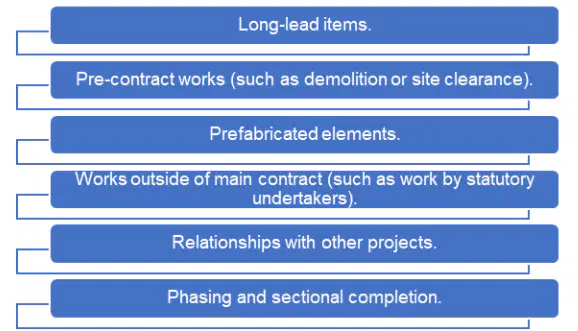
Which factor is explicitly shown in the figure of factors for programme preparation?
Inflation rate forecasts
Long-lead items
Weather contingencies
Tax liabilities
Under CDM regulations, what is the purpose of including a CDM planning period in the programme?
To allow contractors time to evaluate health and safety issues and plan work before construction begins
To ensure contractors can accelerate the critical path
To replace the need for method statements
To fix the contract completion date
How should key client decision points (gateways) be programmed to support informed decisions?
As milestones without regard to attendee availability
To occur during existing meetings with briefing materials issued in advance
Only after all construction is complete
At random times to avoid bias
Which statement about the contractor’s master programme and the contract is accurate?
The master programme is part of the contract documents and legally fixes the completion date.
The completion date in the contract is unenforceable, but the master programme is enforceable.
The master programme is not part of the contract; the contract completion date is enforceable and may differ from the master programme date.
Neither the contract nor the master programme can be enforced regarding completion dates.
If a contractor fails to meet the contract completion date, what potential consequence is identified?
Automatic extension of time
Liquidated damages claimed by the client
Conversion of tasks to non-critical
Mandatory re-tendering of the project
Why might enforcing a design programme be difficult, according to the section?
Because design programmes never include deliverables
Because it depends on activities by third parties outside the consultant’s control, such as planning authorities and stakeholders
Because clients are prohibited from monitoring progress
Because design work has no dependencies
Which statement best describes the purpose of a flow diagram in project contexts?
A pictorial model that reveals the logic of a process or project
A financial schedule that forecasts cash flow for procurement
A spatial layout that shows the physical arrangement of site equipment
A photographic record that documents construction progress
According to the material, which of the following are listed as common types of programmes of activities?
Gantt or bar charts, line of balance charts, critical path techniques, precedence diagrams
Histogram charts, pie charts, Monte Carlo trees, scatter plots
Network sockets, sequence diagrams, UML class charts, entity–relationship models
Earned value curves, S-curves, pareto charts, tornado diagrams
Flow diagrams have applications across multiple fields. Which combination aligns with the text?
Geography, Engineering, Medicine, and Computer science
Accounting, Fine Arts, Linguistics, and Theology
Sports Science, Music Theory, Culinary Arts, and Fashion Design
Astrology, Homeopathy, Mythology, and Poetry
Which option correctly identifies examples that planners commonly use and are considered types of flow diagrams in the text?
Activity-on-arrow diagrams, precedence diagrams, and linked bar charts
Work breakdown structures, RAM matrices, and responsibility charts
Fishbone diagrams, control charts, and box plots
Benchmarking matrices, SWOT charts, and strategy maps
Which statement about flow charts is supported by the text?
They represent a process using differently shaped boxes linked by arrows and were first developed by Frank Gilbreth in the early 1920s
They originated in the 1970s to support computer programming and always use only rectangles and circles
They depict financial flows only and are not used in construction
They are exclusively known as workflow diagrams and not by any other name
Which flowchart symbol is used to represent the start or end of a process?
Rectangle (Process)
Oval (Terminator)
Diamond (Decision)
Parallelogram (Input/Output)
In a flowchart, what does the rectangle (Process) symbol most appropriately represent?
Start or stop points
A choice that branches the flow
Actions or basic steps within the process
Data storage location
When drawing flow lines in a flowchart, what is the key guideline mentioned?
Use at least three different arrow types
Keep the arrow type consistent throughout
Avoid connecting symbols directly
Only use curved arrows
What does the diamond symbol indicate in a flowchart?
Data entry point
Process completion
Decision point requiring a choice
Document reference
Which statement best describes the use of document symbols in a flowchart?
They replace all process steps to simplify diagrams
They mark points of reference such as ‘issue a receipt’
They indicate when the flowchart begins or ends
They store data permanently
Within data symbols, what is their primary purpose according to the material?
To show where data is stored as referenced in the flowchart
To represent manual operations in the workflow
To indicate user decisions
To display the final output on screen
Input & Output symbols in flowcharts are used to show which of the following?
Where and how data and elements emerge throughout the process
Only keyboard input steps
Only printed output documents
Temporary storage states only
Which step should be completed first when creating a flowchart according to the guide?
Draw the flowchart
Organize the tasks and assign symbols
Arrange the tasks in chronological order
Define the scope and purpose
A project team lists all activities from start to finish before assigning symbols. Which step of the flowcharting process are they performing?
Defining the scope and purpose
Arranging tasks in chronological order
Drawing the flowchart
Conducting product testing
Why is organizing tasks and assigning flowchart symbols emphasized before drawing?
It eliminates the need for arrows
It ensures proper representation and eases diagram drawing
It reduces the number of steps required
It automatically generates the flowchart in MS Word
When constructing a flowchart in MS Word, which feature helps determine shape size and placement?
Track Changes
Mail Merge
Gridlines with Layout > Align > Grid Settings
Autosummarize
A process requires branching into more than two paths based on a test result. Which symbol should be used to clearly highlight the options?
Terminator
Process
Decision (Diamond)
Document
Which statement best defines method study in a construction context?
The systematic recording and critical examination of the proposed ways of doing work
The allocation of resources to meet a project deadline
The evaluation of worker satisfaction with site conditions
The development of cost estimates for materials
Work measurement is primarily concerned with which objective?
Designing safer equipment for construction sites
Establishing the time for a qualified worker to carry out a specified job at a defined level of performance
Determining the number of workers needed to meet a deadline
Comparing alternative construction materials for durability
According to the systematic approach outlined, what is the most appropriate first step when addressing productivity issues?
Identify the problem
Select the work area or activity to be studied
Record the facts
Develop a new improved method
A planner has recorded the facts of a masonry operation. What should be the next step to align with the method study approach?
Install the new method
Identify the problem
Examine the recorded facts
Maintain the new method and check the results
Which sequence best represents the later stages of the method study after developing a new improved method?
Maintain the new method and check the results, then install the new method
Install the new method, then maintain the new method and check the results
Examine the recorded facts, then record the facts
Select the work area, then identify the problem
Which statement best defines a Gantt chart in construction scheduling?
A bar chart that links activities to form a pictorial programme of techniques
A network of nodes that only shows critical paths without durations
A histogram that displays resource usage over time without sequencing
A scatter plot used to correlate cost and time performance
According to the material, why have linked bar charts (Gantt charts) remained the most popular form for analysing construction work?
They are mandated by building regulations in most countries
They are supported by widely used software that draws them and provides network-analysis information
They require no activity data entry, reducing setup time
They eliminate the need for logic links between activities
When creating a Gantt chart using common software, which set of basic activity data is typically entered first?
Activity identifier, activity name, and activity duration
Resource histogram, cash flow, and S-curves
Weather forecasts, labor agreements, and material prices
Only the expected completion date for the project
What pragmatic feature has enabled the widespread use of Gantt charts in construction scheduling?
Automatic cost estimation from supplier databases
Logic links between activities showing construction sequence
3D visualization of building components
Real-time procurement tracking without manual input
Which capability do modern tools like MS Project provide for Gantt charts, as described in the text?
Automatic conversion of bar charts to scatter plots
Rescheduling activities on screen and calculating the project completion date and critical path
Estimating labor productivity without activity durations
Generating contractual clauses from schedule data
In the critical examination chart for reviewing construction activities, which question category includes “What is achieved?” and “How is it done?”
Primary questions
Secondary questions
Alternatives
Tertiary questions
Within the critical examination framework, which example best represents a Secondary question?
Who does it?
Why that way?
What is the alternative?
Where should it be done?
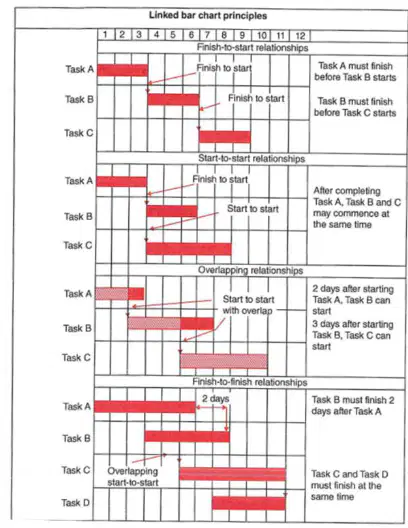
Which statement best describes the purpose of space diagrams in construction planning?
They provide a two-dimensional picture of project activities and their schedule.
They calculate project budgets using unit costs per kilometer.
They display only resource histograms without activity timing.
They show weather forecasts to adjust construction sequences.
For which type of projects are time chainage charts particularly suitable?
Projects where work location is defined along a linear distance from a fixed point.
Projects confined to a single building footprint with no linear progression.
Projects focused solely on equipment maintenance cycles.
Projects where activities occur randomly with no spatial reference.
Which example aligns with the text’s description of projects that use time chainage charts?
Construction of a pipeline across a region.
Refurbishment of office interiors on one floor.
Installation of HVAC units in a single plant room.
Periodic repainting of a warehouse.
Commissioning tests inside a laboratory.
What is a key advantage of multiple activity charts according to the text?
They provide a comprehensive analysis of tasks and their interaction.
They completely eliminate the need for any planning software.
They require very little time to produce compared to other charts.
They replace all other scheduling methods such as bar charts.
Why are multiple activity charts not widely used in construction practice?
They take significant time to produce and suitable software is not readily available.
They cannot represent resource usage in any form.
They are prohibited by most construction standards.
They fail to show relationships between tasks.
You are preparing a programme for upgrading a steel portal frame skeleton into a gym facility. Which planning artifact best communicates task durations, sequencing, and overlaps to stakeholders?
Critical path network diagram
Gantt chart
Risk register
Resource histogram

