
Font size
 Worksheets
Fields 2
Total questions: 27
Worksheet time: 14hrs 30mins
It takes 5.3 x 10⁻³ J of work to move 1.8 x 10⁻⁶ C of charge from point A to point B in an electric field. Calculate the potential difference between A and B.
2900 V
2500 V
3200 V
1500 V
Calculate the magnitude of the electric field strength in a parallel plate apparatus whose plates are 1.4 cm apart and have a potential difference of 410 V between them.
32,000 V/m
25,000 V/m
15,000 V/m
29,000 V/m
What potential difference would have to be maintained across the plates of a parallel plate apparatus if the plates were 2.9 cm apart, to create an electric field strength of 1.9 x 10⁴ N/C?
550 V
450 V
700 V
600 V
The electric potential difference between the inside and outside of a neuron cell membrane of thickness 5.0 nm is typically 0.070 V. Calculate the work you would have to do on a group of sodium ions, of charge 8.0 x 10⁻¹⁹ C, to move it through the membrane from the region of lower potential into the region of higher potential.
5.6 x 10⁻²⁰ J
4.2 x 10⁻²⁰ J
6.8 x 10⁻²⁰ J
7.5 x 10⁻²⁰ J
The potential difference between two parallel plates is 6.5 x 10³ V. You would have to do 0.87J of work if you were to move a small charge, in opposition to the electric force, from one plate to the other. Calculate the magnitude of the charge.
5.1 x 10⁻⁵ C
1.3 x 10⁻⁴ C
2.7 x 10⁻⁴ C
8.9 x 10⁻³ C
An α particle has a positive charge of 2e and a mass of 6.6 x 10⁻²⁷ kg. With what velocity would an α particle reach the negative plate of a parallel-plate apparatus with a potential difference of 7.3 x 10⁴ V
2.7 x 10⁶ m/s
8.5 x 10⁶ m/s
9.8 x 10⁵ m/s
4.0 x 10⁶ m/s
A pith ball of mass 5.2 x 10⁻⁵ kg with a positive charge of 3.2 x 10⁻⁶ C is slowly pulled at a constant speed by a string a distance of 34 cm through a potential difference of 8.0 x 10² V. It is then released from rest and “falls” back to its original position. Calculate the magnitude of the average force required to do this work.
8.0 x 10⁻⁴ N
5.2 x 10⁻⁴ N
6.0 x 10⁻³ N
7.5 x 10⁻³ N
Two electrons are held, at rest, 7.5 x 10⁻¹⁰ m apart, then released. With what speed is each moving when they are a “large”distance apart?
5.8 x 10⁵ m/s
3.5 x 10⁵ m/s
1.2 x 10⁸ m/s
2.3 x 10⁷ m/s
What is the potential difference required to accelerate a proton of mass 1.67 x 10⁻²⁷ kg and charge 1.6 x 10⁻¹⁹ C from rest to a speed of 4.8 x 10³ m/s?
2.4 V
3.6 x 10⁻⁴ V
0.12 V
5.0 x 10⁻⁴ V
What is the definition of a ferromagnetic material?
A ferromagnetic material is a substance that is ferocious and magnetic.
A ferromagnetic material is a substance that can be magnetized in an external magnetic field.
Which word best describes the force occurring between the North pole of one magnet and the South pole of another?
Quadratic
Which word best describes the force between the North pole of one magnet and the North pole of another magnet?
Quartic
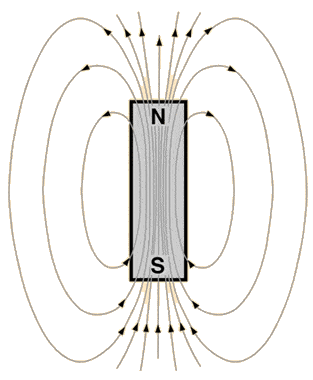
Select all true statements about the magnetic field generated by a bar magnet.
Inside the magnet, magnetic field lines go from South to North.
Outside the magnet, magnetic field lines go from North to South.
Inside the magnet, magnetic field lines go from North to South.
Outside the magnet, magnetic field lines go from South to North.
Magnetic field lines are scalars and do not have direction.
What is the shape of a magnetic field around a wire?
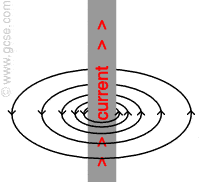

Using the right hand grip rule, A represents the direction of the
current
magnetic field
Using the right hand rule, B represents the direction of the
current
magnetic field

Using the 1st right hand rule, if the current is flowing out of the screen then the magnetic fields will flow from...
A to D to C to B and around
A to B to C to D and around
A to C to D to B and around
A to C to B to D and around
Using the 1st right hand rule, if the current is flowing into the screen then the magnetic fields will flow from...
A to D to C to B and around
A to B to C to D and around
A to C to D to B and around
A to C to B to D and around


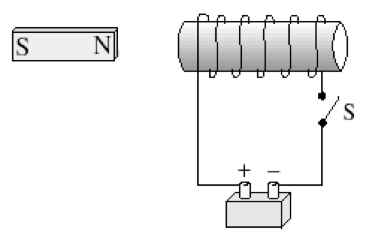
1) A bar magnet is at rest, next to a fixed electromagnet. In which direction will the bar magnet move when switch S is closed?
to the left
to the right
up the page
down the page

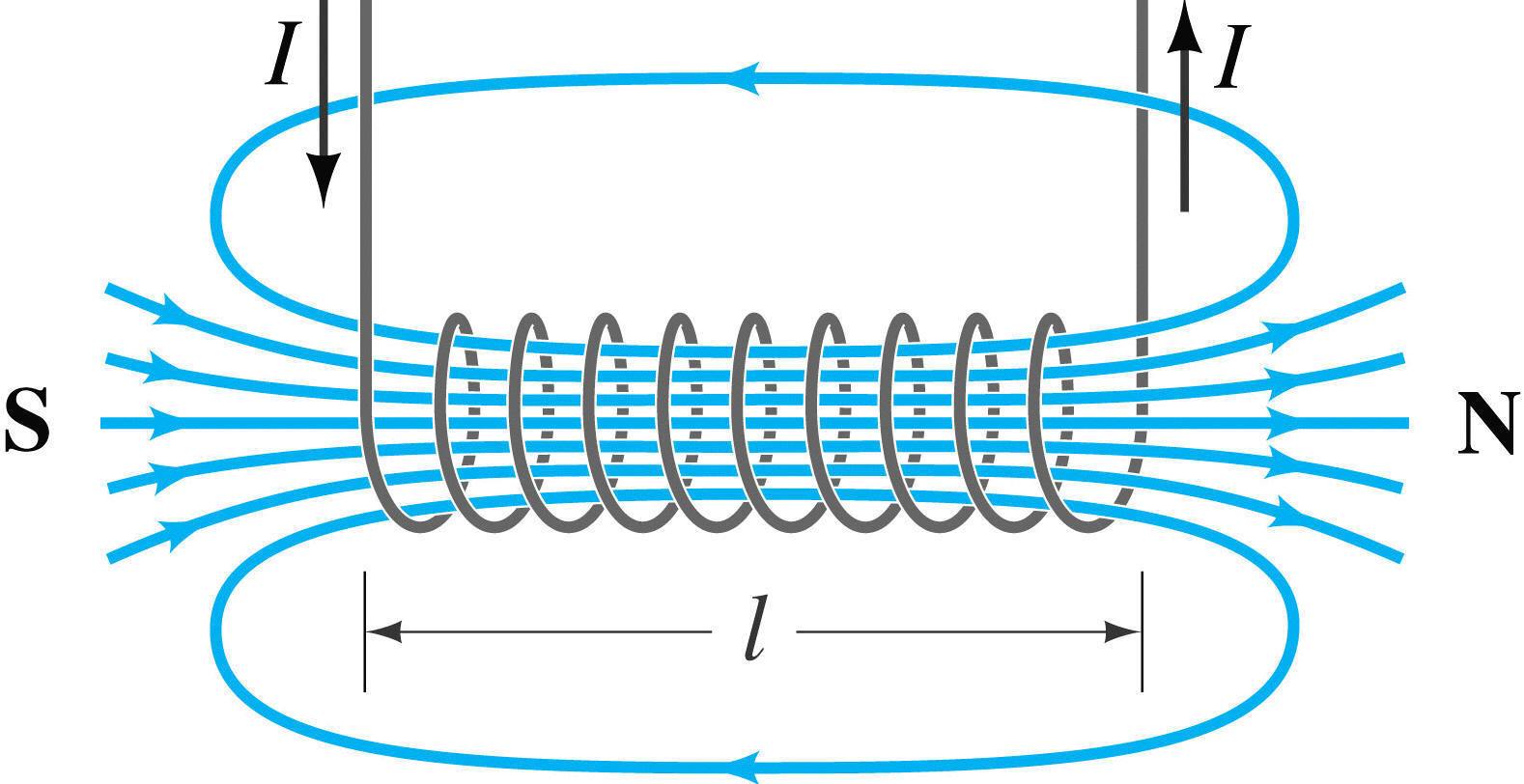
In the solenoid pictured, the north pole would be on the
Left side
Right side
In the solenoid pictured, the south pole would be on the
Left side
Right side

In the solenoid pictured, the north pole would be on the
Left side
Right side
In the solenoid pictured, the south pole would be on the
Left side
Right side
Determine the magnitude and direction of the magnetic force on a proton moving horizontally northward at 5.3 x 10³ m/s, as it enters a magnetic field of 1.7 T directed vertically downward.
Magnitude: 1.4 x 10⁻¹⁵ N Direction: West
Magnitude: 1.4 x 10⁻¹⁵ N Direction: East
Magnitude: 5.7 x 10⁻¹⁵ N Direction: West
Magnitude: 5.7 x 10⁻¹⁵ N Direction: East
An electron moving through a uniform magnetic field with a velocity of 8.2 x 10⁵ m/s [left] experiences a maximum magnetic force of 5.1 x 10⁻¹⁴ N [up]. Calculate the magnitude and direction of the magnetic field.
0.39 T [into the page]
0.41 T [down]
0.67 T [right]
0.39 T [out of the page]

