
 Worksheets
MUSIC COMPREHENSION in TESTS (ENEM)
Total questions: 20
Worksheet time: 3600secs
What Makes you Beautiful (2011) by One Direction
(UDESC) The text is about:
a boy who is looking for his dream girl
a relationship that ends up in a bad marriage
the boy rejected by a girl
the girl who doesn't really know she is hot.
the beauty of a group of girls.
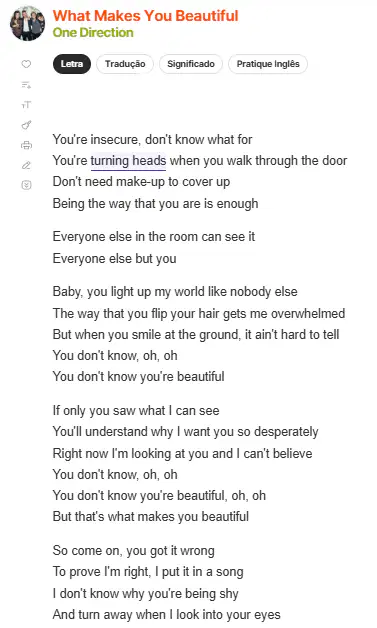
(UDESC) The text says that:
all the alternatives are correct.
nobody can be her copy.
all he wants is to sing for her.
everybody knows and can see the stunning look she has.
he is gonna write a song to prove his anger.
(UDESC) The grammar use for the word "Being" (l.4) is:
present continuous
infinite
past participle
present perfect
gerund
(TEACHER - 2025) E POR FALAR EM GRAMÁTICA... rs
You're insecure
Simple Present
(VERB TO BE)
Being the way that you are
Present Continuous
(ING)
You don't know
Simple Present
(NEGATIVE FORM)
You'll understand why
Simple Future
(WILL)
The way that you flip your hair gets me overwhelmed.
Simple Present
(3rd person)
(ANGLO) Mark the correct grammar end for the beginning: "If only you saw..." (l.12)
I'll show you
I can show you.
I'm showing you
I'm able to show you.
I'd show you.

(TEACHER - 2025) Só relembrando que quando utilizamos o IF em frases condicionais, temos quatro tipos principais:
*a condicional zero que fala sobre fatos da vida real e científicos, com o uso do (a) ;
* a primeira condicional, onde falamos das diversas possibilidades que acontecerão a depender das nossas atitudes noa gora, utilizando, portanto, o presente simples e também os tempos verbais do (b) ;
*a segunda condicional, ou condicional imaginária, no qual criamos cenários fictícios onde as coisas poderiam acontecer, e por isso combinamos o IF com o tempo (c) e também o verbo modal (d) ;
*por último, na terceira condicional, já é tarde demais para fazer mudanças, utilizada para expressar arrependimentos e discutir situações passadas , com uso do passado perfeito (HAD) em conjunto com o uso do auxiliar HAVE e o tempo (e) , aquelas palavras da 3ª coluna.
The words make-up (l.3), desperately (6.13), shy (l.20) are used in the text, respectively, as:
noun, pronoun, adverb.
substantive, adverb, adjective.
substantive, adverb, pronoun.
verb, noun, pronoun.
noun, verb, adverb.
The phrasal verbs TO COVER UP e LIGHT UP have their meaning in the text, respectively, as
invent, fulfill.
lie, transform.
hide out, illuminate.
disguise, turn on.
be beautiful, darker.
(TEACHER - 2025) Mas o que são as phrasal verbs mesmo? Classifique as palavras a seguir:
COVER
COVER UP
UP
TRY
TRY ON
ON
GIVE
GIVE UP
RUN
IN
AT
WITH
AWAY
(UDESC) The correct alternative that shows a synonym of overwhelmed is:
confused
blue
disapponted
affected
angry
What does the text mean with "So come on, you got it wrong" (l.18).
They got the wrong way.
There was a misunderstanding.
They wrote the wrong song.
There will be something else with them.
Everything is out of order.
(UDESC) "You're turning heads when you walk through the door" (l.2) means:
Everybody looks at you the moment you enter.
When you get in, no one cares.
Everyone looks at the other side the moment you enter.
Everyone moves when you get in.
You look away the moment you get in.
(UDESC) When saying: "Being the way that you are is enough" (l.4), the authors mean:
It's good to change a little.
It's necessary to pretend.
The attitudes are unexpected.
It's not necessary enything else.
The is an apple polisher in the lyrics.
(TEACHER - 2025) Naturalmente, vídeoclipes não podem cair na prova do ENEM em seu formato original. Contudo, a partir da letra da música e das expressões (LINGUAGEM NÃO VERBAL) dos artistas envolvidos, podemos inferir que:
Eles estão desapontados com o rumo que a relação tomou.
Eles estão ansiosos pelo pedido de casamento que irá a seguir.
Eles estão envolvidos com as qualidades da garota dos sonhos.
Eles se sentem insignificantes e desqualificados diante da beleza dela.
Eles se sentem incapazes de conquistá-la, uma vez que ela é superior a todos eles.
(ENEM MEC/2016)
Ebony and ivory
Ebony and ivory live together in perfect harmony
Side by side on my piano keyboard, oh Lord, why don’t we?
We all know that people are the same wherever we go
There is good and bad in ev’ryone,
We learn to live, we learn to give
Each other what we need to survive together alive
Em diferentes épocas e lugares, compositores têm utilizado seu espaço de produção musical para expressar e problematizar perspectivas de mundo. Paul McCartney, na letra dessa canção, defende:
a necessidade de donativos.
o aprendizado compartilhado.
o respeito étnico.
as manifestações culturais.
o bem em relação ao mal.
(ENEM MEC/2019)
Englishman in New York
I don’t drink coffee I take tea my dear
I like my toast done on one side
And you can hear it in my accent when I talk
I’m an Englishman in New York
See me walking down Fifth Avenue
A walking cane here at my side
I take it everywhere I walk
I’m an Englishman in New York
[…]
I’m an alien, I’m a legal alien
I’m an Englishman in New York
I’m an alien, I’m a legal alien
I’m an Englishman in New York
Modesty, propriety can lead to notoriety
You could end up as the only one
Gentleness, sobriety are rare in this society
At night a candle’s brighter than the sun
Na letra da canção Englishman in New York, a fala do eu lírico evidencia uma atitude de:
valorização da diversidade de costumes.
exaltação dos hábitos de um outro povo.
predisposição a um comportamento solitário.
disponibilidade para aprender coisas novas.
dificuldade de adaptação à cultura alheia.
(ENEM MEC/2010)
Viva la Vida
I used to rule the world
Seas would rise when I gave the word
Now in the morning and I sleep alone
Sweep the streets I used to own
I used to roll the dice
Feel the fear in my enemy’s eyes
Listen as the crowd would sing
“Now the old king is dead! Long live the king!”
One minute I held the key
Next the walls were closed on me
And I discovered that my castles stand
Upon pillars of salt and pillars of sand
[…]
Letras de músicas abordam temas que, de certa forma, podem ser reforçados pela repetição de trechos ou palavras. O fragmento da canção Viva la vida, por exemplo, permite conhecer o relato de alguém que
costumava ter o mundo aos seus pés e, de repente, se viu sem nada.
almeja o título de rei e, por ele, tem enfrentado inúmeros inimigos.
causa pouco temor a seus inimigos, embora tenha muito poder.
limpava as ruas e, com seu esforço, tornou-se rei de seu povo.
tinha a chave para todos os castelos nos quais desejava morar..
(ENEM MEC/2019)
In this life
Sitting on a park bench
Thinking about a friend of mine
He was only twenty-three
Gone before he had his time.
It came without a warning
Didnꞌt want his friends to see him cry
He knew the day was dawning
And I didnꞌt have a chance to say goodbye.
A canção, muitas vezes, é uma forma de manifestar sentimentos e emoções da vida cotidiana. Por exemplo, o sofrimento retratado nessa canção foi causado:
pela morte precoce de um amigo jovem.
pelo término de um relacionamento amoroso.
pela mudança de um amigo para outro país.
pelo fim de uma amizade de mais de vinte anos.
pela traição por parte de pessoa próxima.
(ENEM/MEC - 2024)
Holy War
Oh, so we can hate each other and fear each other
We can build these walls between each other
Baby, blow by blow and brick by brick
Keep yourself locked in, yourself locked in
[…]
Oh, maybe we should love somebody
Oh, maybe we could care a little more
So maybe we should love somebody
Instead of polishing the bombs of holy war
Nessa letra de canção, que aborda um contexto de ódio e intolerância, o marcador “instead of ” introduz a ideia de
mudança de comportamento.
panorama de conflitos.
rotina de isolamento.
perspectiva bélica.
cenário religioso.
ENEM/MEC - 2020
A Minor Bird
I have wished a bird would fly away,
And not sing by my house all day;
Have clapped my hands at him from the door
When it seemed as if I could bear no more.
The fault must partly have been in me.
The bird was not to blame for his keys.
And of course there must be something wrong
In waiting to silence any song.
No poema de Robert Frost, as palavras fault e blame revelam por parte do eu lírico uma
culpa por não poder cuidar do pássaro.
atitude errada por querer matar o pássaro.
necessidade de entender o silêncio do pássaro.
sensibilização com relação à natureza do pássaro.
irritação quanto à persistência do canto do pássaro.

