
Font size
 Worksheets
Models of Gases and Atomic Structure
Total questions: 20
Worksheet time: 10mins
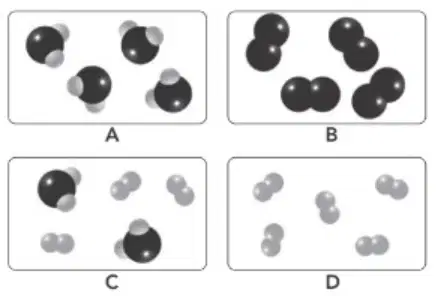
The figure shows models of four different gases. Each ball represents an atom. Based on the models, which two statements are best supported by the information in the models?
Substance A is a molecule made up of different types of atoms.
Substance D is a compound made up of only one type of atom.
Substances A and B are the same substances because they contain the same types of atoms.
Substances A and D are different substances because they contain different combinations of atoms.
Substances B and D are the same substance because they contain a
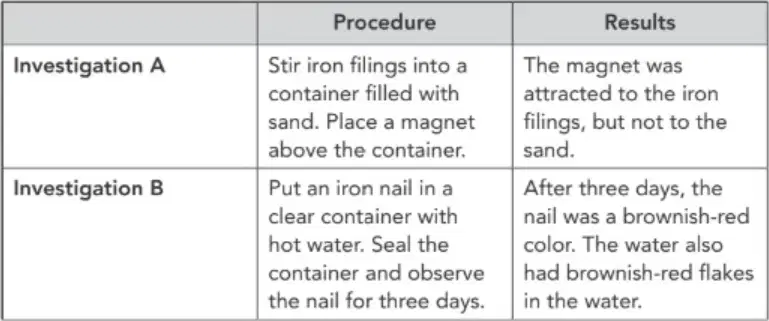
Which two claims are best supported by the results of the investigations with iron?
In Investigation A, the properties of the substances changed.
In Investigation B, the properties of the substances changed.
A chemical reaction occurred in both Investigations A and B.
A separation of a mixture occurred in Investigation A, but not in Investigation B.
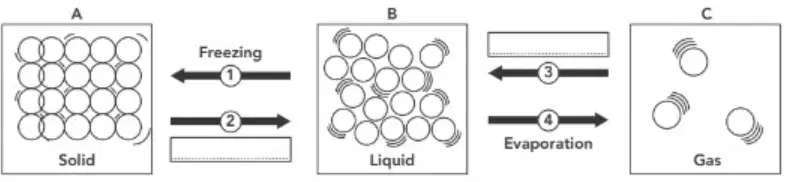
The model shows the arrangements of particles in matter. Which text label should be added to arrow 2?
Arrow 2 should be labeled melting because particle motion is decreasing and temperature is increasing.
Arrow 2 should be labeled melting because particle motion and temperature are both increasing.
Arrow 2 should be labeled condensation because particle motion is increasing and temperature is decreasing.
Arrow 2 should be labeled condensation because particle motion and temperature are both decreasing.
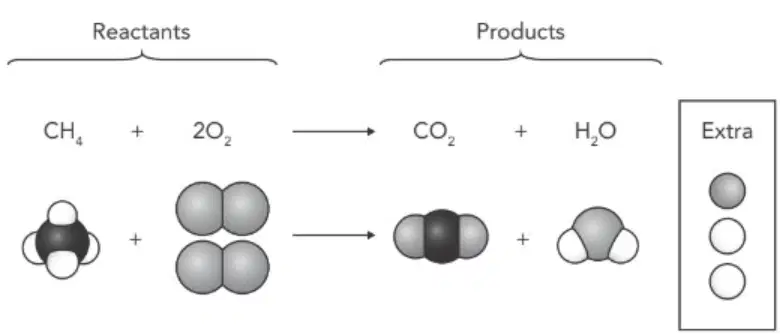
Students are using clay balls to model how atoms are recombined in chemical reactions. First, they model the reactants in the reactions shown. Then they take apart the clay balls representing the reactants and use them to model the products. According to the Law of Conservation of Mass, which change should the students make to correct the model?
Move all of the white balls from CH₄ to the Extra box.
Move all the gray balls from the products to the reactants.
Draw a molecule of one dark ball and four white balls in the reactants.
Draw a molecule in the products made from the atoms in the Extra box.
A group of students plan an investigation to determine if combining baking soda and vinegar causes an endothermic reaction. The students plan to mix the substances and place a thermometer inside the container to measure the temperature. Which result would indicate that this reaction is endothermic?
The temperature increases, which indicates that energy is released when bonds break and reform.
The temperature increases, which indicates that energy is stored within the bonds of the products.
The temperature decreases, which indicates that energy is released when bonds break and reform.
The temperature decreases, which indicates that energy is stored within the bonds of the products.
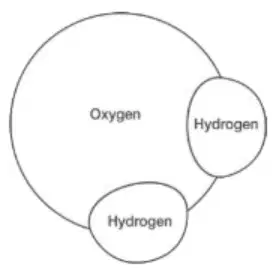
The diagram shows a water molecule. Which statement is true about this molecule?
It is made up of one atom.
It is made up of two types of atoms.
It is not made up of atoms.
It is made up of three types of atoms.
Which two statements best describe copper sulfide?
It is a heterogeneous mixture.
It is a compound.
Copper sulfide can be easily separated into its elements.
Copper sulfide has different properties than the elements copper and sulfur.
The copper and sulfur are so evenly mixed that you cannot see the different parts.
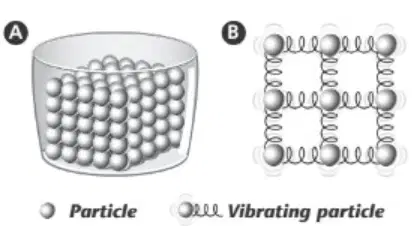
Which two changes could the student make to the model to show melting?
Draw a thermometer to show that the temperature of the object is increasing and allow the particles to move in any direction, so they leave the container and fill the entire room.
Draw a thermometer to show that the temperature of the object is increasing and allow the particles to move more freely, so they take on the shape of their container.
Draw a thermometer to show that the temperature of the object is decreasing and delete the vibrating particles diagram.
Allow the particles to move more freely and delete the vibrating particles diagram.
Which claim about the mass of the products in the chemical reaction is correct if Reactant 1 has a mass of 37 g and Reactant 2 has a mass of 42 g?
The mass cannot be predicted.
The mass of the products will be less than 75 g.
The mass of the products will be greater than 85 g.
The mass of the products will be equal to 79 g.
The table shows the numbers and types of atoms in the products of a chemical reaction. Atoms in the Products of a Reaction Types of atoms | Number of atoms Carbon | 6 Oxygen | 18 Hydrogen | 12 Which statement about the products of the reaction is correct?
The products will have less than 36 atoms, and there will only be one type of atom in the products.
The products will have more than 36 atoms, and the types of atoms will differ from the reactants.
The products will have a total of 36 atoms, and the number of each type of atom will be the same as in the reactants.
The products will have a total of 36 atoms, and the number of each type of atom will be different from the reactants.
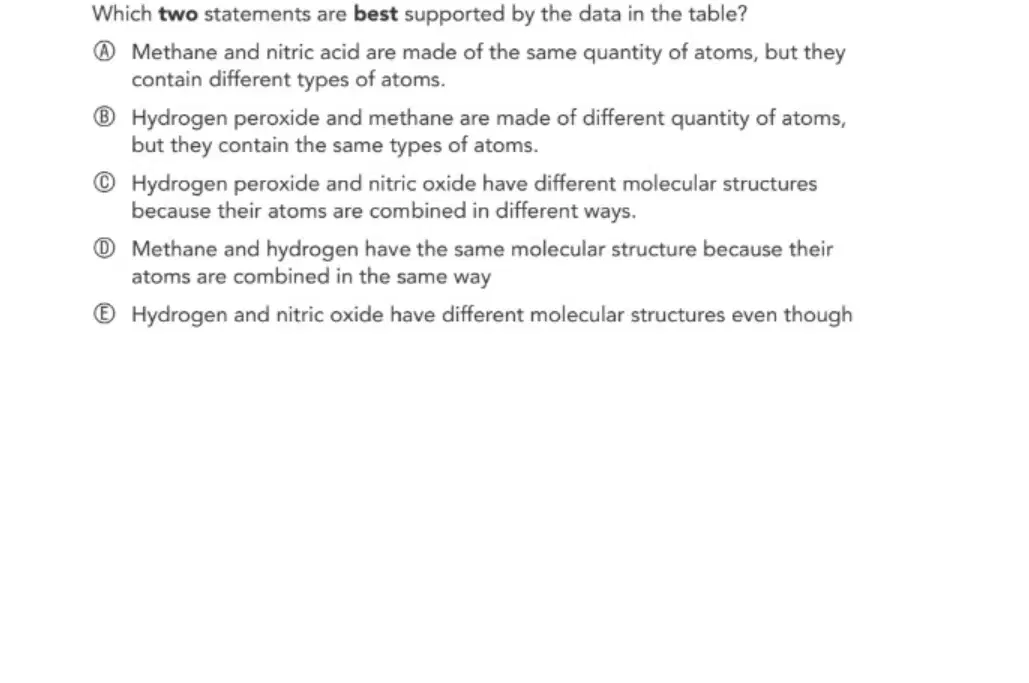
Which two statements are best supported by the data in the table showing the number of atoms in three different compounds?
Methane and nitric acid are made of the same quantity of atoms, but they contain different types of atoms.
Hydrogen peroxide and methane are made of different quantity of atoms, but they contain the same types of atoms.
Hydrogen peroxide and nitric oxide have different molecular structures because their atoms are combined in different ways.
Methane and hydrogen have the same molecular structure because their atoms are combined in the same way.
Hydrogen and nitric oxide have different molecular structures even though they are made of the same types of atoms.
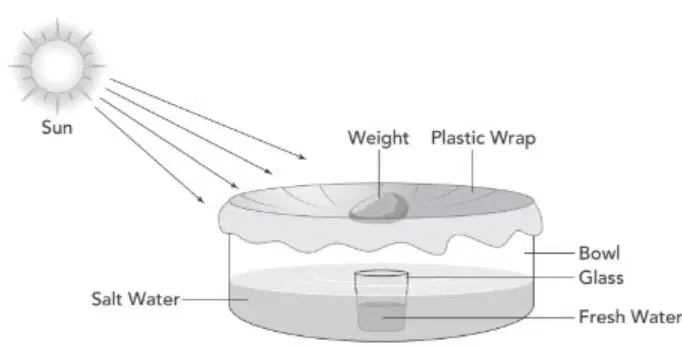
Which statement best summarizes the accuracy of the students’ claim that a chemical reaction occurred to remove the salt from salt water?
The students are correct because fresh water has a different chemical composition than salt water.
The students are partially correct because a chemical reaction did occur, but the chemical structure of the water stayed the same.
The students are partially correct because the chemical structure of water changed, but a chemical reaction did not occur.
The students are incorrect because salt water is a mixture, and fresh water is one component of that mixture.
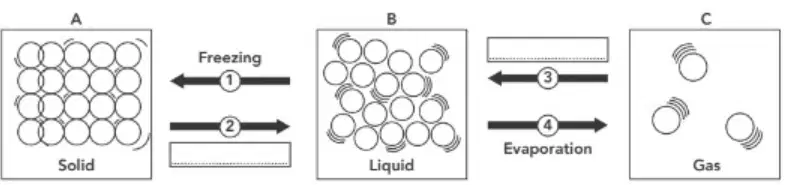
Which two labels can be added to Arrow 4 in the Particles of Matter Model diagram?
condensation and chemical reaction
chemical reaction and temperature decreasing
temperature decreasing and particle motion increasing
particle motion increasing and distance between the molecules is increasing
Which response to the student’s claim about the chemical equation 2Na + 2H₂O → 2NaOH + H₂ is correct?
The student is correct because the chemical equation is balanced.
The student is incorrect because there should be two NaOH molecules.
The student is incorrect because there should be two H₂ molecules.
The student is incorrect because H₂ should be deleted from the equation.
Based on the evidence from the experiment, what type of chemical reaction occurred when vinegar was mixed with steel wool and the temperature inside the container increased?
It was an endothermic reaction because energy was released when the products formed.
It was an endothermic reaction because energy was stored when the products formed.
It was an exothermic reaction because energy was released when the products formed.
It was an exothermic reaction because energy was stored when the products formed.
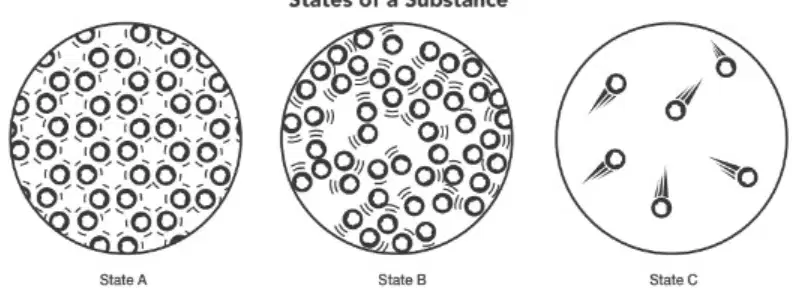
The diagram compares the particles in three different states of matter. What process causes particles in State C to change to State B?
condensation
evaporation
freezing
melting
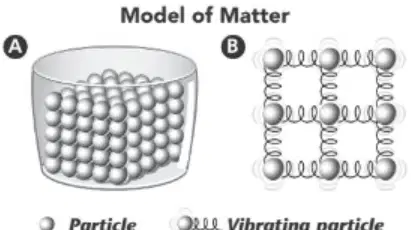
A student makes this model to show what happens when the temperature of a liquid changes. Based on this model, what temperature change most likely occurred in the liquid?
The temperature decreased and particle motion increased.
The temperature decreased and particle motion decreased.
The temperature increased and particle motion increased.
The temperature increased and particle motion decreased.
According to the Law of Conservation of Mass, what is the mass of Reactant 2 if Reactant 1 has a mass of 64 g and the products have a mass of 83 g?
12 g
19 g
64 g
147 g
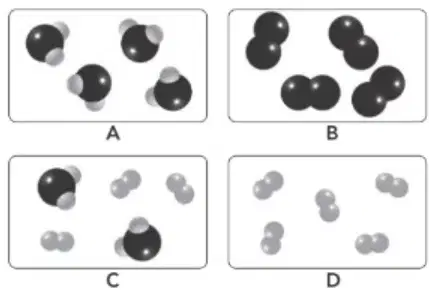
The figure shows models of four different gases. Which statement is true about Substance C?
It is an element because it is made of one type of atom.
It is a compound because it is made of two types of atoms.
It is made of different molecules, and each molecule is made of atoms.
It is made up of the same type of molecule, and each molecule contains one atom.
The following process involves hydrogen peroxide (H₂O₂): 2 H₂O₂ → 2 H₂O + O₂. Which statement describes what happens to hydrogen peroxide during this change?
Hydrogen peroxide becomes a mixture with different properties.
Hydrogen peroxide changes state of matter with the same properties.
Hydrogen peroxide becomes a new substance with different properties.
Hydrogen peroxide becomes a new element with the same properties.

