
Font size
 Worksheets
1.3 Cellular Respiration
Total questions: 20
Worksheet time: 20mins
Which of the following is required by the process of aerobic respiration?
Carbon dioxide
Lactic acid
NADPH
Oxygen
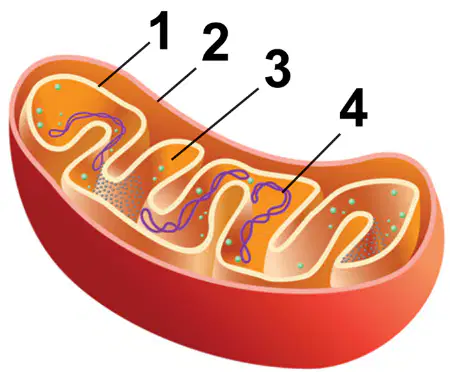
Use the diagram of a mitochondrion labeled with numbers 1–4 to answer: Which number represents the inner membrane?
1
2
3
4
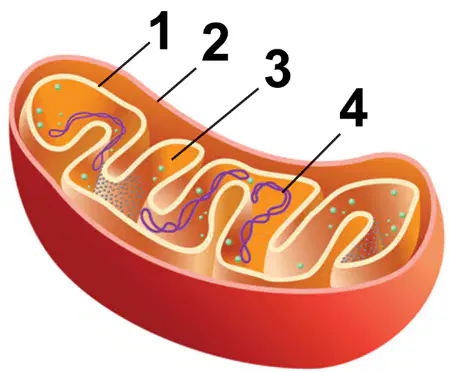
Use the diagram of a mitochondrion labeled with numbers 1–4 to answer: Which number represents the location of the Krebs cycle?
1
2
3
4
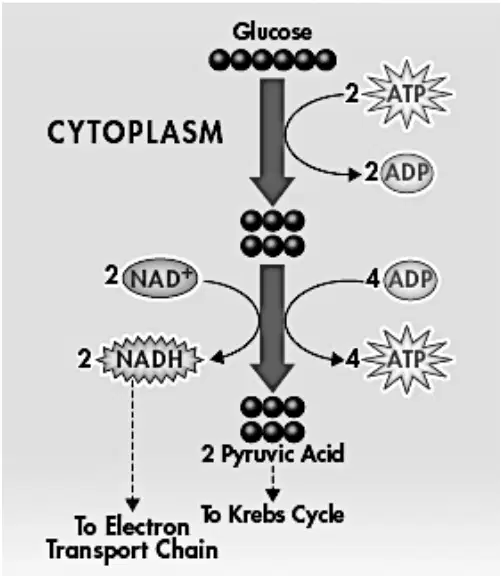
Use the diagram of glycolysis in the cytoplasm to answer: Which statements correctly describe the process shown? Select all that apply.
It is glycolysis occurring in the cytoplasm.
It produces pyruvic acid that is the reactant of the Krebs cycle.
It produces 2 NADH that are used in the electron transport chain.
It results in a net gain of 2 ATP molecules per glucose.
It requires oxygen to proceed.
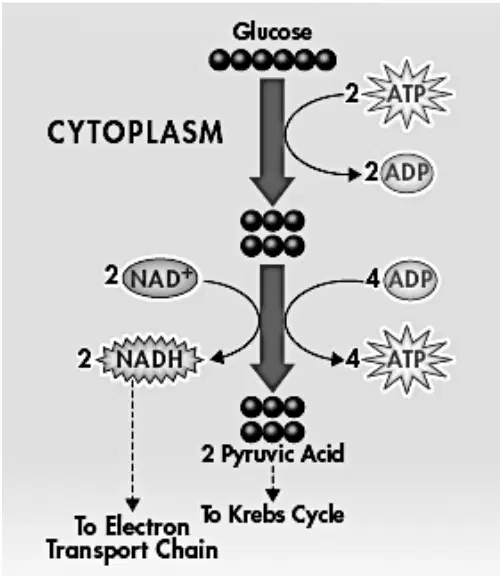
Based on the glycolysis diagram, which statement best describes ATP change during this process?
It uses 2 ATP and produces none.
It produces 4 ATP and uses none.
It uses 2 ATP and produces 4 ATP for a net gain of 2 ATP per glucose.
It neither uses nor produces ATP.
Which of the following is a correct match between the stage of cellular respiration and its location in the cell?
ATP production: Mitochondrial outer membrane
Electron transport chain: Endoplasmic reticulum
Krebs cycle: Mitochondrial matrix
Glycolysis: Mitochondrial inner membrane
The starting molecule for glycolysis is
ADP
citric acid
glucose
pyruvic acid
Which of the following best describes the steps of the Krebs cycle in terms of reactants and products?
Acetyl-CoA reacts with oxygen to form glucose, producing FADH2 and NADH
Acetyl-CoA undergoes reactions that produce NADH, FADH2, ATP, and carbon dioxide
Pyruvate is converted into acetyl-CoA, which is then used to produce lactic acid and ATP
NADH and FADH2 react with glucose to produce oxygen and carbon dioxide
The Krebs cycle starts with ________ and yields ________.
glucose; carbon dioxide
glucose; lactic acid
pyruvic acid; carbon dioxide
pyruvic acid; lactic acid
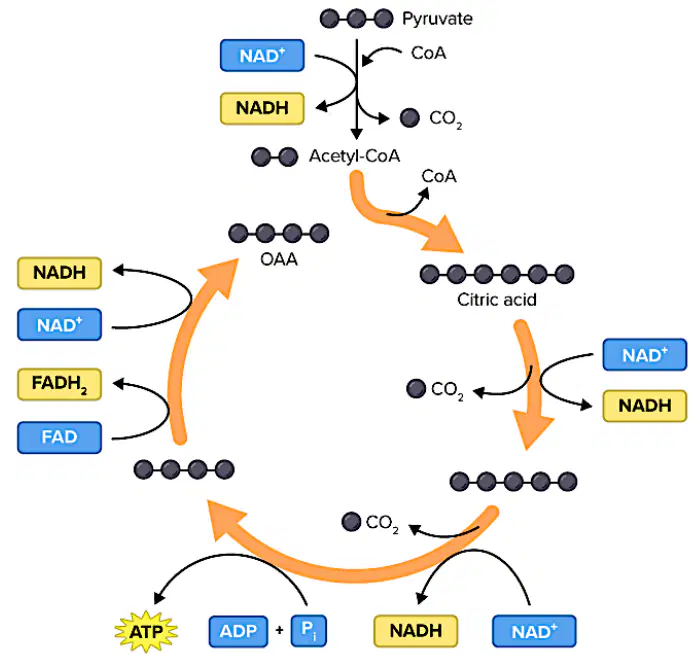
Use the diagram of the Krebs cycle to answer: Identify the number of FADH2 molecules that will be produced during the Krebs cycle for each glucose molecule.
1 molecule
2 molecules
3 molecules
4 molecules
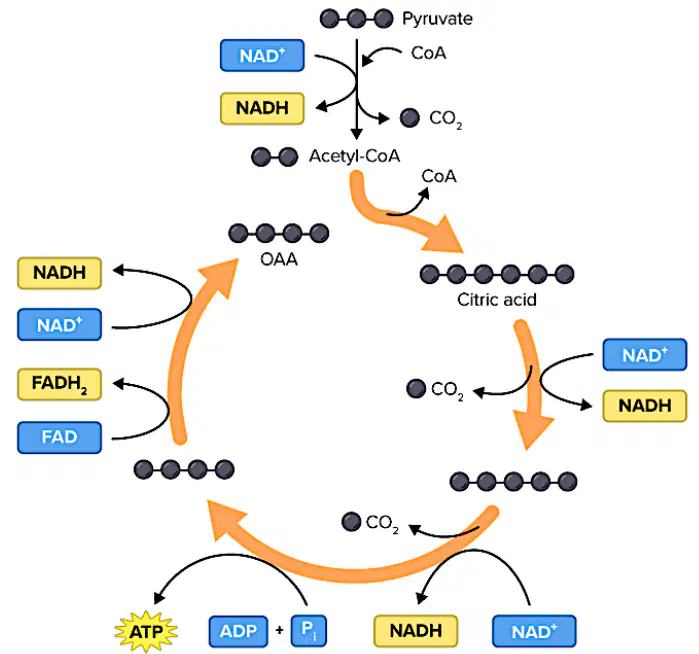
Use the diagram of the Krebs cycle and the preparatory reaction to answer: Identify the number of carbon dioxide molecules produced after the preparatory reaction and after the complete turn of one round of the Krebs cycle.
2 molecules
3 molecules
4 molecules
6 molecules
What is the role of the electron transport chain in cellular respiration?
It uses glucose to produce pyruvate and other electron carrier molecules
It converts ATP into NADH and FADH2 that are then transported to the cytoplasm
It breaks water into oxygen and hydrogen ions that are used to operate ATP synthase
It generates a proton gradient across the mitochondrial membrane to synthesize ATP
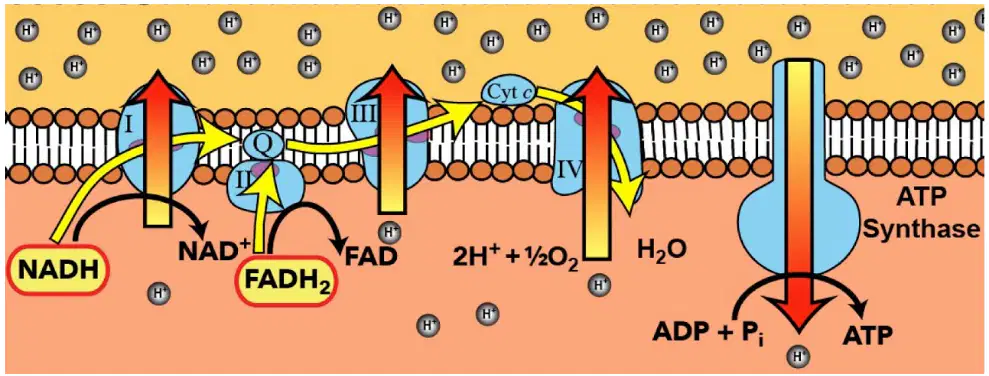
Use the diagram showing the electron transport chain (ETC) in cellular respiration to identify the statements that correctly describe its steps and role. Select all that apply.
Electrons from NADH and FADH2 move along inner‑membrane proteins of the mitochondrion
H+ ions are pumped into the intermembrane space, creating a concentration gradient
H+ ions flow back through ATP synthase, converting ADP to ATP
Oxygen acts as the final electron acceptor and combines with H+ and electrons to form water
Overall, the ETC directly yields 2 ATP
Which of the following is the correct number of net ATP molecules produced by each stage of cellular respiration per one molecule of glucose?
Glycolysis 2 ATP, Krebs Cycle 2 ATP, Electron Transport chain 32 ATP
Glycolysis 4 ATP, Krebs Cycle 4 ATP, Electron Transport chain 32 ATP
Glycolysis 2 ATP, Krebs Cycle 2 ATP, Electron Transport chain 38 ATP
Glycolysis 4 ATP, Krebs Cycle 4 ATP, Electron Transport chain 34 ATP
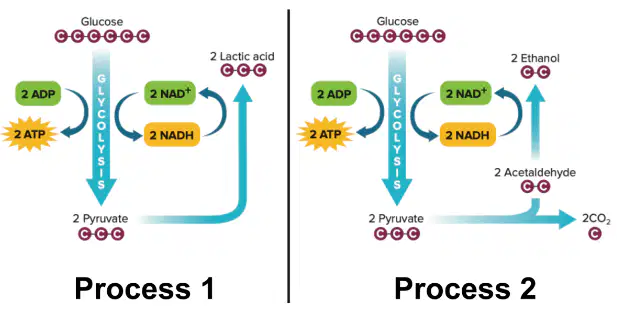
Use the fermentation diagrams labeled Process 1 and Process 2 to match each process to its products and a typical example of cells performing it.
Process 1
Lactic acid fermentation
Process 2
Alcohol fermentation
Products of Process 1
2 ATP, 2 Lactic acid
Products of Process 2
2 ATP, 2 Ethanol, 2 CO2
Example cells (Process 1/2)
Muscle cells / Bacteria-yeasts
A student kept a yeast culture in a place that lacked oxygen, and the yeast cells were still able to produce carbon dioxide. This is due to ____________.
aerobic fermentation
alcoholic fermentation
carbonic acid fermentation
lactic acid fermentation
Analyze how different variables affect the process of alcoholic fermentation. Select all statements that accurately describe these effects.
Higher temperatures generally speed fermentation until enzymes become denatured at excessive heat
At very low temperatures, enzyme activity slows and fermentation decreases
Extremely acidic or alkaline pH can reduce or stop fermentation by impairing enzymes
Simpler sugars such as glucose are fermented more quickly than more complex sugars like lactose
Fermentation rate is unaffected by pH within any practical range
Complete the comparison by choosing the option that correctly lists the reactants for each process: Photosynthesis and Cellular respiration.
Photosynthesis: CO2 + H2O + Sunlight; Cellular respiration: C6H12O6 + O2
Photosynthesis: C6H12O6 + O2; Cellular respiration: CO2 + H2O + Sunlight
Photosynthesis: CO2 + H2O; Cellular respiration: C6H12O6 + Sunlight
Photosynthesis: O2 + Sunlight; Cellular respiration: CO2 + H2O
Complete the comparison by selecting the statement that correctly describes energy use or production in each process.
Photosynthesis uses energy; cellular respiration produces energy
Photosynthesis produces energy; cellular respiration uses energy
Both photosynthesis and cellular respiration use energy
Both photosynthesis and cellular respiration produce energy
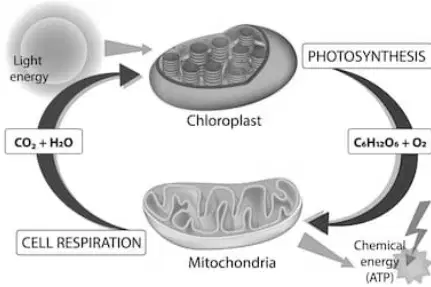
Which of the following statements best describes the relation in the figure showing chloroplasts performing photosynthesis using light energy to convert CO2 and H2O into C6H12O6 and O2, and mitochondria performing cellular respiration that uses C6H12O6 and O2 to generate ATP and releases CO2 and H2O?
The energy captured in photosynthesis is used to power cellular respiration.
Photosynthesis and respiration perform the same task in terms of energy transformation
The energy transformed in cellular respiration is used to power photosynthesis.
Energy is not involved in either photosynthesis or cellular respiration.

