
 Worksheets
6035 Hot Water Revision
Total questions: 48
Worksheet time: 24mins
What does CWSC stand for in hot water systems?
Cold Water Storage Cistern
Central Water Supply Chamber
Continuous Water Supply Circuit
Closed Water System Cylinder
What is the function of F & E in central heating systems?
Feed and Expansion (tops up the central heating supply and allows expansion with the heating circuit)
Filtration and Extraction (removes impurities from the heating system)
Flow and Equalization (balances water flow in the system)
Fuel and Efficiency (improves energy usage in the heating system)
What is the main function of an Open Vent in a hot water cylinder?
To allow for expansion and safety device
To increase water pressure
To filter impurities from water
To heat the water
Which type of hot water system feeds all outlets within the property and is central within the property?
Centralised
Localised
Instantaneous
Stored
Which type of hot water system feeds just one outlet?
Localised
Centralised
Instantaneous
Storage
Instantaneous hot water systems heat water instantly once the tap is opened.
True
False
Stored hot water systems keep water within the cylinder and then heat it up before being sent around to the outlets.
True
False
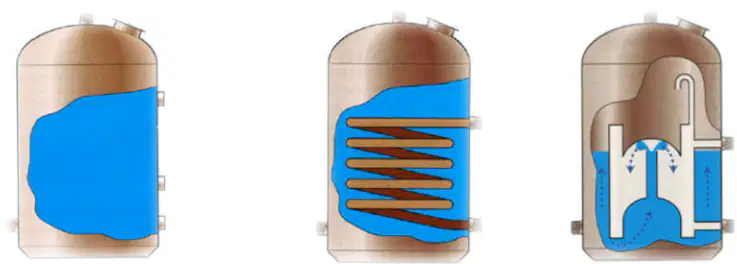
Look at the diagram of the cylinder with blue water only (first image). What does this represent?
Cold Water Storage Cistern
Feed and Expansion
Open Vent
Look at the diagram of the cylinder with blue water and heating coils (second image). What does this represent?
Cold Water Storage Cistern
Feed and Expansion
Open Vent
Look at the diagram of the cylinder with pipes and arrows (third image). What does this represent?
Cold Water Storage Cistern
Feed and Expansion
Open Vent
Which type of cylinder contains a coil heat exchanger that heats up the Secondary water fed from the CWSC?
Indirect Cylinder
Direct Cylinder
Thermal Store Cylinder
Unvented Cylinder
Which type of cylinder mixes Primary water from the boiler with Secondary water within the cylinder and is now heated via an Immersion Heater?
Direct Cylinder
Indirect Cylinder
Thermal Store Cylinder
Unvented Cylinder
Which type of cylinder contains a chamber that acts as the heat exchanger, fills initially from the CWSC, and forms an air bubble to separate primary and secondary waters?
Indirect Single Feed Cylinder
Direct Cylinder
Twin Coil Cylinder
Thermal Store Cylinder
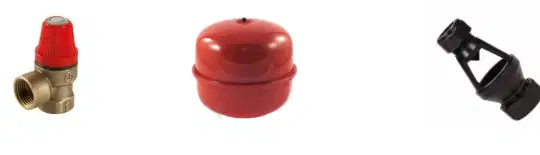
Which type of cylinder uses a Mains Pressure Expansion Vessel for expansion and a Pressure Relief Valve to discharge extra hot water if the pressure gets too high?
Unvented Cylinder
Vented Cylinder
Thermal Store Cylinder
Direct Cylinder
Which water heating system provides mains pressure, instantaneous hot water, and does not require any storage?
Combi Boiler
Gravity-fed Cylinder
Vented Cylinder
Immersion Heater
Which cylinder is smaller, has a more compact coil with greater surface area, and gives off more heat?
High Heat Recovery Cylinder
Low Pressure Cylinder
Standard Storage Cylinder
Insulated Cylinder
Which water heater is also known as Point Of Use (POU) and is a local water heater to the appliance?
Single Point Water Heater
Storage Water Heater
Centralized Water Heater
Solar Water Heater
Which water heater produces hot water for more than one appliance?
Multi Point Water Heater
Single Point Water Heater
Instant Water Heater
Storage Water Heater
What is the minimum size for the Vent Pipe in an Open Vent Cylinder?
22mm
15mm
28mm
35mm
Valves are allowed in hot distribution up to the vent pipe in an Open Vent Cylinder.
True
False
What is the minimum rise required in the hot distribution pipe before the vent connection in an Open Vent Cylinder?
450mm
300mm
600mm
150mm
Where should the Cylinder Stat be located in an Open Vent Cylinder?
1/3 of the way up from the bottom
At the very top of the cylinder
Halfway up the cylinder
At the very bottom of the cylinder
2/3 of the way up from the bottom
Which of the following is NOT a requirement for Unvented Cylinders?
Mains Pressured
Expansion Vessel
Pressure Relief Valve
Cylinder Stat
What is the purpose of a thermostat in heating systems?
To control the heat so it only heats when required and shuts off once at set temperature.
To increase the speed of the heating system.
To provide electricity to the heating system.
To clean the air in the heating system.
If an appliance is not heating up or is overheating, what is normally the faulty component?
Thermostat
Fuse
Power cord
Heating element
What is a 'Dead Leg' in hot water systems?
A dead leg in hot water occurs when water is delivered from point A to B without keeping the heat.
A dead leg in hot water is a pipe that is always hot.
A dead leg in hot water is a system that recycles water continuously.
A dead leg in hot water is a pipe that is used for cold water only.
What should be added to increase efficiency if pipework exceeds 12-22mm – 12m, 22-28mm – 8m, or over 28mm – 3m in secondary circulation?
A bronze pump
A plastic valve
An expansion tank
A pressure gauge
What is Trace Heating?
Electrical element attached to vulnerable pipe (located in a cold area) with a frost stat which heats up the pipe.
A method of cooling pipes using refrigerant coils.
A process of painting pipes to prevent rust.
A technique for insulating pipes with foam sleeves.
Where should pipework insulation be fitted?
Where pipework is running in cold area, lofts, unheated garage under a suspended ground floor.
Where pipework is running in heated living rooms.
Where pipework is running in bathrooms with underfloor heating.
Where pipework is running in kitchens with central heating.
What is a Bath Shower Mixer?
A device that blends hot and cold water within the valve
A bath mixer tap which can be used to fill a bath or go to the shower head
A pump that boosts water pressure
A valve that mixes water to a preset temperature
What does a Thermostatic Mixer Valve do?
Boosts water pressure
Blends Hot and Cold water within the valve to keep the water at a safe temperature 38°C
Heats water using an electric element
Mixes water to a preset temperature
Fill in the blank: An Instantaneous Electric Shower is a mains fed shower which uses an ________ to heat up the cold water to desired temperature.
electric element
gas burner
solar panel
heat pump
What is the function of a Single Impellor Pump?
Boosts the pressure of both Hot & Cold water
Boosts the pressure of either the Hot or Cold water supply to a shower and contains an inlet and an outlet on the pump
Mixes hot and cold water
Heats water using solar energy
Fill in the blank: A Twin/Double Impellor Pump will boost the pressure of both Hot & Cold to a shower and will contain ________ inlets and ________ outlets.
two; two
one; two
two; one
one; one
Renewable Heat Sources for hot water are commonly ________ and ________.
Solar (Sun/UV) and Ground Source (heat gained from underground)
Coal and Oil
Natural Gas and Propane
Electricity and Diesel
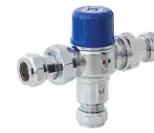
What does a Thermostatic Blending Valve do?
Boosts water pressure
Mixes Hot and Cold water to a bath and is pre-set at to 48°C by the manufacturer
Heats water using an electric element
Blends water to a safe temperature 38°C
Fluid Category 1 is defined as ________ water supplied by the water Undertaker (Mains Drinking Water).
Wholesome
Contaminated
Recycled
Distilled
Fluid Category 2 is defined as wholesome but some of its qualities are ________.
slightly
highly
completely
extremely
Which fluid category is described as having a slight health risk and should not be drunk?
Fluid Category 3
Fluid Category 4
Fluid Category 5
Fluid Category 2
Fluid Category 5 is most likely fatal and includes which types of water?
Bath water
Sink, Bidet, WC waste water
Dishwasher water
Hot water from cylinder
Backflow is when water travels in the ______ direction to which it was designed to travel.
opposite
same
forward
downward
What is back siphonage?
When water is drawn backwards via negative pressure (suction)
When water flows upwards due to gravity
When water is filtered through sand
When water is heated and rises
Which valve is used to protect Fluid Category 1 from Fluid Category 2?
Double Check Valve
RPZ Valve
Single Check Valve
Pressure Relief Valve
Double Check Valve is used to protect Fluid Category 1 from Fluid Category _____.
3
2
4
5
RPZ Valve (Reduced Pressure Zone Valve) is used to protect Fluid Category 1 from Fluid Category ____.
4
2
3
5
When testing rigid pipework (Copper or LCS), after filling the system and allowing 30 mins for temperature stabilisation, what is the next step?
Leave for 2 hours
Raise pressure 1½ times the working pressure and leave for 1 hour
Reduce pressure to 1/3
Test for 45 mins
When testing plastic pipework, after raising the pressure to 1 bar for 45 mins, what should be done next?
Raise pressure 1½ times the working pressure and leave for 15 mins. Then reduce pressure to 1/3 and test for a further 45 mins.
Release all pressure and inspect for leaks immediately.
Increase pressure to 2 bar and maintain for 30 mins.
Lower pressure to zero and repeat the test.
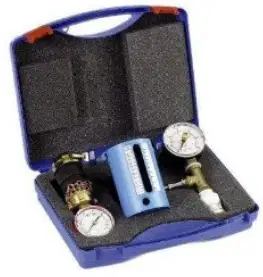
Identify the equipment shown in the image.
Pressure tester and Flow Cup Kit
Water pump
Valve tester
Pipe cutter

