
 Worksheets
6035 Cold Water Revision 2
Total questions: 59
Worksheet time: 30mins
Read the passage about the rain water cycle. What is the first stage of the rain water cycle?
Condensation
Precipitation
Evaporation
Collection
Read the passage about the rain water cycle. What is the process called when water vapour rises and forms clouds?
Evaporation
Condensation
Precipitation
Collection
When water droplets become too heavy, they fall to the earth in the form of _________?
precipitation
evaporation
condensation
transpiration
Read the passage about the rain water cycle. What happens to most of the water that seeps through the soil?
It evaporates
It forms clouds
It flows downhill as run-off into streams, lakes, oceans, and other bodies of water
It stays in the soil forever

Which process is shown as water turning into vapour due to heat from the sun?
A) Condensation
B) Precipitation
C) Evaporation
D) Collection
According to the passage, rain that has fallen is stored as surface water in lakes, rivers, streams, reservoirs, etc.
True
False
Read the passage below and answer the question: Water undertakers are responsible for collecting water, treating it and maintaining the supply of wholesome water. Before distribution the water must be treated and turned into wholesome water at a treatment works. Which type of water is fit for human consumption?
Wholesome water
Grey water
Recycled rain water
Black water
What is the main use of grey water?
Drinking and food preparation
Re-used to flush WC cisterns only
Used in clothes cleaning operations
Treated by a water undertaker
Fill in the blank: __________ is water from WCs and kitchen sinks and can only be treated by a water undertaker.
Black water
Grey water
Rainwater
Distilled water
Cold water supply systems: There are two types of basic cold water systems. What are they?
Direct and indirect
Hot and cold
Mains and tank
High and low pressure
Direct systems: All cold water taps feed directly from the mains supply, which means wholesome drinking water is available from all taps. Is this statement True or False?
True
False
Direct systems: This is the most common type of cistern because a high pressure supply is available from the mains and it is a cost-effective choice.
True
False
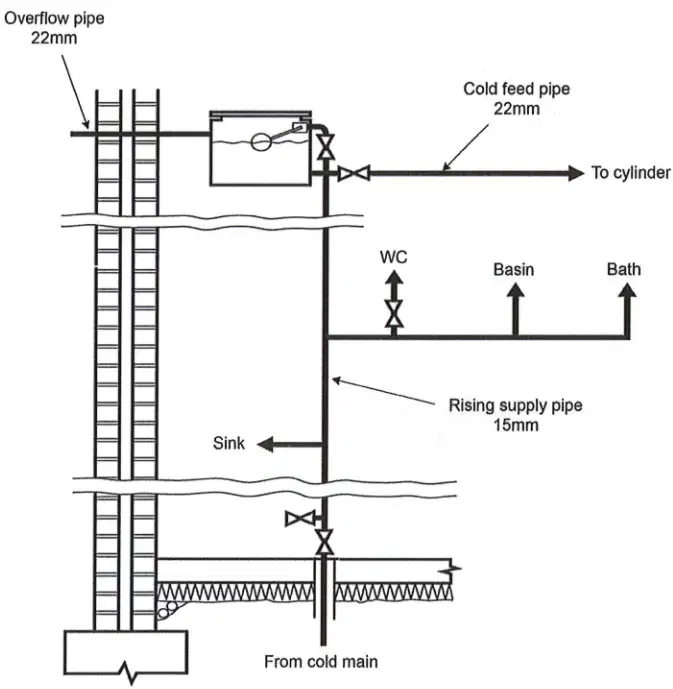
Refer to the diagram of the direct cold water supply system. What is the diameter of the rising supply pipe?
22mm
15mm
10mm
30mm

Refer to the diagram of the direct cold water supply system. The cold feed pipe to the cylinder has a diameter of _____
22mm
15mm
28mm
35mm
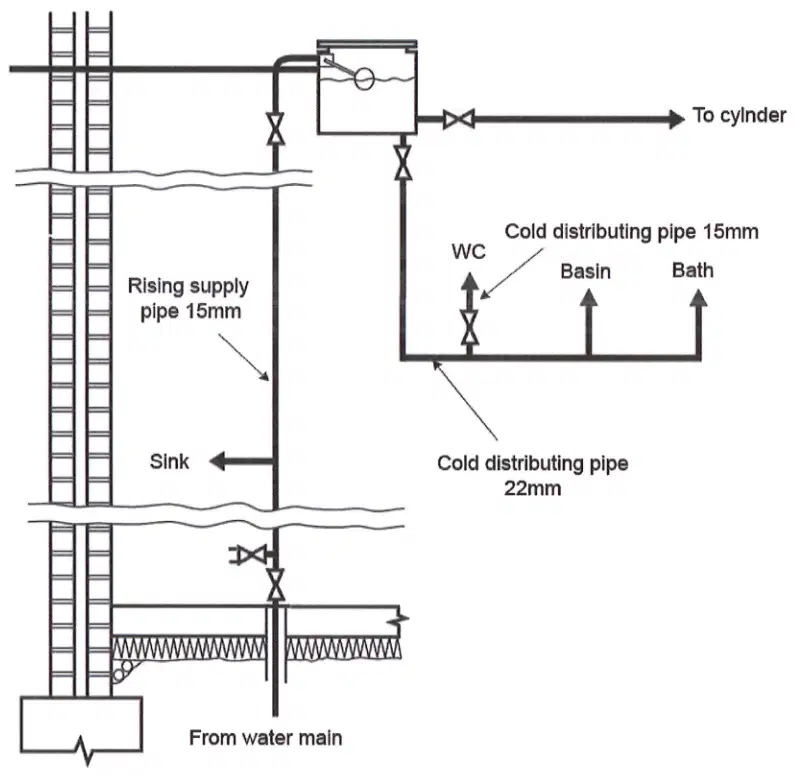
Which appliances are fed directly from the mains in the cold water supply system?
Kitchen sink and cold water storage cistern
Basin and bath
WC and cylinder
All appliances
Fill in the blank: This cold water supply system is used in ______ pressure water areas where the mains system cannot fully supply the system.
low
high
medium
normal
The cold water supply system shown has a water reserve which can be used should the mains system fail.
True
False
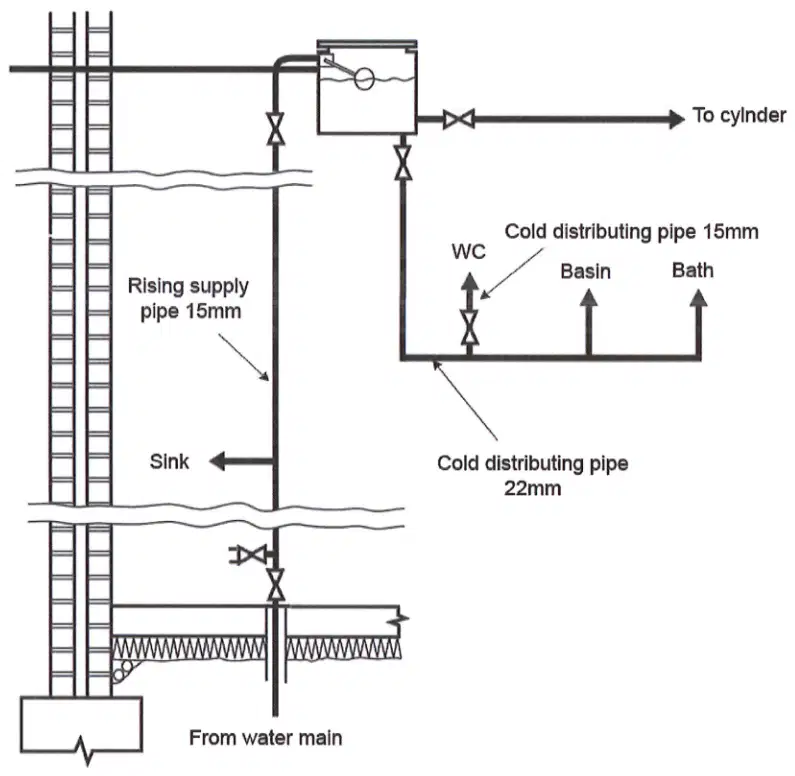
Where does the water supply originate in the system shown in the diagram?
From water main
From storage tank
From cylinder
From bath
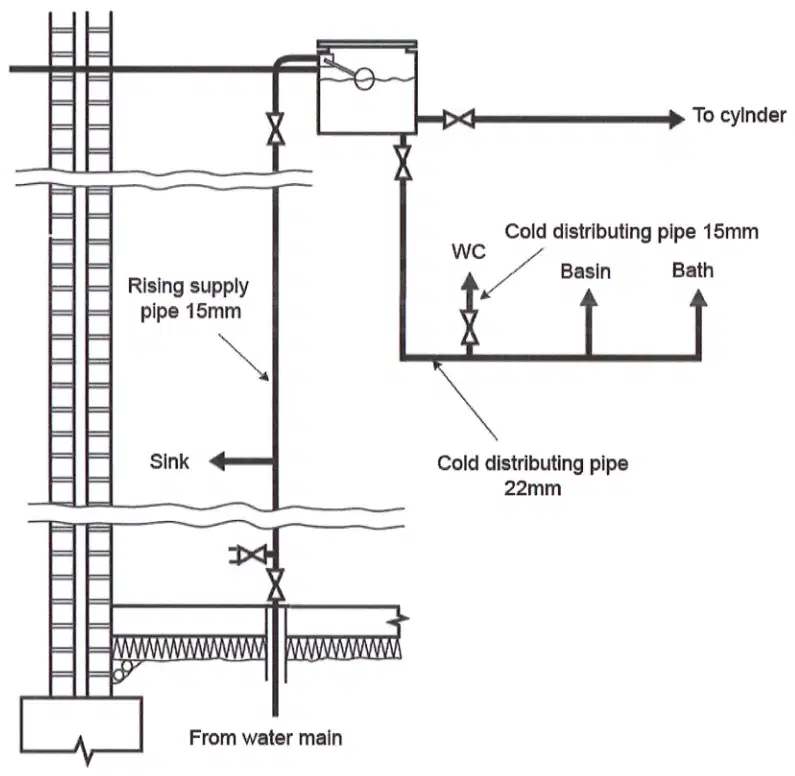
Fill in the blank: The cold distributing pipe to the WC, Basin, and Bath is ______ mm in diameter.
15
20
25
32
Refer to the diagram of a protected cold water storage cistern. What is the purpose of the float operated valve?
To control the water level in the cistern.
To increase the water pressure in the cistern.
To filter impurities from the water entering the cistern.
To heat the water in the cistern.
Which part of the cold water storage cistern is responsible for preventing insects and light from entering?
Rigid and tight fitting lid
Overflow pipe
Ball valve
Outlet pipe
Cisterns should be fitted with an effective inlet control device to maintain the correct water level.
True
False
Cisterns should be fitted with service valves on inlet and outlet pipes.
True
False
Cisterns should be fitted with screened warning/overflow pipes to warn of overflow.
True
False
Cisterns should be covered to exclude light or insects.
True
False
Why should cisterns be insulated?
To prevent heat loss and undue warming in hot weather conditions.
To increase the water pressure in the pipes.
To make the cisterns look more attractive.
To reduce the amount of water stored.
Cisterns should be installed so that risk of contamination is minimised.
True
False
Cisterns should be arranged so that water can circulate preventing stagnation.
True
False
Which of the following materials are commonly used to make plastic cold water storage cisterns?
Polyethylene
Polypropylene
Polyvinyl chloride
All of the above
Fill in the blank: Cisterns made from plastic materials are ______, strong, hygienic, resistant to corrosion, and flexible.
light
heavy
fragile
opaque
Plastic cisterns are produced in black to prevent algae growth.
True
False
Fill in the blank: The base of a plastic cistern must be fully ______ to ensure safety.
supported
painted
covered
exposed
According to the passage, what is the recommended method for cutting holes for pipe connections in plastic cisterns?
Using a drill
Using a hole saw
Using a knife
Using a hammer
Oil-based paste should be used for joints in plastic cisterns.
True
False
What is the minimum distance the supporting board should extend beyond the edges of the cistern base?
100mm
150mm
200mm
50mm
According to the Water Regulations, what must a pipe supplying water to a cold water storage cistern be fitted with?
An effective adjustable shut-off device.
A pressure reducing valve.
A non-return valve.
A water filter.
Which British Standard must float-operated valves comply with for domestic applications?
BS1212
BS1010
BS8000
BS5292
True or False: The Part 1 Portsmouth valve is widely used on new installations.
True
False
Label the following parts in the diagram of the BS1212 diaphragm type float operated valve:
Seating, Washer, Split pin
Handle, Nut, Bolt
Spring, Lever, Screw
Gasket, Flange, Clamp
According to the passage on servicing valves, where must a servicing valve be fitted on inlet pipes to cisterns?
Immediately before the connection to the cistern.
At the main water supply entry point.
Anywhere along the length of the inlet pipe.
After the outlet pipe from the cistern.
According to the passage on servicing valves, what is the preferred location for connecting outlet pipes in a cistern according to Water Regulations?
In the bottom of the cistern rather than the side.
In the top of the cistern rather than the bottom.
On the side of the cistern rather than the bottom.
Near the lid of the cistern rather than the base.
Refer to Fig. 4 – Outlet & Vent Pipe Connections to Cistern. Which of the following is NOT labeled in the diagram?
Screened air vent
Filtered warning pipe
Overflow pipe
Insulation against frost
The servicing valve should be located as near to the point of connection to the system as possible, according to the passage on servicing valves.
True
False
According to the diagram (Fig. 4), what is the minimum distance required for the screened air vent above the cistern?
350mm
150mm
500mm
250mm
What is the purpose of an overflow pipe in a cistern?
To give warning to occupiers of a building
To discharge water where it will not cause damage to the building
To filter water
To fill the cistern
A warning pipe is used to give warning to the occupiers of a building that a cistern is overflowing and needs attention.
True
False
For small cisterns of up to ____ litres, these must be fitted with a warning pipe and no other overflow pipe.
1000
500
1500
2000
In larger cisterns, between 1000 and 5000 litres, they are fitted with both a warning pipe and an overflow pipe.
True
False
What is the minimum distance between the finished water level in the cistern and the invert of the warning/overflow pipe?
10mm
25mm
50mm
100mm
If the float operated valve becomes defective, the warning pipe should be capable of removing excess water without becoming submerged.
True
False
Where should warning pipes discharge water?
Inside the building
Where the water will be noticed, usually outside the building
Into the cistern
Into a filter
Warning pipes should be fitted with a ______ or filter to exclude insects.
screen
valve
gasket
plug
What is the description of fluid category 1 in backflow prevention?
Fluid representing a serious health hazard
Wholesome water supplied by a water undertaker and complying with the requirements of regulations made under water section 67 of the Water Industry Act 1991
Fluid which represents a slight health hazard
Fluid which represents a significant health hazard
Which example of risk is associated with fluid category 2 in backflow prevention?
Kitchen sink
Hot water system
Combination boilers
Washing machines
Fill in the blank: Fluid category 3 represents a ______ health hazard because of the concentration of substances of low toxicity.
slight
severe
critical
moderate
Fluid category 5 represents a serious health hazard because of the concentration of pathogenic organisms, animal remains, human waste, radioactive or very toxic substances.
True
False
What is an air gap in plumbing? Fill in the blank: An air gap is simply a space between _______ water and a contamination risk, normally used to protect the cold water supply from tap outlets on baths, bidets, and sinks.
wholesome
waste
hot
rain
Which type of check valve has one valve orifice?
Single check valve
Double check valve
Which type of check valve has two valve orifices?
Single check valve
Double check valve

