
NEW
Font size
 Worksheets
Biology Revision
Total questions: 58
Worksheet time: 39mins
Which of the following is not an abiotic factor?
Tree
Water
Light
Temperature
Plants are examples of:
Producers
Consumers
Carnivores
Decomposers
An animal with a backbone is called a:
Invertebrate
Vertebrate
Protist
Monera
Which of the following is an example of a decomposer?
Grasshopper
Fungi
Lion
Tree
In a binomial name, the first word represents:
Species
Genus
Family
Kingdom
Which of the following best describes mutualism?
Both species benefit
One species benefits and the other is harmed
One species benefits and the other is unaffected
Both species are harmed
A tick feeding on a dog is an example of:
Mutualism
Commensalism
Parasitism
Predator-prey
Two lions fighting over a mate is an example of:
Intraspecific interaction
Interspecific interaction
Mutualism
Commensalism
A remora fish attaches to a shark to get food scraps but does not harm the shark. This is:
Mutualism
Parasitism
Commensalism
Predator-prey
A kangaroo eats grass. A dingo eats the kangaroo. What type of consumers are the kangaroo and dingo?
Primary, secondary
Secondary, tertiary
Producer, primary
Primary, tertiary
Energy in a food chain flows from:
Consumers → Producers
Sun → Producers → Consumers
Decomposers → Producers → Consumers
Sun → Consumers → Producers
Herbivores eat:
Meat
Plants
Both plants and animals
Decomposers
Omnivores eat:
Plants only
Animals only
Both plants and animals
Dead material only
Which of these is a primary consumer in a food chain?
Grass
Rabbit
Fox
Fungi
Interspecific interactions occur between members of the same species.
True
False
Predator-prey interactions help maintain population balance in ecosystems.
True
False
Producers can make their own food using sunlight.
True
False
Decomposers return nutrients to the soil.
True
False
Commensalism harms one of the organisms involved.
True
False
A clownfish lives among sea anemones. The clownfish gets protection, and the anemone is unharmed. Which type of interaction is this?
Commensalism
Mutualism
Parasitism
Predator-prey
A bee collects nectar from flowers while pollinating them. Which type of interaction is this?
Mutualism
Commensalism
Parasitism
Predator-prey
A flea feeds on a dog’s blood. Which type of interaction is this?
Mutualism
Commensalism
Parasitism
Predator-prey
Two male elephants fight for access to mates. What type of interaction is this?
Intraspecific interaction
Interspecific interaction
Mutualism
Commensalism
A lion hunts and eats a zebra. Which type of interaction is this?
Mutualism
Commensalism
Parasitism
Predator-prey
A fox eats a rabbit that eats grass. Identify the trophic levels of the grass, rabbit, and fox.
Producer, primary consumer, secondary consumer
Primary, secondary, tertiary
Producer, secondary consumer, tertiary consumer
Decomposer, producer, consumer
Explain how decomposers help maintain energy flow in an ecosystem.
They block energy flow
They break down dead matter, returning nutrients to the soil and making energy available to producers
They are eaten by predators
They compete with producers
What is a dichotomous key used for?
To identify organisms by following a series of choices based on characteristics
To feed organisms
To classify rocks
To measure energy
In a dichotomous key, what is a couplet?
Two organisms that are similar
A pair of statements at each step that leads to the next division
A type of food chain
A predator-prey relationship
Binomial names consist of:
Family and species
Genus and species
Order and class
Kingdom and phylum
Aboriginal and Torres Strait Islander classification systems differ from Linnaean taxonomy because they include:
Observable traits only
Cultural and social attributes like totemic associations
Only species names
No categorisation
Which of the following is an example of a vertebrate?
Earthworm
Frog
Spider
Jellyfish
Which of these is an example of a fungus?
Mushroom
Oak tree
Earthworm
Bacteria
A branching key is helpful because:
It provides a visual guide to identification
It only works for plants
It replaces scientific names
It is easier than a written key
In a food web, which organism is always at the base?
Secondary consumer
Producer
Tertiary consumer
Decomposer
Which of the following is a secondary consumer?
Grass
Rabbit
Snake
Fungi
In a food chain: Grass → Grasshopper → Frog → Snake → Hawk, which is the tertiary consumer?
Grasshopper
Frog
Snake
Hawk
Decomposers are important because they:
Eat predators
Recycle nutrients into the soil
Increase energy in ecosystems
Feed producers
Which type of interaction occurs within the same species?
Intraspecific
Interspecific
Predator-prey
Mutualism
A wolf hunts a deer. What type of interaction is this?
Predator-prey
Parasitism
Commensalism
Mutualism
Two plants growing close together competing for sunlight is an example of:
Intraspecific competition
Interspecific competition
Mutualism
Commensalism
A bird eats ticks off a cow. This is an example of:
Commensalism
Parasitism
Mutualism
Predator-prey

Using the food web which of the following is a primary consumer?
butterfy
snake
fox
frog

Using food web which of the following is a secondary consumer?
snake
worm
butterfy
squirrel

Using the food web which of the following is a tertiary consumer?
frog
bird
eagle
worm

Using the food web what would happen if the eagle became extinct?
The frog population would decrease.
The frog population would increase.
The butterfly population would increase.
The snake population would decrease.
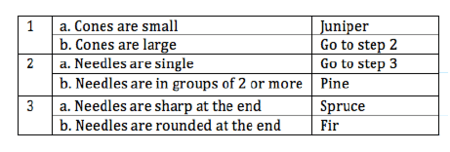

A student discovers an arachnid without a segmented abdomen, and legs longer than its body. The student uses the dichotomous key below to identify it. Which arachnid has the student found?
Whip Scorpion
Wind Scorpion
Daddy long legs
Scorpion

Which leaf is shown in the drawing?
Magnolia
Redbud
Sweetgum
None of the above

Identify the plant shown
A
B
C
D


Which organism has legs, has wings and is active at night?
Spider
Butterfly
Moth
Snail
Which two organisms are closely related?
Spider and butterfly
Snail and worm
Worm and spider
Centipede and snail
Which organism has no legs and no shell?
Spider
Snail
Centipede
Worm

What characteristics do a salamander and human share?
Can produce milk
Has limbs
Has opposable thumbs
Has speech

