
 Worksheets
Genetics
Total questions: 60
Worksheet time: 2hrs 57mins
Name
Class
Date
1.
G = green, g = yellow
The genotype for a yellow plant is...
The genotype for a yellow plant is...
a)
GG
b)
Gg
c)
gg
d)
all of the choices result in yellow
2.
Two heterozygous (Tt) tall pea plants are crossed. Which describes their offspring?
a)
50% tall and 50% short
b)
75%tall and 25% short
c)
100%short
3.
Having two identical alleles for a given trait, either both dominant or both recessive
a)
Homozygous
b)
Selective Breeding
c)
Mutation
d)
Carrier
4.
R=round seed
r=wrinkled seed.
Cross a homozygous round with a wrinkled. Which statement predicts the results?
r=wrinkled seed.
Cross a homozygous round with a wrinkled. Which statement predicts the results?
a)
offspring will be Rr
b)
offspring will be RR
c)
round seeds will be recessive to wrinkled
d)
Wrinkled will be observed in half of offspring
5.
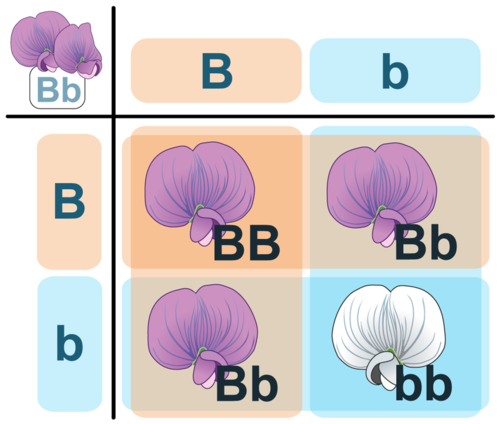
In this punnett square, which is the dominant trait?
The B stands for bud.
The B stands for bud.
a)
purple flower bud
b)
white flower bud
c)
dominant
d)
recessive
6.
What does heterozygous mean?
a)
An organism that has the same genes for a trait (TT or tt)
b)
An organism that has different genes for a trait (Tt)
c)
When neither gene is fully dominant; offspring is a mixture of both
d)
the different forms of a trait (hair color--> brown, blonde, red
7.
A homozygous dominant dog with brown fur is crossed with a heterozygous dog with brown fur. What are the percentages of the possible genotypes?
a)
100% BB
b)
75% BB and 25%Bb
c)
50 % BB and 50% Bb
d)
50% Bb and 50% bb
8.
Which of the following is a phenotype?
a)
BB
b)
Bb
c)
bb
d)
Blue eyes
9.

An offspring will receive how many alleles from each parent to determine a specific trait?
a)
one
b)
two
c)
three
d)
five
10.
Two brown eyed parents (Bb) have a baby. What is the chance the baby is blue eyed?
a)
0 %
b)
25%
c)
50%
d)
75%
11.
Tt is-
a)
homozygous dominant
b)
homozygous recessive
c)
heterozygous
d)
none of these
12.
An allele whose trait only shows up when no dominant allele is present.
a)
hidden allele
b)
dominant allele
c)
recessive allele
d)
present allele
13.

What is the percentage of offspring that have green pods?
a)
100%
b)
75%
c)
50%
d)
25%
14.
An organism’s physical appearance, or visible traits
a)
Recessive
b)
Genotype
c)
Phenotype
d)
Heterozygous
15.
Where, in the eukaryotic cell, is DNA located?
a)
ribosomes
b)
nucleus
c)
E.R.
d)
cytoplasm
16.
One form of a gene is called_______________
a)
a DNA
b)
a Phenotype
c)
a trait
d)
an allele
17.
What is the definition of genotype?
a)
The physical expression of a trait
b)
The genetic combination of alleles
c)
the genes on a DNA strand
18.
What is the definition of phenotype?
a)
The physical expression of a trait
b)
The genetic combination of alleles
c)
A gene on the DNA strand
19.
Which of the following genotypes is homozygous recessive?
a)
RR
b)
Rr
c)
rr
d)
None of the Above
20.
Dominant alleles are-
a)
capital
b)
lowercase
c)
both
d)
neither
21.
Recessive alleles are-
a)
capital
b)
lowercase
c)
both
d)
neither
22.
If a pea plant were homozygous recessive for height, how would its alleles be represented?
a)
TT
b)
Tt
c)
tt
d)
tT
23.

Which is the correct phenotype for this organism?
a)
BB
b)
blue
c)
green
d)
bb
24.

If green is dominant over purple, then what is the genotype for this individual?
a)
Purple
b)
Green
c)
GG
d)
gg
25.
Which characteristic is a lion least likely to pass on to its offspring?
a)
fur color
b)
length of tail
c)
scars on leg
d)
body size
26.

What is the genotype for this organism?
(E= 3 eyes, e= 1 eye)
(E= 3 eyes, e= 1 eye)
a)
EE
b)
Ee
c)
ee
d)
EE or Ee
27.
B - black, b - brown. Two black mice mate and have some black and some brown mice. What is the genotype of the parents?
a)
BB x Bb
b)
BB x bb
c)
Bb x Bb
d)
Bb x bb
28.
What are personal characteristics called that have been passed on to offspring from parents, such as dimples or eye color?
a)
recessive traits
b)
genetics
c)
inherited traits
d)
gene
29.
Pairs of genes that control the same trait are known as
a)
allelles
b)
gametes
c)
hybrids
d)
loci
30.
In screech owls, red feathers are dominant over gray feathers. If two heterozygous red-feathered owls are mated, what percentage of their offspring would be expected to have red feathers?
a)
25%
b)
50%
c)
75%
d)
100%
31.
An organism’s genetic makeup, or allele combinations
a)
Recessive
b)
Genotype
c)
Phenotype
d)
Heterozygous
32.
Having two different alleles for a given trait, usually one dominant and one recessive
a)
Recessive
b)
Genotype
c)
Phenotype
d)
Heterozygous
33.
An allele whose trait always shows up in the organism when the allele is present
a)
Gene
b)
Pedigree
c)
Punnett Square
d)
Dominant
34.
Which of the following always pairs with G in DNA?
a)
C
b)
G
c)
A
d)
T
35.
Which of the following always pairs with A in DNA?
a)
T
b)
C
c)
G
d)
A
36.
Scientific study of how traits are passed to offspring through genes
a)
Heredity
b)
Genetics
c)
Inheritance
d)
Allele
37.
What is the possibility of a bb child when you cross a BB with a Bb parent?
a)
100%
b)
75%
c)
50%
d)
0%
38.
What is the possibility of a bb child when you cross a Bb with a Bb parent?
a)
100%
b)
75%
c)
50%
d)
25%
39.
The nitrogen base adenine is always paired with the nitrogen base ____________.
a)
cytosine
b)
guanine
c)
thymine
d)
nitrogen
40.
Which of the following is the location of chromosomes ?
a)
mitochondria
b)
nucleus
c)
ribosomes
41.

Which of the following best describes a DNA molecule?
a)
double helix
b)
contains ribose
c)
made of amino acids
d)
contains Uracil
42.
Which of the following is the complement of DNA to: AATCCG
a)
TTAGGC
b)
UUAGGC
c)
UUTCCG
d)
A - C - G
43.
What is a phenotype?
a)
The expression of a trait; physical appearance.
b)
refers to the genetic makeup of an individual
c)
An organism that has the same genes for a trait (ex. TT or tt)
d)
the passing of traits from parent to offspring
44.
W=white hair
w= non-white hair
If you cross a horse with WW and a horse with ww what fraction of the offspring would be expected to have white hair?
w= non-white hair
If you cross a horse with WW and a horse with ww what fraction of the offspring would be expected to have white hair?
a)
none
b)
3/4
c)
1/2
d)
all
45.
Two brown eyed parents (Bb) have a baby. What is the chance the baby is blue eyed?
a)
0 %
b)
25%
c)
50%
d)
75%
46.
Which of the following is a phenotype?
a)
Aa
b)
red hair
c)
heterozygous
d)
DNA
47.
The nitrogen base guanine is always paired up with the nitrogen base ________________.
a)
thymine
b)
guanine
c)
cytosine
d)
adenine
48.

If the dominant allele (B) represents brown hair and the recessive allele (b) represents blonde hair, which offspring represents a homozygous recessive genotype?
a)
BB
b)
Bb
c)
blonde
d)
bb
49.
What part of our cells holds our DNA?
a)
cytoplasm
b)
cell membrane
c)
nucleus
d)
ribosomes
50.

The dominant trait is
a)
yellow pea seeds
b)
green pea seeds
c)
there is no dominant seed
d)
Jolly green giant
51.
A cell is...
a)
something we study in science class
b)
Not important
c)
a multicellular object
d)
the basic unit of life
52.
specific portions of DNA that determine hereditary characteristics .
a)
Genotype
b)
Gene
c)
Phenotype
53.
If an individual inherits one dominant allele and one recessive allele what is the genotype
a)
Homozygous, GG
b)
Heterozygous, gg
c)
Homozygous, Gg
d)
Heterozygous, Gg
54.
What characteristic would a child not inherit from parents?
a)
freckles
b)
eye color
c)
hair style
d)
dimples
55.
What is the scientific study of heredity called?
a)
Geneology
b)
Selective Breeding
c)
Genetics
d)
Heredity
56.

A heterozygous yellow pea plant's genotype would be:
a)
YY
b)
yy
c)
Yy
d)
Yg
57.
having two of the same genes for the trait (sometimes called purebred).
a)
homozygous
b)
hetrozygous
c)
protein
d)
chromosome
58.
having two different alleles for a trait (sometimes called hybrid).
a)
protein
b)
homozygous
c)
heterozygous
d)
genotype
59.
A homozygous dominant dog with brown fur is crossed with a heterozygous dog with brown fur. What are the percentages of the possible genotypes?
a)
100% BB
b)
75% BB and 25%Bb
c)
50 % BB and 50% Bb
d)
50% Bb and 50% bb
60.
Which characteristic is NOT inherited?
a)
Hairline (straight or widow's peak)
b)
Spoken language (English, Spanish, etc...)
c)
Earlobes (attached or detached)
d)
Hair type (straight or curly)
100 %

