wayground logo

Free Printable Worksheets

NEW

Font size

S
M
L
XL
Worksheets

The Chemistry of Cells

Total questions: 60

Worksheet time: 30mins

Name
Class
Date
1.
If a cell has a nucleus, then it must be what type of cell? 
a)
animal 
b)
prokaryotic 
c)
eukaryotic 
d)
 plant
2.
What is NOT part of the cell theory?
a)
All living things have blood cells. 
b)
All organisms are made of one or more cells.
c)
The cell is the basic unit of all living things.
d)
All cells come from existing cells. 
3.
The smallest part of matter is in this picture. What is it called?
a)
Atom
b)
molecule
c)
pebble
d)
piece
4.
Proteins are made up of small units called ____.
a)
Disaccharides
b)
Lipids
c)
Amino Acids
d)
Monosaccharides
5.
What is the function of nucleic acids?
a)
Stores energy
b)
Stores genetic information
c)
Movement
d)
Physical structure
6.
Another name for fats and oils
a)
proteins
b)
sugar
c)
lipids
d)
nucleic acids
7.
This organelle is in all eukaryotic cells. It is the control center of the cell because it holds the DNA.
a)
Mitochondria
b)
Nucleus
c)
Chloroplasts
d)
Ribosomes
8.
Which of these supports the cell theory as it is stated today?
a)
Cells must contain a nucleus
b)
All organisms are made of more than one cell
c)
All cells come from pre-existing cells
d)
Not all cells are alive
9.
Living or Nonliving?
Mouse
a)
Living
b)
Nonliving
10.
Living or Nonliving?
Plants
a)
Living
b)
Nonliving
11.
Living or Nonliving?
Paint
a)
Living
b)
Nonliving
12.
a)
Living
b)
Nonliving
13.
Grass
a)
Living 
b)
Nonliving
14.

Rocks

a)

Living

b)

Non-Living

15.
Which organism performs all life processes in one cell?
a)
grass
b)
bacteria
c)
mushroom
d)
butterfly
16.
Which best explains why humans are multicellular organisms?
a)
Human cells are too small to function alone.
b)
Human cells join together to form one large cell.
c)
Humans need many cells to carry out life processes.
d)
Humans have many systems that perform the same function.
17.
Which is an example of a single-celled organism?
a)
fish
b)
tree
c)
fungi
d)
human
18.
Basic unit of life
a)
Cell
b)
Tissue
c)
Organ
d)
Organ System
19.
Multicellular Organisms
a)
Made of 1 cell
b)
Made of more than 1 cell
20.

Is composed of a single cell

a)

Unicellular

b)

Multicellular

c)

Both

21.
Which organism performs all life processes in one cell?
a)
grass
b)
bacteria
c)
mushroom
d)
butterfly
22.
Which is an example of a multicellular organism?
a)
amoeba
b)
bacteria
c)
worm
d)
fungi
23.
Which is an example of a multicellular organism?
a)
bacteria
b)
bear
c)
algae
d)
yeast
24.
Bacteria is what kind of cell?
a)
Eukaryotic
b)
Prokaryotic
25.
What kind of cell is this?
a)
Eukaryotic
b)
Prokaryotic
26.
Cells can only be seen with the help of a...
a)
hand lens 
b)
magnifying glass
c)
3D glasses 
d)
microscope 
27.
All living things are made of...
a)
atoms 
b)
cells 
c)
bacteria 
d)
plants 
28.
What is unicellular? 
a)
one cell 
b)
many cells 
c)
no nuclues 
d)
DNA 
29.
What is multicellular? 
a)
one cell 
b)
no cells 
c)
many cells 
d)
no nucleus 
30.
All cells come from other...
a)
cells 
b)
plants 
c)
nucleus 
d)
microscopes 
31.
What type of cell has a nucleus? 
a)
eukaryotic
b)
prokaryotic 
32.
What type of cell does not have a nucleus?
a)
eukaryotic 
b)
prokaryotic 
33.
Plants and animal cells are examples of ___ cells 
a)
prokaryotic cells 
b)
eukaryotic cells 
34.

Where is DNA found in a Eukaryotic cell?

a)

in the nucleus

b)

in the cell wall

c)

in the vacuole

d)

in the mitochondria

35.
All of this type of cell are single celled. 
a)
animal
b)
prokariotic
c)
plant
d)
eukariotic
36.
Which of these is the smallest unit of living things?
a)
cells
b)
atoms 
c)
molecules
d)
compounds
37.
Which terms best describe heterotrophs?
a)
Plants; producers
b)
Animals; producers
c)
Plants; consumers
d)
Animals; consumers
38.
Which terms best describe autotrophs?
a)
Plants; producers
b)
Animals; producers
c)
Plants; consumers
d)
Animals; consumers
39.
From where do autotrophs obtain their energy?
a)
The sun
b)
Other organisms
40.
How can animals and fungi best be classified?
a)
Autotroph
b)
Heterotroph
41.
Which type of organisms are typically plants?
a)
Autotrophs
b)
Heterotrophs
42.

BUNNY

a)

AUTOTROPH

b)

HETEROTROPH

c)

AUTOPHOTOTROPH

d)

NONE OF THE ABOVE

43.
What is an autotroph?
a)
an organism that can make their own food. 
b)
an organism that cannot make their own food
c)
Herbivore
d)
Omnivore
44.

What process do heterotrophs use to obtain their food?

a)

photosynthesis

b)

chemosynthesis

c)

cellular respiration

d)

cellular synthesis

45.

Organisms that cannot make their own food and must get energy from eating other organisms are called...

a)

autotrophs

b)

heterotrophs

c)

plants

46.

In what organelle is the genetic material found inside?

a)

cell membrane

b)

chloroplast

c)

nucleus

d)

ribosome

47.

What organelle is called the "powerhouse" of a cell?

a)

mitochondria

b)

nucleus

c)

cell wall

d)

cell membrane

48.

A large central vacuole is found in a _____ cell.

a)

animal

b)

plant

49.

What is the function of a chloroplast?

a)

makes proteins for animal cells

b)

allows materials in and out of the cell

c)

provides structure and support

d)

absorbs sunlight for photosynthesis

50.

What is the structure that contains DNA and directs the cell?

a)

endoplasmic reticulum

b)

central vacuole

c)

cell wall

d)

nucleus

51.

Looking in a microscope, you see cells that have rectangular shapes and a green color. What type of cells are you probably viewing?

a)

plant cells

b)

animals cells

c)

muscle cells

d)

blood cells

52.

Identify the structure that is indicated by the arrow in the image.

a)

cell wall

b)

central vacuole

c)

chloroplast

d)

nucleus

53.

Identify the structure that is indicated by the arrow in the image.

a)

cell wall

b)

central vacuole

c)

chloroplast

d)

cell membrane

54.

The arrow is showing the fluid inside the cell that surrounds the cell organelles. What is the arrow pointing to in the cell?

a)

cytoplasm

b)

mitochondria

c)

ribosomes

d)

nucleus

55.

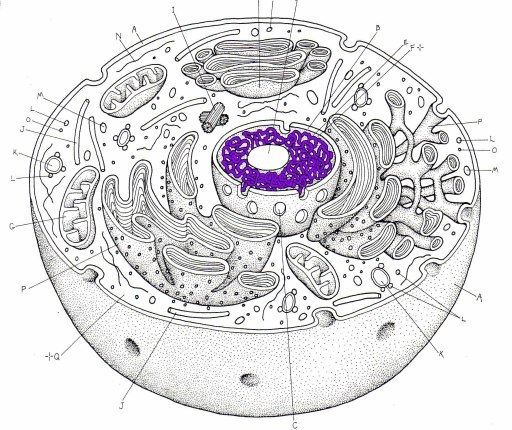
What type of cell is being shown in the image?

a)

plant

b)

animal

56.

Identify the structure that is labeled "C" in the image.

a)

central vacuole

b)

nucleus

c)

chloroplast

d)

mitochondria

e)

cell membrane

57.

Identify the structure that is labeled "H" in the image.

a)

cell wall

b)

chloroplast

c)

mitochondria

d)

nucleus

e)

cell membrane

58.

I make proteins for the cell. What am I?

a)

ribosome

b)

cell membrane

c)

nucleus

d)

chloroplast

59.
Gives the cell a rigid, box-like shape; outside of the cell membrane; in plants.
a)
cytoplasm
b)
chromatin
c)
cell wall
d)
cell membrane
60.
Which part of the cell is often called "the brain of the cell"?
a)
nuclear membrane
b)
endoplasmic reticulum
c)
nucleus
d)
ribosomes