
 Worksheets
Earth's Processes Practice
Total questions: 56
Worksheet time: 46mins
Name
Class
Date
1.
An instrument that detects and measures earthquakes is a
a)
seismogram
b)
focus seismic map
c)
focus
d)
seismograph
2.
a scientist who studies earthquakes
a)
seismologist
b)
seismogram
c)
seismograph
3.
The point along a fault at which the first motion of an earthquake occurs
a)
focus
b)
epicenter
c)
surface
d)
fault
4.
Measures the magnitude or size, of an Earthquake
a)
epicenter
b)
liquefaction
c)
Richter scale
d)
aftershock
5.
Weaker earthquakes that follow a stronger earthquake
a)
aftershock
b)
epicenter
c)
seismograph
d)
P waves
6.
Where are most faults located?
a)
Along plate boundaries
b)
Along mountain ranges
c)
Near volcanoes
d)
In the ocean
7.
What is a fault?
a)
A place where two tectonic plates meet
b)
A break in the Earth's lithosphere
c)
A shaking of the ground cause by the movement of large rocks
d)
An opening in the Earth's crust where magma comes up
8.

A tsunami is caused by______
a)
lots of rain
b)
a meteorite
c)
a tornado
d)
an earthquake
9.

What is a tsunami?
a)
a large a long, high sea wave
b)
a moving of the earth
c)
magma flowing from inside the earth
d)
a column of rotating air
10.

What is the definition of dormant?
a)
sleeping
b)
extinct
c)
active
d)
invisible
11.

What are scientists that study volcanoes called?
a)
doctor
b)
vet
c)
volcanologist
d)
volcano scientist
12.

What is the opening that extends from the magma chamber to the top of the volcano called?
a)
magma
b)
lava
c)
vent
d)
crater
13.

What is Magma when it reaches the surface of Earth?
a)
Lava
b)
Mafic Magma
c)
Felsic Magma
d)
None of these
14.

A volcano that has gentle sloping sides and is formed from runny lava
a)
Shield volcano
b)
Cinder cone
c)
Composite
d)
None of these
15.

When an explosive eruption forms a mixture of hot rock, ash, and gas, this material is called a...?
a)
Land slide
b)
Lava
c)
Eruption trail
d)
Pyroclastic flow
16.
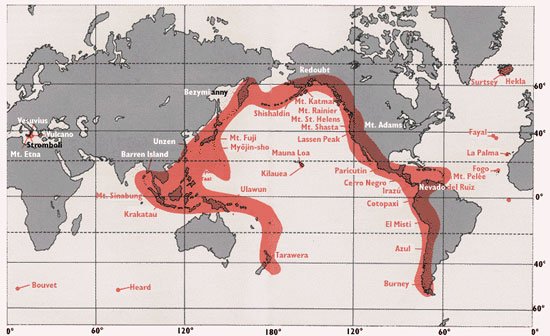
This is the name for the chain of volcanos around the edge of the Pacific Plate.
a)
Circle of Fire
b)
Ring of Lava
c)
Ring of Fire
d)
Circle of Magma
17.

A volcano that is made from layers of both runny lava and lava chunks is called
a)
a shield volcano
b)
a cinder cone volcano
c)
a composite volcano
18.

This city was destroyed in 79 A.D. by the eruption of Mt. Vesuvius.
a)
Rome
b)
Munich
c)
Pompeii
d)
Naples
19.
What layer is the hottest?
a)
Core
b)
Crust
c)
Mantle
20.

Which layer is made up of iron and nickel?
a)
Crust
b)
Mantle
c)
Inner Core
d)
Lithosphere
21.
What are the two types of crust?
a)
top crust,bottom crust
b)
oceanic crust, continental crust
c)
water,land
d)
none of the above
22.
Scientists determine what Earth’s interior looks like by using:
a)
Volcanoes
b)
Seismic Waves
c)
Continental Drift
d)
Convection Currents
23.
What layer of Earth do we live on?
a)
Crust
b)
Core
c)
Mantle
24.
The five PHYSICAL layers of the Earth are...
a)
Crust, Mantle, Core
b)
Crust, Upper Mantle, Lower Mantle, Inner Core, Outer Core
c)
Eurasia, North America, South America, Antarctica, Africa
d)
Lithosphere, Asthenosphere, Mesosphere, Outer Core, Inner Core
25.
The three COMPOSITIONAL layers of the Earth are...
a)
Lithosphere, Asthenosphere, Atmosphere
b)
Crust, Mantle, Core
c)
Crust, Upper Mantle, Lithosphere
d)
Upper Mantle, Asthenosphere, Mesosphere
26.
The thinnest layer of the Earth is?
a)
Mantle
b)
Lithosphere
c)
Athenosphere
d)
Crust
27.
The lithosphere combines what two layers?
a)
Athenosphere & Crust
b)
Crust & Upper Mantel
c)
Mantel & Athenosphere
28.
Which layer of Earth is made up of tectonic plates?
a)
outer core
b)
inner core
c)
asthenosphere
d)
lithosphere
29.
The soft layer of the mantle on which the tectonic plates move
a)
Asthenosphere
b)
Outer Core
c)
Mantle
d)
Mesosphere
30.
What was the name given to all the continents when they were joined as one super continent?
a)
Supreme Continent
b)
Eurasia
c)
Plate tectonics
d)
Pangea
31.

Name the boundary
a)
convergent boundary
b)
divergent boundary
c)
transform boundary
d)
sergent boundary
32.

Name the boundary
a)
convergent boundary
b)
divergent boundary
c)
transform boundary
d)
sergent boundary
33.

Name the boundary
a)
convergent boundary
b)
divergent boundary
c)
transform boundary
d)
sergent boundary
34.
Where does the heat come from that drives this convection current in the mantle?
a)
The sun
b)
The crust
c)
the mantle
d)
the core
35.
Which of the following occurs because of convection currents?
a)
Tectonic plates on the crust move.
b)
The mantle increases in size.
c)
Pressure in the crust increases.
d)
Pressure in the crust decreases.
36.
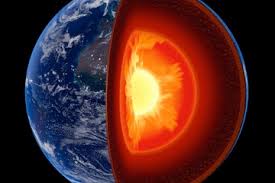
As you travel from the inner core to the crust, how would temperature, pressure and density of the material change?
a)
The would all increase
b)
The would all decrease.
c)
They would stay the same.
d)
Temperature would decrease, but pressure and density would increase.
37.
What does the theory of continental drift state?
a)
The continents were once joined in a super-continent and have moved over time
b)
Continents are stationary and do not move
c)
The Earth is broken into lithospheric plates that move due to convection currents
d)
none of the above
38.
Associated with transform boundaries.
a)
Volcanoes
b)
mountains
c)
trenches
d)
earthquakes
39.
Oceanic crust is
a)
Younger and less dense than continental crust
b)
Thinner, younger and more dense than continental crust
c)
Older, thicker and less dense that continental crust
d)
Bigger and younger than continental crust
40.
What is molten rock that has formed deep within the Earth?
a)
Hot Spot
b)
Magma
c)
Lava
d)
Volcano
41.
Why does magma tend to rise to the surface?
a)
It has large amounts of silica.
b)
It contains very little silica.
c)
It is denser than the surrounding material.
d)
It is less dense than the surrounding material.
42.
What type of volcano has steep slopes made of alternating layers of ash and silica rich lava?
a)
Caldera
b)
Cinder Cone
c)
Composite Volcano
d)
Shield Volcano
43.
What type of volcano is made of lava fragments that have been ejected from a volcanic vent?
a)
Caldera
b)
Cinder Cone
c)
Composite Volcano
d)
Shield Volcano
44.
Where are most volcanoes found?
a)
Southern Hemisphere
b)
Ring of Fire
c)
Mid-Atlantic Ridge
d)
Hot Spots
45.
What is molten rock that has reached the Earth's surface?
a)
Aa
b)
Lava
c)
Magma
d)
Pahoehoe
46.
What is the definition of dormant?
a)
sleeping
b)
extinct
c)
active
d)
invisible
47.

Volcanoes are found...
a)
on land
b)
under water
c)
on islands
d)
all of the above
48.
Volcanoes that are NOT found at plate boundaries occur in the middle of plates in areas called ___________.
a)
hot spots
b)
mid-ocean ridges
c)
fissure volcanoes
d)
shield volcanoes
49.
Most volcanoes occur at which 2 types of plate boundaries?
a)
convergent w/ subduction and divergent
b)
divergent and transform
c)
divergent and hot spots
d)
convergent w/ subduction and hot spots
50.
__________ volcanoes are formed from fast flowing, lava which flows easily over the surface, forming larger volcanoes with gentle sides.
a)
Cone
b)
Composite
c)
Angel
d)
Shield
51.
75% of America's volcanoes are found in this state...
a)
Washington
b)
Oklahoma
c)
California
d)
Alaska
52.
What type of seismic wave travels compressionally?
a)
P wave
b)
S wave
c)
Surface
d)
None
53.
Which is the fastest type of seismic wave?
a)
p-waves
b)
s-waves
c)
surface waves
54.

The place where the earthquake is felt on the Earth's surface is called the...
a)
Epicenter
b)
Hypocenter (focus)
c)
Surface
d)
Crust
55.

Earthquakes happen every day. Most are too small for humans to notice.
a)
True
b)
False
56.

Which image models secondary waves?
a)
Top
b)
Bottom
c)
Both
100 %

