wayground logo

Free Printable Worksheets

Font size

S
M
L
XL
Worksheets

Ace Biotic vs Abiotic/food web vs chains/Biodiversity

Total questions: 60

Worksheet time: 3600secs

Name
Class
Date
1.

High biodiversity makes the food web more complex and better able to support the most species, even if some populations decrease.

a)

True

b)

False

2.

High biodiversity ensures that many different ecological niches (jobs, roles) are filled, which helps the ecosystem function well.

a)

True

b)

False

3.

High biodiversity makes it more likely that the ecosystem will be able to keep functioning after a disturbance, such as disease or natural disaster.

a)

True

b)

False

4.

High biodiversity makes an ecosystem more sustainable because the food web is stronger and organisms perform a wider variety of functions.

a)

True

b)

False

5.

A stable ecosystem typically has high biodiversity.

a)

True

b)

False

6.

High biodiversity is a sign of a healthy ecosystem.

a)

True

b)

False

7.
What is the difference between biotic and abiotic?
a)
Biotic are non-living things
b)
Abiotic are living organisms
c)
Biotic is life,
Abiotic is non-living
d)
Biotic is non-living, Abiotic is living
8.
 Which biome is more likely to survive a change in the environment?
a)
High (rich) biodiversity
b)
Low (poor) biodiversity
9.
What does biodiversity mean?
a)
Only one species in an area.
b)
The different amount of species in an area
c)
All abiotic life
d)
Nitrogen fixation
10.
What happened to the wolf population between 1980 and 1982?
a)
it increased rapidly
b)
it decreased rapidly
11.

Image "B" shows more biodiversity than image "A". Why?

a)

Because "B" shows more different species than image "A"

b)

Because image "B" has less different species than "A"

c)

"A" has a greater number of same species plants so this statement is wrong.

d)

Both images show the same biodiversity

12.

A rock

a)

Biotic (living)

b)

Abiotic (non-living)

13.

Zebra

a)

Biotic (living)

b)

Abiotic (non-living)

14.

Temperature

a)

Biotic (living)

b)

Abiotic (non-Living)

15.

Sand

a)

Abiotic (non-living)

b)

Biotic (living)

16.

Sunlight

a)

Biotic (living)

b)

Abiotic (non-living)

17.

wind

a)

Biotic (living)

b)

Abiotic (non-living)

18.

Spider

a)

Abiotic (non-living)

b)

Biotic (living)

19.
Which of the following is not an abiotic factor?
a)
sun
b)
temperature
c)
soil
d)
grass
20.
A living or once-living organisms in an ecosystem is a
a)
population
b)
biotic factor
c)
abiotic factor
d)
community
21.

A system made up of all the living and non-living things interacting with one another

a)

biology

b)

abiotic

c)

biotic

d)

ecosystem

22.

Is your cellphone considered abiotic or biotic?

a)

Abiotic

b)

biotic

c)

neither

23.

Bio means _________.

a)

non-living

b)

not/without

c)

life

24.
A is the prefix that means ____________.
a)
life
b)
living
c)
not/ without
d)
biotic factor
25.

Precipitation (rain, snow, sleet, hail)

a)

Biotic factor

b)

Abiotic factor

26.

Bacteria

a)

Biotic factor

b)

Abiotic factor

27.

Is a Cat considered abiotic or biotic?

a)

Abiotic

b)

Biotic

28.

Climate

a)

Biotic factor

b)

Abiotic factor

29.

Soil or dirt

a)

Biotic factor

b)

Abiotic factor

30.
The relationship between ALL the organisms in a community showing who eats whom is called a ___________________________.
a)
Food Web
b)
Food Chain
c)
Abiotic Factors
d)
Biotic Factors
31.
One path that energy could take through an ecosystem is called a ________________________.
a)
Food Web
b)
Food Chain
c)
Abiotic Factors
d)
Biotic Factors
32.
Where does the energy that travels through an ecosystem originally come from?
a)
Earth's Core
b)
Water
c)
Plants
d)
The Sun
33.
An organism that lives by breaking down dead organic matter into simpler parts is a _______________________.
a)
scavenger
b)
consumer
c)
decomposer
d)
carnivore
34.
An animal that only eats other animals is a _______________.
a)
carnivore
b)
omnivore
c)
herbivore
d)
decomposer
35.
A living thing that makes its own food is called a __________________________.
a)
consumer
b)
producer
c)
carnivore
d)
herbivore
36.
If you connect all the food chains in an ecosystem you get a __________________________.
a)
food web
b)
food chain
c)
niche
d)
symbiosis
37.
A population of mice lives in a barn community. A cat population has just joined the community. What will happen?
a)
Mouse and cat populations both go up?
b)
Mouse and cat populations both go down
c)
Mouse population goes down as cat population goes up
d)
Mouse population goes up as cat population goes down
38.
Recently, a family of bobcats moved into an area with a large rabbit population. What changes may occur in the ecosystem?
a)
The rabbit population may increase
b)
The rabbit population may decrease
c)
The rabbit population may increase first, then decrease
d)
The rabbit population will remain the same
39.
An animal that eats only plants is a ______________________.
a)
carnivore
b)
omnivore
c)
herbivore
d)
decomposer
40.
Which organism do the owl and the weasel compete for in the food web?
a)
Hawk
b)
Spider
c)
Grasshopper
d)
Shrew
41.
Identify the correct food chain that demonstrates the energy flow of this food web
a)
Plant > Caterpillar > Bluebird > Eagle
b)
Plant > Lizard > Snail
c)
Plant >Lizard > Snail >Eagle
d)
Eagle >Lizard>Caterpillar>Plant
42.
What is a producer?
a)
an organism that gets energy from eating other organisms
b)
an organisms that uses sunlight to make its own food
c)
an organism that gets energy from eating dead organisms, non-living material or waste
d)
an organism that uses chemical energy to make its own food
43.
An energy pyramid represents what?
a)
How much sunlight is available for the ecosystem to use. 
b)
How much energy a particular organism needs. 
c)
How much energy is needed to build a pyramid. 
d)
The amount of energy available to the next 'feeder' in a food web.
44.

Which of the following organisms is a producer?

a)

grass

b)

rabbit

c)

fox

d)

snake

45.

Which of the following organisms is a primary consumer?

a)

grass

b)

rabbit

c)

fox

d)

snake

46.

Which of the following organisms in competition with the weasel for their food source?

a)

grass

b)

rabbit

c)

fox

d)

snake

47.

Which of the following organisms is a herbivore?

a)

grass

b)

rabbit

c)

fox

d)

snake

48.

What would happen to the rabbit population if the fox population moved out of the area represented by the food web?

a)

The rabbit population would increase

b)

The rabbit population would decrease

c)

The rabbit population would neither increase nor decrease
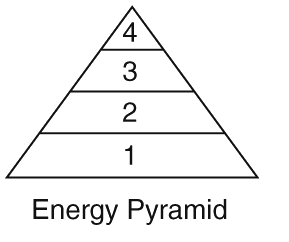
49.

Level 1 on the pyramid

a)

Producers

b)

Primary Consumer

c)

Secondary Consumer

d)

Tertiary Consumer

50.

Level 2 on the pyramid

a)

Producers

b)

Primary Consumer

c)

Secondary Consumer

d)

Tertiary Consumer

51.

Level 3 on the pyramid

a)

Producers

b)

Primary Consumer

c)

Secondary Consumer

d)

Tertiary Consumer

52.

Level 4 on the pyramid

a)

Producers

b)

Primary Consumer

c)

Secondary Consumer

d)

Tertiary Consumer

53.

Which section of the pyramid has the most energy?

a)

1

b)

2

c)

3

d)

4

54.

Which section of the pyramid has the least energy?

a)

1

b)

2

c)

3

d)

4

55.

How much energy moves up each level of the energy pyramid?

a)

5%

b)

10%

c)

50%

d)

90%

56.

How much energy is lost at each level of the energy pyramid?

a)

5%

b)

10%

c)

50%

d)

90%

57.

How many are only Primary Consumers (herbivores) ?

a)

1

b)

2

c)

3

d)

0

58.

How many are Omnivores (eat both plants/animals) ?

a)

1

b)

2

c)

3

d)

0

59.

How many are producers (makes their own food) ?

a)

1

b)

2

c)

3

d)

0

60.

What two organisms compete for the grasshopper as a food source (prey)?

a)

Fox and mouse

b)

Carrots and owl

c)

Rabbit and bird

d)

Owl and bird