
 Worksheets
GRADE 6. CELLS
Total questions: 60
Worksheet time: 1hrs 22mins
A cell is...
the basic unit of structure and function in living organism
an organism
a basic part of everything that we see
found only in animals, not plants
Which of the following are NOT found in animal cells?
chloroplasts and cytoplasm
chloroplasts and cell wall
cell wall and cell membrane
cell wall and nucleus
The jelly-like fluid part that surrounds the other parts in the plant and animal cells is called _____.
chloroplast
cytoplasm
vacuole
cell wall
What do sap vacuoles do?
They give the cells their shape.
They protect the cell.
They are the brain of the cell.
They are used for storage.
Which part of cells helps plants with the process of photosynthesis (to make food)?
Vacuole
Mitochondria
Cytoplasm
Chloroplast
A large vacuole is found in a/an _____ cell.
animal
plant
both plant and animal
none of them

Identify the structure that is indicated by the arrow in the image.
cell wall
sap vacuole
chloroplast
nucleus

The arrow is showing the fluid inside the cell that surrounds the other parts. What is the arrow pointing to in the cell?
cytoplasm
cell membrane
chloroplast
nucleus
Which part is strong, stiff and gives the cell a rigid, box-like shape?
cytoplasm
chloroplasts
cell wall
cell membrane
Which structure is found in plant cells and not in animal cells?
cell wall
cell membrane
nucleus
cytoplasm

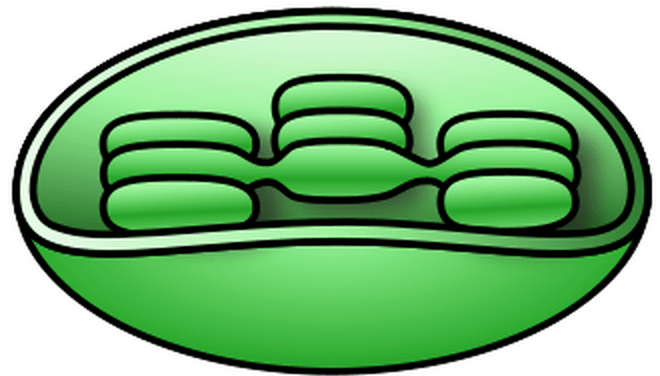
I am only found in a plant cell. What am I?
cell wall
vacuole
cytoplasm
chloroplast
All things are made of cells.
True
False
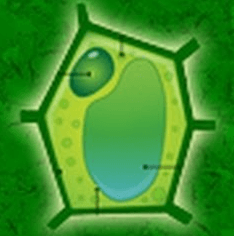

surrounds the cell; thin and flexible; regulates what enters/leaves cell
sap vacuole
cytoplasm

Student 1: Cell 1 is a plant cell because it has a cell wall
Student 2: Cell 2 is an animal cell because it has a nucleus
Student 3: Cell 1 is a plant cell because it has chloroplasts
Student 4: Cell 2 is an animal cell because it has a cell membrane
Who is correct?
Which of the following shows the levels of organization in order from simple to complex?
1. Cell
2. Tissue
3. Organ
4. Organ System
5. Organism
1. Cell
2. Tissue
3. Organelle
4. Organ
5. Organ System
1. Tissue
2. Organelle
3. Cell
4. Organ
5. Organism
1. Organ
2. Tissue
3. Cell
4. Organism
5. Organ System
Cells combine to form...
tissue
organs
organ systems
organisms
Tissues combine to form...
cells
organs
organ systems
organelles
Organs combine to form...
organ systems
organs
tissues
organisms
Organ systems combine to form...
cells
tissues
organs
organisms
Which level of organization is the smallest and simplest?
Cell
Tissue
Organ
Organ System
Organisms
Which level of organization is the largest and most complex?
Cell
Tissue
Organ
Organ System
Organism

Organs that work together are part of a(n) ________________________.
cells
tissue
organ system

Group of organs with similar functions.
Organism
Cell
Organ
System

Group of tissues with similar functions.
Organelles
Cells
Tissues
Organs


This picture represents which of the levels of organization?
tissue
organism
organ
organ system

A group of tissues that work together is a(n) ______________________.
cell
organ
organ system

What is a group of cells that are alike and work together?
a cell team
a tissue
a cell family

Which type of specialized cell carries oxygen from the lungs all over the body?
red blood cells
skin cells
muscle cells
white blood cells (macrophages)
nerve cells (neurons)
Which type of specialized cell carries electrical signals through the body to the brain?
red blood cells
squamous (skin) cells
muscle cells
white blood cells (macrophages)
nerve cells (neurons)
Why would some cells contain more mitochondria than others?
They need more oxygen
They require more energy
They are bigger
They wouldn't; all cells contain the same amount of mitochondria

Red blood cells have a disk-shape with a lot of surface area.
This statement describes a STRUCTURE.
This statement describes a FUNCTION.
Red blood cells deliver oxygen to every part of the body.
This statement describes a STRUCTURE.
This statement describes a FUNCTION.

What is the function of nerve cells?
They are long and have finger-like projections.
Transport oxygen throughout the body.
Control DNA expression.
Transmit electrical signals to different parts of the body.
How does the neuron's form or shape help it perform its function?
It is round and disc like to carry plenty of oxygen.
It is cylindrical in order to stretch and relax.
It has axon and dendrite which help to collect and let electrical signals travel very quickly.
It is flat so that gases can pass across easily.
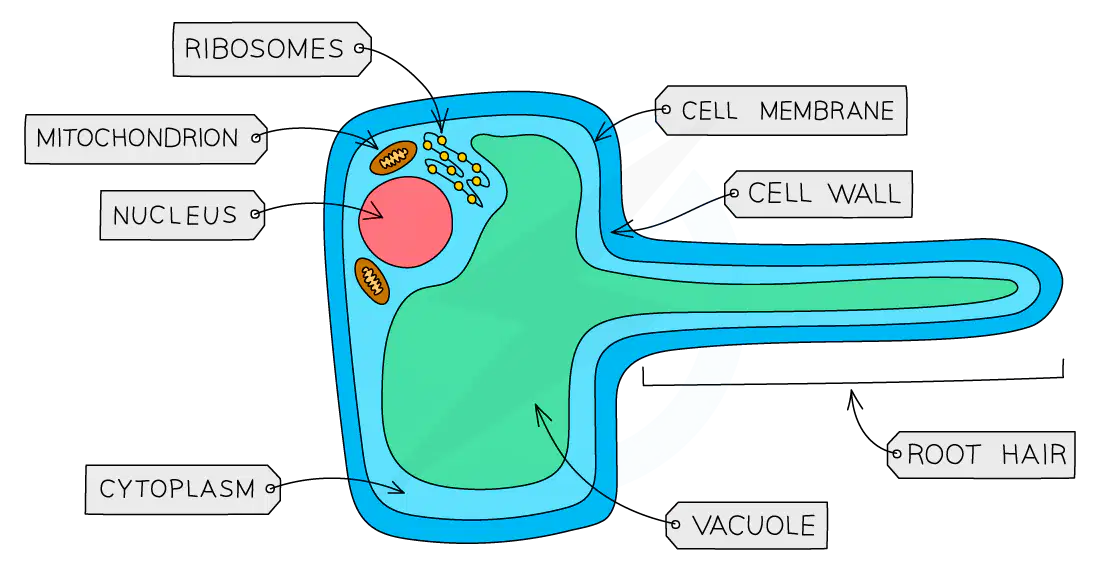
Which type of specialized cell has long and thin extension that allows water to move easily from soil and large vacuole to store water?
ciliated cells
palisade cells
neurones
red blood cells
root hair cells
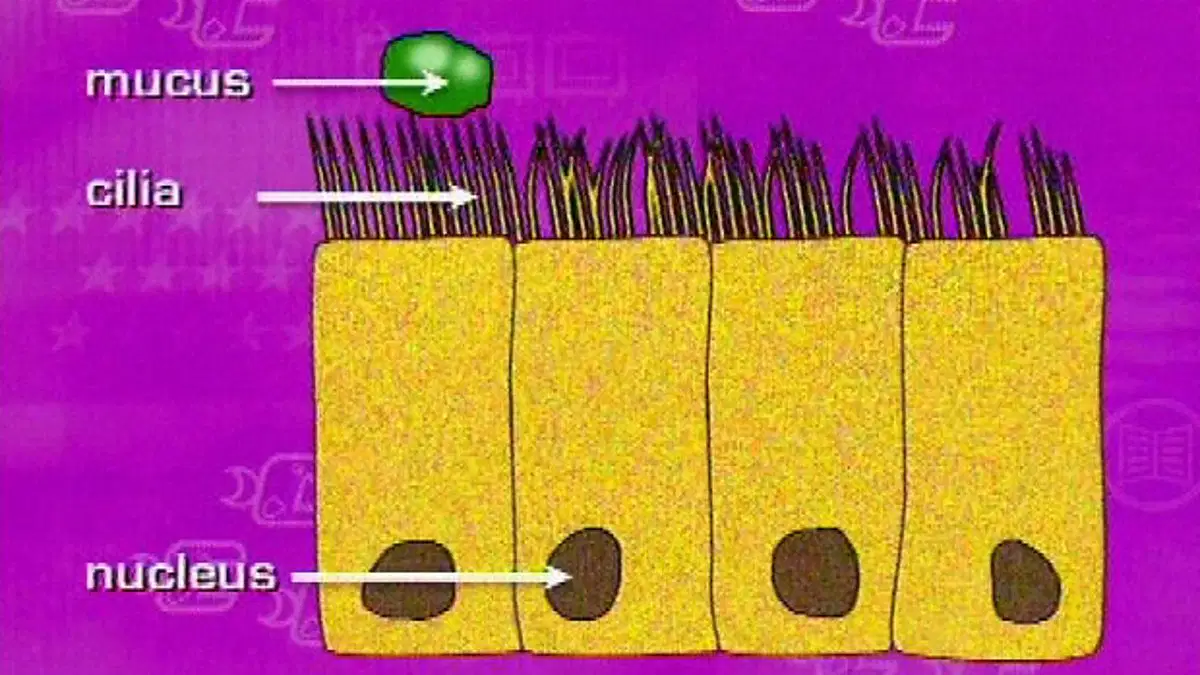
Which type of specialized cell has tiny threads along one edge which sweep mucus and stop them going to your lungs?
ciliated cells
palisade cells
neurones
red blood cells
root hair cells


What is the structure of red blood cells?
Disc-shaped with no nucleus
Tapered at each end
Long and cylindrical
Branched with intercalated discs
Mitochondrion

Nerve Cells
Palisade Cells
Smooth Muscle Cells
Chlorophyll

Which of these pictures shows plant cells under a microscope?

X-cell wall
Y-cytoplasm
Z-nucleus
x-nucleus
Y-cytoplasm
Z-Chloroplast
x-nucleus
Y-cell wall
Z-chloroplast
X-chloroplast
Y-cell wall
Z-nucleus

