
 Worksheets
WED Water Review 2025
Total questions: 20
Worksheet time: 10mins
Name
Class
Date
1.
Sediment is deposited as a river enters a lake because the
a)
velocity of the river decreases
b)
force of gravity decreases
c)
volume of water increases
d)
slope of the river increases
2.
Which characteristics of a particle would usually result in the longest settling time for the particle in calm water?
a)
Low density and round shape
b)
Low density and flat shape
c)
High density and round shape
d)
High density and flat shape
3.
When small particles settle through water faster than large particles, the small particles are probably
a)
lighter
b)
flatter
c)
better sorted
d)
more dense
4.
Where is the most deposition likely to occur?
a)
On the side of a sand dune facing the wind
b)
At the mouth of a river, where it enters an ocean
c)
At a site where glacial ice scraped bedrock
d)
At the top of a steep slope in a streambed
5.
Deposition within a meandering stream usually occurs on the inside of the curves because the
a)
water velocity decreases
b)
stream gradient increases
c)
water is deeper
d)
stream is narrower
6.
When wind and running water gradually decrease in velocity, the transported sediments are deposited
a)
all at once, and are unsorted
b)
all at once, and are sorted by size and density
c)
over a period of time, and are unsorted
d)
over a period of time, and are sorted by size and density
7.
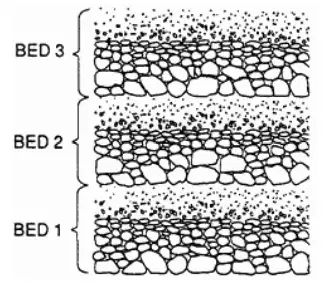
The diagram below shows three beds of sediment deposited at different times in a quiet body of water. The sediment deposited in each bed is best described as
a)
sorted mainly according to particle size
b)
sorted mainly according to particle shape
c)
a mixture of sorted and unsorted particles
d)
showing no evidence of sorting
8.

The graph below shows the relationship between particle shape and settling rate. Which statement best describes the relationship shown?
a)
Flatter particles settle more slowly than rounder particles.
b)
Flatter particles settle faster than rounder particles.
c)
All particles settle at the same speed.
d)
Particle shape does not affect settling rate.
9.
Which graph best represents the correct relationship between the discharge of a river and the particle size that can be transported by that river?
a)
A
b)
B
c)
C
d)
D
10.
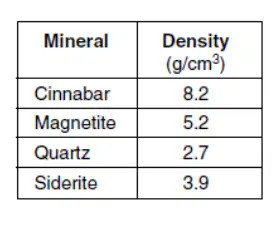
The table below shows the density of four mineral samples. If the shape and size of the four mineral samples are the same, which mineral will settle most slowly in water?
a)
Cinnabar
b)
Magnetite
c)
Quartz
d)
Siderite
11.
Trees growing on the edge of a river's meander are most likely to fall into the river due to
a)
deposition on the inside of the meander
b)
deposition on the outside of the meander
c)
erosion on the inside of the meander
d)
erosion on the outside of the meander
12.
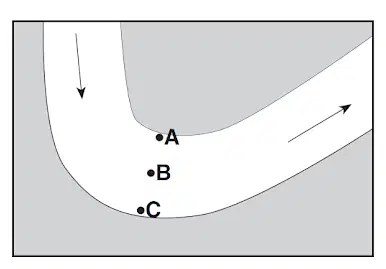
The map below shows the bend of a large meandering stream. The arrows show the direction of stream flow, Letters A, B and C are positions on the streambed where erosion and deposition data were collected.
Which table best represents the locations where erosion and deposition are dominant and where an equilibrium exists between the two processes?
a)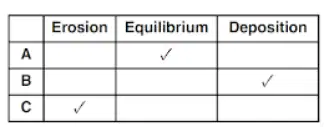
A
b)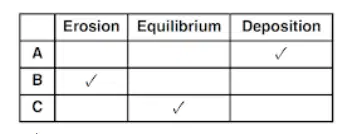
B
c)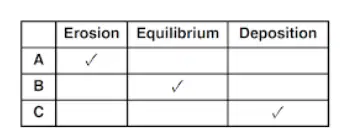
C
d)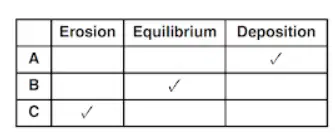
D
13.
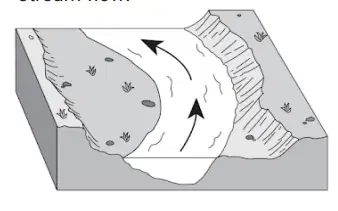
The diagram below shows a section of a meander in a stream. The arrows show the direction of stream flow.
The streambank on the outside of this meander is steeper than the streambank on the inside of this meander because the water on the outside of this meander is moving
a)
slower, causing deposition
b)
faster, causing deposition
c)
slower, causing erosion
d)
faster, causing erosion
14.
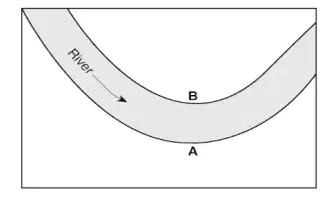
The map below shows the path of a river. The arrow shows the direction the river is flowing. Letters A and B identify the banks of the river.
The water depth is greater near bank A than bank B because the water velocity near bank A is
a)
faster, causing deposition to occur
b)
faster, causing erosion to occur
c)
slower, causing deposition to occur
d)
slower, causing erosion to occur
15.
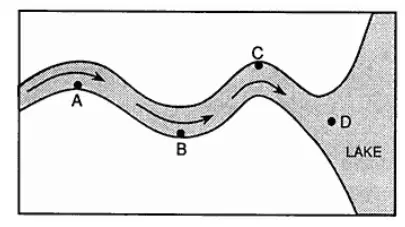
The map below shows the top view of a meandering stream as it enters a lake.
At which points along the stream are erosion and deposition dominant?
a)
Erosion is dominant at A and D, and deposition is dominant at B and C.
b)
Erosion is dominant at B and C, and deposition is dominant at A and D.
c)
Erosion is dominant at A and C, and deposition is dominant at B and D.
d)
Erosion is dominant at B and D, and deposition is dominant at A and C.
16.
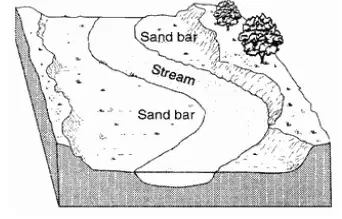
The diagram below shows a portion of a stream. The sand bars formed as a direct result of
a)
erosion due to a decrease in stream velocity
b)
erosion due to an increase in stream velocity
c)
deposition due to a decrease in stream velocity
d)
deposition due to an increase in stream velocity
17.
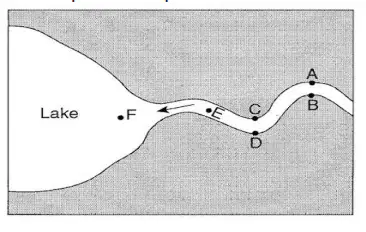
The map below represents a river as it enters a lake.
At which locations is the amount of deposition greater than the amount of erosion?
a)
A, C and E
b)
B, C and F
c)
B, D and F
d)
A, D and E
18.
Outwash plains are formed as a result of deposition by
a)
landslides
b)
ocean waves
c)
winds from hurricanes
d)
meltwater from glaciers
19.
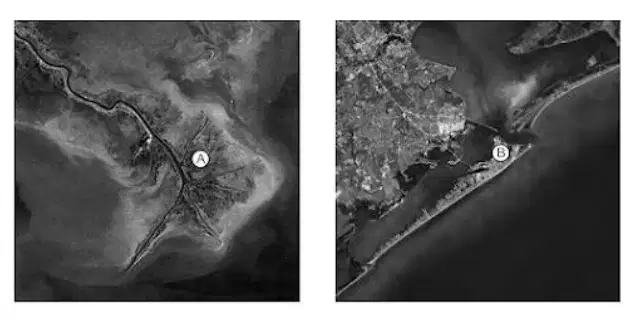
The photograph below shows two depositional features labeled A and B.
Which terms correctly identify depositional features A and B?
a)
A: Delta; B: Barrier Island
b)
A: Sand Bar; B: Island Arc
c)
A: Barrier Island; B: Delta
d)
A: Island Arc; B: Sand Bar
20.
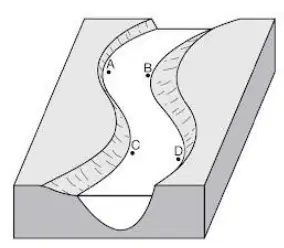
A decrease in the velocity of this stream will most likely cause an increase in
a)
the amount of sediment carried by the stream
b)
the size of the particles carried by the stream
c)
the deposition within the stream channel
d)
abrasion of the stream channel
100 %

