
 Worksheets
Quiz on Kecerdasan Buatan
Total questions: 90
Worksheet time: 45mins

What is the main question posed in the introduction regarding machines?
Can machines think?
How do machines work?
What is the history of machines?
Can machines replace humans?
What term is used in the introduction to describe the concept of thought or thinking?
Mind
Brain
Intelligence
Logic
What is the meaning of intelligence according to Winston and Pendergast (1994)?
The ability to memorize facts and figures.
The ability to learn or understand from experience, respond effectively to new situations, and solve problems using reasoning.
The ability to perform physical tasks quickly and efficiently.
The ability to communicate fluently in multiple languages.
Which of the following is NOT a characteristic of intelligence as described by Winston and Pendergast (1994)?
Understanding contradictory and ambiguous messages.
Responding quickly and effectively to new situations.
Using reasoning to solve problems effectively.
Memorizing large amounts of information.
According to Winston and Pendergast (1994), intelligence involves the ability to:
Learn from experience and solve problems effectively.
Perform physical tasks with precision.
Memorize and recall information accurately.
Communicate effectively in multiple languages.
What is the definition of Artificial Intelligence according to H. A. Simon (1987)?
The study of how computers can perform tasks better than humans.
The area of research, application, and instruction related to programming computers to do something considered intelligent by humans.
The process of creating machines that mimic human emotions.
The development of software that automates repetitive tasks.
According to Rich and Knight (1991), what is the focus of their study on Artificial Intelligence?
How to make computers perform tasks that humans currently do better.
How to create machines that can think independently.
How to program computers to replicate human emotions.
How to automate simple computational tasks.
Why is Artificial Intelligence (AI) necessary?
Almost all problems can be solved with the help of computers.
Increasingly complex problems cannot be solved manually anymore.
There are no longer hardware limitations.
Human desire: Computers act like humans.
What is the perspective of "Sudut Pandang Kecerdasan" in artificial intelligence as described in the material?
Making machines capable of performing tasks better than humans.
Making machines intelligent to act like humans.
Studying how computers can perform tasks as well as humans.
Creating machines that can only perform repetitive tasks.
What does "Sudut Pandang Penelitian" focus on in artificial intelligence?
Studying how computers can perform tasks as well as humans.
Making machines capable of performing tasks better than humans.
Creating machines that can only perform repetitive tasks.
Making machines intelligent to act like humans.
What does "Sudut Pandang Bisnis" refer to in the context of artificial intelligence?
The study of symbolic programming and problem solving
A collection of powerful tools and methodologies to solve business problems
The process of searching for solutions in programming
The study of artificial intelligence in the medical field
What does "Sudut Pandang Pemrograman" focus on in artificial intelligence?
The study of symbolic programming, problem solving, and searching
The application of AI in business problem-solving
The development of AI tools for medical research
The use of AI for environmental studies
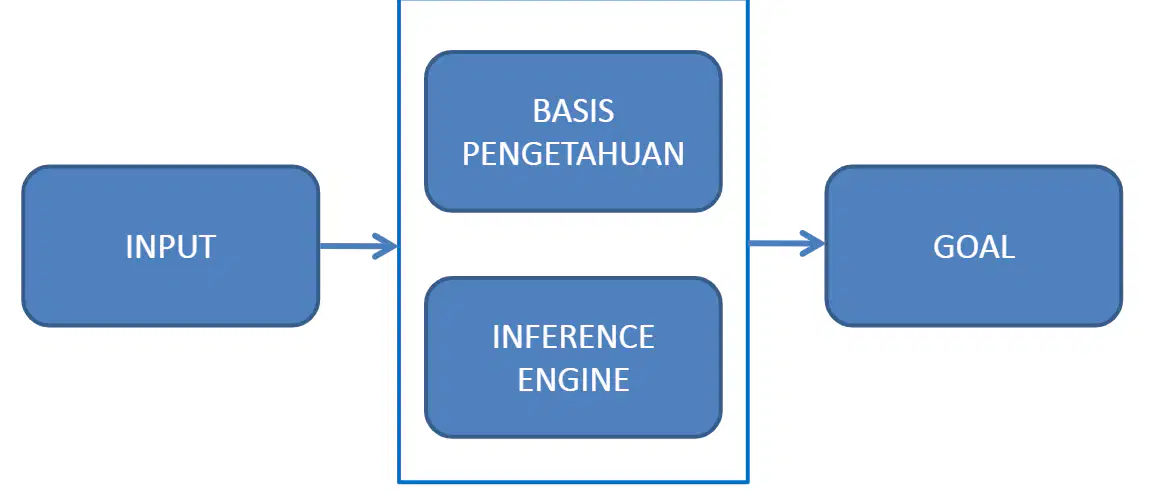
What is the main purpose of the "Inference Engine" in the architecture of intelligence?
To store knowledge for future use
To process input and derive conclusions
To define the ultimate goal of the system
To act as the input source for the system
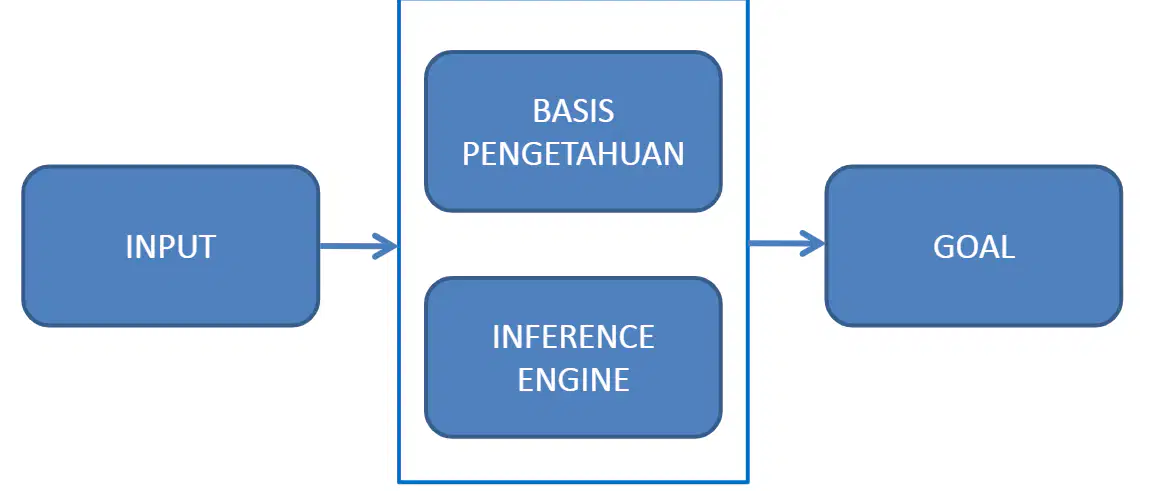
Which component in the architecture of intelligence is responsible for storing knowledge?
Input
Basis Pengetahuan (Knowledge Base)
Inference Engine
Goal
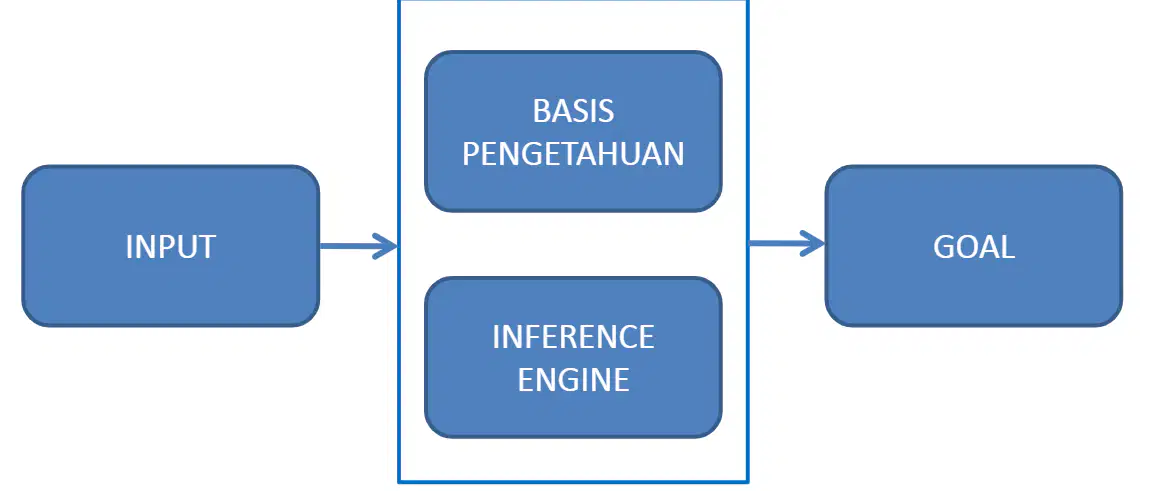
What is the role of the "Input" in the architecture of intelligence?
To store knowledge
To provide data for processing
To define the system's goal
To execute reasoning tasks
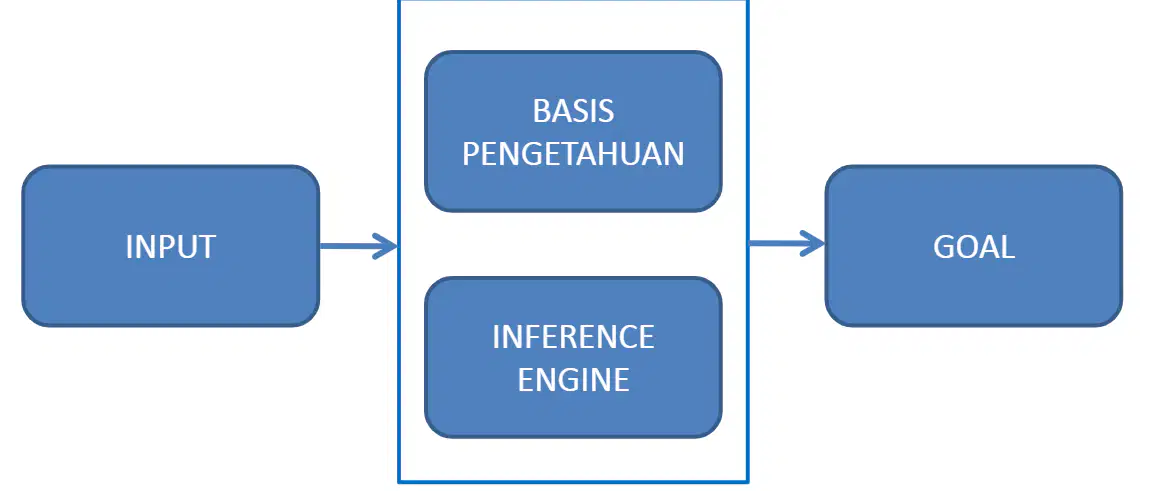
In the architecture of intelligence, what does the "Goal" represent?
The final output or objective of the system
The process of reasoning and decision-making
The storage of knowledge
The input data for the system
What is the primary function of a "Basis Pengetahuan" (knowledge base)?
To store facts, theories, and relationships between components.
To perform calculations and mathematical operations.
To generate conclusions based on experience.
To duplicate processes using machines.
What does "Motor Inferensi" (inference engine) primarily involve?
Storing facts and theories.
Drawing conclusions based on experience.
Performing mathematical operations.
Organizing data into categories.
Which of the following is an example of a "Motor Inferensi" (inference engine)?
A database storing facts and theories.
A robot or computer duplicating processes.
A manual book for learning theories.
A collection of unrelated data.
What is the Turing Test used for in the context of Artificial Intelligence?
To test the speed of a computer
To evaluate the intelligence of a machine
To measure the efficiency of algorithms
To analyze symbolic processing in AI
Which of the following is a key characteristic of symbolic processing in Artificial Intelligence?
It involves only algorithmic processes
It is unrelated to computer science
It uses symbolic and non-algorithmic methods to solve problems
It focuses solely on hardware optimization
Who developed the concept of the Turing Test?
Alan Turing
John McCarthy
Marvin Minsky
Ada Lovelace
In the Turing Test, how many entities are involved in the process?
One
Two
Three
Four
What is the primary focus of symbolic processing in AI?
Hardware development
Symbolic and non-algorithmic problem-solving
Speed optimization
Data storage
What is the purpose of a heuristic strategy in problem-solving?
To guarantee the correct solution to a problem.
To guide the search process effectively in the problem space.
To eliminate all possible solutions except one.
To randomly select a solution from the problem space.
Which characteristic best describes a heuristic approach?
It ensures success in every scenario.
It follows a systematic and exhaustive search.
It focuses on paths with the highest likelihood of success.
It avoids decision-making entirely.
What does the term "search" refer to in the context of heuristics?
Random exploration of all possible solutions.
Effective navigation through the problem space.
Avoiding the problem space entirely.
Exhaustive testing of all solutions.
What does "Inferensi (Penarikan Kesimpulan)" in AI aim to achieve?
To create machines capable of reasoning and inferencing based on facts and rules using heuristic methods.
To match patterns in computational processes without logical relationships.
To store large amounts of data for future use.
To perform simple calculations without reasoning.
What is the primary goal of "Pencocokan Pola (Pattern Matching)" in AI?
To explain objects, events, or processes in logical or computational relationships.
To create machines capable of reasoning and inferencing.
To store and retrieve data efficiently.
To perform heuristic-based calculations.
What is the main goal of artificial intelligence?
To make computers smarter
To understand intelligence
To make machines more useful
To improve human creativity
What is one of the advantages of artificial intelligence compared to natural intelligence?
Artificial intelligence is less permanent.
Artificial intelligence is more expensive than natural intelligence.
Artificial intelligence offers ease of duplication and distribution.
Artificial intelligence is inconsistent and incomplete.
Which of the following is true about artificial intelligence compared to natural intelligence?
Artificial intelligence cannot be documented.
Artificial intelligence is cheaper than natural intelligence.
Artificial intelligence executes tasks slower than humans.
Artificial intelligence is less consistent than natural intelligence.
How does artificial intelligence perform tasks compared to humans?
Artificial intelligence performs tasks slower than humans.
Artificial intelligence performs tasks better and faster than humans.
Artificial intelligence performs tasks inconsistently.
Artificial intelligence cannot perform tasks better than humans.
What is a characteristic of artificial intelligence that makes it advantageous over natural intelligence?
Artificial intelligence is less permanent.
Artificial intelligence is inconsistent and incomplete.
Artificial intelligence can be documented.
Artificial intelligence is more expensive than natural intelligence.
What is one advantage of natural intelligence compared to artificial intelligence (AI)?
It is less creative.
It can perform direct learning processes.
It relies on narrow focus for decision-making.
It requires symbolic inputs for learning.
How does natural intelligence differ from AI in terms of focus for decision-making?
Natural intelligence uses narrow focus, while AI uses broad focus.
Natural intelligence uses broad focus, while AI uses narrow focus.
Both use narrow focus for decision-making.
Both use broad focus for decision-making.
What type of input does AI require for learning compared to natural intelligence?
AI requires direct learning processes.
AI requires symbolic inputs and representations.
AI requires broad focus for decision-making.
AI requires creative thinking.
Which AI system defeated Kasparov, the world chess champion?
PEGASUS
MARVEL
Deep Blue
Sistem robot
What is the primary function of the PEGASUS AI system?
Monitoring real-time data from Voyager aircraft
Handling speech-based transactions like finding the cheapest flight tickets
Driving a car at high speed on public roads
Playing chess against world champions
What does the MARVEL AI system monitor?
Chess games
Speech-based transactions
Real-time data from Voyager aircraft and signal anomalies
Road traffic conditions
Which AI system is designed to drive a car at high speed on public roads?
PEGASUS
MARVEL
Deep Blue
Sistem robot
What is the primary function of a diagnostic expert system in artificial intelligence?
To create new domains of knowledge
To correct the results of expert diagnoses with established reputations
To teach learning agents about gravitational centers
To develop face recognition software
What is the role of intelligent agents in artificial intelligence according to the text?
To focus solely on gravitational studies
To operate in various domains with rapidly increasing rates
To replace expert systems entirely
To develop security applications exclusively
Which application of artificial intelligence is mentioned in the text?
Weather prediction software
Face recognition software for security
Autonomous vehicle systems
Language translation tools
What is the purpose of teaching learning agents in artificial intelligence as described in the text?
To determine gravitational centers
To develop new diagnostic systems
To create intelligent agents for single domains
To replace human experts in all fields
What is Deep Blue?
A computer designed for playing chess by IBM
A chess tournament held in 1996
A software program for chess analysis
A book about chess strategies
Who was the world champion defeated by Deep Blue in a standard chess tournament?
Garry Kasparov
Magnus Carlsen
Bobby Fischer
Anatoly Karpov
What was the final score when Garry Kasparov defeated Deep Blue in their first match?
4-2
3-3
5-1
6-0
What is an example of artificial intelligence used in the field of defense and security?
Face Recognition Software
Weather Prediction Software
Language Translation Software
Virtual Reality Gaming Software
What is the primary function of face recognition software?
Detecting and recognizing faces
Predicting weather patterns
Translating languages
Creating virtual environments
What is the term used for the adaptation of human facial recognition by computers?
Face Recognition
Virtual Reality
Language Processing
Weather Analysis
What principle do AI developers adhere to when solving different problems?
Using a single universal technique for all problems
Developing techniques based on symbol manipulation (create, modification, reproduction, destruction)
Avoiding the use of symbols in problem-solving
Relying solely on predefined algorithms
What is one characteristic of knowledge required for intelligence?
It is static and unchanging
It is narrowly defined
It is broad and constantly evolving
It has a single, universal meaning
Which of the following is NOT a characteristic of knowledge mentioned ?
It is difficult to define precisely
It is always static
It can have different meanings depending on its use
It is very broad
What does intelligence require according to the text?
Creativity
Knowledge
Predefined rules
Fixed algorithms
Which AI technique is used to solve problems by shifting the framework to direct techniques when no direct approach is available?
Search
Use of Knowledge
Abstraction
Optimization
What does the "Use of Knowledge" technique in AI focus on?
Exploiting the structure of objects related to the problem
Separating important and unimportant information
Using direct techniques for problem-solving
Randomly selecting solutions
Which AI technique involves separating important information from irrelevant details to speed up problem-solving?
Search
Use of Knowledge
Abstraction
Optimization
What is the primary goal of the "Search" technique in AI?
To exploit the structure of objects related to the problem
To provide solutions when direct approaches are unavailable
To separate important and unimportant information
To optimize the problem-solving process
Which AI technique is best suited for solving complex problems by utilizing the structure of related objects?
Search
Use of Knowledge
Abstraction
Optimization
What is the primary consideration before developing an AI program, as mentioned in the text?
Whether the program can perform tasks smarter than humans.
Whether the program can perform tasks as intelligently as humans.
Whether the program can perform tasks in the same way as humans.
Whether the program can perform tasks more easily and efficiently than humans.
What is the purpose of answering the questions mentioned in the text before developing an AI program?
To determine the limitations of the system or program development.
To ensure the program is smarter than humans.
To create a program that mimics human behavior.
To avoid creating a program that is too complex.
Which of the following is NOT a question mentioned in the text regarding AI program development?
Can the program perform tasks as intelligently as humans?
Can the program perform tasks in the same way as humans?
Can the program perform tasks more easily and efficiently than humans?
Can the program replace human intelligence entirely?
What is the characteristic of 'Program kelas pertama' as described in the text?
It solves problems using complex algorithms and mechanisms.
It solves problems in a way that aligns perfectly with AI definitions.
It uses simple algorithms and mechanisms that are easy for computers but difficult for humans.
It is designed to be highly attractive for human implementation.
What is the Elementary Perceiver and Memorizer (EPAM) program designed to do?
Solve complex mathematical problems
Recall paired syllables from memory
Translate languages automatically
Perform psychometric analysis
Who developed the Elementary Perceiver and Memorizer (EPAM) program?
Alan Turing
Feigenbaum
John von Neumann
Marvin Minsky
Why is recalling syllables from memory easier for computers than humans?
Computers can process context better than humans
Computers store and retrieve data without considering context
Humans have faster memory retrieval than computers
Humans rely on psychometric tests for memory recall
What is one common use of tasks like recalling syllables in humans?
Language translation
Psychometric tests to measure memory ability
Artificial intelligence development
Contextual analysis in linguistics
What is the purpose of the second-class program mentioned in the text?
To simplify computer tasks.
To model human capabilities in performing tasks.
To create a new definition of AI.
To replace human psychology theories.
Who wrote the program PARRY in 1975, as mentioned in the text?
Alan Turing.
John McCarthy.
Colby.
Marvin Minsky.
What psychological behavior does the program PARRY exploit?
Anxiety.
Paranoid behavior.
Depression.
Aggression.
What is the role of psychologists in analyzing the results of conversations in the program PARRY?
To determine if someone is paranoid or not.
To diagnose physical illnesses.
To create new AI models.
To simplify human communication.
What is required for a computer to understand human reasoning according to the text?
The computer must simulate human reasoning processes.
The computer must be programmed to ignore human reasoning.
The computer must rely solely on pre-programmed responses.
The computer must avoid analyzing human behavior.
Why is it important for humans to understand computer reasoning as mentioned in the text?
To ensure humans trust computer outputs.
To make computers more autonomous.
To eliminate the need for human interaction with computers.
To reduce the complexity of computer programming.
What happens when the reasoning process used by computers aligns with human reasoning?
Humans find it easier to accept the explanations provided by computers.
Computers become less efficient in processing data.
Humans lose trust in computer outputs.
Computers require more resources to function.
What is the main reason humans are considered as a guide for solving problems or processing tasks, according to the text?
Humans have the ability to mimic machines.
Humans possess the best capability in problem-solving.
Humans are motivated by artificial intelligence.
Humans rely on machines for processing tasks.
What motivates AI developers to continue producing intelligent machines, as mentioned in the text?
The desire to replace human intelligence.
The need to create machines that mimic human behavior.
The goal of eliminating human involvement in tasks.
The ambition to surpass human problem-solving abilities.
What is the ultimate goal of exploiting knowledge collected from humans, as stated in the text?
To replace humans in all tasks.
To find ways to solve problems or process tasks.
To motivate humans to work harder.
To create machines that surpass human intelligence.
What is one of the most important questions to answer in a scientific research project?
How do we know if we have succeeded?
What is the purpose of the research?
How long will the research take?
What resources are required for the research?
In the context of AI, what question is similar in difficulty to "How do we know if we have succeeded?"
How do we know the machine we created is intelligent?
How do we know the machine is fast?
How do we know the machine is cost-effective?
How do we know the machine is user-friendly?
What is the challenge in answering the question "Is the machine intelligent?" in AI?
It requires ensuring the machine performs activities to confirm its intelligence.
It requires testing the machine's speed.
It requires analyzing the machine's design.
It requires comparing the machine to other technologies.
Who introduced the method to determine whether a machine can think, known as the Turing Test?
Charles Babbage
Alan Turing
Ada Lovelace
John von Neumann
How many participants are required to conduct the Turing Test?
1 person and 1 machine
2 people and 1 machine
3 people and 1 machine
2 people and 2 machines
What is the main goal of the Turing Test?
To determine if a machine can perform calculations faster than humans
To determine if a machine can deceive the questioner into thinking it is human
To test the speed of machine responses
To evaluate the machine's ability to store data
In the Turing Test, how does the questioner interact with the participants?
By speaking directly to them
By typing questions and receiving typed answers
By observing their physical behavior
By analyzing their voice responses
What strategy is suggested for the machine to successfully deceive the questioner in the Turing Test?
Always provide correct answers immediately
Provide incorrect answers deliberately
Answer correctly but delay responses
Avoid answering any questions
What is the main goal of the Turing Test as described in ?
To determine if a machine can answer all questions correctly.
To evaluate the speed of a machine's responses.
To assess whether a machine can be perceived as a human.
To test the intelligence of a machine based on its programming.
stata yang menyatakan keadaan awal dari masalah, disebut
initial state
goal state
start state
state
Teknik Pencarian yang biasa digunakan? (pilih 2)
nearest neighbor heuristic
brute force search
blind search
heuristic search
"Hari tidak hujan atau jalanan basah". Pernyataan yang tidak sesuai dengan kaidah WFF?
Hari hujan dan jalanan basah
Jika tidak hujan maka jalanan basah
Jika hujan maka jalanan tidak basah
Jalanan basah jika dan hanya jika hujan

