
 Worksheets
Electrical Circuits
Total questions: 26
Worksheet time: 53mins

How can a battery and wires be used to complete a circuit and light up a light bulb? Choose the best way to connect the parts so the bulb turns on.
Connect one wire from the battery to the bulb and leave the other battery terminal unconnected.
Attach wires from both battery terminals to the bulb’s metal contacts so the battery, wires, and bulb form a closed loop.
Place the bulb next to the battery without any wires; the light will turn on automatically.
Connect wires to the bulb but leave a gap in the loop so the circuit is open.
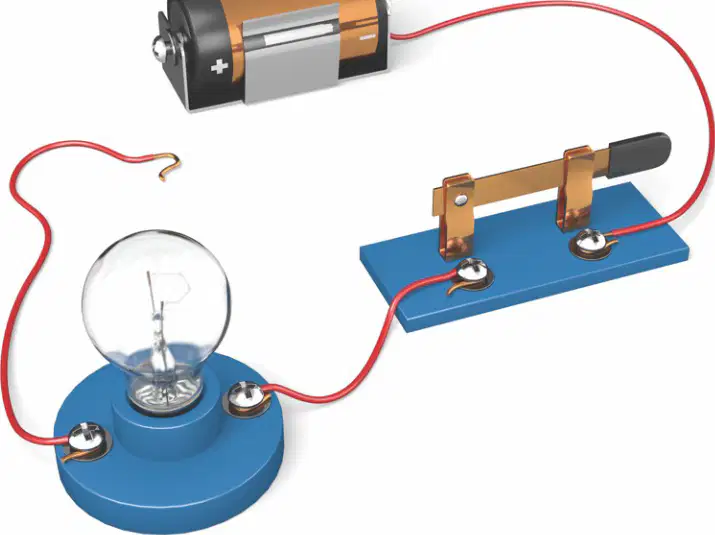
Why is this path considered an open path? Look at the diagram of a battery, a switch, and a bulb connected with wires; one wire has a visible gap between its ends.
There is a gap in the wires, so energy cannot complete the circuit.
The battery is too strong, so the light turns off even in a closed path.
The switch is closed, so the path is connected.
The bulb is glowing, which makes the path open.

Explain How do these stadium lights turn on?
Electrical energy from a power source travels through wires in a closed path to the stadium lights.
The lights glow when the circuit is open and electricity stops flowing.
The lights turn on by sunlight charging them instantly at night without wires.
The lights turn on only when people make loud sounds in the stadium.
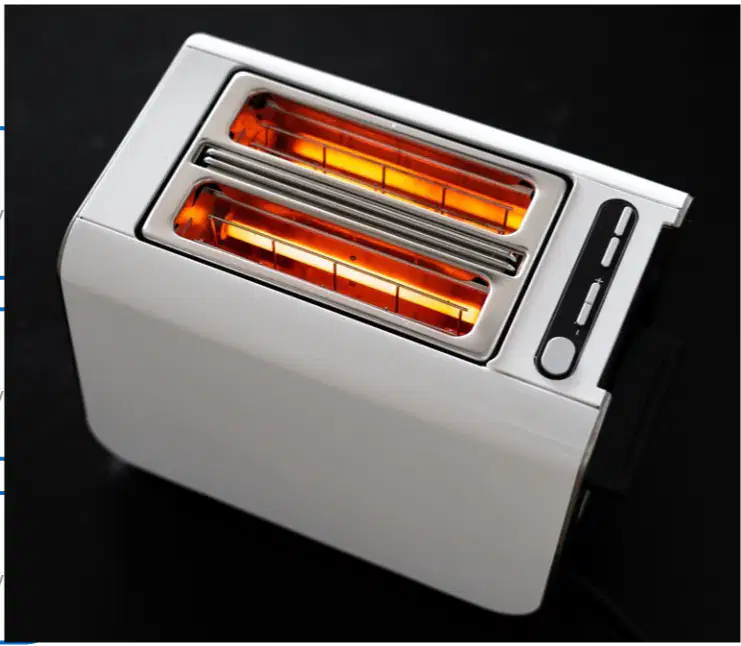
Explain: How does the toaster work? Choose the statement that best describes what happens when the toaster is plugged in and turned on.
Electrical energy from the outlet travels through wires to the toaster and changes to thermal energy in the heating elements, which toasts the bread.
The toaster turns thermal energy into electrical energy so the bread becomes cooler.
The bread produces light energy that powers the toaster to make heat.
Only the mechanical energy from pushing the lever cooks the bread without using electricity.

What happens if you remove one wire from a closed circuit containing a battery, a switch, and a bulb?
The switch will automatically close the gap.
The battery will stop working permanently.
The bulb will glow brighter.
The circuit becomes open and the bulb will not light up.
Which of the following devices changes electrical energy into both light and sound energy?

Alarm clock

Refrigerator

Microwave oven

Ceiling fan

Why does a lamp not turn on when the switch in its circuit is open?
Because the bulb is made of glass.
Because the wires are too long.
Because the lamp only works during the day.
Because the open switch breaks the path, stopping the flow of electricity.
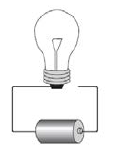


A group of students built the circuit shown above. The lightbulb does not glow. Which statement explains this observation?
The battery is not charged
The lightbulb is not part of a complete circuit
The circuit does not have a switch
The bell uses most of the energy from the battery
What is the main source of current(power) in a circuit?
wire
light bulb
battery
insulator
What carries electrical energy to the lightbulb?
wire
light bulb
switch
battery
What turns the circuit on and off?
conductor
insulator
switch
light bulb
What changes electrical energy to light energy?

switch

light bulb

battery

conductor
What appliance converts (changes) ELECTRICAL energy to HEAT energy?
gas clothes dryer
calculator
hair dryer
cell phone

A phone charger has plastic around the metal wire inside. Why is there plastic surrounding the wire?
metal wire is an insulator
plastic is an insulator
plastic is a conductor
A closed path along which an electric charge can flow.
Electric Circuit
Electric Current
Static Electricity
Electricity
An energy source often used in a circuit.

the sun

a windmill

gas

a battery

wire

light bulb

battery

switch

electric circuit
A (a) is a complete electrical path. An (b) is an electrical path that is not complete.
What is the purpose of a switch in an electric circuit?
to change the direction of the current
to provide a "push" to electrons
to allow the circuit to be opened or closed
to increase power to the light bulb
A circuit contains a battery, a wire, a switch, and a bulb. What would happen if you removed the battery?
The current would not flow.
The current would flow faster
The bulb would glow more brightly
The bulb would glow less brightly
From the dots on the image, pick the one that could control whether or not the electrons would flow through the circuit:

