
 Worksheets
World History Unit 3 Review
Total questions: 48
Worksheet time: 26mins
What is nationalism?
a form of global governance
promotes international cooperation and unity
an economic theory focused on trade policies
a political ideology focused on promoting the interests and culture of a specific nation
What is antisemitism?
a form of religious celebration
a political movement for Jewish rights
support for Jewish culture
prejudice or discrimination against Jewish people
What caused both Italy and Germany to become unified nations?
Who were the key figures in Italian unification?
Giuseppe Mazzini
Napoleon Bonaparte
Count Camillo di Cavour
Giuseppe Garibaldi
Who were the leaders behind German unification?
Karl Marx
King Wilhelm I of Prussia
Otto von Bismarck
Friedrich Engels
What is realpolitik?
a theory that emphasizes moral values in politics
a strict adherence to ideological beliefs
a diplomatic strategy based solely on historical precedents
a pragmatic political approach focused on practical objectives
What is imperialism?
the process of forming alliances between nations for mutual benefit
the act of promoting tourism in foreign countries
the cultural exchange between different countries
the practice of extending a nation's authority over other nations
What is Social Darwinism?
against competition in economic systems and supports cooperation
promotes social welfare and equality among all classes
a philosophy advocating for universal education and health care
a theory that applies the principles of natural selection to social issues, justifying inequality and imperialism
What was the Berlin Conference?
a treaty to end World War I
a summit on climate change
a cultural festival in Germany
a meeting of European powers to discuss the colonization of Africa
Why were Europeans interested in colonizing Africa?
Sought new markets for selling manufactured goods
Interested in missionary work
Establish cultural exchanges and education
Obtaining raw materials for industrialization
Was African resistance to European imperialism mostly successful or unsuccessful?
Successful
Unsuccessful
What African nation was able to remain independent during European imperialism?
Zulu
Boer
Ethiopia
Ashanti

Which claim is best supported by the evidence included in this map?
In 1913, European countries controlled most of the territory in Africa.
In 1913, European countries controlled all of the territory in Africa.
By 1913, European countries built extensive railroad systems in sub-Saharan Africa.
In 1913, European countries ruled territory in Africa with the consent of the Africans who lived there

A historian could best use this map to study which of the following topics?
World War I alliances
free trade
militarism
imperialism
About how much of Africa was controlled by European nations?
60%
70%
80%
90%
Who were the Sepoys in India?
Why did the Sepoy Rebellion occur?
cultural insensitivity regarding religious beliefs, like the gun cartridges
growing resentment against British rule and influence
economic prosperity in India
a response to a new Indian government policy
What was the importance of the Suez Canal?
important for global trade as it provides a shortcut for maritime shipping between Europe and Asia
a land route connecting Africa and Europe
serves as a major tourist attraction in Egypt
primarily used for fishing and recreational boating
Which Asian country emerged as an imperial power in the late 19th and early 20th centuries?
China
India
Japan
Thailand
The Opium Wars were a conflict between which two countries?
Britain and India
France and China
Britain and China
Japan and Russia
Which Asian territory was divided into spheres of influence by European powers?
Japan
China
India
Korea

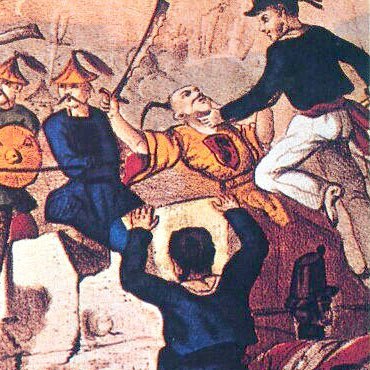

In the 18th century, why was there tension between China and European nations? Check all that apply.
China wanted European goods, but European nations did not want to trade with China.
Both China and European nations wanted control over the continent of Africa.
Europeans wanted Chinese goods, but China was only mildly interested in trading with them.
A significant trade imbalance developed as Europeans scrambled to find a product desirable to the Chinese.
British control of India was led by...
the East India Company.
the Royal Navy.
the British Imperial Army.
the British-Indian Raj.

What was the result of the Sepoy Rebellion?
India became an independent nation
Great Britain stopped the rebellion and took full control of India
Great Britain restored the Mughal Emperors to power to help control the Sepoy.
India agreed to join the British Empire as long as they were given their own king called a Raj.
Commodore Matthew Perry’s visits to Japan in 1853 and 1854 resulted in the
colonization of Japan by the United States
transfer of spheres of influence to China
introduction of Christianity to Japanese society
opening of trade and diplomatic relations with Japan
Japan’s increased foreign trade during the Meiji Restoration was closely related to its
need to maintain a traditional society
desire for a modern industrialized society
colonization by Western nations
encouragement of foreign investment
One reason for Japan’s rapid industrialization during the Meiji Restoration was that Japan had
rejected Western ideas
used its access to the sea for fishing
relied on traditional isolationist policies
reformed its political and economic systems
What was one impact of industrialization on Japan during the Meiji Restoration?
Japan became more isolated from world affairs
Demand for natural resources increased
Japan became a colonial possession of China
Traditional practices of Bushido were reintroduced
The Meiji Restoration in Japan was prompted in part by
a fear that Japan would be colonized by western nations
the failure of Japanese expansion
the Shogun’s conversion to Christianity
a desire to stay isolated
One of the many reforms carried out by the Meiji Emperor was of the military. Select all of the following that helped Japan build a modern military.
industrialization
reliance on traditional Japanese military tactics
created national army
based military on Western examples


How did imperialism disrupt local economies in Central and South America?
By promoting local businesses
By favoring colonial interests
By reducing resource exploitation
By supporting native administration.
What was a common result of imperialism on indigenous populations?
Preservation of cultural norms
Imposition of foreign cultural norms
Strengthening of traditional practices
Isolation from European influence.
What country built the Panama Canal?
United Kingdom
Panama
United States
Mexico
What was the key to economic prosperity in Latin America?
Increased exports to other countries
Discovery of gold
Powerful armies conquered nations
New Imperialism brought wealth
What was the significance of building a canal in Panama?
it would take territory away from the Spanish empire
it would allow easier economic and military access to and from the Atlantic and Pacific Oceans
it would make it easier for the US to invade countries in South America
it would allow the US to control worldwide trade
What is cultural diffusion?
the spread of cultural beliefs and practices from one group to another
the isolation of cultural practices within a group
the decline of cultural beliefs over time
the process of creating new cultural practices in a single group
Which of the following is an example of cultural diffusion?
The popularity of traditional folk songs and dances
The spread of new diseases like smallpox
The use of traditional Japanese clothing in Meiji Japan
The use of English as a universal language in business

