
 Worksheets
Hepatitis
Total questions: 18
Worksheet time: 9mins
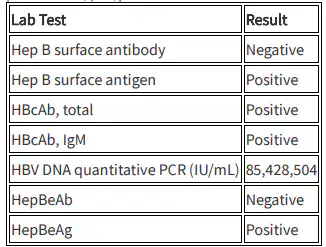
Interpret the following hepatitis B serologies using the table of lab tests and results:
Acute infection
Chronic infection
Immune from natural infection; resolved infection
Immune from vaccination
A 58-year-old man completed a 12-week regimen of ledipasvir/sofosbuvir for compensated HCV cirrhosis. Before treatment he reduced his atorvastatin 80 mg dose by 50%. Ledipasvir elimination half-life is 47 hours and sofosbuvir elimination half-life is 0.5 hours. If he finished therapy today, in how many days may he resume his full atorvastatin dose?
Immediately
3 days
10 days
14 days
A 48-year-old treatment-naïve woman with compensated cirrhosis has an HCV genotype repeatedly reported as indeterminate and a viral load of 5,732,754 IU/mL. Current medications are lisinopril and daily vitamin D. Which regimen is most appropriate?
Elbasvir/grazoprevir × 12 weeks
Sofosbuvir/velpatasvir × 12 weeks
Ledipasvir/sofosbuvir × 12 weeks
Sofosbuvir/velpatasvir + weight-based ribavirin × 12 weeks
LV is a 23-year-old treatment-naïve, noncirrhotic woman with HCV genotype 2 who takes ethinyl estradiol/norethindrone for PCOS. Which treatment plan is most appropriate?
Ledipasvir/sofosbuvir × 12 weeks
Glecaprevir/pibrentasvir × 12 weeks
Sofosbuvir/velpatasvir × 12 weeks
Glecaprevir/pibrentasvir × 8 weeks
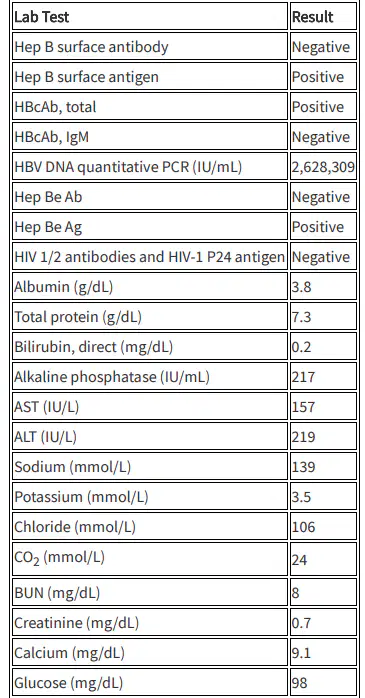
JC is a 59-year-old man with decompensated cirrhosis (jaundice and hepatic encephalopathy) and chronic hepatitis B. Current weight is 68 kg. Lab reports are shown here. What is the recommended starting dose of entecavir for JC at this time?
0.5 mg po daily
0.5 mg po q 72 hours
1 mg po daily
1 mg po q48 hours
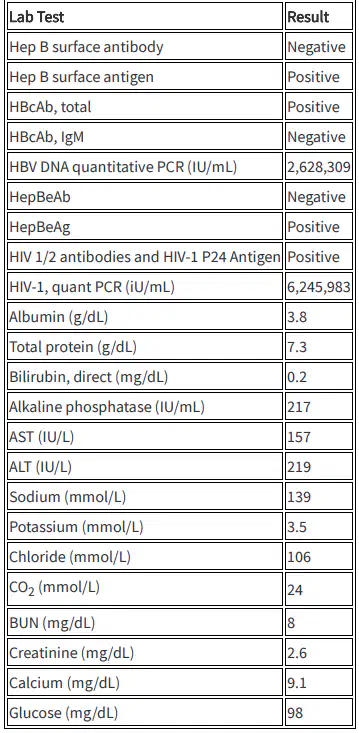
A 26-year-old noncirrhotic man presents to the hepatology clinic for a referral of treatment of hepatitis B. Prior to starting therapy, the provider orders additional lab work (below) and places an order for entecavir 0.5 mg po daily. Patient currently weighs 68 kg. As a clinical pharmacist, what recommendation would you make to the provider?
Approve, review, and proceed with prescription dispense of entecavir 0.5 mg po daily
Request a dosage adjustment to entecavir 0.5 mg po q48h
Recommend therapy switch to lamivudine 150 mg po daily
Recommend a tenofovir-containing human immunodeficiency virus (HIV) regimen instead of entecavir

Interpret the following hepatitis B serologies. Laboratory results:
Acute infection
Chronic infection
Immune from natural infection; resolved infection
Immune from vaccination
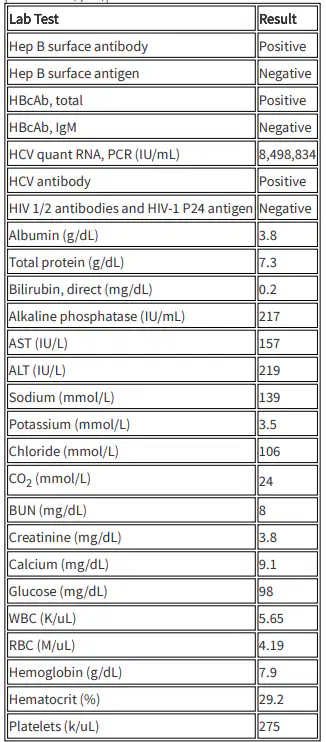
PV is a 62-year-old man following up in the hepatology clinic with hepatitis C virus (HCV) cirrhosis. Patient is treatment-naïve (treatment failure with interferon and ribavirin) and has genotype 3. The patient is currently experiencing hepatic encephalopathy, ascites, and jaundice. Current medications include hydrochlorothiazide, spironolactone, rifaximin, losartan, and trazodone. The patient is not eligible for a transplant at this time. Labs are as follows: Which of the following treatment regimens are most appropriate for this patient?
Sofosbuvir/velpatasvir + weight-based ribavirin × 12 weeks
Ledipasvir/sofosbuvir × 24 weeks
Ledipasvir/sofosbuvir + low initial dose of ribavirin (titrate as tolerated to weight-based dose) × 12 weeks
Glecaprevir/pibrentasvir + weight-based ribavirin × 12 weeks
Which of the following statements are true regarding tablet dosing of glecaprevir/pibrentasvir?
At 400/100 mg each, typical dosing is one tablet by mouth daily for 12 weeks.
At 100/40 mg each, typical dosing is three tablets by mouth daily for 8 to 12 weeks.
At 90/400 mg each, typical dosing is one tablet by mouth daily for 8 to 12 weeks.
At 300/120 mg each, typical dosing is one tablet by mouth daily for 8 to 12 weeks.
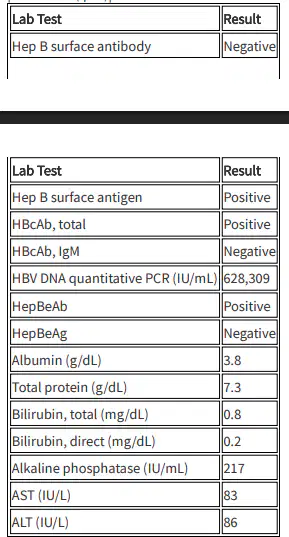
A patient presents to the hepatology clinic for chronic hepatitis B. Her hepatitis B serologies are given below. The patient is 21 weeks gestational age with dichorionic-diamniotic twins. The referral from obstetrics/gynecology is requesting management of hepatitis B treatment and prevention of perinatal transmission of hepatitis B. Which of the following recommendations is appropriate?
Begin entecavir 0.5 mg po daily immediately.
Begin tenofovir alafenamide 25 mg daily immediately.
Administer hepatitis B vaccination to patient in clinic today.
Begin tenofovir disoproxil fumarate 300 mg daily between 28 and 32 weeks gestation.
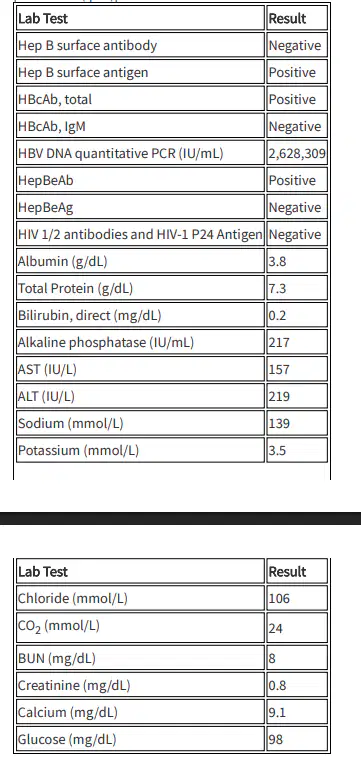
A patient is referred to the hepatology clinic for long-standing chronic hepatitis B. The patient's treatment history includes lamivudine and their primary care physician suspects lamivudine resistance. The patient's recent labwork is as follows. What would be an appropriate treatment recommendation for the patient based on current labwork?
Entecavir 0.5 mg every 48 hours
Entecavir 1 mg po every 72 hours
Tenofovir alafenamide 25 mg po daily
Tenofovir disoproxil fumarate 300 mg po every 48 hours
A male patient calls the pharmacy after picking up a new medication, entecavir. He understands that he is taking it for hepatitis B, but he would like to know how long he will be taking the medication. Upon further questioning, the patient was also recently diagnosed with cirrhosis according to his “liver doctor”. According to American Association for the Study of Liver Diseases (AASLD) hepatitis B guidelines, what is the suggested duration of therapy of antiviral treatment for this patient?
6 months
12 months after loss of surface antigen and persistently normal liver function tests (LFTs)
Indefinitely
12 months

A 62-year-old, treatment-naïve, cirrhotic female patient has genotype 1a hepatitis C. Patient is experiencing abdominal ascites and jaundice, but is not eligible for a transplant at this time. Patient's recent labs are as follows: Which of the following is the best treatment option for this patient?
Glecaprevir/pibrentasvir × 12 weeks
Sofosbuvir/velpatasvir + weight-based ribavirin × 12 weeks
Ledipasvir/sofosbuvir × 12 weeks
Ledipasvir/sofosbuvir × 24 weeks
Which of the following direct-acting antiviral combination tablets do not contain a protease inhibitor?
Glecaprevir/pibrentasvir
Ledipasvir/sofosbuvir
Sofosbuvir/velpatasvir/voxileprevir
Elbasvir/grazoprevir
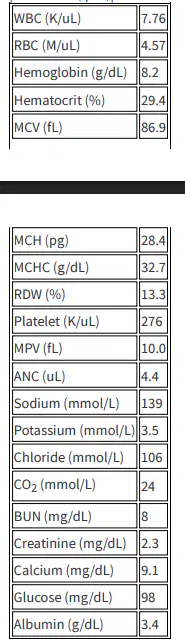
A 58-year-old compensated cirrhotic man has genotype 3 hepatitis C. The patient previously failed interferon and ribavirin and has a NS5A Y93H resistance-associated substitution. The patient's recent labs are given below. Which of the following is the best treatment option for this patient?
Sofosbuvir/velpatasvir × 12 weeks
Sofosbuvir/velpatasvir + weight-based ribavirin × 12 weeks
Ledipasvir/sofosbuvir × 12 weeks
Sofosbuvir/velpatasvir/voxileprevir × 12 weeks
A 37-year-old noncirrhotic man presents to the hepatology clinic for hepatitis C treatment. He is genotype 1a. The previous year, he failed sofosbuvir/velpatasvir due to incarceration in the middle of his treatment. NS5A resistance testing revealed no resistance-associated substitutions. Which of the following treatment regimens is most appropriate for this patient?
Ledipasvir/sofosbuvir + ribavirin × 12 weeks
Glecaprevir/pibrentasvir × 8 weeks
Sofosbuvir/velpatasvir + ribavirin × 12 weeks
Sofosbuvir/velpatasvir/voxileprevir × 12 weeks
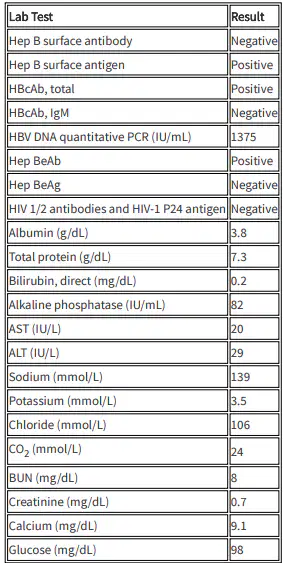
A 32-year-old noncirrhotic woman of Asian descent presents to the hepatology clinic for possible treatment of chronic hepatitis B. The patient's recent liver biopsy showed no concerns for necroinflammation or fibrosis. Hepatitis B serologies and other pertinent labs are given below. The hepatology provider requests your assistance in screening the patient for possible initiation of treatment.
Which of the following recommendations are most appropriate based on current American Association for the Study of Liver Diseases (AASLD) hepatitis B treatment guidelines?
Treatment for hepatitis B should be deferred and the patient should be monitored by the hepatology clinic every 6 months
Begin treatment with entecavir 0.5 mg po daily.
Begin treatment with tenofovir alafenamide 25 mg po daily.
Instead of treatment, vaccinate patient with the initial dose of hepatitis B vaccine today
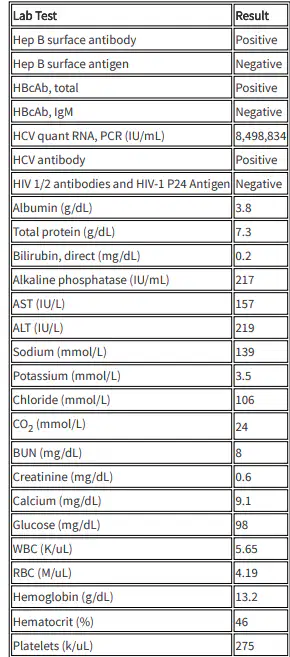
A patient with decompensated cirrhosis in the form of ascites and jaundice presents to clinic for treatment of hepatitis C. The patient is genotype 1a, treatment-naïve, and is not a transplant candidate at this time. Current medications include spironolactone, hydrochlorothiazide, losartan, amiodarone, rosuvastatin, and trazodone. Labs are as follows:
Based on American Association for the Study of Liver Diseases/Infectious Disease Society of America (AASLD/IDSA) hepatitis C guidelines, treatment options include sofosbuvir/velpatasvir + ribavirin for 12 weeks or ledipasvir/sofosbuvir + ribavirin for 12 weeks. Both regimens interact with amiodarone. The half-life of amiodarone is 55 days. The hepatologist has informed you that treatment with hepatitis C is medically necessary. After speaking to the patient's cardiologist, the cardiologist has agreed to switch the patient to digoxin. After initiation of digoxin, how long should the hepatologist wait before starting direct-acting antiviral therapy?
55 days
3 months
6 months
10 months

