
 Worksheets
Single Phase Transformer Construction
Total questions: 50
Worksheet time: 25mins
In a basic single-phase transformer, which statement best describes the role of the primary winding?
It delivers power to the load by conducting the secondary current.
It receives the applied AC voltage and current, establishing magnetic flux in the core.
It mechanically couples the two coils through a rotating shaft.
It provides a DC excitation to magnetize the core.
Which pair correctly identifies the two coils found in a basic transformer and their typical placement?
Primary and tertiary coils, both mounted on an aluminum frame.
Input and output coils, both wound on separate wooden cores.
Primary and secondary windings, both mounted in a soft iron core.
Series and shunt coils, both housed in an air-core structure.
According to the construction principles shown, what physical quantity links the primary and secondary windings to enable energy transfer?
Electrostatic charge accumulation between coil ends
Magnetic flux in the transformer core produced by AC in the primary
Direct conduction through a shared electrical connection
Thermal coupling due to core heating
Select all statements that are true about a single-phase transformer as depicted.
It is an alternating current device.
It transfers energy from one AC circuit to another through electromagnetic induction.
A basic transformer has more than two coils to improve efficiency.
Both coils are mounted in a soft iron core.
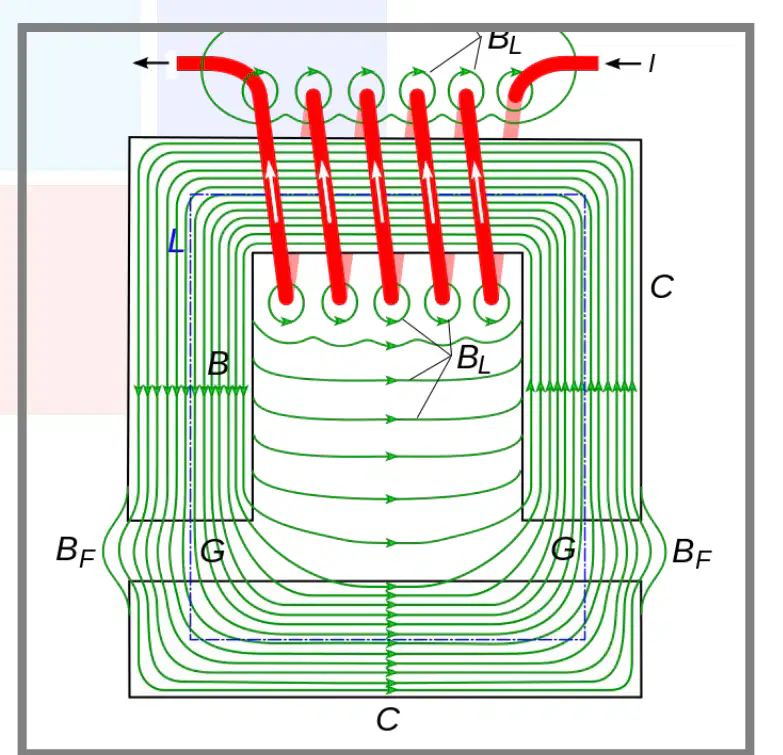
In the diagram showing magnetic flux paths, which principle specifically links both coils for operation?
Self-capacitance coupling
Mutual induction between windings via the core
Mechanical resonance of coil turns
Radiative coupling across an air gap
Which description best characterizes the magnetic circuit of a well-constructed single-phase transformer?
A path with high reluctance including intentional air gaps to reduce flux.
A complete low-reluctance path in the core with no air gaps.
An open magnetic path relying on stray fields around the enclosure.
A path dominated by eddy currents in the windings rather than the core.
Which properties are correct for the device illustrated? Select all that apply.
It has no moving parts.
Its typical efficiency range is around 95% to 98%.
It requires DC excitation on the primary to operate.
It relies on electromagnetic induction to transfer energy.
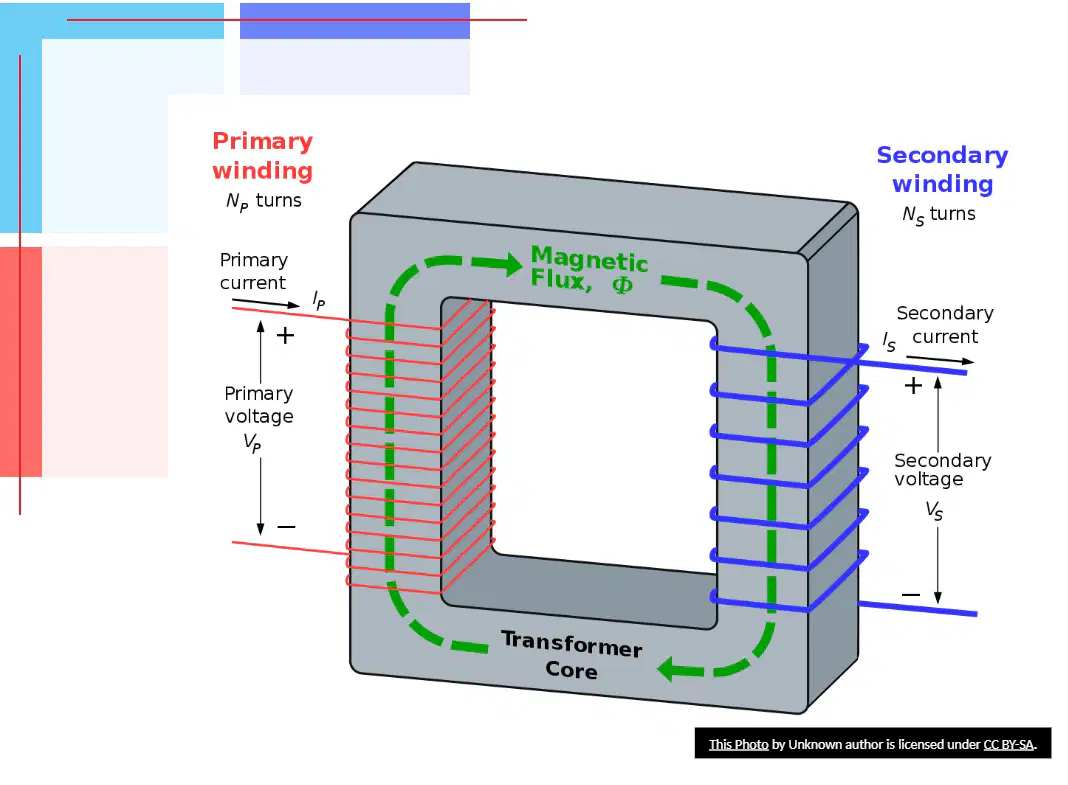
Consider the labeled quantities Vp, Ip for the primary and Vs, Is for the secondary in the construction schematic. What is their essential purpose in the context of transformer operation?
They define the mechanical torque transmitted from primary to secondary.
They represent the AC electrical inputs and outputs that create and result from core magnetic flux.
They measure static charges that prevent flux leakage.
They indicate temperature gradients that drive thermal conduction.
In transformer core materials, what does reluctance specifically refer to?
The resistance to electric current through the windings
The opposition offered to the establishment of magnetic flux
The tendency of the core to saturate under high current
The efficiency loss due to eddy currents
Which statement correctly distinguishes materials by their magnetic reluctance?
Air has low reluctance and therefore guides flux efficiently
Iron has high reluctance and therefore blocks most flux
Air has high reluctance while iron has low reluctance
Both air and iron have similar reluctance in practical transformers
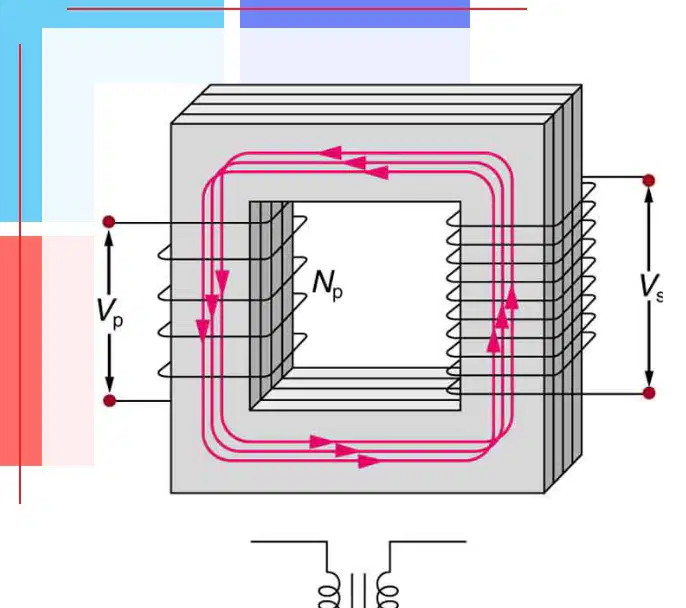
Select all TRUE statements about reluctance in the context of the illustrated transformer core and windings.
Higher reluctance paths make it harder for magnetic flux to establish
Iron cores are used because they provide lower reluctance paths for flux
Air gaps increase the opposition to magnetic flux compared to solid iron
Reluctance is the same concept as electrical resistance in the windings
In single-phase transformers, which material is commonly used for the core to reduce hysteresis losses?
Soft iron without additives
Aluminum alloy
Silicon steel
Copper with varnish
Which statement best explains why transformer cores are laminated with a thin coat of varnish?
It increases magnetic flux density to improve coupling.
It electrically insulates the sheets to reduce eddy currents.
It cools the core by improving heat transfer.
It prevents hysteresis by locking magnetic domains.
Select all phenomena listed as common single-phase transformer losses in the material.
Hysteresis
Eddy currents
Dielectric breakdown
Changing magnetic flux
A soft iron core in a transformer primarily serves which purpose in the context of losses described?
To eliminate eddy currents entirely
To provide a low-reluctance path that supports changing magnetic flux
To act as an electrical conductor for the secondary circuit
To increase core resistance to reduce copper losses
Which combination of design choices directly targets core losses according to the instructional material?
Using silicon steel to address hysteresis
Laminating core sheets with varnish to address eddy currents
Thicker solid core to increase magnetic inertia
Replacing iron with copper to reduce flux leakage
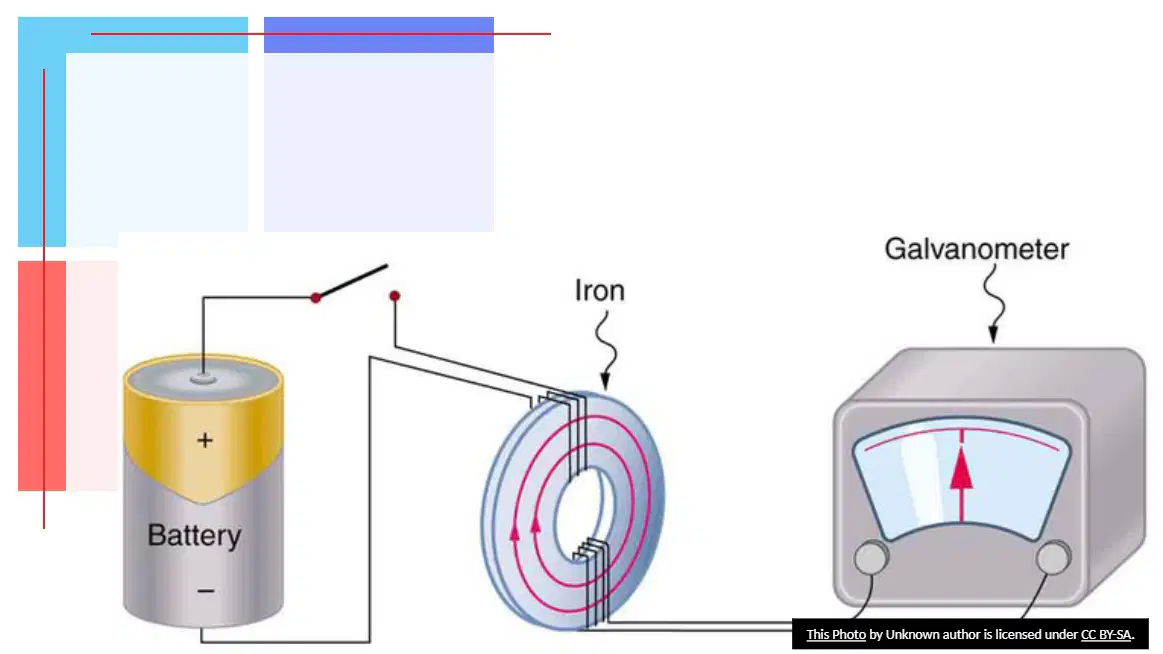
In the depicted setup with a battery, iron ring, and galvanometer, what does the needle deflection most directly indicate when the circuit is switched?
A steady DC current through the iron core
Induced current due to changing magnetic flux
Elimination of hysteresis losses
Increase in eddy current paths by solid core design
Why do eddy currents form in transformer cores, and how does lamination mitigate them according to the material?
They arise from static magnetic fields; lamination increases conductivity to spread them.
They arise from time-varying flux; lamination introduces insulation that interrupts circulating paths.
They arise from thermal gradients; lamination adds mass to absorb heat.
They arise from mechanical vibrations; lamination stiffens the core to prevent movement.
Refer to the diagram showing a transformer with red and blue windings and magnetic field lines. Which statement best describes flux leakage loss in this context?
Magnetic flux that stays confined within the core and links both windings to transfer energy
Magnetic flux that bypasses the core and fails to link the secondary winding, resulting in wasted energy
Electrical resistance in the windings that heats the core and increases useful flux
Current that flows only in the secondary winding and improves energy transfer
Based on the visual labeling of 'Useful Flux' and the surrounding field lines, which set correctly identifies what contributes to useful flux versus flux leakage? Select all that apply.
Field lines that close through the magnetic core and link both the primary and secondary windings contribute to useful flux.
Field lines that bulge outside the core and do not fully couple the windings represent flux leakage loss.
Field lines that pass through only the primary winding increase power delivered to the load and are considered useful.
Field lines that are strengthened by adding an external resistor become useful flux.
Which statement best explains why laminating the iron core is used in transformers?
It concentrates magnetic flux to increase the secondary voltage.
It reduces wasteful circulating currents in the core that cause heating.
It prevents hysteresis by eliminating magnetic domains.
It allows DC to pass through the primary without loss.
What is the primary consequence of these currents in the iron core?
Useful mechanical work produced in the core.
Increase in core heating without delivering useful output.
Improved coupling between primary and secondary windings.
Reduction of resistive losses in the windings.
Which combination of design choices directly targets reduction of eddy current core losses in the depicted transformer? Select all that apply.
Segmenting the core into thin insulated laminations.
Using a solid, thick iron core to increase mass.
Orienting laminations to interrupt circulating current paths.
Adding external resistors to the secondary circuit to absorb heat.
Refer to the diagram showing a sinusoidal current and ferrous core sections labeled "Not Magnetized" and "Temporarily magnetized core sections." What is hysteresis loss in a transformer core?
Energy dissipated as heat due to resistance in copper windings
Energy required to realign core molecules as the electromagnetic field changes
Energy stored in the magnetic field during peak current
Energy lost from leakage flux escaping the core
Which statements describe the behavior of a ferrous transformer core under alternating current? Select all that apply.
The core becomes permanently magnetized once current starts flowing.
The core is temporarily magnetized as the current alternates.
Molecular friction occurs as domains realign with the changing field.
The electromagnetic field remains constant, so domains do not move.
In the diagram’s context, what primarily causes energy loss in the iron core when current alternates?
Eddy currents due to laminated core gaps
Molecular friction from repeatedly realigning magnetic domains
Voltage drop across the secondary winding
Mechanical vibration of the core laminations
According to the material, which transformer construction has the greatest leakage flux and which has the least?
Core type has the most; H type has the least
Shell type has the most; core type has the least
H type has the most; shell type has the least
Core type has the most; shell type has the least
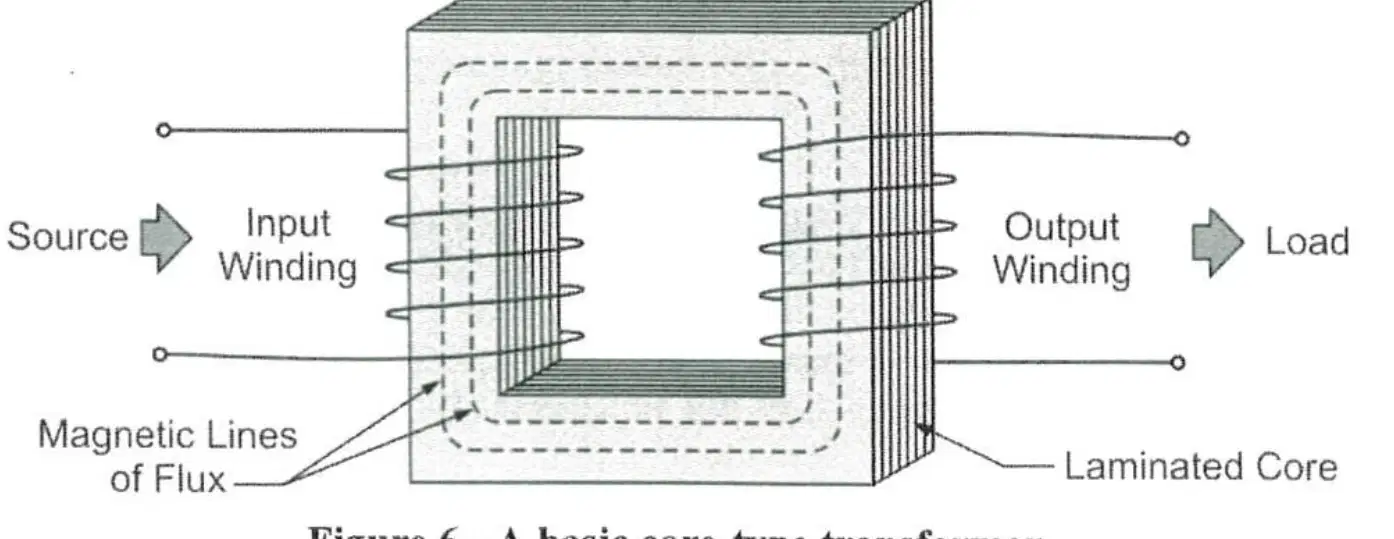
Select the statements* that correctly describe a basic core-type transformer as illustrated
Windings are wrapped around a laminated magnetic core
The input winding connects to the source
The output winding connects to the load
Magnetic flux is confined entirely inside the core material without leakage
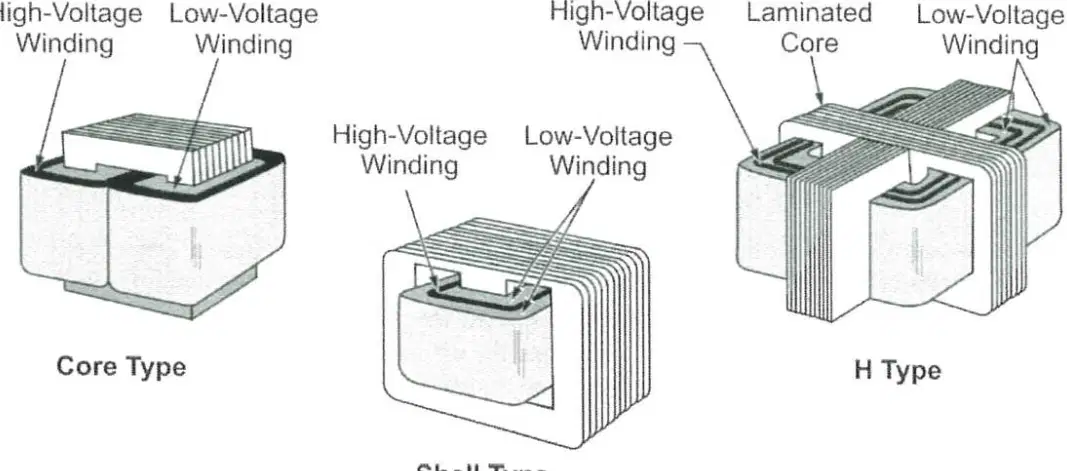
For cores-, shell-, and H-type transformers, what component is explicitly labeled on the H-type that highlights its construction?
Laminated core
Toroidal core
Air gap spacer
Steel yoke
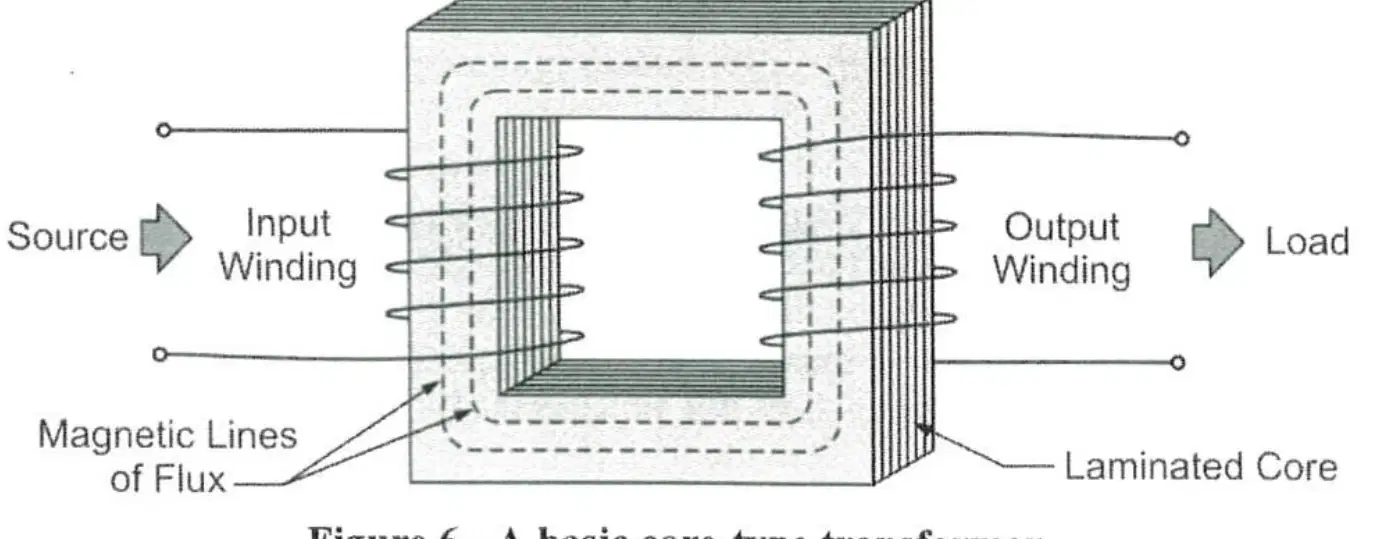
Which pairing correctly matches each winding role in the core-type transformer illustration?
Input winding receives energy from the source; output winding delivers energy to the load
Input winding delivers energy to the load; output winding receives energy from the source
Both input and output windings receive energy from the source
Both input and output windings deliver energy to the load
Refer to the diagram of the basic shell-type transformer. Which statement best describes the core–winding relationship in this construction?
The windings wrap around the core on two sides
The core is wrapped around the windings, forming a shell
The core and windings are separated by an air gap on all sides
The windings are encapsulated and not visible because the core fully encloses them
In a shell-type transformer, what is the primary purpose of the laminated core shown?
To increase resistance and reduce current in the windings
To provide a closed magnetic path with reduced eddy current losses
To mechanically support the windings without affecting flux
To dissipate heat from the windings through convection

According to the description of an H-type transformer, which configuration feature most directly helps minimize stray leakage flux?
Using a core with a single central leg only
Surrounding the windings on four sides with extra core material
Placing the windings farther from the core to reduce coupling
Adding more turns to the secondary winding to balance flux
Select all statements that are correct about similarities and differences between shell-type and H-type transformer cores as described.
Both have an iron core through the center around which windings are wound
The H-type core surrounds windings on four sides instead of two
Shell-type cores are commonly used for high-voltage distribution transformers
H-type construction enhances transformer efficiency by minimizing stray leakage flux
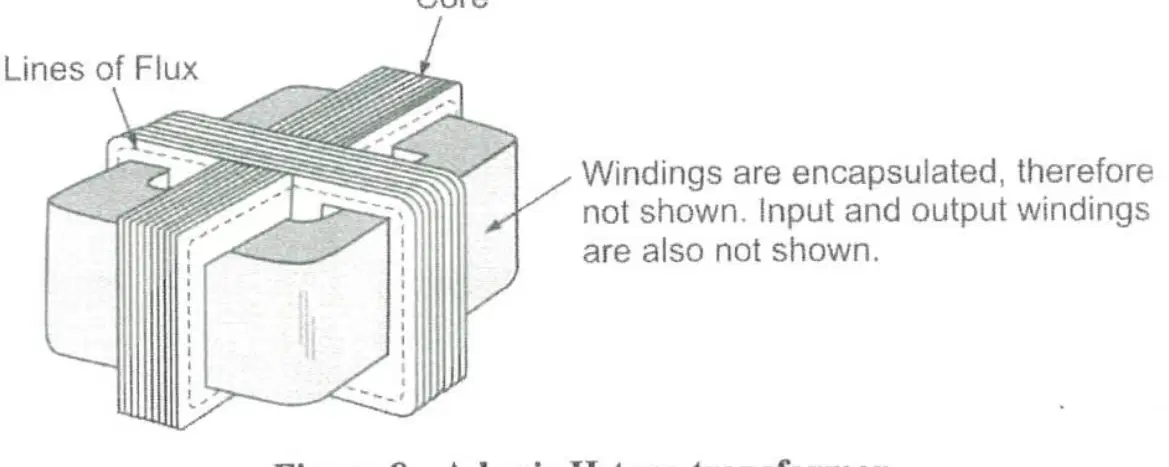
Which application is the H-type center commonly associated with based on the instructional text?
Low-voltage control transformers in industrial panels
Audio output transformers in consumer electronics
High-voltage distribution transformers
Isolation transformers for laboratory instrumentation
In the shell-type transformer diagram, what components are explicitly labeled as connected to the source and to the load?
The primary (input) and secondary (output) windings
The laminated core and the magnetic flux lines
The encapsulated windings and the core clamps
The flux paths and the core window
Which statement best describes transformer efficiency based on the provided text?
Transformers are perfectly efficient under normal operation.
Transformers are very efficient but not 100% due to losses.
Transformers are inefficient because most input power is lost as heat.
Which loss specifically occurs in the windings of a transformer and limits its efficiency?
Core saturation loss
Copper loss
Leakage flux loss
Mechanical vibration loss
According to the material, which losses occur within the transformer core? Select all that apply.
Copper losses
Eddy current losses
Hysteresis losses
Conduction losses in insulation
What is the cause of eddy currents in a transformer core as stated in the text?
Static magnetic field in the core
Changing magnetic field induces circulating currents
Direct conduction from windings into the core
Mechanical movement of laminations
How are the effects of eddy currents characterized in the material?
They reduce voltage without producing heat.
They produce heat that is accounted for as power losses.
They increase magnetic flux without any energy loss.
They cool the core through convection.
What is the stated mechanism behind hysteresis losses in a transformer core?
Electron leakage through insulation
Molecular friction due to reversal in direction of current flow
Resonance between windings and core
Static alignment of domains with no motion
Which statement aligns with the description of molecular behavior contributing to hysteresis in the core?
Molecules remain fixed, preventing friction.
Molecules are constantly rubbing on each other, causing friction.
Molecules form a vacuum gap that eliminates heat.
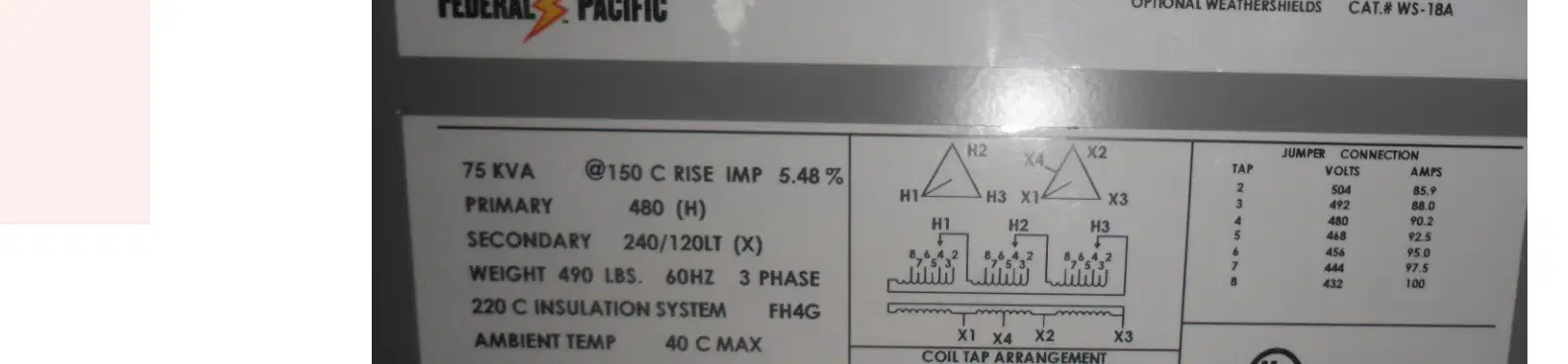
Refer to the transformer nameplate shown. What is the apparent power rating specified for this dry-type transformer?
50 kVA
75 kVA
100 kVA
150 kVA
Which statement best explains why transformer nameplates use kVA rather than kW for ratings?
kVA reflects true power delivered to resistive loads only.
kVA excludes the effect of power factor to avoid overrating inductive loads.
kVA is the apparent power independent of load power factor on the secondary.
kVA accounts for only reactive power and ignores real power.
A transformer is nameplated at 75 kVA. Under full-load conditions, this rating represents which quantity? Select all that apply.
Apparent power available at the secondary at full load
True power at the secondary assuming unity power factor
Reactive power only, regardless of load type
The maximum kVA the transformer is designed to supply continuously
In a transformer, which statement correctly identifies the primary winding?
The winding connected to the load and delivering output power
The winding connected to the energy source and receiving input power
The winding with the greater number of turns regardless of connections
The winding connected only when the transformer is step-down
Select all statements that accurately describe transformer windings according to the provided definitions.
Primary winding: connected to the energy source
Secondary winding: connected to the load
Primary winding: always has fewer turns than the secondary
Secondary winding: provides the input to the transformer
A single-phase transformer has a VA rating of 50,000 VA. The rated secondary voltage is 240 V. Using the relationship Is = VA / Es, what is the maximum secondary current Is?
20.83 A
208.33 A
240 A
50,000 A
For the same transformer (VA = 50,000 VA), the rated primary voltage is 2400 V. Using Ip = VA / Ep, which value is the maximum primary current Ip?
2.08 A
20.83 A
208.33 A
24.00 A

