
 Worksheets
Review: Pies and Knives
Total questions: 40
Worksheet time: 23mins
In the formation of flaky layers, what role does fat primarily play?
It creates pockets that separate flour layers during baking
It dissolves gluten strands to make the dough tender
It provides sweetness that aids browning
It prevents moisture loss from the filling
Why does the guidance emphasize chilling pie dough and its ingredients?
To prevent butter from melting and interacting with gluten
To infuse flavor into the fat pockets
To reduce moisture so the crust crisps
To stop sugar from caramelizing too early
For blind baking, what is the most important step to maintain the crust's structure?
Weighing down the crust so it holds its shape
Adding the filling early to support the sides
Using a ceramic pan for better insulation
Brushing with egg wash before baking
What is an effective way to roll out dough while minimizing the use of extra flour that could toughen it?
Roll on plastic sheets or silicone mats
Add more flour to the countertop for nonstick
Use a warm rolling pin to smooth the dough
Dust with granulated sugar instead of flour
A recipe labeled as a cream pie most likely features which characteristic?
Baked fruit filling set by pectin or starch.
Cooked, creamy custard filling topped with whipped cream.
Unbaked chiffon filling stabilized with gelatin.
Savory meat-based filling in a double crust.
Which description best matches a custard pie?
A pie with a precooked fruit filling thickened with starch.
A pie in which an egg-rich liquid is baked until set.
A pie with an airy, gelatin-stabilized filling.
A pie made with cream cheese and no baking.
What is the safest way to hold food while chopping with a chef's knife?
Use the claw grip, tucking your fingertips under
Hold the food flat with your palm pressed down
Grip the food with your fingertips extended
Balance the food on the edge of the cutting board
The bolster of the knife is:
Metal pieces that fasten the handle to the tang
The part of the blade that continues into the knife's handle
The spot where the blade and handle come together
The tip of the knife
What should you do after cutting lettuce with a knife that was used to cut raw meat?
Dip the knife in sanitizer
Run the knife through the dishwasher
Wash and sanitize the knife separately
Wash the knife with other dishes
Why should you NOT use a dull knife?
Accidental cuts are less likely.
Accidental cuts are more likely.
It requires less pressure to slice vegetables.
It uses less time for sharpening.
This cut resembles a matchstick.
Julienne
Chiffonade
Diagonal
Mince
This cut is used to finely slice leafy vegetables or herbs.
Torunee
Rondelle
Shirred
Chiffonade
Why is it important to cut foods into uniform shapes?
Improves flavor
Conserves nutrients
Ensures that the foods are safe to eat
Helps cook food evenly
Never put knives in __________.
Hot water
Soapy water
Cold water
the dishwasher
What is the size of minced food?
Large, irregularly sized pieces
Medium, irregularly sized pieces
Small, irregularly sized pieces
Which knife is used for chopping, slicing, and most other cutting tasks?
Utility knife
Chef knife
Paring knife
Serrated knife
What should be placed under a cutting board to prevent it from slipping?
Damp paper towel
Dry paper towel
Damp wash cloth
Dry cloth towel
How should you wash your knives?
Leave knives in the sink to clean later
Wash, rinse, dry, and put away
Use a damp towel
What is the best way to hold a knife?
With all five fingers on the handle
With all five fingers on the blade
The Claw
Thumb and pointer finger on the blade, with the other three fingers wrapped around the handle
What are the three basic ingredients in a pie crust?
Flour, water, and fat
Sugar, butter, and eggs
Baking powder, water, and oil
Flour, eggs, and milk
What is the role of gluten in a pie crust?
It gives the dough its stretch and strength.
It adds sweetness to the crust.
It makes the crust flaky.
It prevents the crust from baking.
Why is temperature crucial when making pie crust?
It enhances the flavor of the crust.
It affects the rising of the dough.
It determines the baking time.
It prevents the butter from melting too soon.
Which fat is known for making the most flavorful pie crust?
Margarine
Lard
Shortening
Butter
Why is blind baking necessary for some pies?
To ensure the filling is cooked
To brown the crust more evenly
To make the crust crunchier
To prevent the crust from becoming soggy
What is the disadvantage of using shortening in pie crust?
It has no flavor
It can make the crust too flaky
It makes the crust too tough
It has a high melting point
How does chilling the pie dough before rolling it out affect the final crust?
It makes the crust less flaky
It helps in gluten development
It prevents the fat from melting too quickly
It makes the dough harder to work with
What happens when you handle the dough too much?
Toughens the dough
Softens the dough
Makes the dough flaky
Makes the dough sticky
How should you walk with the knife?
With the knife down at your side, holding your arm stiff
With the knife down at your side, swinging your arm slightly
With the knife out in front
Why do you use a guiding hand?
To prevent burns
To prevent cuts
To help you walk with the knife
If a knife falls....
ALWAYS try and catch it
Catch it if it seems safe
Step out of the way and let it fall to the floor
What should you say when walking behind someone with a knife?
Knife Behind
Nothing, just walk slowly
Watch Out!
True or False: You can allow another student to use the knife you are assigned to, when you are done using the knife
True
False
True or False: If you are assigned a knife, then you are responsible for the knife until the end of the lab
False
True
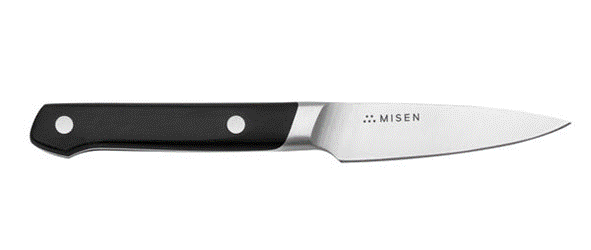
Which knife is pictured here?
Santoku Knife
Paring Knife
Serrated Knife
Chef's knife
What is the best way to cut with your knife?
With the center part only
With the tip only
Using a rocking motion
Cut and lift, cut and lift
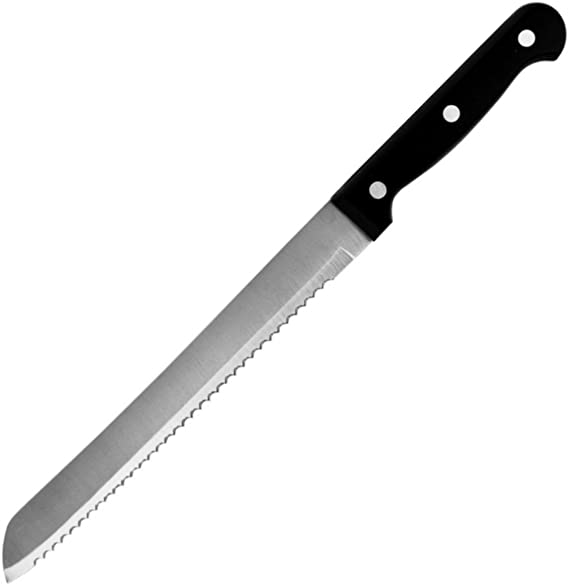
Which knife is pictured here?
Santoku Knife
Paring Knife
Serrated Knife
Chef's Knife

When using a knife, what is the safest practice?
Run with it
Put it in your back pocket
Cut away from your body
Why are bread knives designed with serrated edges?
To crush the food
To easily cut through without crushing
To make the knife heavier
To make the knife look decorative

With your hand wrapped around the handle, and thumb on the back of the knife

With your hand wrapped around the handle, and your index finger straight along the back of the knife blade

With your hand wrapped around the handle, and your index finger and thumb firmly pinching the back of the knife blade near the handle (pinch grip)

Throw the contaminated food away

Wash the cut, and apply pressure, if needed

Tell the teacher immediately, even if it is super small

If the cut is small, you don't need to say anything

