
 Worksheets
American Pageant Ch 10 DIFFICULT Question Bank
Total questions: 89
Worksheet time: 45mins
In the presidential contest of 1800, which pair of leaders symbolized the rivalry between the Federalists and the Democratic-Republicans?
John Adams and Thomas Jefferson
George Washington and Alexander Hamilton
James Madison and Aaron Burr
John Jay and Henry Clay
Select the policy positions commonly associated with the Federalist Party’s platform in the 1800 election.
Advocacy for strong central government and public order
Defense of agrarian purity and states’ rights
Promotion of an expanded "new navy" and war preparedness with France
Commitment to strict separation of church and state at the national level
Which ideas best capture the Democratic-Republican self-presentation during the 1800 campaign?
Guardians of agrarian purity, liberty, and states’ rights
Champions of commercial banking and urban manufacturing
Supporters of broad federal authority over the states
Advocates for permanent military mobilization
Match each term or episode from the 1800 election climate to its description.
Alien and Sedition Acts
Federalist measures that aroused many enemies and fueled partisan hostility
Hamilton’s pamphlet attack on Adams
A Federalist schism-causing document criticizing the sitting president
Refusal to wage war with France
A decision that undercut Federalist war preparations and public support
Which statement best explains why Jeffersonians found it harder to govern than to oppose, once in power after 1800?
Opportunities and crises demanded assertion of federal authority, complicating earlier promises
The party immediately lost its congressional majority
The Supreme Court declared the party unconstitutional
European wars ended all foreign policy challenges
According to the section on mudslinging, what was a major Federalist vulnerability during the 1800 campaign?
Internal division as Hamilton split openly with President Adams
Unified backing from New England clergy
Successful, popular war with France
Broad public support for new taxes
Which accusation exemplifies the "whispering campaigns" against Thomas Jefferson mentioned in the text?
Robbing a widow and her children of a trust fund
Selling federal offices for profit
Plotting to restore monarchy with foreign aid
Organizing urban riots to undermine elections
What reaction among some Federalist families illustrates the religious anxiety surrounding Jefferson’s election, as reported in the text?
Old ladies buried their Bibles or hung them in wells
Clergy called for a nationwide fast to protest the vote
Congregationalists refused to pay taxes
Families emigrated en masse to Canada
According to the passage, what event first publicized accusations about Thomas Jefferson’s alleged relationship with Sally Hemmings?
A biography by James Parton in the mid-19th century
An 1802 publication by James Callendar spread by Federalist newspapers
Dumas Malone’s calculation of Jefferson’s presence at Monticello
DNA testing conducted by the Thomas Jefferson Memorial Foundation
Which combination of evidence most directly advanced the case for Jefferson being the father of Sally Hemmings’s children, according to the passage? Select all that apply.
Madison Hemmings’s claim identifying Jefferson as the father
James Parton’s report that a nephew fathered most of Sally’s children
Dumas Malone’s calculation placing Jefferson at Monticello nine months prior to births
DNA testing of the remains of Jefferson’s white and possibly Black descendants
In the passage’s account of political motivations, how were Jefferson and Hemmings depicted in the print “The Philosophic Cock,” and what was the intended effect?
Jefferson as a rooster and Hemmings as a hen, aiming to disgrace Jefferson by linking him to radical sympathies
Jefferson as a fox and Hemmings as a goose, aiming to portray Jefferson as a cunning statesman
Jefferson as a rooster and Hemmings as a fox, aiming to suggest Hemmings manipulated Jefferson for power
Jefferson as an eagle and Hemmings as a dove, aiming to celebrate revolutionary virtue
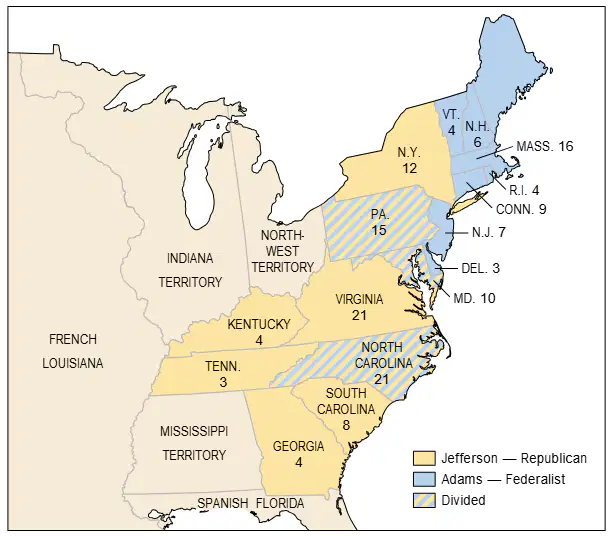
According to the map of the Presidential Election of 1800, which statement identifies New York’s significance and Aaron Burr’s contribution to Jefferson’s victory?
New York was a minor Federalist stronghold, and Burr avoided campaigning there to prevent backlash.
New York was the key state that swung to Jefferson, with Aaron Burr helping shift it from the Federalists through aggressive organizing.
New York split its electors evenly between parties, and Burr focused on Southern states instead.
New York backed John Adams decisively, and Burr’s efforts mainly aided New England Federalists.
What was the final electoral vote count in the 1800 election as described in the passage, and what does it reveal about Jefferson’s margin?
Jefferson 73, Adams 65—indicating a narrow but clear Jefferson victory.
Jefferson 80, Adams 62—showing a comfortable Jefferson landslide.
Jefferson 73, Adams 73—demonstrating a perfect tie resolved by the Senate.
Jefferson 65, Adams 73—indicating Adams’s re-election by a slim margin.
Which development created the unexpected deadlock in the presidential election of 1800?
The Constitution required a runoff if no candidate had a majority of popular votes.
Jefferson and his running mate Aaron Burr received the same number of electoral votes for the presidency.
The Supreme Court invalidated several Southern electoral returns.
A tie between Adams and Jefferson forced a special national referendum.
Under the Constitution in 1800, which institution resolved the presidential election deadlock, and how did the process unfold?
The House of Representatives, controlled by lame-duck Federalists, moved slowly and finally broke the tie when a few Federalists abstained.
The Senate, led by Jeffersonians, immediately voted to install Jefferson after a single ballot.
The Supreme Court issued a binding opinion selecting Jefferson due to separation of powers.
A national popular vote was organized to decide between Jefferson and Burr.
Match each figure or group with their described role in the 1800 election and its aftermath.
Aaron Burr
Helped turn New York to Jefferson with zealous campaigning
Lame-duck Federalists
Controlled the House during the deadlock and initially preferred Burr
John Adams
Last Federalist president; his party declined after 1800
Thomas Jefferson
Claimed the election was a ‘revolution’ restoring republican ideals
Why did Jefferson describe the election of 1800 as a ‘revolution,’ and how did his interpretation differ from a violent upheaval?
He saw it as a massive popular uprising that dismantled the Constitution.
He meant a return to the original spirit of the Revolution—checking government growth and halting decay of virtue under Federalists—achieved through a peaceful transfer of power.
He believed it marked the beginning of one-party rule enforced by the military.
He argued it replaced the republic with a direct democracy governed by town meetings.
Which statement best summarizes the Twelfth Amendment’s relevance to the electoral tie of 1800, as noted in the passage’s footnote?
It abolished the Electoral College and created a national popular vote.
It removed the possibility of another tie by requiring separate electoral votes for president and vice president.
It mandated that the House choose the vice president in all elections.
It guaranteed that the second-place finisher would become president in case of a tie.
What broader significance did the 1800 election’s outcome hold for the young American republic, according to the passage?
It demonstrated that peaceful, orderly transfers of power based on an election could occur and be accepted by all parties, despite intense partisanship.
It proved that partisan bitterness made peaceful transfers impossible, leading to a temporary dictatorship.
It showed that comparable peaceful successions had already become routine in Britain, making the U.S. unremarkable.
It confirmed that Federalist policies would dominate for another generation.
According to the passage, how did Thomas Jefferson’s personal appearance and arrival for his inauguration reflect his democratic ideals?
He rode in a lavish carriage escorted by Federalist elites
He strode on foot from his boardinghouse, spurning customary pomp
He arrived by riverboat accompanied by military bands
He flew the national flag over a parade of cabinet members
Which statement from Jefferson’s inaugural address best encapsulated his core democratic principle as described in the text?
“The will of the majority is in all cases to prevail.”
“Liberty is secured only through vigorous executive authority.”
“A strong standing army is the bulwark of our republic.”
“Property rights outweigh all other political considerations.”
Select the actions Jefferson took that extended democratic principles into government etiquette and practice, as detailed in the passage. (Select TWO)
Established seating at official dinners without regard to rank
Sent ornate, monarchical speeches to Congress from the throne
Received callers informally in dressing gown and slippers
Granted precedence to the pro-British minister at receptions
The text notes that Jefferson started a precedent of delivering messages to Congress in writing to be read by a clerk. What rationale is given for this change?
He sought to reduce legislative workload
Personal appearances suggested too strongly a monarchical speech from the throne
He wished to avoid press criticism
The House of Representatives required written messages by law
The triumph of Jefferson’s Democratic-Republicans over the Federalists is described as what milestone in American political history?
The first peaceful transfer of power between colonies
The first party overturn in American history
The first time the Supreme Court intervened in an election
The first popular vote for president
In office, Jefferson showed moderation by resisting patronage. What outcome did this have, according to the passage?
Most Federalist appointees were immediately dismissed
Few public servants were removed for political reasons, and “few die, none resign”
Democratic-Republicans gained a loyal political following through appointments
Congress forced Jefferson to expand patronage to secure votes
Match each Jeffersonian policy action with its description from the passage.
Remitted Sedition Act sentences and fines
Pardoned “martyrs” and forgave penalties
Revised naturalization requirements
Reduced residency from fourteen to five years
Opposed the excise tax
Eliminated a Hamiltonian revenue measure that cost about a million dollars annually
Why did Jefferson especially dislike the excise tax, and what was one consequence of its repeal mentioned in the passage?
He feared foreign retaliation; repeal increased customs revenue
He viewed it as bureaucratic and burdensome on farmers; repeal cost the federal government about a million dollars in urgently needed revenue
He considered it unconstitutional; repeal led to immediate economic boom
He thought it favored urban merchants; repeal reduced tariffs
Who is identified as the capable secretary of the treasury under Jefferson, and what nickname does the passage provide?
Alexander Hamilton, “Architect of Finance”
Albert Gallatin, “Watchdog of the Treasury”
Henry Clay, “Champion of the West”
John Marshall, “Guardian of the Constitution”
Which provision of the Judiciary Act of 1801 most alarmed Jeffersonians and was denounced as a partisan entrenchment?
Creation of sixteen new federal judgeships and other judicial offices
Abolition of lifetime tenure for federal judges
Transfer of Supreme Court review to Congress
Immediate repeal of the Bank of the United States
Why were the late-term appointees under President Adams referred to as "midnight judges"?
They were appointed after Congress convened at midnight sessions
Their commissions were signed in the final hours of Adams’s presidency
They heard cases exclusively held at night
They issued secret midnight rulings overturning Republican laws
Select the statements that accurately describe Jeffersonian reactions to the Judiciary Act of 1801.
They viewed the act as a necessary, nonpartisan long-overdue reform
They condemned the last-minute appointments as defiance of the people’s will
They immediately impeached Chief Justice John Marshall in 1801
They prepared to repeal the act and remove newly created judgeships
What immediate action did the newly elected Republican Congress take regarding the Judiciary Act of 1801?
Expanded the number of federal circuits
Repealed the act and swept away the new judgeships
Added a bill of rights for litigants
Transferred appointment power to state governors
Which figure, appointed by Adams late in his term, became central to establishing judicial review through the case of Marbury v. Madison?
Samuel Chase
William Marbury
James Madison
Thomas Jefferson
In the dispute that led to Marbury v. Madison (1803), what precipitated William Marbury’s lawsuit?
His nomination was rejected by the Senate
His commission as justice of the peace was withheld by the new secretary of state
He was removed from office by impeachment
He was denied salary by the Treasury
Match each person to the role they played in the Marbury v. Madison controversy.
William Marbury
Midnight appointee seeking his commission
John Marshall
Chief Justice who crafted the ruling
James Madison
Secretary of state who withheld the commission
Thomas Jefferson
President whose administration opposed delivery
According to Marshall’s ruling in Marbury v. Madison, what made Marbury’s specific appeal unconstitutional?
It violated the First Amendment’s petition clause
It relied on a provision of the Judiciary Act of 1789 that improperly expanded Supreme Court power
It failed to meet standing requirements under common law
It conflicted with an executive order issued by Jefferson
What doctrine did Chief Justice John Marshall firmly assert in Marbury v. Madison (1803)?
Executive supremacy over statutory interpretation
States’ rights to nullify federal laws
Judicial review—the Court’s authority to determine constitutional meaning
Legislative supremacy in constitutional disputes
Which statement best captures Marshall’s view of the Constitution as quoted in his Marbury opinion?
The Constitution is equivalent to ordinary legislation and can be changed by routine statutes
The Constitution is a superior, paramount law not alterable by ordinary means, and it is the Court’s duty to say what the law is
The Constitution should be interpreted primarily by the executive branch in times of crisis
The Constitution is subordinate to state constitutions when conflicts arise
Select all consequences of Marshall’s decision in Marbury v. Madison described in the material.
It magnified the authority of the Supreme Court
It immediately invalidated numerous federal statutes
It established the Court’s role in determining constitutional meaning
It provoked Jeffersonians to pursue impeachment of a Supreme Court justice
Which Supreme Court justice became the target of impeachment efforts by Jeffersonians after Marbury v. Madison?
John Marshall
Samuel Chase
Oliver Ellsworth
Bushrod Washington
What precedent emerged from the Senate’s handling of impeachment charges against Justice Samuel Chase?
Justices could be removed for partisan behavior alone
High crimes and misdemeanors require clear evidence beyond intemperate partisanship
The House may convict without Senate concurrence
Impeachment applies only to executive officers, not judges
Which experience during the Revolutionary War influenced John Marshall’s lifelong Federalist convictions?
Serving in the Continental Congress
Suffering the drawbacks of feeble central authority at Valley Forge
Observing French support for American independence
Leading state militias against British forces
How did Marshall’s leadership style affect the Supreme Court’s development?
He deferred to states’ rights advocates, weakening federal authority
He dominated the Court with a commanding personality, shaping American legal tradition more than any other figure
He limited opinions to brief per curiam decisions, reducing the Court’s influence
He frequently resigned and returned, producing instability
Which action by the pasha of Tripoli in 1801 forced Thomas Jefferson to respond militarily despite his noninterventionist stance?
He imposed higher import tariffs on American goods
He informally declared war on the United States by cutting down the flagstaff of the American consulate
He seized the island of Santo Domingo from France
He blockaded New Orleans, preventing American trade
In the Tripolitan War, what measure did Jefferson ultimately secure in 1805 after years of intermittent fighting by the U.S. Navy and Marine Corps?
A formal alliance with Britain against France
A treaty of peace from Tripoli at a bargain price of roughly $60,000 for ransom payments
An immediate conquest of Algiers and Tunis
Recognition of U.S. sovereignty over the Barbary States
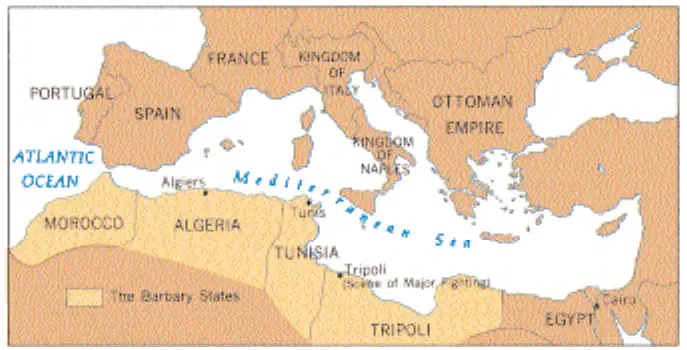
Match each location or entity with its relation in the Barbary context circa 1801–1805.
Tripoli
Pasha's state that provoked war with the United States
Algiers
Piratic state receiving tribute in blackmail dollars
U.S. Marine Corps
Force that fought in "the shores of Tripoli"
Savannah, Georgia
Site where a gunboat was deposited inland by hurricane and tidal wave
What geopolitical shift in 1800 set the stage for the Louisiana Purchase by placing the trans-Mississippi region under French control?
Britain ceded Louisiana to Spain for naval support
Napoleon Bonaparte induced Spain to cede Louisiana to France
The United States purchased New Orleans from Spain
Mexico asserted independence and took control of Louisiana
Rumors in 1802 confirmed that Spain had withdrawn the right of deposit at New Orleans. What did this right allow for American frontier farmers?
Immediate citizenship in Spanish Louisiana
Duty-free transport of goods overland to Canada
Warehouse privileges to float produce down the Mississippi to its mouth to await oceangoing shipment
Exclusive fishing rights in the Gulf of Mexico
Early in 1803, Jefferson sent envoys to Paris with instructions regarding New Orleans. Which directive captures his policy and contingency plan?
Buy New Orleans and as much land to its east as possible for up to $10 million
If purchase failed, open negotiations with Britain for an alliance
Refuse any offer that included territory west of the Mississippi
Threaten immediate military invasion of France if talks stalled
Why did Napoleon abruptly decide to sell all of Louisiana to the United States in 1803? Select all reasons mentioned.
Failure to reconquer Santo Domingo and its stubborn resistance led by Toussaint L'Ouverture
Yellow fever devastated French troops in the Caribbean
Imminent victory over Britain made Louisiana unnecessary
Impending naval conflict with Britain and the desire to strengthen the United States as a counterweight to British ambitions
What unexpected offer did the French foreign minister make to Robert Livingston during negotiations, and how did the resulting treaties compare to Jefferson’s original authorization?
An alliance against Spain; the treaties matched Jefferson’s $10 million cap
Sale of all Louisiana; the envoys signed treaties pledging $15 million for territory largely to the west rather than only New Orleans and land east
A lease of New Orleans; the treaties cost $5 million for port access only
Recognition of U.S. claims to Florida; the treaties added $25 million without land
Which constitutional concern did Jefferson privately express about the Louisiana Purchase before submitting the treaties to the Senate?
That treaties could not be negotiated without a declaration of war
That the Constitution lacked a clause authorizing incorporation of new expanse and populations into the Union by purchase
That Congress alone could manage foreign negotiations
That purchasing territories required unanimous approval of the states
Identify the approximate size and price of the Louisiana Purchase that made it "the most magnificent real estate bargain" in history.
10,000 square miles at ten cents an acre
28,000 square miles at about three cents an acre
828,000 square miles at about three cents an acre
1,200,000 square miles at one cent an acre
Match each figure or element with its role in the Louisiana Purchase and exploration.
Meriwether Lewis
Jefferson’s personal secretary who co-led the expedition
William Clark
Young army officer who co-led the expedition with Lewis
Sacagawea
Shoshoni woman who aided the expedition
Missouri River ("Great Muddy")
River ascended from St. Louis to begin the journey west
Which short-term consequence of the Louisiana Purchase most directly fueled fears of secession and foreign intrigue in the early 1800s?
Immediate clarification of western boundaries reduced local tensions
Vast new territory combined with a feeble federal reach made control difficult
Rapid settlement created a strong national presence across the West
Enhanced naval power ensured decisive enforcement of federal law
Identify the primary role Aaron Burr played in the conspiracy described: Jefferson’s first-term vice president, dropped from the cabinet in Jefferson’s second term, joined with Federalist extremists to plot the secession of New England and New York.
Organizer of a plan to consolidate federal power in the West
Leader in a plot to detach western territories for a Spanish alliance
Participant with Federalist extremists in a secession scheme for New England and New York
Mediator attempting to reconcile Jeffersonians and Federalists
Multi-select: According to the material, which statements accurately describe the Hamilton–Burr duel and its immediate political ramifications? Select all that apply.
Hamilton refused to fire, and Burr killed him with one shot
Dueling was legal everywhere in the United States at the time
Hamilton’s death destroyed the Federalist party’s one remaining hope of effective leadership
The duel ended Burr’s political career, which then flourished in national office
Match each figure or entity to the associated description.
Aaron Burr
Jefferson’s first-term vice president who engaged in secession plots
Alexander Hamilton
Federalist leader who exposed Burr’s conspiracy and died in a duel
James Wilkinson
Louisiana Territory’s unscrupulous military governor, a sometime Spanish agent
Chief Justice John Marshall
Jurist who strictly followed the law of evidence in Burr’s treason trial
Which alliance did Burr pursue after the duel when he turned his plotting to the trans-Mississippi West?
An agreement with frontier missionaries to secure Oregon
A pact with General James Wilkinson, military governor of Louisiana Territory
A coalition with Zebulon Pike to claim the headwaters of the Mississippi
A treaty with the British in Canada to annex New England
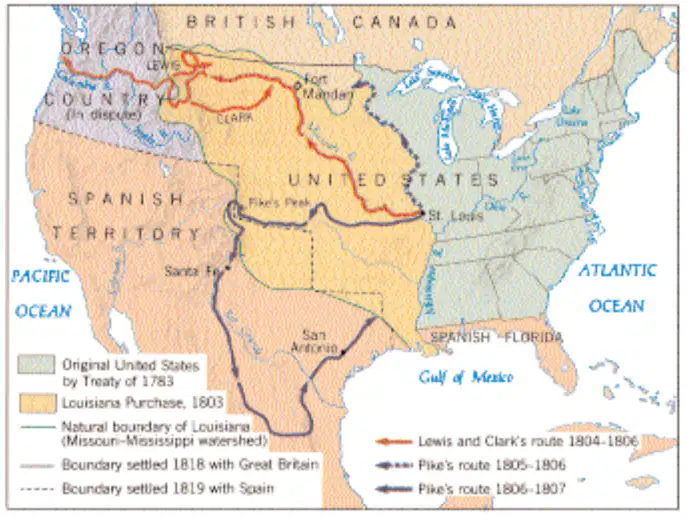
Based on the map of the Louisiana Purchase and western routes, which exploration is correctly paired with its timeframe and destination?
Lewis and Clark’s route, 1804–1806, to the Florida coasts
Pike’s route, 1806–1807, into the Southwest toward Spanish-controlled territories
Lewis and Clark’s route, 1805–1806, strictly within the original United States
Pike’s route, 1805–1806, confined to the Atlantic seaboard
Which statement best captures Chief Justice John Marshall’s approach during Burr’s treason trial, as described in the material?
He openly favored Jeffersonian policies and relaxed evidentiary standards
He strictly hewed to the law of evidence, appearing to Jeffersonians as biased toward the accused
He deferred entirely to the military governor of Louisiana Territory
He ruled that foreign intrigue excused conspiracy charges
Which achievement or sighting is attributed to Zebulon M. Pike during his western explorations following the Louisiana Purchase?
Charting an overland trail across the Oregon Country to the Pacific
Sighting the Colorado peak that bears his name during a venture into southern Louisiana Territory
Defeating Spanish forces to annex Florida for the United States
Establishing permanent settlements at the headwaters of the Mississippi River
Jefferson’s second-term foreign challenges escalated after Napoleon unloaded Louisiana in 1803. Which development most directly renewed conflict with Britain and set the stage for maritime pressure on American neutrality?
The Battle of Trafalgar establishing British naval supremacy
French recognition of American neutrality under the Berlin Decree
Napoleon’s deliberate provocation of a renewal of war with Britain
U.S. annexation of West Florida provoking Spanish retaliation
In 1806–1807, how did the British Orders in Council and Napoleon’s counter-decrees jointly affect American commerce?
They opened European ports to neutral carriers if licensed by Britain
They required neutral ships to pay equal duties to Britain and France
They closed European ports to French trade and ordered seizure of merchant ships, leaving American vessels trapped between the two powers
They guaranteed safe passage to neutral ships that avoided contraband goods
Which statement best explains the phrase that American vessels were “caught between the Devil and the deep blue sea” during the Napoleonic Wars?
They faced domestic embargoes and piracy in the Caribbean
They confronted mutually exclusive British and French regulations that made lawful trade nearly impossible
They were barred from trading with Asia due to British monopolies
They lacked sufficient naval escorts against privateers
Identify the practice that most inflamed American pride: the forcible enlistment of sailors by the British, often through press gangs and shipboard seizures.
Privateering
Blockade-running
Impressment
Conscription by state militias
During the Chesapeake affair in 1807, what demand by the British captain sparked American outrage?
Payment of reparations for cargo losses
Surrender of four alleged deserters from His Majesty’s service
Permission to search the Chesapeake for contraband French goods
Immediate towing of the American frigate to Halifax for trial
Match each policy or event with its description.
Orders in Council (1806)
Closed European ports to French trade; required ships to stop at British ports
Napoleon’s response to Orders in Council
Ordered seizure of merchant ships, including American, that entered British ports
Impressment
Forcible enlistment of sailors by British press gangs and ship seizures
Chesapeake affair
British assault on U.S. frigate demanding surrender of alleged deserters
Which development immediately followed the Chesapeake affair and heightened tensions with Britain?
London admitted fault and offered full reparations quickly
Jefferson demanded war and Congress declared hostilities
Britain’s partial admission of wrong-doing without full relief, while American anger surged
France offered naval protection to U.S. ships in the Atlantic
The Embargo Act of 1807 aimed to implement Jefferson’s idea of “peaceful coercion.” What did the law specifically forbid?
Import of British manufactured goods only
Export of all goods from the United States, whether in American or foreign ships
Trade with Britain but not with France
Sailing beyond the U.S. coastal waters by American ships
Select the economic effects of the Embargo Act described in the material. (Choose all that apply.)
Forests of dead masts and deserted docks in New England
A sudden boom in American shipbuilding due to domestic demand
Soup kitchens appearing for the unemployed
Southern and Western farmers suffering less disastrously than New England
Why did Jefferson believe a voluntary cutoff of American exports would pressure Britain and France to respect U.S. rights?
Both powers depended heavily on American raw materials and foodstuffs
The U.S. Navy could enforce the embargo worldwide
European wars had ended, increasing demand for U.S. luxury goods
Britain and France sought closer diplomatic ties with the U.S.
Which factors help explain why the embargo failed after fifteen months?
Underestimated British resilience and overestimated belligerent dependence on U.S. trade
Unexpected alternative markets emerged, including Latin American ports
The embargo was tightly enforced without illicit trade
Napoleon controlled much of Europe and could tighten his belt
According to the description of Macon's Bill No. 2, what bargaining measure did Congress adopt in 1810 to reopen American trade while attempting to influence Britain and France?
A permanent repeal of all trade restrictions without conditions
A policy reopening trade with all nations while promising commercial restoration to the first belligerent that ended its restrictions on U.S. trade
A renewed full embargo against both Britain and France
A naval blockade of French ports coupled with tariffs on British goods
Which statement best explains Napoleon's diplomatic maneuver in response to Macon's Bill No. 2?
He clearly abolished all French decrees and guaranteed unrestricted trade with both the United States and Britain
He ambiguously implied French decrees might be repealed if Britain also lifted its Orders in Council, aiming to push the United States to restore the embargo against Britain
He demanded the United States maintain neutrality and avoid any trade with Europe
He offered military support to the United States in exchange for an alliance against Britain
Identify the policy progression described: Which law followed Jefferson's Embargo by partially reopening trade and was set to expire in 1810?
The Neutrality Act
The Non-Intercourse Act of 1809
The Alien and Sedition Acts
The Jay Treaty Renewal
Madison's domestic political position is described as weakened by factions. Which characterization aligns with the text's portrayal of James Madison as president?
A commanding executive who easily dominated Congress like Jefferson
A tall, forceful orator who unified his party through charisma
A scholarly but slight and soft-spoken leader hampered by party divisions and risky foreign policy dilemmas
A military hero whose battlefield successes secured legislative compliance
Based on Madison's strategic choice under Macon's Bill No. 2, which outcome occurred when London refused to bargain while fighting Napoleon?
America traded exclusively with the British Empire, restoring neutrality
Madison's gamble succeeded, and both Britain and France lifted all restrictions
The United States reestablished the embargo solely against Britain, a step Madison feared would end neutrality and edge toward war
Congress revoked Macon's Bill and reinstated the Non-Intercourse Act of 1809
Multi-select: Which factors fueled the rise of 'war hawks' in the Twelfth Congress, as described? Select all that apply.
Resentment over British Orders in Council that impeded American trade
Detestation of the impressment and manhandling of American sailors
A desire to renew alliances with Britain and France simultaneously
Impatience with older 'submission men' and eagerness for a new confrontation with the old enemy
Match each figure or term to its description.
Macon's Bill No. 2
Bargaining measure reopening trade and promising restoration to the first power ending restrictions
Orders in Council
British directives that obstructed American trade and contributed to tensions
Henry Clay
Eloquent Speaker of the House elevated by war hawks, advocating honor and independence through war
War hawks
Younger legislators from the South and West favoring a more confrontational stance
Which statement captures western war hawks' aims regarding Native Americans in the trans-Allegheny region?
They promoted negotiated settlements to preserve Native control of forests
They sought to wipe out the renewed Indian threat to pioneer settlers streaming westward, as white settlement pushed more Indians toward the setting sun
They demanded federal removal of settlers to reduce conflict with Native nations
They argued for closing western lands to farming to prevent tension
Which statement best explains Tecumseh's goal as he and Tenskwatawa (the Prophet) organized tribes east of the Mississippi?
To negotiate separate land treaties for each tribe to avoid conflict
To weld a confederacy of tribes to resist selling land to whites unless all Indians agreed
To ally exclusively with the British to regain lands lost to Americans
To relocate Shawnee communities west of the Mississippi to escape U.S. control
According to Tecumseh’s argument quoted from Vincennes, what critique did he level against the white concept of land ownership?
Land should be divided into private parcels based on tribal status
Selling land is acceptable if the Great Spirit approves a treaty
Humans cannot sell what belongs to the Great Spirit and is for the use of all children
Ownership requires tribute to the United States before any sale
Which change in material culture did Tecumseh’s movement encourage among its followers?
Adoption of European textile clothing for warmth
Use of traditional buckskin garments in place of textile clothing
Exclusive use of British woolens to signal alliance
Abandonment of clothing as a spiritual statement
Identify the outcome and significance of the Battle of Tippecanoe (1811).
Shawnee forces routed and their settlement burned
William Henry Harrison became a national hero
Tecumseh defeated Harrison and solidified his confederacy
The Prophet’s defeat pushed him toward alliance with the British
Match each figure or group with the role described.
Tecumseh
Sought a pan-Indian confederacy and rejected individual land sales
Tenskwatawa (the Prophet)
Led a spiritual revival and was defeated at Tippecanoe
William Henry Harrison
Indiana Territory governor who attacked Tippecanoe
War hawks in Congress
Advocated war with Britain, citing Indian attacks and Canadian base
Based on William Henry Harrison’s later assessment quoted in the text, how did he characterize Tecumseh?
An ordinary tribal leader committed to gradual reform
A genius who could overturn established orders and found a great empire
A British agent focused on securing Canada for the Crown
A pacifist who opposed any armed resistance to U.S. expansion
Which factors contributed to President Madison’s decision to seek war with Britain by spring 1812? Select all that apply.
British arming of hostile Indians on the frontier
Pressure from war-hawk leaders in his own party
A desire to punish France for the Continental System
Calls to wipe out Britain’s Canadian base
What happened to Tecumseh after the United States declared war on Britain in 1812?
He retired from politics and moved to Spanish Florida
He allied with the British, fought fiercely, and died at the Battle of the Thames in 1813
He was captured at Tippecanoe and executed by Harrison
He negotiated a peace that dissolved the Indian confederacy without further fighting

