
 Worksheets
Paychecks & Taxes - Personal Finance Unit 3 REVIEW
Total questions: 44
Worksheet time: 4hrs 40mins
Spencer gives a talk about the benefits of living in the United States. He mentions health care access, widespread availability of electricity and internet, clean drinking water, everyone has a vehicle, and their own home. Spencer is likely discussing:
The standard of living in the United States
The cost of living in the United States
The lifestyle of the United States
The tax system of the United States
Ashley and her friends are discussing their choices and habits in clothing, cars, meals, and savings. Ashley and her friends are likely discussing
Their standard of living
Their cost of living
Their lifestyles
Their paychecks
Kaleb is thinking about moving out of the city and into a more rural area. He believes the benefits will be that his paycheck will have more purchasing power because he will keep his remote job. Kaleb is likely moving to change his
His standard of living
His cost of living
His lifestyle
His insurance
Which of the following describes a cover letter best?
A. A list of your past work, school, and personal experiences related to a job
B. Skills that you possess that are useful in both professional and every-day situations
C. An introduction to an employer that explains who you are and why you would be good for a job
D. The form you fill out for an employer to determine what position you should have at a job.
Which of the following describes a résumé best?
A. A list of your past work, school, and personal experiences related to a job
B. Skills that you possess that are useful in both professional and every-day situations
C. An introduction to an employer that explains who you are and why you would be good for a job
D. The form you fill out for an employer to determine what position you should have at a job.
Which of the following best describes transferable skills?
A. A list of your past work, school, and personal experiences related to a job
B. Skills that you possess that are useful in both professional and every-day situations
C. An introduction to an employer that explains who you are and why you would be good for a job
D. The form you fill out for an employer to determine what position you should have at a job.
Which of the following is NOT a way of building transferable skills?
Taking classes that interest you
Volunteering or taking on new challenges or tasks
Waiting until you naturally develop new skills with age
Starting new hobbies or interests
What is the relationship between education levels and income?
Higher levels of education result in higher levels of income
Lower levels of education result in higher levels of income
Your education and income should be about the same
There is no relationship between education and income
Which of the following is NOT true?
Jobs are activities for which a person earns money
A profession is a paid job that has opportunities for growth
Everyone has only one career in their life
Most people stay at the first job for their whole life
Tyler is looking for a new job, which of the following is NOT something he would likely consider when applying for a new job?
How much he will be making either hourly or salary
What good restaurants and stores are nearby
What employee benefits are provided by the new job
The responsibilities of the job and what qualifications are needed
Which of the following is NOT a common employee benefit?
Travel to and from work
Retirement account contributions
Health insurance paid in part or in full
Company-provided items like vehicles needed to do the job
Which of the following is a way to ensure that you will have future job opportunities?
Get a degree in your field and never worry about updating your knowledge
Mix your personal and business profiles online and post everything about your life
Maintain professional and ethical behaviors in your jobs and networks
Bribe nearby managers so they will offer you a job
Which of the following is true about direct costs and indirect costs of college?
Direct costs are paid by the college and indirect costs are paid by you
Direct costs are paid immediately to the college and indirect costs are other costs you will need to pay before graduating
Direct costs are the tuition and fees that you pay and indirect costs are all other costs associated with college (like room and board)
Financial aid only pays for direct costs and cannot be used for indirect costs
Which of the following is NOT true about the FAFSA?
It is completely free to fill out
About 85% of all applicants receive financial aid
You only need to complete it once, before starting college
The FAFSA opens October 1st and you should complete it as soon as possible
Which formula is used to calculate the net price of college?
Sticker price + grants and scholarships = net price
Sticker price + value = net price
Sticker price – grants and scholarships = net price
Sticker price – value = net price
What is the relationship between your Student Aid Index (SAI) and your likelihood of qualifying for financial aid?
A. A higher SAI means you’ll likely qualify for MORE financial aid
B. A higher SAI means you’ll likely qualify for LESS financial aid
C. Your SAI is equal to the amount of financial aid you’re eligible to receive
D. Your SAI has no effect on how much financial aid you’ll qualify for
Rank the types of financial aid options from best to worst (financial aid includes: federal loans, private loans, scholarships & grants, work study)
1. Scholarships & grants 2. Federal loans 3. Work study 4. Private loans
1. Federal loans 2. Scholarships & grants 3. Work study 4. Private loans
1. Private loans 2. Federal loans 3. Work study 4. Scholarships & grants
1. Work study 2. Scholarships & grants 3. Private loans 4. Federal loans
Which of the following actions would MOST likely increase your cost of attending college?
Taking out federal student loans rather than private student loans
Using grants and scholarships to pay for college costs
Accepting a work study position
Attending an out-of-state college
All of the following statements about private student loans are true EXCEPT
Part of the interest is subsidized by the U.S. government
You may need to start paying them back as soon as you accept them
Their interest rates can be variable or fixed
They are unlikely to be eligible for student loan forgiveness
Which of the following is NOT true about grants and scholarships?
They are usually merit based
You have to pay them back
You can receive them for academic or athletic achievement
They can come from sources other than the government
When accepting financial aid, you will likely have to do all of the following EXCEPT
Submit an online form with the amounts of aid you’re accepting
Sign and return a promissory note
Complete entrance counseling
Make a deposit to secure your student loans
After completing the FAFSA, when do you receive your FAFSA summary?
1 – 3 business days after submitting
1 – 3 months after submitting
At the end of the year that you submitted
Immediately
How do you find your net income?
You multiply the number of hours worked with the hourly rate, adding additional rates and time as needed.
You divide your salary by the number of paychecks you receive in a year
Find 70% of your gross income because 30% is always taken for deductions
Take your gross income and subtract all mandatory taxes and optional deductions.
Which of the following is true about Social Security and Medicare deductions?
Social Security and Medicare are optional deductions
Social Security is 6.2% of gross income and Medicare is 1.45% of gross income
Social Security is 1.45% of gross income and Medicare is 6.2% of gross income
The same amount of money is deducted for both Social Security and Medicare
What is the federal minimum wage?
$15.00
$13.75
$9.50
$7.25
Which of the following is NOT a mandatory paycheck deduction?
Income taxes
Life insurance
Social Security
Medicare
Which of the following is NOT a consideration when choosing a depository institution?
Where the depository institution is located and the number of locations
How long the depository institution has been in business
The financial services provided by the depository institutions
Interest rates percentages, different fees that you may have to pay and the amount of each fee.
Sanjay is concerned about the safety of the money in his savings account. Which type of depository institution should he choose?
A. A commercial bank since his deposits would be insured by the Federal Deposit Insurance Corporation (FDIC)
B. A credit union since his deposits would be insured by the National Credit Union Association (NCUA)
C. He could safely choose either a commercial bank or a credit union as long as his savings account balance meets the insurance requirements.
D. Neither a commercial bank nor a credit union. Money is most safely kept at home ins a personal safe or vault.
Savings tools offered by depository institutions may earn interest. Which of the following statements is NOT TRUE about interest?
Interest is the price paid for using someone else’s money
When earning interest, look for low rates
When paying interest, look for low rates
The amount of interest earned or paid is determined by the interest rate.
Common fees that may be charged by a depository institution include all EXCEPT:
Overdraft fees
Late fees
ATM fees
Minimum balance fees
In the United States, we have marginal tax rate system. What does this mean?
Businesses only pay taxes on their profit margins
You pay a percentage of tax on all money you make each year
You pay different tax percentages on different amounts of money
All tax calculations are done in the margins of the tax form
Paying your income taxes on an ongoing basis means
Taxes will be withheld from each paycheck
You won’t owe as big of a tax bill later in the year
You were meeting part of your civic duty
All of the above
Which of the following can NOT be deducted from your income taxes?
IRA contributions
Student loan interest
Cost of repairs done to your house and car
Business expenses
Which of the following is true about interest rates?
You want high interest rates when earning interest and when taking loans
You want high interest rates when earning interest and low interest rates when taking loans
You want low interest rates when earning interest and high interest rates when taking loans
You want low interest rates when earning interest and when taking loans
When should you update or complete a new Form W-4?
Never. You only need to fill it out once.
Every year
Every 5 years
Any time a major life event such as marriage or gaining/losing a new job.
Hannah decides to have an additional $100 withheld from her income taxes, included on her Form W-4. Which of the following is a reason she might do this?
By reducing the amount of money on her net income, she is reducing the amount of taxes and other deductions
Hannah wants to guarantee that she has a large tax return and always having extra money withheld will do that
Hannah has other income that she will need to pay income taxes
By having more money for income tax withheld now, her future taxes next year will already be paid off.
Which of the following is NOT true about standard and itemized deductions?
Everyone can take either a standard deduction or an itemized deduction
If you file as single then your standard deduction is $14,600 and if you're married filing jointly, then your standard deduction is $29,200
Itemized deductions can be more than standard deductions but you have to track all of your expenses and keep all of your receipts
Itemized deductions can be added on to your standard deduction based on what records you have kept from the year
Why do we pay taxes?
We pay taxes to fund the local, state, and federal government and their projects
We pay taxes so that businesses and corporations do not have to
We pay taxes to ensure that everyone’s basic needs are met
We pay taxes to fund remain citizens of the United States
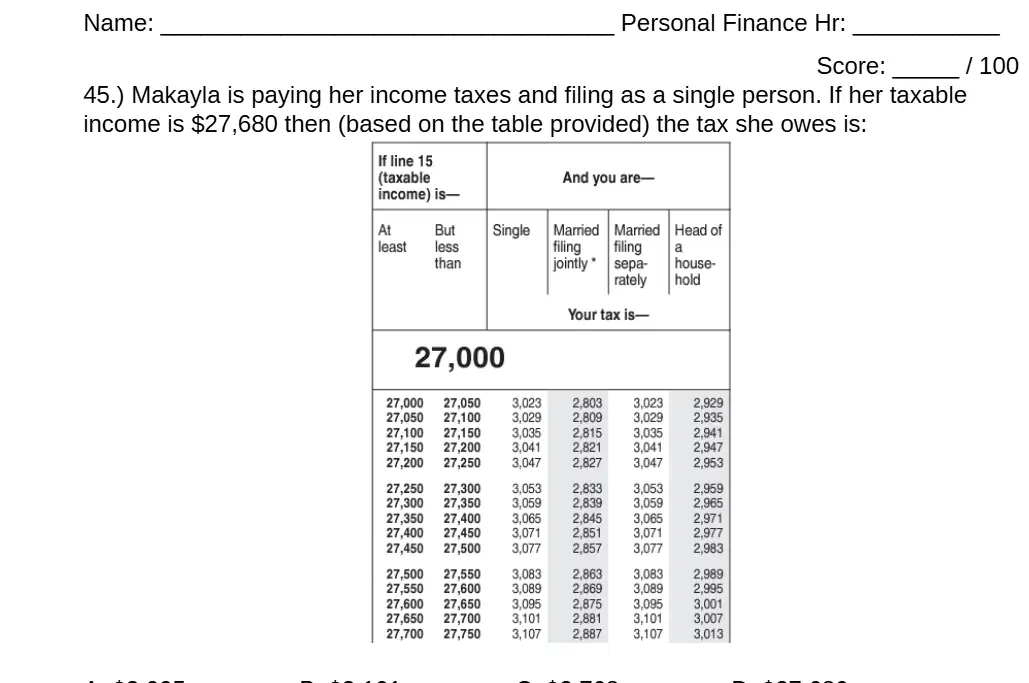
Makayla is paying her income taxes and filing as a single person. If her taxable income is $27,680 then the tax she owes is:
$3,095
$3,101
$2,768
$27,680
The Sandersons have a tax liability of $3,490. According to their federal income tax withholding, they have paid $2,350. Which of the following is true?
They owe $2,350 in taxes
They owe $1,140 in taxes
They will get a refund of $2,350
They will get a refund of $1,140
Why is it important to understand how to file your taxes?
You can cheat the system to pay less in taxes or get a large refund
It contributes to positive financial wellbeing because you understand the process even if you have someone else do them
If you know how to file your taxes then you are smarter than everyone else in this room.
It is not important to understand taxes – just pay someone else to do it
When is the deadline to file your income taxes?
January 1st
April 15th
October 12th
December 31st
Which of the following is NOT subject to federal income tax?
Capital gains made from selling assets
Cash received from working jobs
The value of a house and other assets
Interest earned on savings accounts
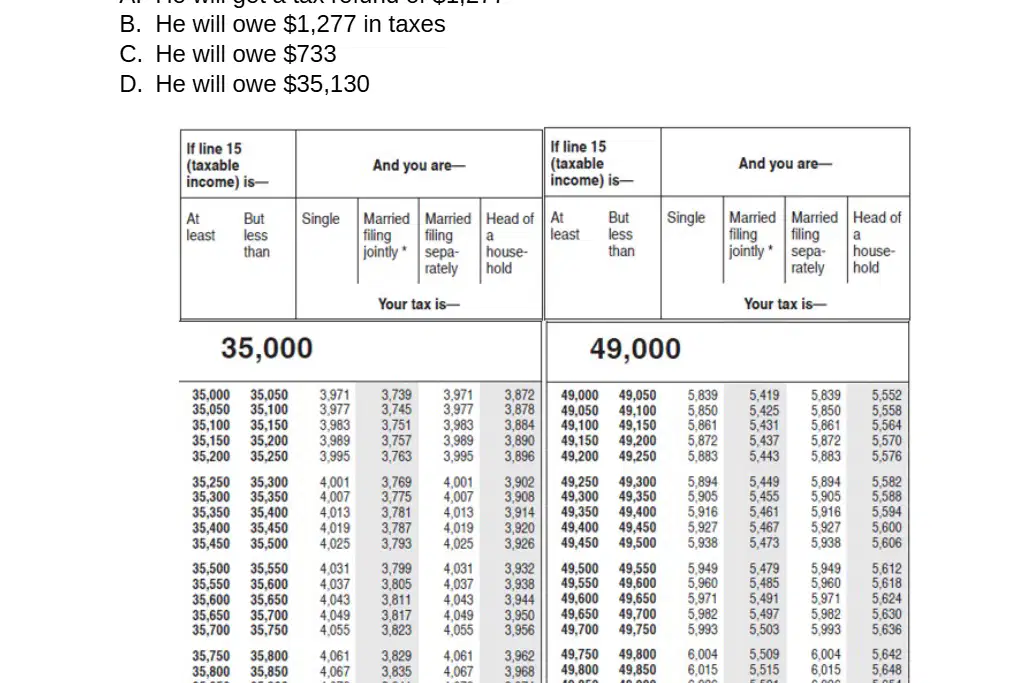
Chris is doing his income taxes for the year. His W-2 says that he made $46,700 at his job. He also made $2,950 in tips and $80 in interest not reported on his W-2. He is filing as a single person. According to his W-2, he had $5,260 withheld. Based on this information, the result of his taxes is:
He will get a tax refund of $1,277
He will owe $1,277 in taxes
He will owe $733
He will owe $35,130

