
 Worksheets
Glaucoma Worksheet Questions (Grade 13)
Total questions: 20
Worksheet time: 10mins
A 70-year-old lady comes to emergency at midnight for the complaint of painful, blurred and red right eye for three hours.
The provisional diagnosis is
Primary open-angle glaucoma
Primary angle-closure glaucoma
Normal-tension glaucoma
Secondary glaucoma
What is the most common risk factor for developing primary open-angle glaucoma?
Increased intraocular pressure
Diabetes mellitus
Hyperopia
Age under 30 years
Which structure is primarily affected by increased intraocular pressure in glaucoma?
Retina
Optic nerve head (optic disc)
Cornea
Lens
What is the hallmark optic nerve finding in glaucoma?
Optic disc swelling
Optic disc hemorrhage
Increased cup-to-disc ratio
Retinal detachment
Which of the following medications is a first-line topical treatment for lowering intraocular pressure in glaucoma?
Topical corticosteroids
Prostaglandin analogues
Beta-blockers
Carbonic anhydrase inhibitors
Which glaucoma type often presents with normal intraocular pressure but progressive optic nerve damage?
Primary open-angle glaucoma
Normal-tension glaucoma
Secondary glaucoma from uveitis
Congenital glaucoma
In primary angle-closure glaucoma, what is the underlying pathophysiology?
Trabecular meshwork blockage by pigment
Narrow or closed anterior chamber angle preventing aqueous outflow
Optic nerve ischemia
Increased aqueous humor production
What is the primary diagnostic test for assessing glaucomatous optic nerve damage?
Visual field testing (perimetry)
Optical coherence tomography (OCT) of the retina
Fundus photography
Fluorescein angiography
Which systemic medication can increase intraocular pressure and risk for glaucoma exacerbation?
Beta-blockers
Oral corticosteroids
ACE inhibitors
Calcium channel blockers
What visual field defect is classically seen in early glaucoma?
Central scotoma
Bitemporal hemianopia
Paracentral scotoma
Homonymous hemianopia
What anatomical feature distinguishes congenital glaucoma?
Increased corneal diameter (buphthalmos)
Normal intraocular pressure at birth
Presence of iris neovascularization
Posterior synechiae
The best medication for acute attack of angle closure glaucoma is
Betablocker
carbonic anhydrase inhibitors
Prostagladin analogues
Alpha 2 agonist
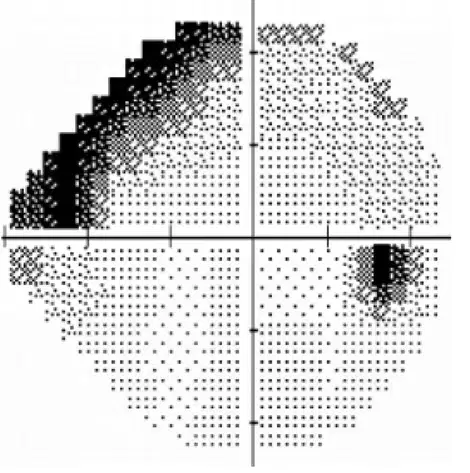
A patient complains with visual field defect in upper and nasal quadrant of the right eye (displayed).
Which part of retina is damaged for her right eye?
Macular
Upper temporal
Lower temporal
Lower temporal
Which of the following features is NOT typical in normal-tension glaucoma?
Optic nerve cupping similar to open-angle glaucoma
Normal range intraocular pressure
Rapid progression despite treatment
Increased susceptibility to vascular dysregulation
What is the main goal of glaucoma treatment?
Reduce optic nerve inflammation
Stabilize blood glucose levels
Lower intraocular pressure to prevent optic nerve damage
Increase retinal perfusion pressure
Which test can directly measure the intraocular pressure?
Tonometry
Perimetry
Slit lamp examination
Fundoscopy
Which part of the eye produces aqueous humor that contributes to intraocular pressure?
Ciliary body
Cornea
Iris
Retina
What characteristic finding may develop in the cornea of an eye with chronic glaucoma?
Corneal edema and striae
Keratic precipitates
Neovascularization of the cornea
Corneal pannus
Which condition can cause secondary angle closure glaucoma?
Diabetic retinopathy
Uveitis
Age-related macular degeneration
Cataract
Which diagnostic imaging modality is most useful to evaluate the anterior chamber angle in glaucoma?
biomicroscopy
MRI orbit
Fundus fluorescein angiography
CT orbit

