
NEW
Font size
 Worksheets
Pre-Test PA Blok 2.3 Inflammation and Neoplasia
Total questions: 10
Worksheet time: 8mins
A 32-year-old woman presents with vaginal discharge and mild postcoital spotting. Speculum examination reveals an erythematous cervix with mucopurulent exudate. Microscopic examination of a cervical smear shows neutrophilic infiltration and epithelial ulceration. Which of the following best describes the subtype of inflammation and its typical etiology?
Chronic inflammation caused by Candida albicans
Acute inflammation due to Neisseria gonorrhoeae
Granulomatous inflammation due to Mycobacterium tuberculosis
Chronic inflammation caused by chemical irritants
Serous inflammation caused by viral infection
A 40-year-old multiparous woman has a history of recurrent vaginal infections. Biopsy of the cervix shows lymphocytes, plasma cells, and squamous metaplasia forming Nabothian cysts. What is the most accurate interpretation of these findings?
Features of cervical intraepithelial neoplasia (CIN I)
Normal post-inflammatory reparative changes
Early invasive squamous cell carcinoma
Viral cytopathic effect due to HPV-16
Adenocarcinoma in situ
A 29-year-old woman’s Pap smear shows koilocytosis, nuclear enlargement, and perinuclear halos. HPV testing is positive for type 16. Which molecular event best explains these morphological changes?
Activation of tumor suppressor p53 by E6 protein
Inactivation of p53 and Rb tumor suppressors by viral oncoproteins
Upregulation of BCL-2 leading to apoptosis
Overexpression of E-cadherin maintaining cell adhesion
Mutation in BRCA1 causing DNA repair failure
Histologic sections of a cervical biopsy show dysplastic cells occupying the lower one-third of the epithelial layer, with mild nuclear enlargement and preserved maturation at the surface. Which diagnosis best fits these findings?
CIN I / Low-grade squamous intraepithelial lesion (LSIL)
CIN II / High-grade squamous intraepithelial lesion (HSIL)
CIN III / Carcinoma in situ
Reactive squamous metaplasia
Adenocarcinoma in situ
A 52-year-old woman presents with irregular vaginal bleeding. Cervical biopsy reveals nests of malignant squamous cells invading the stroma, forming keratin pearls and intercellular bridges. Which is the most appropriate interpretation?
Squamous cell carcinoma of the cervix
High-grade squamous intraepithelial lesion (HSIL)
Endocervical adenocarcinoma
Chronic cervicitis with reactive atypia
Cervical intraepithelial neoplasia grade 2
A cervical tissue sample shows loss of maturation and marked nuclear atypia. Immunostaining demonstrates diffuse positivity for p16INK4a and Ki-67 throughout the epithelial thickness. What is the diagnostic significance of these findings?
They indicate a benign reactive lesion
They confirm chronic inflammation
They support a diagnosis of high-grade intraepithelial lesion (HSIL)
They are specific for adenocarcinoma only
They indicate tissue necrosis
A 45-year-old woman undergoes routine screening. Her Pap smear shows atypical squamous cells of undetermined significance (ASC-US). What is the next appropriate diagnostic step?
Immediate hysterectomy
Repeat Pap smear after one year
HPV DNA testing for high-risk types
Start antibiotic therapy
Ignore the finding as clinically insignificant
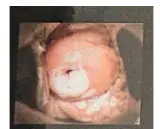
A 33-year-old woman with no symptoms comes to a primary health center. The clinic uses the Visual Inspection with Acetic Acid (VIA/IVA) test as part of a community screening program. After application of 5% acetic acid, a well-defined acetowhite area is observed near the transformation zone. What is the most appropriate next management step?
Reassure and repeat screening in five years
Prescribe antibiotics for cervicitis
Perform colposcopy and guided biopsy or cryotherapy (screen-and-treat)
Proceed directly to radical hysterectomy
No further action required
A Pap smear report using the Bethesda System states: “High-grade squamous intraepithelial lesion (HSIL).” Which cytologic and histologic changes correspond to this diagnosis?
Mild dysplasia limited to the lower third of epithelium
Full-thickness loss of maturation with nuclear hyperchromasia
Normal squamous epithelium with inflammatory changes
Presence of glandular atypia consistent with adenocarcinoma in situ
Only reactive metaplasia and edema
A 24-year-old sexually active woman asks when she should begin cervical cancer screening. According to international and national recommendations, what is the correct advice?
Begin screening immediately after menarche
Begin within three years of first sexual activity or by age 21
Begin only after childbirth
Screening is unnecessary before age 30
Begin at age 40 with HPV testing only

