
 Worksheets
Autonomous Vehicles LiDAR — Reading Comprehension Quiz
Total questions: 44
Worksheet time: 22mins
According to the content, LiDAR stands for which term?
Light Detection And Ranging
Laser Distance And Radar
Linear Detection And Reflection
Light Distortion And Ranging
Which statement best describes LiDAR as introduced in the content?
A remote sensing technology using pulsed laser light to measure variable distances
A camera-based system that measures color variations in daylight
A radio-frequency sensor that maps magnetic fields
An ultrasonic sensor used only at short ranges underwater
What combined information allows LiDAR to generate precise three-dimensional information about the shape of the Earth, its surface characteristics, and visible objects?
Light pulses together with other data recorded by the airborne system
Only the intensity of sunlight recorded by a camera
Acoustic echoes captured by microphones
Thermal images recorded by infrared sensors
Which benefit is highlighted as a reason LiDAR has been an enabling technology for autonomous vehicle technology?
It provides detailed 3D scans of the environment even in the dark
It relies solely on GPS for localization
It requires no sensors mounted on the vehicle roof
It operates only during clear daytime conditions
Which capability of LiDAR is emphasized regarding distance measurement?
It is able to provide very accurate range information
It estimates distance by comparing images frame by frame
It measures range based on ambient temperature gradients
It relies on driver input to estimate range
Based on the working principle overview, what do Lidars do at very high rates?
Transmit and receive data from hundreds of thousands of laser pulses every second
Capture a single photograph once per minute
Emit continuous radio waves without timing
Release sonar pings only when a collision is imminent
According to the working principle, what does the on-board computer do with the laser’s reflections?
Converts the recorded points into a point cloud to form a 3D representation of the surroundings
Averages them into a single distance value for the closest object only
Deletes weak reflections to save storage space
Transforms them into 2D images without depth

As described, LiDAR fires pulses of laser light at a surface along what kind of direction?
A known ray direction
A random and unknown direction
Only a vertical downward direction
A curved trajectory determined by gravity

What is the speed characteristic of the outward-traveling LiDAR pulse mentioned in the content?
It travels at the speed of light
It travels at the speed of sound
It is stationary until an object moves
Its speed depends on target color
Upon hitting a target, how does the laser pulse behave according to the working principle?
It scatters off the surface in all directions
It is absorbed completely with no reflection
It reverses direction only at right angles
It accelerates and passes through the object unchanged
Which component detects the returning light in the LiDAR system as described?
A photodetector
A barometer
A tire pressure sensor
A GPS antenna

What time measurement is emphasized for determining distance in LiDAR?
Time-of-Flight of the pulse bouncing back
Daily cycle time of ambient light
Processor clock cycle time
Time since last GPS update
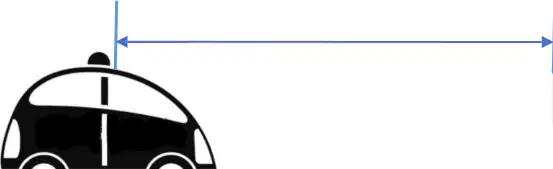
As stated, LiDAR uses the constant speed of light to calculate distance between itself and a target. What value is used for the speed of light?
c=3×10⁶ m/s
c=3×10⁸ m/s
c=3×10¹⁰ m/s
c=3×10⁵ km/s
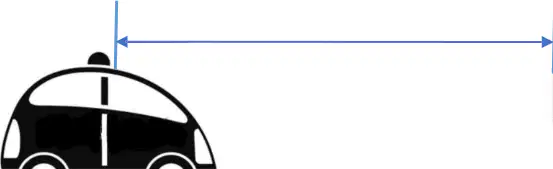
Why can it be assumed during measurement that the LiDAR and the target are stationary?
Because the laser power is low
Because light travels much faster than cars
Because the sensor only measures at night
Because the truck in the scene is parked

The total round-trip distance traveled by a LiDAR laser pulse is determined by multiplying which quantities?
Speed of light and one-way travel time
Speed of light and the round-trip time (time-of-flight)
Laser power and target reflectivity
Sensor aperture and pulse width

What is the name of the ranging technique that multiplies the speed of light by the round-trip time to infer distance?
Phase-correlation ranging
Parallax ranging
Time-of-flight ranging
Triangulation ranging
Which equation correctly represents the relationship used for LiDAR distance measurement based on round-trip time?
Distance=c×Time-of-Flight
Distance=2c×Time-of-Flight
2×Distance=Time-of-Flightc
Distance=c+Time-of-Flight
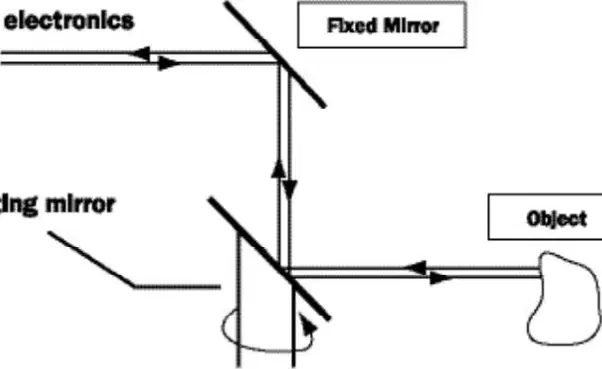
According to the basic concept described, what component typically emits the light pulse in a LiDAR system?
LED array
Laser diode
Flash lamp
Microwave oscillator
After the emitted light hits a target, what happens that enables distance measurement?
All the light is absorbed and converted to heat
A portion of the light energy is reflected back toward the emitter
The target emits its own light at a different wavelength
The pulse splits into two beams that circle the object
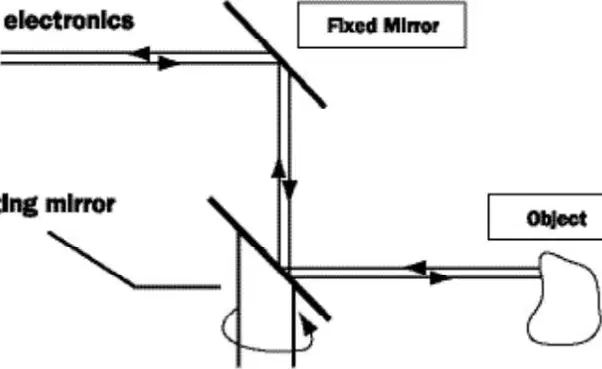
What measurement does the detector near the emitter use to determine the target distance?
The amplitude difference between outgoing and incoming pulses
The frequency shift between transmitted and received signals
The difference between the emission time and the detected return time
The polarization change upon reflection
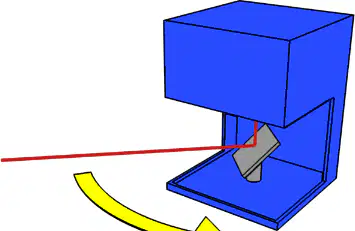
In measuring distances in 2D, what directs the emitted pulses along different directions?
A static lens array
A rotating mirror in the LiDAR
A moving photodiode array
A vibrating prism
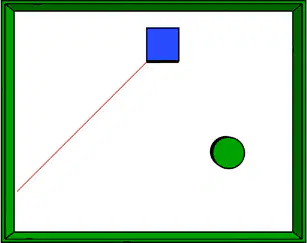
As the mirror rotates during 2D measurement, what is recorded around the sensor?
A single distance straight ahead
Distances at points in a 2D slice around the sensor
Only the closest obstacle distance
Only angular velocity of the mirror
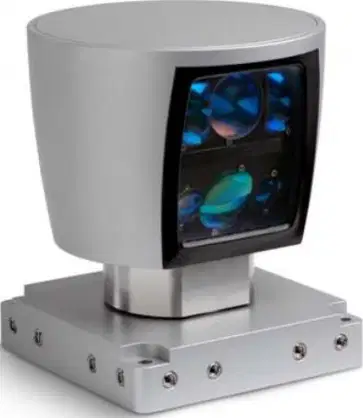
Which specification is stated for the Velodyne HDL-64E sensor regarding its emitter-detector configuration and elevation field of view?
32 pairs with 13.25° elevation field of view
64 pairs with 26.5° elevation field of view from +2° to −24.5°
48 pairs with 45° elevation field of view from −10° to +35°
16 pairs with 90° elevation field of view from 0° to −90°
What default rotation speed is stated for the HDL-64E, and what adjustable range can it be instructed to run at?
300 RPM by default; adjustable 100–300 RPM
600 RPM by default; adjustable 300–900 RPM
900 RPM by default; adjustable 600–1200 RPM
10 RPM by default; adjustable 1–20 RPM
Select all components of Autonomy for passenger cars as listed in the worksheet: Sensors, Actuators, Communication, Intelligence.
Sensors
Actuators
Communication
Intelligence
Powertrain
RADAR stands for which phrase and uses radio waves in autonomous vehicles.
Radio Detection and Ranging
Remote Direction and Response
Radiation Direction and Reading
Range Detection and Routing
Which components are listed as parts of a radar system for autonomous vehicles.
transmitter
transmitting antenna
receiving antenna
receiver
processor
According to the description of radar operation, the reflected radio waves provide information about what property of the object in addition to its location.
speed
temperature
color
material composition
For vehicles traveling fast (about 50–70 km/h or more), which sensor type is stated as having one of the big advantages over LIDAR due to reaction time considerations.
RADAR
Ultrasonic
Camera
Infrared
Short-range automotive radar is identified with which frequency on the worksheet.
24 GHz
40 GHz
60 GHz
77 GHz

Long-range automotive radar sensors are identified with which frequency on the worksheet.
24 GHz
57 GHz
64 GHz
77 GHz
Which functions are associated with short-range radar on the worksheet.
blind spot monitoring
lane-keeping assistance
parking aids
automatic distance control
Which function is associated with long-range radar sensors on the worksheet.
automatic distance control
blind spot monitoring
parking aids
driver drowsiness detection
Compared with camera sensors, what condition is stated as typically not troubling radar systems when identifying objects.
fog or rain
bright sunlight
nighttime lighting
tunnel environments
Which advantages are explicitly listed for radar in autonomous vehicles.
accuracy from new mmW devices
warning system able to alert before imminent collision
compact design with smaller components
eliminates need for any antennas
Which item is given as a common challenge for radar due to certain atmospheric and meteorological phenomena and the presence of pollutants.
vulnerability affecting threat identification
improved accuracy in clear weather
ability to see color of objects
insensitivity to electromagnetic fields
Which issue is described as alarms activating even when there is no real threat, leading to harmless mistakes.
over-sensitivity of the technology
external interference from mechanical vibrations
inadequate battery power
software latency
Which limitations are explicitly mentioned for radar in its present state.
limited in terms of accuracy and range
inability to measure distance
requires optical line of sight like a camera
only works indoors
Electrical towers or electromagnetic hotspots are cited as examples of what challenge for radar.
external interference
signal amplification
automatic calibration
weather hardening
GPS is operated by
European Union
United States
Russia
China
The three segments of GPS are:
User, Control, Space
Transmit, Receive, Process
Earth, Satellite, Vehicle
Vehicle, Terrain, Space
The control segment of GPS includes:
Ground monitoring and master control stations
Only satellites
End-user receivers
LiDAR and IMU
DGPS improves GPS accuracy by:
Averaging signals
Using base station correction
Adding more satellites
Increasing frequency
RTK achieves centimeter-level accuracy by:
Using phase correction relative to base station
Averaging multiple fixes
Combining IMU and LiDAR
Increasing satellite count

