
NEW
Font size
 Worksheets
Unit 3 Assessment Review
Total questions: 40
Worksheet time: 21mins
In the periodic table, the vertical columns are called
periods
hangouts
classes
(groups) families
Which element is an alkaline earth metal?
Li
O
Ne
Ca
Which element has the same number of valence electrons as krypton (Kr)?
neon (Ne)
fluorine (F)
chlorine (Cl)
selenium (Se)
Which group in the periodic table forms ions that have a valence of 1+?
1
2
16
17
What is the charge on an ion of calcium?
2+
2-
0
4+
What is the charge on a neon atom?
8+
8-
0
1
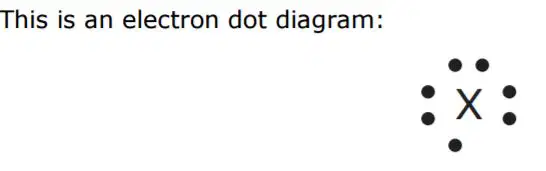
What would the charge be on the element pictured below?
7-
1-
7+
1+
Which pair of elements has the most physical and chemical properties in common?
Ge and Se
K and Kr
Al and Ga
Ba and Bi
Which two elements have the same number of valence electrons?
C and O
Na and Mg
Cl and F
Ga and Ge
What does the subscript in a chemical bond represent?
The charge on the whole formula
The number of atoms of that particular element in the chemical formula
The number of valence electrons
The number of bonds in the bond
Which of the following are transferred or shared when two atoms react chemically?
protons
neutrons
electrons
photons
Which statement best describes the atoms of elements that form compounds by covalent bonding?
They share electrons between them
They have a large difference in atomic mass
They are in the same period in the periodic table
They have a large difference in valence electron number
An ionic bond typically forms between certain types of elements. Which pair of elements will form an ionic compound?
Na and Cu
K and Cl
Ne and O
Li and Mg
What type of bonds are formed when nonmetal atoms combine with nonmetal atoms and share the electrons?
covalent bonds
ionic bonds
metallic bonds
not enough information to determine
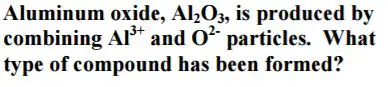



What is the name of the compound below?
Krypton oxide
oxide potassium
potassium monoxide
potassium oxide

What is the name of the formula below?
Krypton chlorate
Potassium chlorate
Potassium chlorine oxide
Krypton chlorine oxide

What is the name of the following formula?
Iron chloride
Iron (III) chloride
Chloride (III) iron
Iron chlorine

What is the name of the compound listed below.
magnesium phosphorous oxide
magnesium (III) phosphide
magnesium phosphate
magnesium (II) phospate

How many atoms of oxygen in the bond below?
1
2
3
4
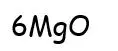
How many magnesium atoms are in this bond?
1
2
6
0
What is a cation?
a negative ion
a postive ion
an ion with equal protons and electrons
an ion with more electrons than protons
What is a anion?
a negative ion
a postive ion
an ion with equal protons and electrons
an ion with more protons than electrons
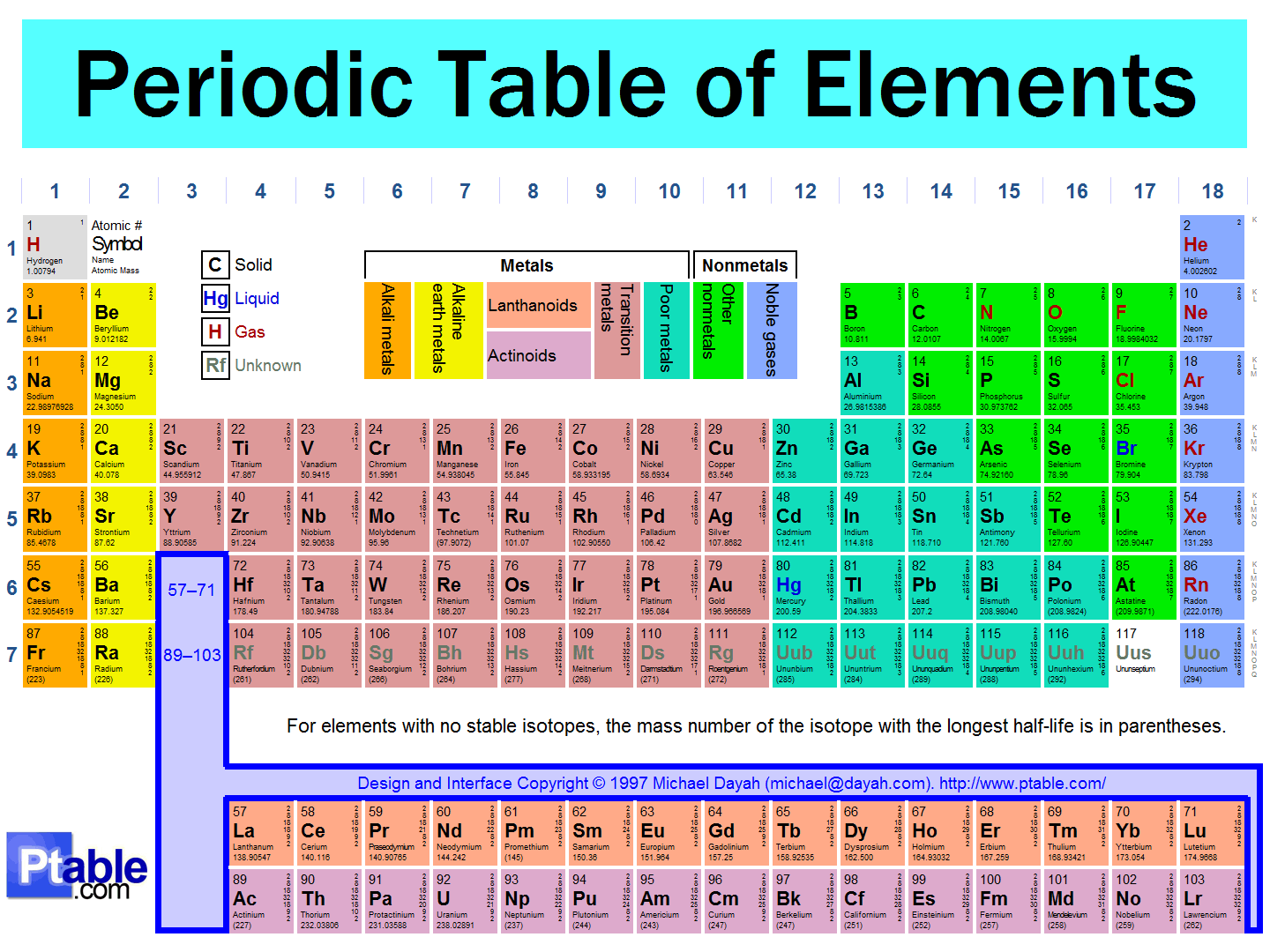

What two elements are in the same Period?
K - Potassium and Na - Sodium
Li - Lithium and Mg - Magnesium
B - Boron and C - Carbon
Zn - Zinc and N - Nitrogen

Sodium (Na) is found in which period?
1
2
3
4

Which element is in GROUP 15 and PERIOD 2?
Phosphorus
Potassium
Arsenic
Vanadium
Which element is found in Group 1 and Period 3 of the periodic table?
Magnesium (Mg)
Calcium (Ca)
Sodium (Na)
Potassium (K)
What is the charge on an ion of chlorine?
1+
2+
0
1-
Which type of bond is formed when a metal reacts with a nonmetal?
ionic bond
covalent bond
hydrogen bond
metallic bond
Which element is located in Group 17 and Period 2 of the periodic table?
Bromine (Br)
Chlorine (Cl)
Fluorine (F)
Iodine (I)
What is the charge on an ion of potassium?
1-
1+
0
2+
Which of the following elements is a noble gas?
Argon (Ar)
Calcium (Ca)
Oxygen (O)
Phosphorus (P)
Which element is found in Group 1 and Period 3 of the periodic table?
Potassium (K)
Calcium (Ca)
Sodium (Na)
Magnesium (Mg)
What is the charge on an ion of oxygen?
2-
2+
1-
0
Which type of bond is formed when two nonmetals react?
metallic bond
covalent bond
hydrogen bond
ionic bond

Which of the following elements is found in Group 18 of the periodic table?
Sulfur (S)
Neon (Ne)
Magnesium (Mg)
Carbon (C)

