
 Worksheets
Chapter 13 — Building and Managing Credit
Total questions: 100
Worksheet time: 52mins
The 5 Cs of Credit are:
Character, Capacity, Capital, Collateral, Conditions
Credit, Cash, Contract, Collateral, Capital
Character, Credit, Cash, Collateral, Conditions
Capacity, Capital, Contract, Collateral, Conditions
Which of the following is a step you can take to improve your creditworthiness?
Pay your bills on time
Ignore your credit card statements
Max out your credit cards
Apply for multiple loans at once
What does 'Capacity' refer to in the context of the 5 Cs of Credit?
Capacity refers to your ability to repay a loan, including your cash flow and debt-to-income ratio.
Capacity refers to the value of assets you own, such as property or investments.
Capacity refers to your credit history and past borrowing behavior.
Capacity refers to the collateral you can offer to secure a loan.
Which of the following is considered when evaluating 'Capital' for a loan application?
Your monthly income
Assets you own such as cash, investments, and real estate
Your job stability
Your debt-to-income ratio
Collateral refers to:
The amount of money you earn
The assets you put up to secure a loan
The stability of your income
The interest rate on your loan
A credit report is a document that includes which of the following?
Personal information, credit accounts, payment history, and public records
Only your bank account details
Your employment history and salary only
A list of your favorite stores
It is important to monitor your credit report because:
It helps detect identity theft and errors.
It increases your credit score automatically.
It prevents you from getting loans.
It guarantees approval for all credit cards.
How do you resolve errors in your credit report?
By disputing the errors with the credit bureau
By ignoring the errors
By closing your bank account
By applying for a new credit card
Which of the following is NOT one of the three major credit reporting agencies?
Equifax
Transunion
Experian
FICO
Fill in the blank: The three major credit reporting agencies are ________, Transunion, and Experian.
Equifax
Capital One
FICO
Discover
Fill in the blank: A credit report includes loan balance and payment histories, revolving credit limits, and ________ utilization.
credit
income
asset
debt
Which section of the credit report includes your full legal name, previous names or aliases, Social Security number, current and previous addresses, birth date, telephone number, and current and past employers?
Identifying Information
Credit Accounts
Public Records
Inquiries
The credit history section of a credit report lists only current creditors and does not include past creditors or payment history.
True
False
Fill in the blank: The section of the credit report that includes legal proceedings related to an individual's finances, such as court judgments, liens, repossessions, and bankruptcies, is called __________.
Public Records and Collections
Credit Inquiries
Account Summary
Personal Information
What is a 'hard inquiry' in the context of a credit report?
A request to review your credit report by a lender during a loan or credit application process.
A routine check of your credit report by yourself.
A review of your credit report by your employer for a job application.
A periodic update of your credit score by the credit bureau.
Which of the following is NOT typically included in the Identifying Information section of a credit report?
A) Social Security number
B) Outstanding loan balance
C) Birth date
D) Telephone number
Negative accounts are removed from your credit history after seven years.
True
False
Fill in the blank: Credit history typically lists account information for the past ______ years except for negative accounts.
ten
five
seven
three
According to the passage, what is a hard inquiry?
A request that does not impact your credit score
A request that typically drops your credit score by five points or less
A request to check your credit report for errors
A request made by a prospective employer
How long does a hard inquiry stay on your credit report?
One year
Two years
Five years
Ten years
A soft inquiry is a request that does not impact your credit score.
True
False
You are entitled to one free copy of your credit report every year from each of the three nationwide credit reporting companies.
True
False
Fill in the blank: An excellent strategy to monitor your credit report throughout the year is to request a free credit report from one of the agencies every ______ months.
four
six
twelve
two
What should you do if you find an error on your credit report according to the passage?
Ignore the error and do nothing.
Report the error to the credit bureau.
Wait for the error to correct itself.
Share the error on social media.
If you suspect identity theft, what can you request to be placed on your credit report?
A summary explanation
A fraud alert
A credit freeze
A credit score update
A credit score is:
a numerical representation of a person's creditworthiness
the amount of money in a person's bank account
a type of loan offered by banks
a government-issued identification number
A “good” credit score is considered to be:
Below 500
Between 670 and 739
Between 300 and 500
Above 800
Credit scores are calculated based on which of the following factors?
Payment history, amounts owed, length of credit history, new credit, and types of credit used
Only the amount of money in your bank account
Your age and marital status
The city you live in
What actions can you take to build and maintain your credit score?
Pay your bills on time and keep credit card balances low.
Ignore your credit card statements and avoid checking your credit report.
Maximize your credit card usage and apply for new cards frequently.
Only use cash for all purchases and never use credit.
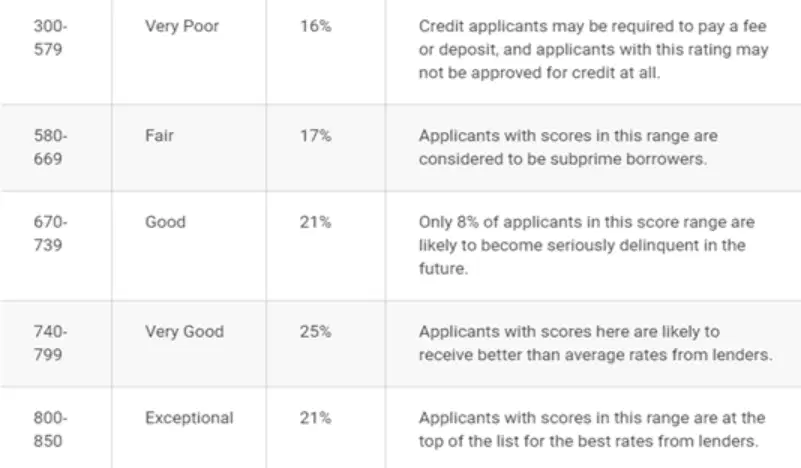
What is the credit score range for a 'Very Poor' rating according to the FICO Score table?
580-669
300-579
670-739
800-850
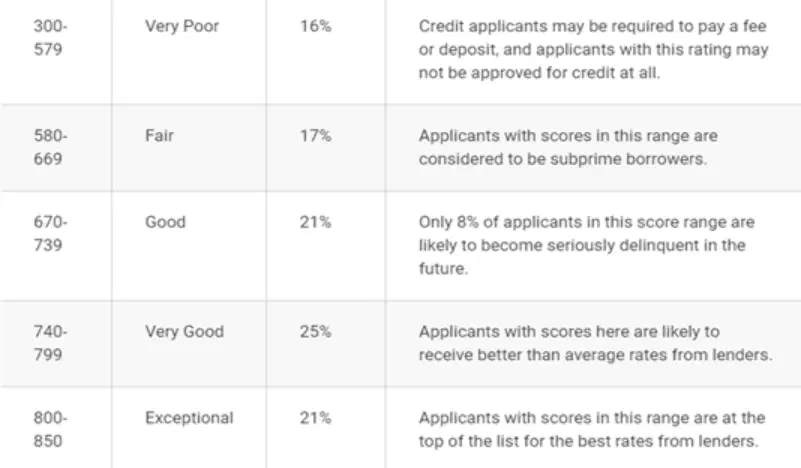
Fill in the blank: Applicants with a 'Fair' FICO credit score are considered to be ______ borrowers.
subprime
prime
excellent
secured
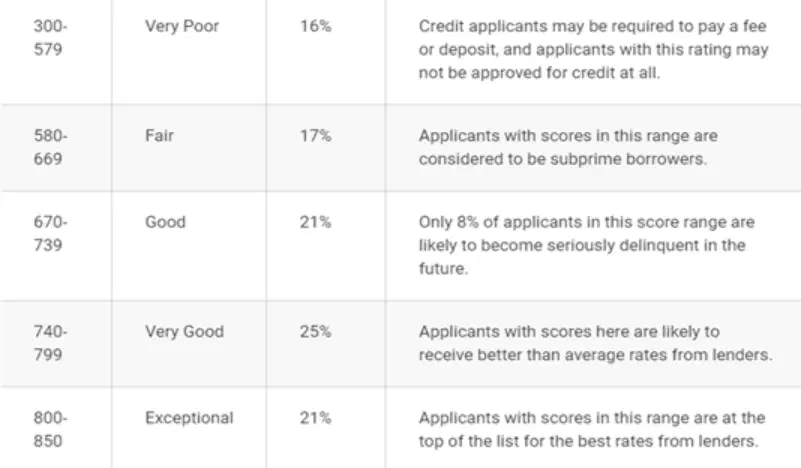
What percentage of people have a 'Good' FICO credit score according to the table?
16%
17%
21%
25%
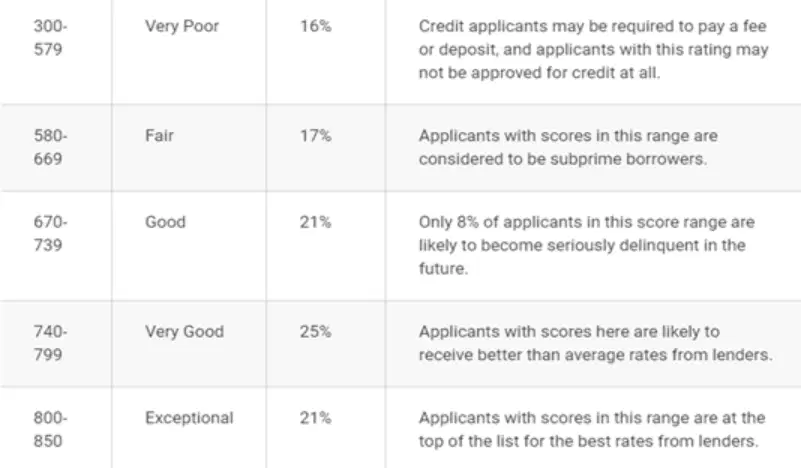
Applicants with an 'Exceptional' FICO credit score are at the top of the list for the best rates from lenders.
True
False
According to the passage, both FICO and VantageScore range from ______ to ______.
300 to 850
200 to 800
400 to 900
250 to 750
What is the rating for a credit score between 300-499?
Poor
Very Poor
Fair
Good
Applicants with a credit score of 781-850 are most likely to receive the best rates and most favorable terms on credit accounts.
True
False
Which of the following is NOT a component of a FICO score?
A) Payment History
B) Amounts Owed
C) Credit Mix
D) Income Level
Making payments in full and on time will help build and maintain a good credit score.
True
False
Fill in the blank: Before extending credit, a lender wants to know if the applicant has made debt payments in full and _____
on time
in cash
with interest
after default
What percentage of your FICO score is based on your ratio of credit used to available credit?
10%
15%
30%
50%
What is the best way to maximize the credit utilization portion of your FICO score?
Keep credit utilization low.
Use all available credit.
Close old credit accounts.
Max out your credit cards.
You should avoid using more than 30% of your available credit on any individual card, even if you pay your balance in full on time every month.
True
False
What percentage of the FICO score is based on how long you have had credit and how long it has been since the last account activity?
10%
15%
30%
50%
Applying for and receiving a credit card, charging small purchases, and paying balances in full and on time is a good way to start building your credit history.
True
False
What percentage of the FICO score is based on your applications for new credit?
10%
15%
30%
50%
Why should you avoid opening too many lines of credit in a short period of time?
It is viewed negatively by prospective lenders and may be seen as a sign of financial trouble.
It will automatically increase your credit score.
It guarantees you will get lower interest rates on all loans.
It makes you eligible for more government benefits.
Assuming all other factors related to scoring their credit are equal, who would have a better credit score: Myra, who has four credit cards each with a credit utilization of 30%, or Mason, who has an auto loan, a mortgage, and two credit cards each with a 30% utilization rate?
Mason would have a better credit score than Myra.
Myra would have a better credit score than Mason.
Both Myra and Mason would have the same credit score.
Neither Myra nor Mason would have a good credit score.

Who uses a credit card to make purchases, makes a payment on a student loan, and paid rent late?
Lender
Borrower
CRA
Credit Score Developer
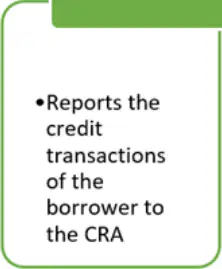
Who reports the credit transactions of the borrower to the CRA?
Borrower
Lender
CRA
Credit Score Developer

Who collects the borrower's credit information and creates and maintains the borrower's credit report?
Borrower
Lender
CRA
Credit Score Developer

Who reviews the Credit Report and creates the FICO score based on the credit report?
Borrower
Lender
CRA
Credit Score Developer
According to the passage, what is often required to access your official FICO Score or VantageScore?
No fee
A fee for the service
A credit card
A loan
Fill in the blank: Only negative transactions are usually reported for bills like ________, utilities, and rent.
cellular service
groceries
entertainment
clothing
If you put bills in your name, you will see your credit score increase as a result.
True
False
One way to begin building a credit score if you have no borrowing history or credit score is:
Apply for a secured credit card.
Take out a large personal loan immediately.
Avoid all forms of credit.
Only use cash for all purchases.
How does your credit score affect the interest rate you'll pay on loans?
A higher credit score usually results in a lower interest rate.
A higher credit score usually results in a higher interest rate.
Your credit score does not affect the interest rate.
A lower credit score usually results in a lower interest rate.
Insurance companies, landlords, and employers use credit scores to:
Determine eligibility and assess risk for services or opportunities.
Set prices for groceries and retail items.
Decide on government policy changes.
Monitor social media activity.
A poor credit score can affect your ability to borrow money in which of the following ways?
It can result in higher interest rates or loan denial.
It guarantees approval for all loans.
It has no impact on borrowing ability.
It ensures lower interest rates.
What is the APR for a FICO score range of 700-759?
7.109%
7.36%
7.48%
7.757%
Refer to the Loan Savings Calculator table. Fill in the blank: The monthly payment for a FICO score range of 660-679 is _______.
$1,613
$1,720
$1,540
$1,680
What is the total interest for a FICO score range of 620-639?
$326,945
$341,033
$363,590
$357,136
According to the Loan Savings Calculator, if your score changes to 760-850, how much could you save in extra interest?
$36,645
$12,500
$5,000
$25,000
Credit scores can affect insurance premiums in which of the following ways?
Higher credit scores can lead to lower insurance premiums.
Higher credit scores always result in higher insurance premiums.
Credit scores have no impact on insurance premiums.
Insurance premiums are only affected by age, not credit scores.
Signs of being in financial trouble include:
Struggling to pay bills on time
Having a high credit score
Saving a large portion of income
Receiving regular salary increases
What types of organizations provide credit counseling?
Nonprofit organizations
Retail companies
Technology firms
Automobile manufacturers
When you declare bankruptcy, what happens?
Your debts may be discharged or restructured.
You receive a large sum of money from the government.
Your credit score immediately improves.
You are exempt from paying taxes forever.
What behaviors indicate you could be in financial difficulty?
You make only the minimum payments on credit card bills.
You have used credit cards to pay off other bills because you lacked other funds.
The total owed on your credit cards has increased over time.
You cannot make recurring payments on time.
You have a debt that has been turned over to a collection agency.
Fill in the blank: If you cannot make regularly scheduled bill payments, the first step is to reach out to your _______.
creditors
neighbors
friends
employees
Which organization is a national nonprofit that connects people with accredited agencies and professionals to help manage their debt?
National Foundation for Debt Counseling (NFDC)
National Foundation for Credit Counseling (NFCC)
U.S. Trustee Program
Consumer Protection Bureau
You must file for bankruptcy to use the U.S. Trustee Program’s credit counseling agencies.
True
False
What is the main difference between nonprofit and for-profit debt consolidation services?
Nonprofit services typically offer lower fees and focus on helping clients, while for-profit services aim to make a profit.
Nonprofit services charge higher fees than for-profit services.
For-profit services are only available to businesses, while nonprofit services are for individuals.
Nonprofit services do not require any repayment, while for-profit services do.
Fill in the blank: NFCC programs like _______ resulted in the average participant’s credit score increasing 50 points and revolving debt dropping by $8,000.
Sharpen Your Financial Focus
Debt Free Pathways
Financial Wellness Initiative
Credit Boost Program
After paying hundreds or thousands of dollars in up-front fees to for-profit debt consolidation companies, many consumers end up in less debt than when they started.
True
False
What is the last resort for a person in a severe debt situation according to the passage?
Declaring bankruptcy
Taking a loan from friends
Ignoring the debt
Selling personal belongings
Which type of bankruptcy involves listing all assets and liabilities at the U.S. District Court and, if approved, most debt is forgiven?
Chapter 7
Chapter 13
Chapter 11
Chapter 5
In Chapter 13 bankruptcy, the applicant proposes a plan to use their assets and future earnings to pay off their creditors within a specified time.
True
False
What act made it more difficult for individuals to file for Chapter 7 bankruptcy and required filers to complete an approved course in personal financial management?
Bankruptcy Abuse Prevention and Consumer Protection Act
Fair Credit Reporting Act
Truth in Lending Act
Consumer Financial Protection Act
How long do bankruptcy filings remain on a credit report?
Ten years
Five years
Seven years
Three years
Two impacts of bankruptcy on a person's credit and financial situation are:
Lower credit score and difficulty obtaining loans
Increase in credit score and easier access to loans
No change in credit score and financial situation
Immediate improvement in financial reputation
What does 'Capacity' refer to in the 5 Cs of credit?
Capacity refers to your ability to repay a loan.
Capacity refers to the amount of collateral you have.
Capacity refers to your credit score.
Capacity refers to the interest rate on your loan.
What does 'Capital' refer to in the 5 Cs of credit?
Capital refers to assets you own such as cash, investments, real estate, and significant assets.
Capital refers to your annual income from employment only.
Capital refers to your credit score and payment history.
Capital refers to the amount of debt you currently owe.
The 5 Cs of Credit are Character, Capacity, Capital, Collateral, and Conditions. Over which do you usually have the least control?
Character
Capacity
Collateral
Conditions
Define DTI. What is considered a good DTI?
DTI stands for Debt-to-Income ratio, and a good DTI is typically considered to be 36% or lower.
DTI stands for Direct Taxation Index, and a good DTI is above 50%.
DTI stands for Daily Transaction Indicator, and a good DTI is 70% or higher.
DTI stands for Digital Transfer Initiative, and a good DTI is below 20%.
What types of loans naturally have collateral built into the loan?
Secured loans
Unsecured loans
Personal loans
Credit card loans
A credit report includes which of the following?
Personal information, credit accounts, payment history, and inquiries
Only your bank account details
Your employment history and salary only
A list of your favorite stores
It is important to review your credit report regularly because:
It helps you detect errors and potential identity theft.
It increases your credit score automatically.
It allows you to avoid paying taxes.
It guarantees loan approval.
How can you regularly obtain credit reports and credit scores for free?
By visiting AnnualCreditReport.com and using free credit score services.
By paying a monthly subscription to a credit bureau.
By applying for a new credit card each month.
By contacting your bank and requesting a paid report.
How would you go about getting an error on your credit report fixed?
Contact the credit bureau and dispute the error.
Ignore the error and wait for it to be removed automatically.
Ask your bank to fix the error for you.
Pay a fee to have the error removed.
A credit score is a number that represents a person's creditworthiness. Which of the following is an example of a “good” credit score?
750
400
600
500
List the components of a credit score. Which two categories are most important?
The components of a credit score include payment history, amounts owed, length of credit history, new credit, and types of credit used. The two most important categories are payment history and amounts owed.
The components of a credit score include income level, employment status, age, and marital status. The two most important categories are income level and employment status.
The components of a credit score include payment history, credit card rewards, travel history, and shopping habits. The two most important categories are travel history and shopping habits.
The components of a credit score include payment history, amounts owed, length of credit history, and favorite stores. The two most important categories are favorite stores and length of credit history.
A credit score differs from a credit report in that:
A credit score is a numerical value representing creditworthiness, while a credit report is a detailed record of credit history.
A credit score is a detailed record of credit history, while a credit report is a numerical value representing creditworthiness.
Both a credit score and a credit report are numerical values representing creditworthiness.
A credit score and a credit report are exactly the same thing.
Having a good credit score is important because:
It helps you qualify for loans and get better interest rates.
It guarantees you will never have financial problems.
It allows you to avoid paying taxes.
It means you do not need to save money.
Which of the following is a strategy to build and improve your credit score?
Pay your bills on time, keep credit card balances low, and avoid opening too many new accounts at once.
Ignore your credit card statements and only pay the minimum due.
Maximize your credit card balances and open several new accounts quickly.
Close all your old credit accounts to improve your score.
Which of the following are behaviors that indicate a person has trouble managing credit?
Paying bills late, maxing out credit cards, and ignoring credit card statements
Paying bills on time, keeping low balances, and monitoring credit reports
Using credit cards only for emergencies, paying more than the minimum payment, and budgeting monthly
Applying for new credit cards only when needed, reviewing statements regularly, and setting up payment reminders
Where should a person go to get help with managing credit?
A bank
A credit counseling agency
A grocery store
A car dealership



