
 Worksheets
Unit 5 - Westward Expansion Review
Total questions: 34
Worksheet time: 17mins
Name
Class
Date
1.
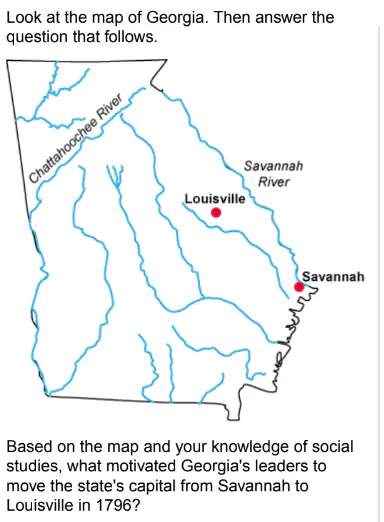
Study the image below and answer the question.
a)
Decreased trade between Savannah and other major cities on the Savannah River.
b)
The state's growing reliance on the Chattahoochee River for trade with other states
c)
The state's population expanded westward shifting from coastal areas inland.
d)
Increased tensions between Georgians and American Indians during the Seminole Wars in Florida.
2.
Why was the founding of the University of Georgia an important development for the country as a whole as well as the state of Georgia?
a)
The university was the first institution of higher learning in the United States to admit women.
b)
The university was the first publicly supported (government funded) university in the U.S.
c)
The university offered scholarships for American Indians to make amends for past injustices.
d)
The university provided an example of the economic benefits private institutions of higher learning provide to states.
3.
The following is a excerpt from a newspaper during this era. Read it and choose what is is describing.
"Tickets were placed into two drums: one drum contained the names of various parcels of land, and the other contained individuals' names. A ticket selected from the "land" drum was matched to a ticket selected from the drum containing people's names."
a)
Yazoo land fraud
b)
Georgia's land lotteries
c)
Georgia's Land ticket selections
d)
Georgia's headright system
4.
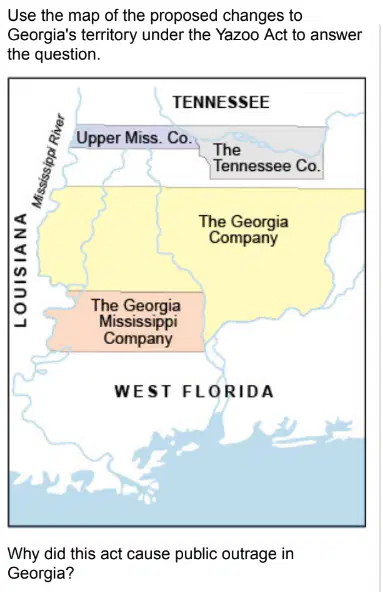
Study the image and answer the question.
a)
Lands that had been farmed by Georgians for generations were sold to northern industrialists seeking cheap land to build factories.
b)
The state returned American Indian land taken in the past to make amends for past injustices.
c)
Territory that could have been granted to individual settlers was instead sold to land companies who bribed lawmakers in Georgia.
d)
Farmers were angry that Georgia gave valuable agricultural land to the federal government in exchange for forgiveness of state debts.
5.
Many Georgians won in land lotteries. Who did this land that was raffled off in lotteries originally belong to?
a)
Creek Indians and the Cherokee nation.
b)
Wealthy Georgia land speculators and investors.
c)
The federal government and the state of Georgia.
d)
The people who won the lottery.
6.
Why did the Yazoo land fraud occur?
a)
Georgia farmers claimed that lotteries were rigged against them.
b)
Land companies bribed legislators so they could buy land cheaply.
c)
Settlers made illegal treaties with the Creek and Cherokee peoples.
d)
The headright system had not provided families with enough land to farm.
7.
What was the process of freely giving away large plots of land to settlers in eighteenth-century (1700s) Georgia called?
a)
The headright system
b)
Land lotteries
c)
Yazoo Land Fraud
d)
The indentured system
8.
What connection can be drawn between the headright system of the late eighteenth century and the land lotteries of the early nineteenth century in Georgia?
a)
Both were government efforts to repay members of the Georgia Militia for their service.
b)
Both were government efforts to help immigrants quickly assimilate into Georgian society.
c)
Both were government efforts to improve relations between Georgians and American Indians.
d)
Both were government efforts to attract settlers to Georgia and encourage economic growth.
9.
During this time period the economy of Georgia depended MOST heavily on which of the following agricultural commodities?
a)
Cotton
b)
Timber
c)
Railroads
10.
During the Industrial Revolution, how did the
invention of the cotton gin affect farming methods
in the South?
a)
It led Southern farmers to increase cotton production, which resulted in the need for more slaves.
b)
It ended the need for slave labor, since it allowed Southern farmers to harvest cotton using machines.
c)
It encouraged Southern farmers to focus on growing other crops, since it became much cheaper to grow cotton in the North.
d)
It forced farmers to hire workers from the North in order to run the machines, increasing the population of the South.
11.
The chartering of the first railroad in Georgia in 1832 was in part due to the need to...
a)
allow for the rapid influx of cheap labor to assist in the operation of the state's manufacturing facilities.
b)
decrease reliance on trade along the state's major rivers due to the threat of American Indian attacks.
c)
acquire materials for the state to begin the process of industrialization.
d)
improve transportation routes and time for the state's profitable cotton industry.
12.
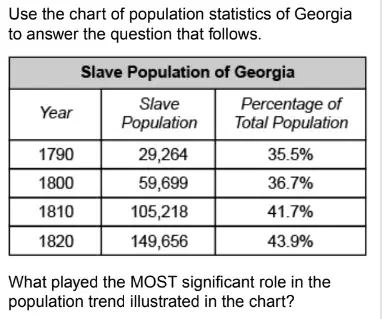
Study the information below and answer the question.
a)
Yazoo land fraud
b)
Development of railroads
c)
Invention of the cotton gin
d)
Georgia Gold Rush
13.
During this time period Americans pushed the President to take land belonging to the Creek Indians. What was the name of the President in question?
a)
Thomas Jefferson
b)
Andrew Jackson
c)
Andrew Johnson
d)
Abraham Lincoln
14.
Chief William McIntosh, signed a treaty that officially transferred the ownership of the remainder of his tribe's land in the state of Georgia to the United States. What tribe did he represent and what was the name of the treaty?
a)
Creek - Treaty of New Echota
b)
Cherokee - Treaty of New Echota
c)
Creek - Treaty of Indian Springs
d)
Cherokee - Treaty of Indian Springs
15.
Which of the following best describes Chief William McIntosh's legacy.
a)
He is remembered as a good chief who helped his people survive and thrive after relocation to Oklahoma.
b)
He is remembered as a good chief who argued for his people before the supreme court and won. Sadly the President did not comply.
c)
He is remembered as a chief who sold his people out and went on to profit off of deal made with his Governor Cousin.
d)
He is remembered as a chief who betrayed his people and lost his life as a result of his action.
16.
Why did settlers' demand for the relocation of the Cherokee intensify in the 1820s?
a)
The Cherokee supported the British in the War of 1812.
b)
Gold was discovered on Cherokee land.
c)
The Cherokee were fiercely opposed to slavery.
d)
They Indian were racists towards the European born Americans.
17.
Why did the Cherokee believe the Supreme Court's decision in Worcester v. Georgia would protect their lands from being taken by the State of Georgia?
a)
The court ruled in their favor and held that the Cherokee Nation was a sovereign and independent nation.
b)
The court ruled against them and held that the US government could take any land without their consent.
c)
The court ruled in their favor and held that the service of the Cherokee during the War of 1812 entitled them to the lands.
d)
The court rules against them and held that any land deal involving an American Indian nation must be supported by a majority of the nation's members.
18.
After the Cherokee won their court case against removal, how did President Andrew Jackson respond?
a)
He filed an appeal with the Supreme Court.
b)
He allowed the Cherokee to remain on their land.
c)
He cut diplomatic and trade relations with all Cherokee.
d)
He ignored the ruling and ordered the military to remove them.
19.
Choose the best explanation of the Indian Removal Act of 1830.
a)
The Act granted the states the authority to set up Indian Reservations in their state and force the Indians to live within that territory.
b)
The Act granted the U.S. Military the authority to force the Indians to leave their land and be relocated west to reservations in present day Oklahoma.
c)
The Act granted the U.S. Military the authority to attack and totally destroy all Indian nations who refused to give their land to the U.S. Government.
d)
The Act allowed Indians to be removed from any land that could be used to grow crops. Indians could remain on all land that was not good for farming.
20.
One-fourth of the Cherokee population died on their forced journey to Oklahoma. This event came to be known as ...
a)
Trail of Fears
b)
Trail of Tears
c)
Journey towards Death.
d)
Jackson's Death March West.
21.
Richard J. believes that Andrew Jackson's likeness should be removed from the U.S. Twenty Dollar Bill. He claims that Jackson violated his oath of office and totally disregarded the U.S. Constitution in regards to Checks and Balances among the three branches of Government. Which one of Jackson's dirty deeds is Richard specifically referring to?
a)
Killing Seminole Indians in Florida during the Seminole Wars.
b)
Supporting the Indian Removal Act
c)
Ignoring the Supreme Court's ruling.
d)
Setting up Indian Reservations in present day Oklahoma.
22.
Which list below contains Georgia's five state capitals in the proper chronological order?
a)
Savannah, Atlanta, Louisville, Milledgeville, Augusta
b)
Savannah, Milledgeville, Louisville, Augusta, Atlanta
c)
Savannah, Athens, Lawrenceville, Milledgeville, Atlanta
d)
Savannah, Augusta, Louisville, Milledgeville, Atlanta
23.
Which notable Georgian drafted the Charter for the University of Georgia?
a)
William Few
b)
Abraham Baldwin
c)
James Oglethorpe
d)
Benjamin Franklin
24.
Which GA capital city had a disease outbreak which caused the relocation of the capital?
a)
Savannah
b)
Milledgeville
c)
Atlanta
d)
Louisville
e)
Augusta
25.
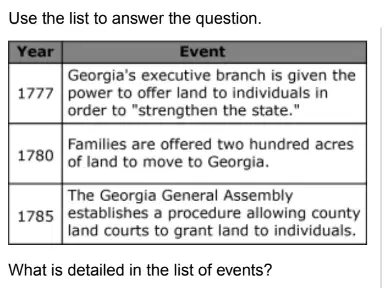
Study the information and answer the question:
a)
The Headright system
b)
Land Lotteries
c)
The Yazoo Land Fraud
d)
The Indian Removal Act
26.
What prompted massive immigration to GA during this time period?
a)
Cotton Gin and Railroads
b)
Free or Cheap Land
c)
Indian Removal
d)
Wars in Europe
27.
Check all of the negative aspects of the cotton gin.
a)
Provided a cash crop to help farmers make a living
b)
Slavery increased.
c)
Georgia became too reliant on a single crop.
d)
Railroads were built to transfer the crop and eventually people.
28.
Bonus: Who invented the Cotton Gin. It must be spelled correctly. Capitalize both his first and last name. Do not put a space after his last name.
(a)
29.
Bonus: What year was the Cotton Gin invented on a plantation near Savannah GA. Do not space after the last number
(a)
30.
Chief of the Cherokee Nation.
a)
William McIntosh
b)
John Ross
c)
John Marshall
31.
Governor of GA who had the Creek Removed.
a)
John Ross
b)
John Marshall
c)
George Troupe
32.
Chief Justice of the U.S. Supreme Court.
a)
John Marshall
b)
John Ross
c)
George Troupe
d)
William McIntosh
33.
Chief of the Creek Nation
a)
John Marshall
b)
William McIntosh
c)
John Ross
d)
George Troupe
34.
Sued Georgia for the Cherokee
a)
John Ross
b)
John Marshall
c)
Samuel Worcester
d)
William McIntosh
100 %

