
NEW
Font size
 Worksheets
Fossil Study Guide
Total questions: 37
Worksheet time: 19mins
What does it mean when a kind of animal or plant is extinct?
It means that no more of that kind of animal or plant exists.
It means that the animal or plant is very rare.
It means that the animal or plant is dangerous.
It means that the animal or plant has moved to a new location.
What does it mean when a species is endangered?
It means the species is at risk of extinction.
It means the species is very common.
It means the species is only found in zoos.
It means the species is not affected by environmental changes.
Before a species becomes extinct, it usually:
experiences a decline in population
increases in population rapidly
remains stable in population
becomes the dominant species
A fossil is:
the preserved remains or traces of ancient organisms
a type of living animal
a modern plant
a recently discovered mineral
What body parts usually turn into fossils?
Soft tissues
Bones and teeth
Hair and skin
Blood vessels
What do flat teeth tell us about what a dinosaur ate?
Flat teeth tell us that a dinosaur ate plants.
Flat teeth tell us that a dinosaur ate meat.
Flat teeth tell us that a dinosaur ate insects.
Flat teeth tell us that a dinosaur ate fish.
Sharp teeth tell us about a dinosaur’s diet.
They ate mostly plants.
They ate mostly meat.
They only ate fish.
They did not eat at all.
Fossil nests and eggs provide information about dinosaur families by showing:
how dinosaurs cared for their young
the color of dinosaur eggs
the exact number of dinosaurs in a family
what dinosaurs ate
Jellyfish fossils are very rare because:
their bodies are soft and decompose quickly, leaving little trace
they live only in deep ocean environments
they are too small to be preserved as fossils
they are made mostly of minerals that dissolve easily
What kind of body parts are most likely to become fossils?
Soft tissues
Bones and teeth
Hair and skin
Organs
For a dead animal to become a fossil, what needs to happen?
It must be quickly buried by sediment.
It must be exposed to sunlight for a long time.
It must be eaten by scavengers.
It must be left on the surface to decay.
Coral fossils might be found on top of mountains because:
mountains were once under the sea
corals can survive at high altitudes
mountains are made of coral
coral fossils are blown by the wind to mountain tops
Palm tree fossils in Antarctica tell us about the climate long ago.
Antarctica was once much warmer than it is today.
Antarctica has always been covered in ice.
Palm trees can survive in freezing temperatures.
Antarctica was once a desert.
Palm trees cannot live in Antarctica today because:
the climate is too cold for them to survive
there is too much sunlight year-round
the soil is too sandy for their roots
there is not enough water available
An adaptation is:
a characteristic that helps an organism survive in its environment
a type of food that animals eat
a place where an organism lives
a process of migration during winter
What does it mean to “infer” something from a fossil?
To draw a conclusion based on evidence from the fossil
To create a fossil from scratch
To ignore the fossil's evidence
To destroy the fossil to learn more
A fossil animal with thick fur probably lived in which kind of environment?
A cold environment
A desert environment
A tropical rainforest
A dry grassland
Environments have stayed the same or changed over time.
Environments have changed over time.
Environments have always stayed the same.
Environments have never existed.
Environments only change in some places.
When did the dinosaurs go extinct?
About 65 million years
About 10 million years
About 500 million years
About 67 million years
What happened when a huge rock from space hit Earth?
It caused mass extinction of many species.
It created a new mountain range.
It made the oceans disappear.
It turned the sky green.
What other event might have caused the extinction?
A massive volcanic eruption
A global ice age
A sudden increase in oxygen levels
The formation of new mountain ranges

Which type of fossil is seen here?
cast
mold
Whole body fossil
trace

A Foot Print is and Example of What Kind of Fossil?
Mold Fossil
Trace Fossil
Cast Fossil
All Fossils are the same
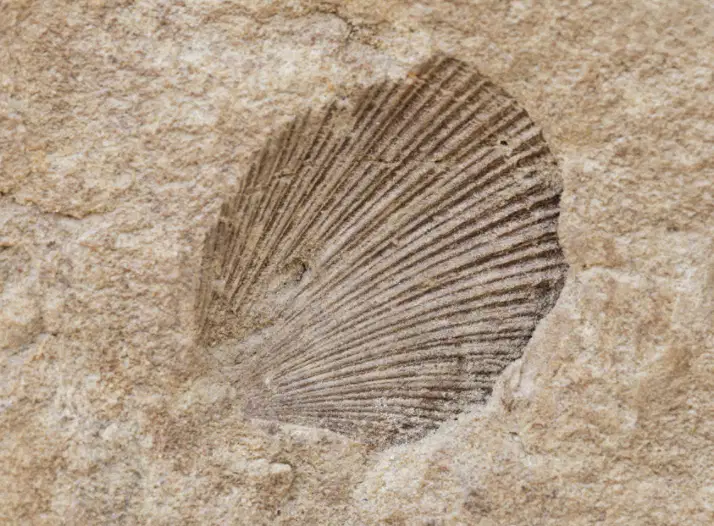
Which of the following is most likely to be preserved as a fossil?
A leaf floating on water
A worm crawling on the surface
A feather blown by the wind
A seashell buried in mud
A footprint left in the mud by a dinosaur.
Cast
Trace
Whole Body
Mold
A shell-shaped hole in a rock.
Cast
Trace
Whole Body
Mold
A fossil made by minerals filling in a mold and hardening.
Cast
Trace
Whole Body
Mold
A fossil of a whole insect trapped in amber.
Cast
Trace
Whole Body
Mold
A trail left by a crawling animal.
Cast
Trace
Whole Body
Mold
A mark left by a leaf that made an imprint in the rock
Cast
Trace
Whole Body
Mold
A copy of an organism made from rock.
Cast
Trace
Whole Body
Mold
A fossil showing a dinosaur’s nest and eggs.
Cast
Trace
Whole Body
Mold
A fossil made when a mold is filled and becomes a copy of the original shape.
Cast
Trace
Whole Body
Mold
A fossil of a mammoth frozen in ice.
Cast
Trace
Whole Body
Mold
Insects are found in a sticky tree substance called resin.
Cast
Trace
Whole Body
Mold
Fossils that are not actual body parts.
Cast
Trace
Whole Body
Mold

