
 Worksheets
8th STAAR History Review, Unites 1-4
Total questions: 166
Worksheet time: 10hrs 2mins
The mountain range that was a barrier that prevented colonists from moving west was the ________.
Appalachian Mountains
Rocky Mountains
Sierra Nevada
Cascade Range
What ocean did colonists settle near?
Atlantic Ocean
Pacific Ocean
Indian Ocean
Arctic Ocean
What was the Northwest Passage?
A sea route through North America to Asia
A land trail across the Appalachian Mountains
A Spanish road used to transport silver
A river linking the Gulf of Mexico to the Great Lakes
Did they find a Northwest Passage?
Yes, a continuous water route existed
No, a continuous water route through North America did not exist
Only during summer months when ice melted
It was discovered by Lewis and Clark
Reasons to Explore and Colonize: In the PERS framework, what does P stand for?
Political
Physical
Pastoral
Philosophical
Reasons to Explore and Colonize: In the PERS framework, what does E stand for?
Economic
Environmental
Educational
Experimental
Reasons to Explore and Colonize: In the PERS framework, what does R stand for?
Religious
Regional
Residential
Recreational
Reasons to Explore and Colonize: In the PERS framework, what does S stand for?
Social
Scientific
Strategic
Seasonal
Treatment of Native Americans: How were Native Americans generally treated by Spanish explorers and colonists?
Conquest and forced labor
Cooperative fur trade alliances
Isolation with minimal contact
Equal political partnership
Treatment of Native Americans: How were Native Americans generally treated by French explorers?
Cooperative trade alliances
Large-scale enslavement
Immediate displacement from land
Complete avoidance of contact
Treatment of Native Americans: How were Native Americans generally treated by English colonists?
Mixed relations including trade and conflicts over land
Primarily conquest with empire-wide forced labor
Exclusive alliance through the fur trade
No permanent settlements or contact
The Founding of Jamestown, VA: Jamestown was founded in the year _____.
1607
1620
1701
1588
Jamestown was founded in the area of _____.
Massachusetts
Virginia
New York
Georgia
Jamestown was founded for _____ reasons.
Religious
Political
Economic
Military
Jamestown settlers came in hopes of finding _____.
land
gold
timber
furs
After a few harsh years, a man named John Rolfe helped the Jamestown settlement survive by bringing _____ to be planted.
corn
indigo
tobacco
rice
In Jamestown, the colonies’ first _____ government was created, called the House of Burgesses.
absolute
military
representative
direct
In Jamestown, the colonies’ first representative government was created, called the House of _____.
Commons
Burgesses
Lords
Delegates
A representative government is when voters _____ representatives to make the laws.
appoint
elect
hire
inherit
A representative government is when voters elect representatives to make the _____.
taxes
treaties
laws
maps
Jamestown shows the idea of _____, in which the mother country (Great Britain) creates a colony for its economic benefit.
federalism
mercantilism
socialism
feudalism
Jamestown shows the idea of mercantilism, in which the mother country (_____) creates a colony for its economic benefit.
France
Spain
Great Britain
Netherlands
Plymouth is a colony in _____.
Virginia
Massachusetts
New York
Pennsylvania
Plymouth was founded by _____ who crossed the Atlantic Ocean on a ship called the Mayflower.
Puritans
Quakers
Catholics
Huguenots
Plymouth, MA was founded in ____.
1607
1620
1636
1492
Plymouth was founded for _____ reasons.
economic
military
religious
political
Pilgrims signed the Mayflower _____ in which they created a representative government in their colony.
Charter
Treaty
Compact
Declaration
Pilgrims created a _____ government in their colony.
authoritarian
representative
monarchic
direct
The Thirteen English Colonies — New England Region: Based on typical geography (rocky soil, forests, natural harbors) and cold climate, which economic activities most likely resulted? Choose the best set.
plantation agriculture and large-scale rice farming
shipbuilding, fishing, and trade
gold mining and cattle ranching
sugar plantations and rubber tapping
The Thirteen English Colonies — Middle Region: With fertile soil, navigable rivers, and a moderate climate, which economic activities most likely resulted? Choose the best set.
grain farming, livestock, and trade
fur trapping only
whaling and shipbuilding exclusively
rice and indigo plantations
The Thirteen English Colonies — Southern Region: With rich soil, a warm climate, and a long growing season, which economic activities most likely resulted? Choose the best set.
manufacturing textiles and iron
plantations producing cash crops
commercial fishing and whaling
small-scale grain markets only
Southern Colonies: Select all cash crops commonly associated with the Southern colonies.
tobacco
rice
indigo
cotton
Southern Colonies: What group of people were the main settlers of Georgia?
Puritans seeking religious freedom
Debtors needing a fresh start
Quaker pacifists
Dutch merchants
Southern Colonies: Why did plantations develop in the Southern colonies?
short growing season and rocky soil
abundant fur-bearing animals and cold waters
fertile land, warm climate, and long growing season ideal for cash crops
lack of rivers and ports preventing trade
Southern Colonies: What was one lasting impact of the plantation system?
decline of agriculture and rise of factories
expansion of slavery and dependence on cash crops
abolition of all taxes
complete religious uniformity
Southern Colonies: Which statement best defines indentured servants?
workers forced to labor for life without pay
people who worked for a set number of years to pay off passage or debt
soldiers hired to protect plantations
craftsmen who owned their own shops
Southern Colonies: What group founded the colony of Maryland?
Puritans
Catholics
Quakers
Anglicans
Define the term mercantilism.
a system where colonies exist to benefit the mother country through controlled trade
a philosophy of strict religious leadership
a form of direct democracy in towns
a tax on imported goods only
Define the term export.
a good brought into a country
a good sent out of a country to be sold elsewhere
a tax collected at a port
a product stored for future use
Define the term import.
a good brought into a country from elsewhere
a written agreement among colonists
a law created by local assemblies
a service performed within a colony
Define the term Triangular Trade.
a route linking Europe, Africa, and the Americas exchanging goods and enslaved people
a three-branch system of colonial government
a trade agreement among three New England towns
a policy that banned oceanic trade
Significant People — William Penn: Which colony did he found?
Rhode Island
Pennsylvania
Connecticut
Maryland
Significant People — William Penn: What was a main reason for founding his colony?
to create a refuge for Quakers with religious tolerance
to expand sugar plantations
to establish military forts
to unite New England under strict Puritan laws
Significant People — Roger Williams: Which colony did he found?
New York
Rhode Island
Pennsylvania
Virginia
Significant People — Roger Williams: What was a main reason for founding his colony?
to enforce mandatory church attendance
to promote separation of church and state with religious freedom
to build large tobacco plantations
to establish a royal capital
Significant People — Thomas Hooker: Which colony did he found?
Connecticut
Georgia
Massachusetts
New Jersey
Significant People — Thomas Hooker: What was a main reason for founding his colony?
to limit Puritan authority by expanding voting rights and creating a more democratic government
to establish a slave-trading center
to seek gold deposits
to create a Catholic refuge
Significant People — Anne Hutchinson: Which colony did she help to found after being banished from Massachusetts?
Maryland
Rhode Island
Pennsylvania
Delaware
Significant People — Anne Hutchinson: What was a main reason associated with her founding activity?
to enforce strict Puritan doctrine
to challenge religious authority and seek greater religious freedom
to establish fur-trading monopolies
to expand royal taxation
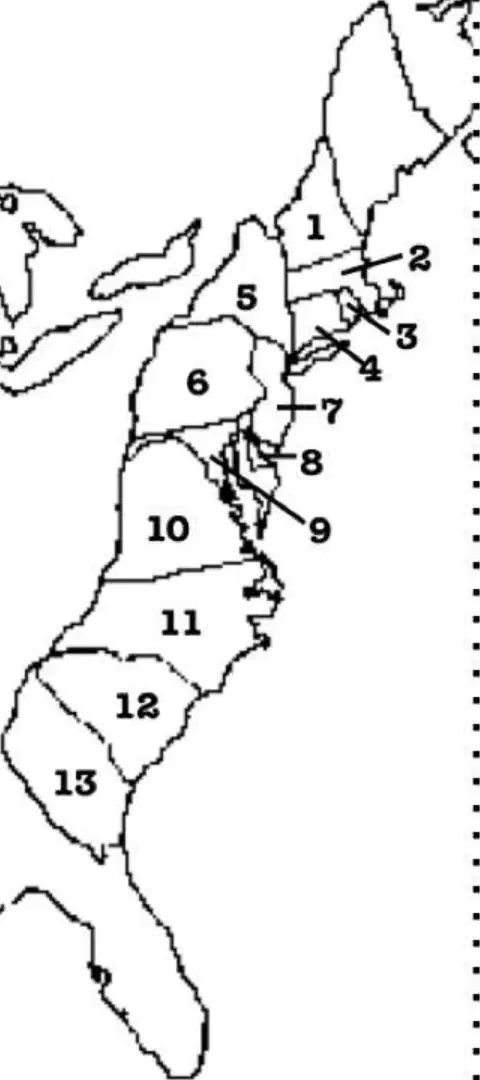
On the provided map of the Thirteen Colonies (numbered 1–13 along the Atlantic coast), which colony is labeled 1?
New Hampshire
Massachusetts
Connecticut
Rhode Island
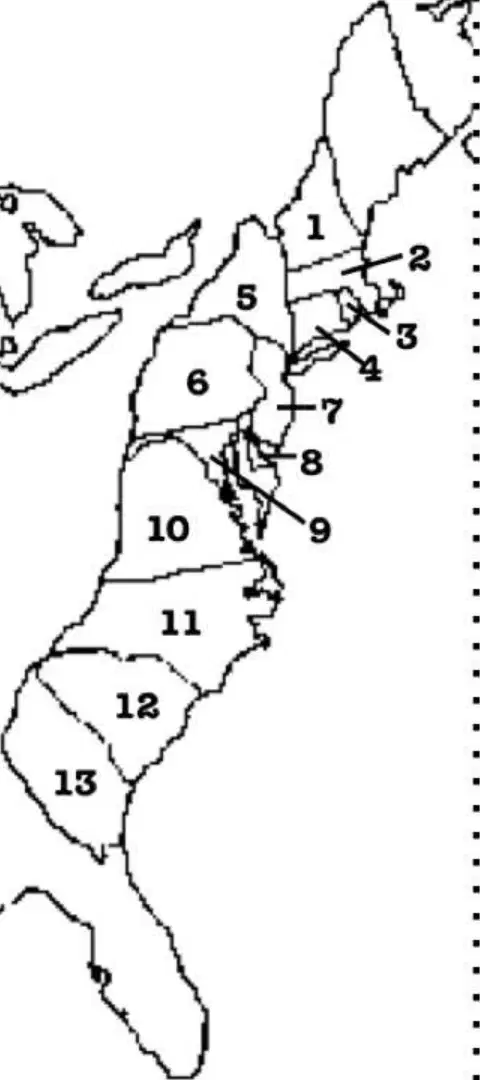
On the provided map of the Thirteen Colonies (numbered 1–13 along the Atlantic coast), which colony is labeled 2?
Massachusetts
New Hampshire
Connecticut
Rhode Island

On the provided map of the Thirteen Colonies (numbered 1–13 along the Atlantic coast), which colony is labeled 3?
Rhode Island
Connecticut
Massachusetts
Delaware
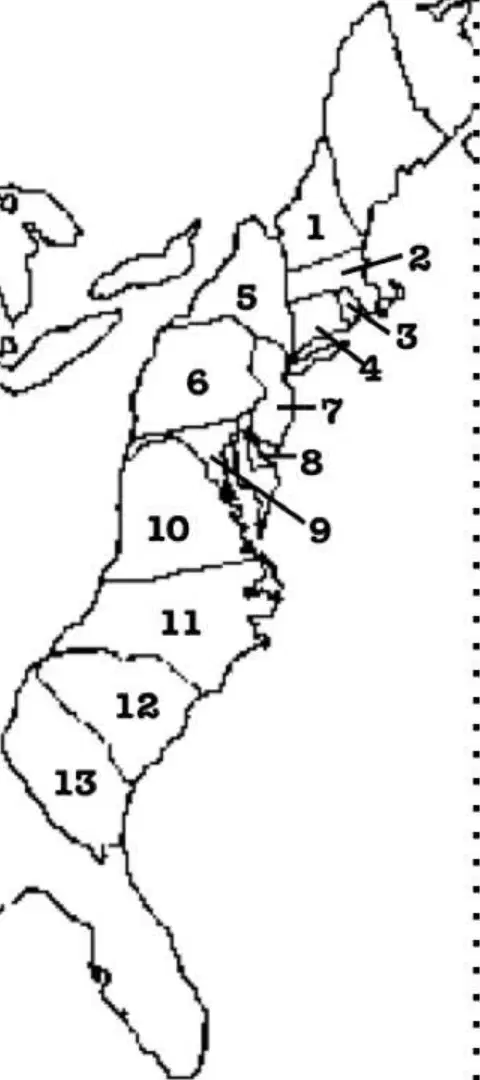
On the provided map of the Thirteen Colonies (numbered 1–13 along the Atlantic coast), which colony is labeled 4?
Connecticut
Rhode Island
Massachusetts
New York
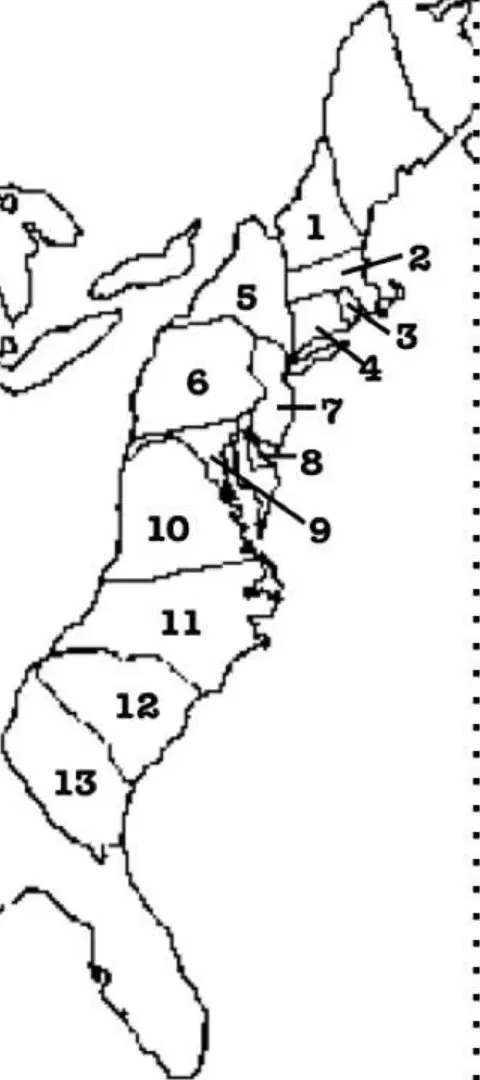
On the provided map of the Thirteen Colonies (numbered 1–13 along the Atlantic coast), which colony is labeled 5?
New York
Pennsylvania
New Jersey
Delaware
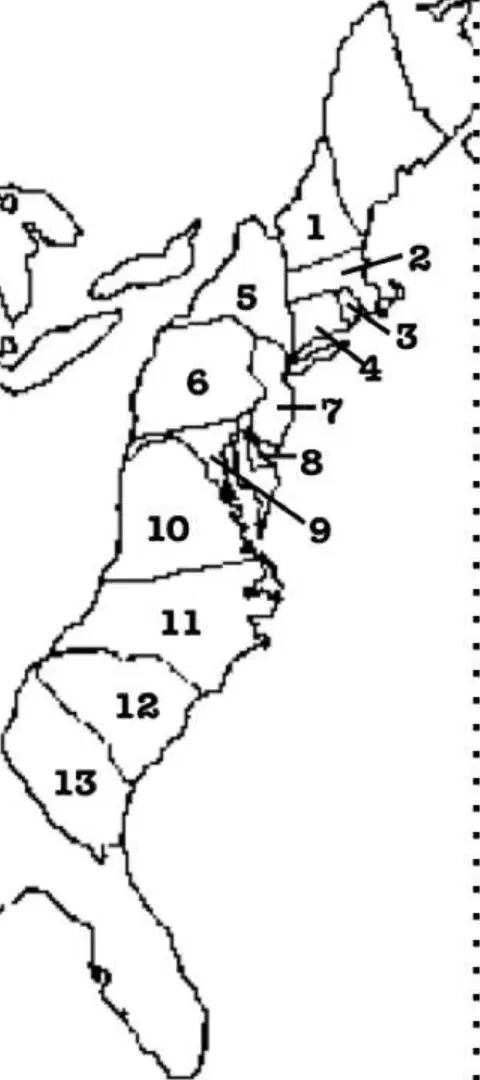
On the provided map of the Thirteen Colonies (numbered 1–13 along the Atlantic coast), which colony is labeled 6?
Pennsylvania
New York
New Jersey
Maryland
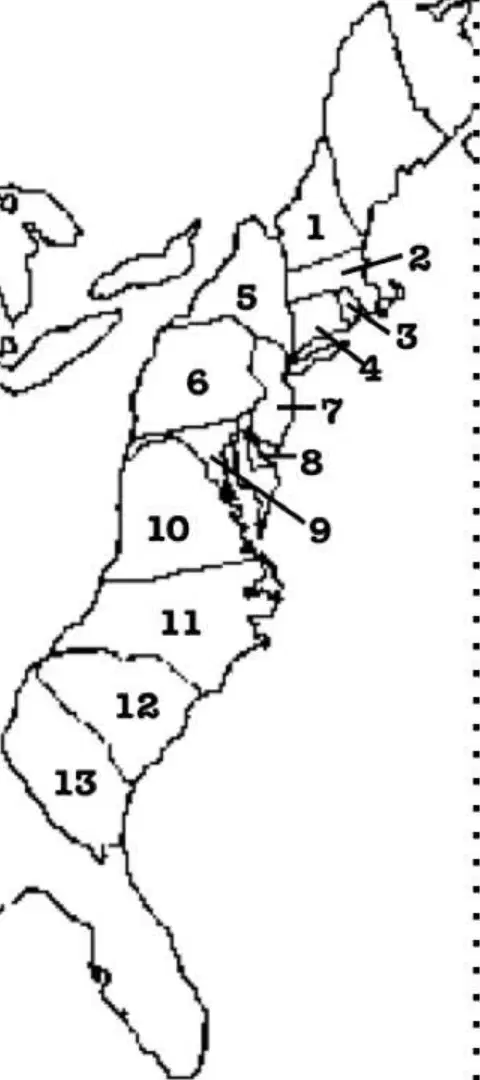
On the provided map of the Thirteen Colonies (numbered 1–13 along the Atlantic coast), which colony is labeled 7?
New Jersey
Delaware
Pennsylvania
Maryland
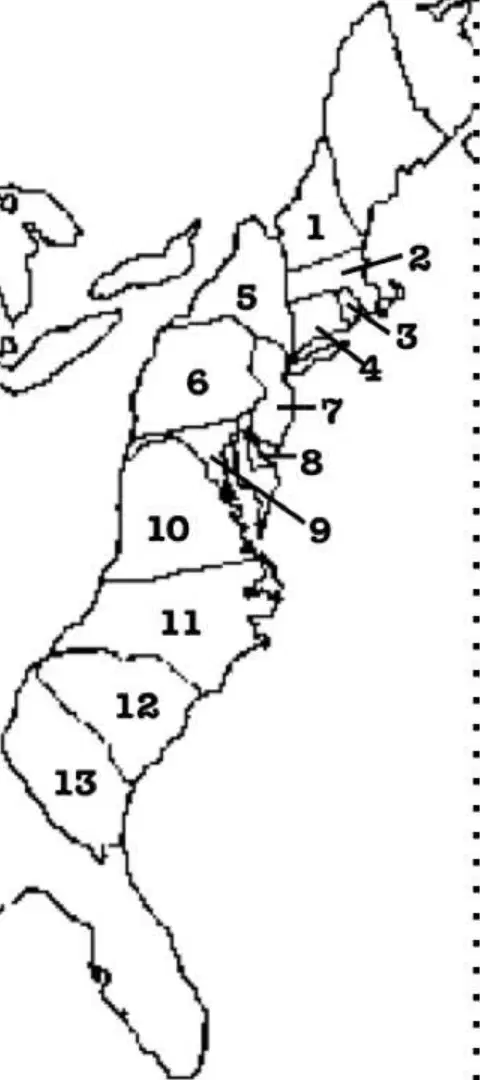
On the provided map of the Thirteen Colonies (numbered 1–13 along the Atlantic coast), which colony is labeled 8?
Delaware
Maryland
New Jersey
Virginia
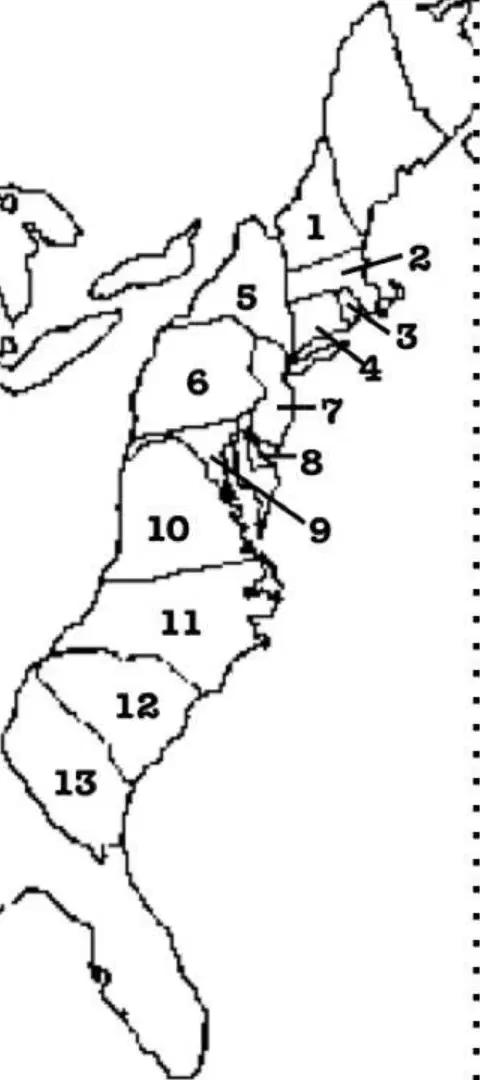
On the provided map of the Thirteen Colonies (numbered 1–13 along the Atlantic coast), which colony is labeled 9?
Maryland
Delaware
Virginia
North Carolina
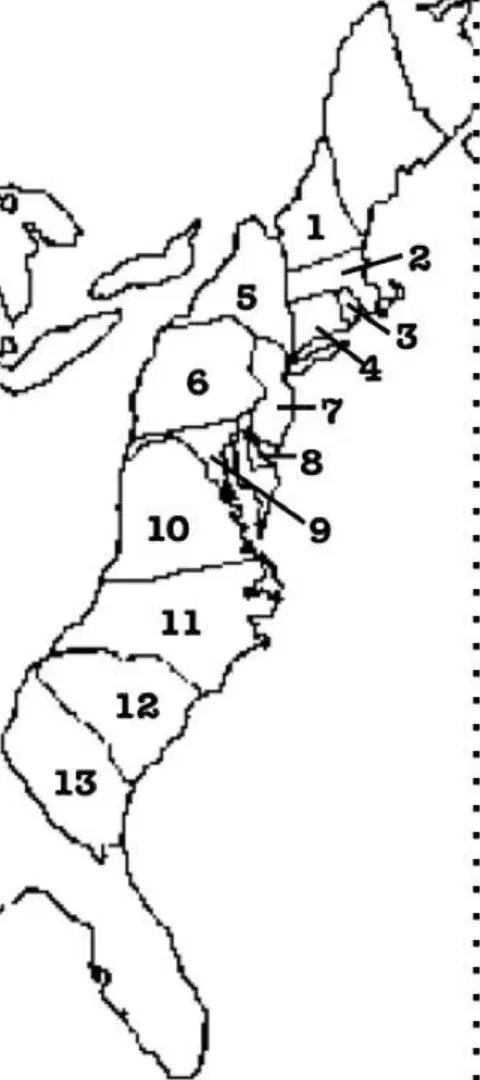
On the provided map of the Thirteen Colonies (numbered 1–13 along the Atlantic coast), which colony is labeled 10?
Virginia
Maryland
North Carolina
South Carolina
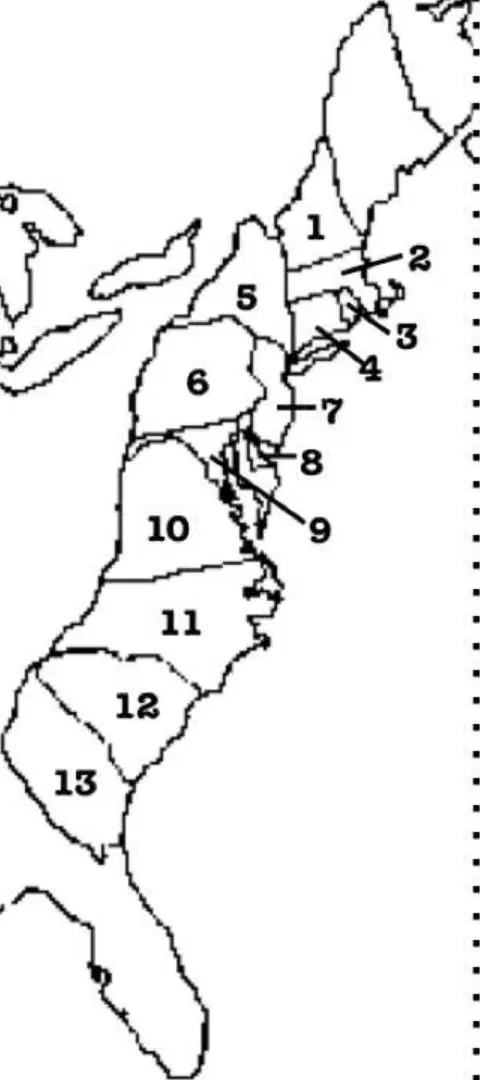
On the provided map of the Thirteen Colonies (numbered 1–13 along the Atlantic coast), which colony is labeled 11?
North Carolina
Virginia
South Carolina
Georgia
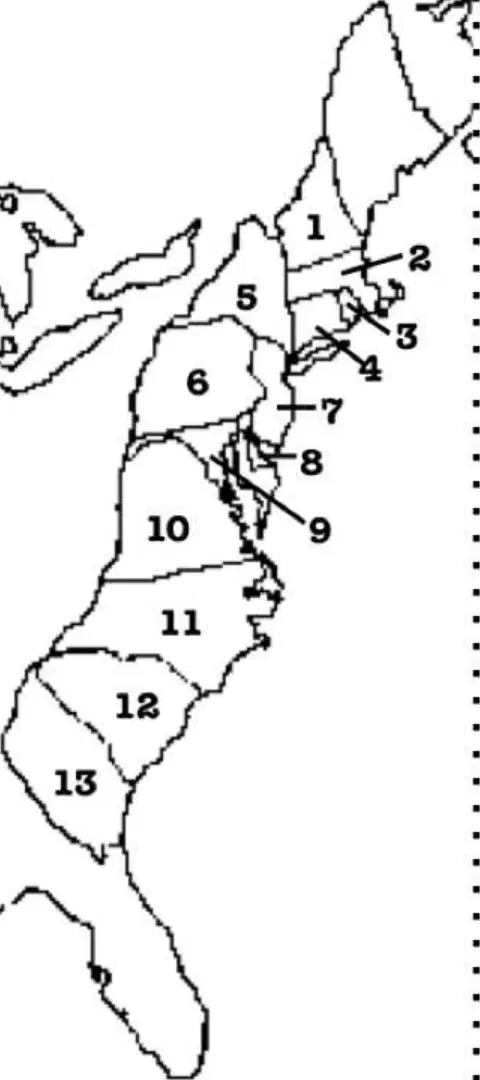
On the provided map of the Thirteen Colonies (numbered 1–13 along the Atlantic coast), which colony is labeled 12?
South Carolina
North Carolina
Georgia
Virginia
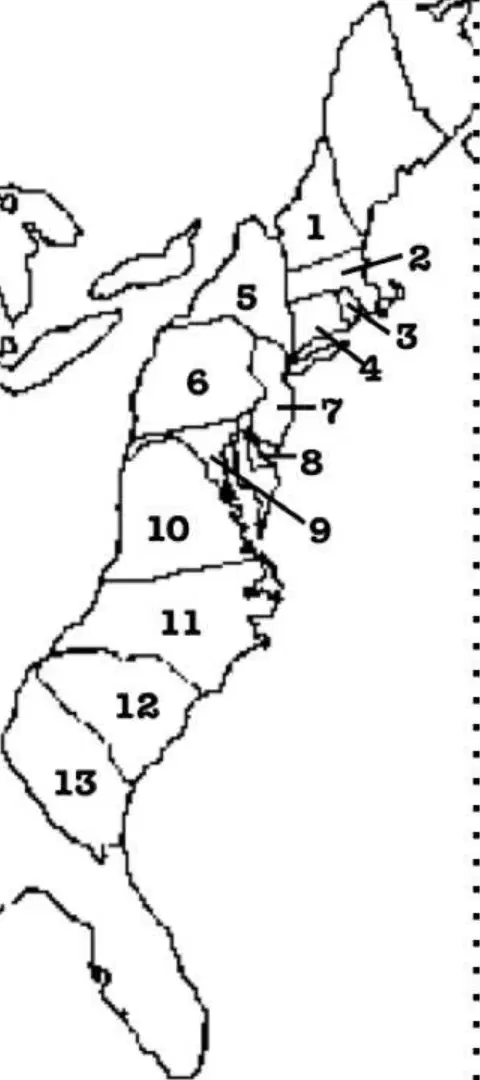
On the provided map of the Thirteen Colonies (numbered 1–13 along the Atlantic coast), which colony is labeled 13?
Georgia
South Carolina
North Carolina
Virginia
Which colonial region includes Massachusetts, Connecticut, Rhode Island, and New Hampshire as shown on the map of the Thirteen Colonies?
New England
Middle
Southern
Which colonial region includes New York, New Jersey, Pennsylvania, and Delaware as shown on the map of the Thirteen Colonies?
Middle
New England
Southern
Which colonial region includes Maryland, Virginia, North Carolina, South Carolina, and Georgia as shown on the map of the Thirteen Colonies?
Southern
Middle
New England
What religious group helped to settle the New England region?
Puritans
Quakers
Catholics
Anglicans
Why did the group that settled New England move there?
To escape religious persecution and practice their faith
To search for gold and quick wealth
To expand large plantation agriculture
To claim a shortcut to Asia for trade
Which were major economic activities in the New England colonies and why? Select all that apply.
Shipbuilding and timber due to abundant forests and good harbors
Fishing and whaling because of rich coastal waters
Large rice plantations because of broad, warm river deltas
Small-scale farming and trade because of rocky soil and shorter growing seasons
What were the Fundamental Orders of Connecticut?
An early written constitution establishing self-government and voting rules
A trade treaty with France that opened Atlantic markets
A royal decree creating the colony of Georgia
A military alliance among New England towns
Who founded the colony of Pennsylvania?
William Penn
John Smith
James Oglethorpe
Lord Baltimore
Which religious group moved to Pennsylvania and was known for pacifism, equality, and religious tolerance?
Quakers
Puritans
Anglicans
Catholics
What are cash crops?
Crops grown for sale to generate income rather than for personal use
Crops planted only to replenish soil nutrients
Crops used exclusively to feed livestock on the farm
Crops paid for by government subsidies
Why were the Middle Colonies known as the Breadbasket colonies?
They produced large amounts of grain such as wheat, barley, and rye due to fertile soil
They focused on shipbuilding more than farming
They relied on gold mining for most income
They lacked rivers suitable for transporting goods
Which statement best explains the Proclamation of 1763 as a cause of tension?
It forbade colonial settlement west of the Appalachian Mountains, angering settlers seeking new land.
It imposed a direct tax on printed materials, leading to widespread protests.
It placed duties on imported goods such as glass, paper, and tea.
It required colonists to house British soldiers in private homes.
Which statement best explains the Sugar Act?
It taxed sugar and molasses to raise revenue and enforce trade laws.
It closed Boston Harbor and curtailed Massachusetts self-government.
It gave the East India Company a monopoly on tea sales in the colonies.
It set a boundary that colonists could not cross west of the Appalachians.
Which statement best explains the Stamp Act?
It required purchased stamps on legal documents, newspapers, and other papers.
It taxed imported glass, paper, and tea.
It mandated housing of British troops.
It reduced the tax on tea while granting a monopoly to the East India Company.
Which statement best explains the Townshend Acts?
They placed duties on imported goods such as glass, paper, and tea, worsening colonial resentment.
They required colonists to house British soldiers in private buildings.
They created courts to try smugglers without juries.
They established a western boundary at the Appalachian Mountains.
Which statement best explains the Boston Massacre?
A deadly confrontation in 1770 between colonists and British soldiers that inflamed anti-British sentiment.
A law requiring colonists to provide housing for British troops.
A protest in which colonists dumped tea into Boston Harbor.
A tax placed on sugar and molasses.
Which statement best explains the Tea Act?
It gave the British East India Company a monopoly on tea and lowered the tax, provoking colonial resistance.
It imposed stamps on newspapers and legal documents.
It shut down Boston Harbor and restricted local government.
It required colonists to feed and house British troops.
Wstatement best explains the Boston Tea Party?
Colonists, protesting the Tea Act, destroyed tea cargo by dumping it into Boston Harbor.
British soldiers fired into a crowd, killing several colonists.
Parliament closed Boston Harbor and altered Massachusetts' charter.
Colonists agreed not to buy British goods as a form of protest.
Which statement best explains the Intolerable Acts (Coercive Acts)?
They punished Massachusetts by closing Boston Harbor and restricting self-government after the Tea Party.
They taxed imported glass, paper, and tea.
They reduced taxes on tea but enforced a monopoly.
They encouraged western settlement beyond the Appalachians.
Which statement best explains the Quartering Act?
It required colonists to house and supply British soldiers.
It taxed printed materials with official stamps.
It created duties on imported tea, glass, and paper.
It forbade settlement west of the Appalachians.
Define the following terms. Which option best defines Patriot?
A colonist who supported independence from Britain during the Revolution.
A colonist who remained loyal to the British Crown.
A person who refuses to buy certain goods as a form of protest.
A group organized to resist British taxes and policies.
Define the following terms. Which option best defines Loyalist?
A colonist who remained loyal to the British Crown and opposed independence.
A colonist who supported independence from Britain.
A person who organized boycotts of British goods.
A delegate to the Continental Congress.
Define the following terms. Which option best defines Boycott?
An organized refusal to buy or use certain goods as a form of protest.
A formal agreement between nations to end a war.
A law that imposes taxes on imported goods.
A pamphlet arguing for independence.
Explain the idea of salutary neglect and how it influenced the growth of government in the colonies. Why were the colonists upset when England changed their policy? Which answer best summarizes the concept and colonial reaction.
Britain long ignored strict enforcement of trade laws, allowing colonial self-government; later crackdowns and new taxes angered colonists.
Britain gave colonies full independence from the start; later reversing independence caused war.
Colonies were always tightly controlled; colonists welcomed stricter taxation as protection.
Britain abolished all taxes; colonists were upset because they wanted to pay more for defense.
What role did the Sons of Liberty play in colonial protests over "Taxation without Representation"? Which statement best describes their role.
They organized resistance, spread propaganda, led boycotts, and helped orchestrate actions such as the Boston Tea Party.
They served as British soldiers enforcing tax laws in the colonies.
They wrote the Treaty of Paris ending the French and Indian War.
They passed the Townshend Acts in Parliament.
Revolutionary Leaders: Choose the statement that best describes the role and contribution of Sam Adams during the Revolutionary Era.
Organizer of the Committees of Correspondence and leader in the Sons of Liberty advocating colonial resistance
British commander who surrendered at Yorktown
Author of Common Sense encouraging independence
French nobleman who commanded British regiments in New York
Revolutionary Leaders: Choose the statement that best describes the role and contribution of Crispus Attucks during the Revolutionary Era.
First African American casualty of the Boston Massacre, remembered as a martyr for the Patriot cause
Principal author of the Declaration of Independence
Diplomat who negotiated the Treaty of Paris 1783
Commander of the Continental Army
Revolutionary Leaders: Choose the statement that best describes the role and contribution of Mercy Otis Warren during the Revolutionary Era.
Playwright and pamphleteer who wrote Patriot propaganda supporting independence
British monarch who issued the Proclamation of 1763
Financier who funded the Continental Army from France
Navigator who led the first American naval victory in the War of 1812
Revolutionary Leaders: Choose the statement that best describes the role and contribution of Patrick Henry during the Revolutionary Era.
Virginia orator famous for "Give me liberty, or give me death!" and opposition to British taxes
Commander of French forces at Saratoga
Author of the Federalist Papers promoting the Constitution
British general who commanded at Bunker Hill
Revolutionary Leaders: Choose the statement that best describes the role and contribution of Thomas Paine during the Revolutionary Era.
Author of Common Sense and The American Crisis urging colonists to support independence
Signer of the Treaty of Paris as British representative
Leader of Loyalist militias in the South
Commander of the British Navy during the Revolution
Revolutionary Leaders: Choose the statement that best describes the role and contribution of John Adams during the Revolutionary Era.
Lawyer and diplomat who helped secure foreign support and advocated independence in Congress
Leader of the Green Mountain Boys at Ticonderoga
British Prime Minister who passed the Stamp Act
Spanish governor who captured Pensacola for Britain
Revolutionary Leaders: Choose the statement that best describes the role and contribution of Abigail Adams during the Revolutionary Era.
Advocated for women’s rights in letters and urged her husband to "remember the ladies"
Commanded American troops at Saratoga
Drafted the Bill of Rights
Negotiated the Louisiana Purchase
Revolutionary Leaders: Choose the statement that best describes the role and contribution of Thomas Jefferson during the Revolutionary Era.
Principal author of the Declaration of Independence drawing on Enlightenment ideas
General who surrendered at Yorktown
Publisher of The Crisis essays
British ambassador who arranged the Quebec Act
Revolutionary Leaders: Choose the statement that best describes the role and contribution of Benjamin Franklin during the Revolutionary Era.
Diplomat who secured French alliance and helped negotiate the Treaty of Paris 1783
Commander of British forces at Saratoga
Leader of the Continental Marines
Author of the Alien and Sedition Acts
Revolutionary Leaders: Choose the statement that best describes the role and contribution of Wentworth Cheswell during the Revolutionary Era.
African American Patriot who rode north with news from Boston and served in local government
British spy who aided General Cornwallis
French officer who trained troops at Valley Forge
Spanish merchant who smuggled supplies to Loyalists
Revolutionary Leaders: Choose the statement that best describes the role and contribution of George Washington during the Revolutionary Era.
Commander in chief of the Continental Army who led the Patriots to victory
Author of Common Sense
British general who captured Philadelphia
Lead negotiator of the Missouri Compromise
Revolutionary Leaders: Choose the statement that best describes the role and contribution of Paul Revere during the Revolutionary Era.
Silversmith who warned colonists of British troops on the night before Lexington and Concord
French nobleman who aided the Continental Army
British admiral who blockaded Boston Harbor
Pennsylvania delegate who drafted the Articles of Confederation
Revolutionary Leaders: Choose the statement that best describes the role and contribution of Marquis de Lafayette during the Revolutionary Era.
French officer who volunteered to assist Washington and helped train Continental soldiers
British general who commanded at Yorktown
Author of the Declaration of Independence
Spanish diplomat who negotiated with Patriots for Florida
Revolutionary Leaders: Choose the statement that best describes the role and contribution of John Paul Jones during the Revolutionary Era.
Naval commander who captured British ships and declared, "I have not yet begun to fight!"
Leader of Loyalists in New York
General who led the British southern campaign
Writer of The American Crisis
Revolutionary Leaders: Choose the statement that best describes the role and contribution of James Armistead during the Revolutionary Era.
Enslaved African American who served as a double agent providing intelligence that helped win at Yorktown
Signer of the Declaration of Independence from Georgia
British officer who negotiated the Treaty of Paris
New England clergyman who opposed independence
Revolutionary Leaders: Choose the statement that best describes the role and contribution of King George III during the Revolutionary Era.
British monarch during the American Revolution who supported policies taxing and controlling the colonies
Patriot leader who wrote Common Sense
French king who sent troops to fight Washington
American diplomat who negotiated the Treaty of Paris
Why were the Battles of Lexington and Concord nicknamed the "shots heard round the world"?
They marked the first military clashes of the American Revolution, signaling a colonial uprising against a major empire
They were the bloodiest battles of the war with the highest casualties
They occurred on the same day as the Declaration of Independence
They involved French and Spanish forces fighting in Massachusetts
What ideas of rights did Thomas Jefferson borrow from John Locke for the Declaration of Independence?
Natural rights of life, liberty, and the pursuit of happiness based on consent of the governed
Divine right of kings to rule colonies
Requirement that colonies pay taxes for standing armies
Right of Parliament to suspend colonial assemblies
What was the turning point of the American Revolution, and why?
Battle of Saratoga because it led to French alliance with the United States
Battle of Yorktown because it started the war
Battles of Lexington and Concord because they ended British rule
Valley Forge because Washington surrendered there
What hardships did the Continental troops face during their Winter at Valley Forge?
Cold, disease, lack of supplies, and training under difficult conditions
Continuous major battles with heavy casualties
Naval blockades along the Gulf of Mexico
Tropical heat and shortages caused by hurricanes
Events of the Revolution Matching: Select the description that correctly matches Lexington and Concord.
Turning point when Benjamin Franklin was able to convince the French to aid the American Continental Army because of the victory
Peace agreement between Great Britain and colonies that officially ends the American Revolution and recognizes the independence of the United States
First battles of the Revolution where Paul Revere warned the colonists that the British were coming to collect weapons and arrest leaders of the Sons of Liberty
Final battle of the Revolution in which American General Washington was able to capture British General Lord Cornwallis
Found in the Declaration of Independence: Life, Liberty, and the Pursuit of Happiness
Events of the Revolution Matching: Select the description that correctly matches Unalienable Rights.
Turning point when Benjamin Franklin was able to convince the French to aid the American Continental Army because of the victory
Peace agreement between Great Britain and colonies that officially ends the American Revolution and recognizes the independence of the United States
First battles of the Revolution where Paul Revere warned the colonists that the British were coming to collect weapons and arrest leaders of the Sons of Liberty
Final battle of the Revolution in which American General Washington was able to capture British General Lord Cornwallis
Found in the Declaration of Independence: Life, Liberty, and the Pursuit of Happiness
Events of the Revolution Matching: Select the description that correctly matches Battle of Saratoga.
Turning point when Benjamin Franklin was able to convince the French to aid the American Continental Army because of the victory
Peace agreement between Great Britain and colonies that officially ends the American Revolution and recognizes the independence of the United States
First battles of the Revolution where Paul Revere warned the colonists that the British were coming to collect weapons and arrest leaders of the Sons of Liberty
Final battle of the Revolution in which American General Washington was able to capture British General Lord Cornwallis
Found in the Declaration of Independence: Life, Liberty, and the Pursuit of Happiness
Events of the Revolution Matching: Select the description that correctly matches Battle of Yorktown.
Turning point when Benjamin Franklin was able to convince the French to aid the American Continental Army because of the victory
Peace agreement between Great Britain and colonies that officially ends the American Revolution and recognizes the independence of the United States
First battles of the Revolution where Paul Revere warned the colonists that the British were coming to collect weapons and arrest leaders of the Sons of Liberty
Final battle of the Revolution in which American General Washington was able to capture British General Lord Cornwallis
Found in the Declaration of Independence: Life, Liberty, and the Pursuit of Happiness
Events of the Revolution Matching: Select the description that correctly matches Treaty of Paris 1783.
Turning point when Benjamin Franklin was able to convince the French to aid the American Continental Army because of the victory
Peace agreement between Great Britain and colonies that officially ends the American Revolution and recognizes the independence of the United States
First battles of the Revolution where Paul Revere warned the colonists that the British were coming to collect weapons and arrest leaders of the Sons of Liberty
Final battle of the Revolution in which American General Washington was able to capture British General Lord Cornwallis
Found in the Declaration of Independence: Life, Liberty, and the Pursuit of Happiness
Conflict in the Ohio Valley: (a) settlers were living along the (b) Ocean. Traders began crossing the (c) Mountains searching for furs and rich, arable land to settle. (d) did not like the English settlers, leading to the Franch and Indian War.
Complete the chronology of events on the timeline.
Battles of Lexington and Concord
Second Continental Congress meets in Philadelphia
Signing of the Declaration of Independence
Battle of Saratoga
Battle of Yorktown
Strength & Weakness of the Articles of Confederation
Create a post office
Create laws (but takes 9 out of 13 states)
Sign treaties
Raise federal taxes
Support and fund a national army
An executive branch (a president)
Match the following items:
Gathering of state representatives in 1785 in Philadelphia to revise the Articles of Confederation but instead the Constitution was written
Constitutional Convention
A plan favored by small states in which each state received an equal number of representatives in Congress
New Jersey Plan
Plan favored by large states that based Congressional representation on a state's population
Virginia Plan
Agreement that the legislative branch would be a bi-cameral with a House of Representatives based on a state's population and a Senate with equal representation
Great Compromise
Agreement that a proportion of the slaves in a state would be counted in the state's population for representation purposes
Three-Fifths Compromise
Influences on the Constitution: Match each idea to the correct description
Idea of limited government and "rule of law" (everyone must follow the laws-even those in government)
Magna Carta
People have rights such as trial by jury and a voice in government through voting
English Bill of Rights
People have unalienable rights (life, liberty, and the pursuit happiness)
Declaration of Independence
Federalists v Anti-Federalists: These two groups had different views on the power of government
Strong, central government
James Madison, John Jay, Alexander Hamilton
Strong, state government
Patrick Henry, George Mason, Thomas Jefferson
Right to bear arms; ability for states to have a militia.
4th Amendment
5th Amendment
2nd Amendment
7th Amendment
Five basic freedoms: speech, religion, press, assembly, & petition.
2nd Amendment
1st Amendment
5th Amendment
6th Amendment
Your right to remain silent (self-incrimination); no double jeopardy; eminent domain; due process
5th Amendment
2nd Amendment
9th Amendment
6th Amendment
How many amendments are included in the Bill of Rights?
4
6
10
8
What historic document is the Bill of Rights a part of?
Declaration of Independence
Articles of Confederation
British Law
US Constitution
Which of these is not allowed, according to the Eighth Amendment?
reasonable bail
reasonable fines
jail terms
cruel punishments
According to the Fourth Amendment, the police can search and seize a person's property only if
judge issues a warrant
police ask to come in
the neighbor gives permission
People sign a petition
The Bill of Rights was added to the Constitution to
make the government stronger
give the states more power
ensure voting rights
protect the rights of the people
Insisted that the Bill of Rights be added to the Constitution
Federalists
Anti-Federalists
Which of these types of rights is NOT included in the Bill of Rights?
Individual Freedoms
Voting
Rights
Rights of the
Accused
Limits on the
Government
Powers not given to the federal government are "reserved" for the states.
10th Amendment
9th Amendment
8th Amendment
2nd Amendment
Right to a speedy & public trial; call witnesses; right to have a lawyer.
10th Amendment
3rd Amendment
6th Amendment
1st Amendment
No quartering of troops.
1st Amendment
2nd Amendment
3rd Amendment
4th Amendment
No unreasonable search or seizure.
10th Amendment
5th Amendment
7th Amendment
4th Amendment
Right to have a jury trial in a CIVIL case . . . total must be $20 or more.
2nd Amendment
9th Amendment
7th Amendment
1st Amendment

Principle of government in which national and state government share power
A. Republicanism
B. Popular Sovereignty
C. Federalism
D. Checks & Balances

Which statement explains how the First Amendment has affected these groups?
A. These groups are allowed to share and promote their beliefs.
B. These groups are allowed to join together to form a national religion.
C. These groups are prevented from having worship services in public places.
D. These groups are prevented from establishing religious schools

What was the purpose of this amendment?
A. To encourage citizens to monitor the federal government
B. To prevent conflicts between state and local governments
C. To limit the authority of the federal government
D. To increase the participation of citizens in state government

Which idea correctly replaces the question mark in this diagram?
A. Federalism
B. Eminent Domain
C. Free Speech
D. Due Process

Which government principle is illustrated in this diagram?
A. Federalism
B. Separation of Powers
C. Individual Rights
D. Popular sovereignty
What type of government involves the people's vote.
Democrats
Republicanism
Limited Government
Monopoly
Popular Sovereignty states power comes from?
Batman
The Government
The American People
The President
What is the system where the 3 branches of government keep one from having too much power?
Popular Sovereignty
Limited Government
The strong arm of the law
Checks and Balances
What does the Bill of Rights protect?
The Constitution
Individual Rights
The President and Vice President
The X-Men
When the federal government and state government share power, it's called...
Teamwork
Limited Government
Separation of Powers
Federalism
What is it called when the government is divided into the legislative, executive, and judicial branches?
Separation of Powers
Federalism and Anti- Federalism
A tree?
Republicanism
The government only gets its power given to it from the Constitution, what is this called?
The Constitution
Separation of Powers
Individual Rights
Limit Government
What does popular stand for in popular sovereignty?
People
the Queen
Vote
the Preamble
True or False: As citizens, we vote and that is how we demonstrate popular sovereignty.
True
False
Like.. the queen?
What is the phrase that describes popular sovereignty?
Legislative, Executive, and Judicial
Your Royal Highness
President rules all
We the people
What is republicanism?
There is no voting and the people have any rights.
The people get to vote for who they want to represent them.
They are a party.
The president controls everything.
What document is the Bill of Rights attached to?
The Articles of Confederation
The Declaration of Independence
The Constitution
It's not this one
The Judicial Branch...
Enforces laws
Executes laws
Makes sure the laws are legal
The Executive Branch
Makes laws
Enforces and executes laws
Makes sure laws are constitutional
The President and Vice President are under what branch of government?
Legislative
Executive
Judicial
The Supreme Court may check Congress by declaring a laws unconstitutional.
True
False
The Three branches of government are the: Judicial, Executive, and _____
Congress
Legislative
House of Representatives
There are two houses in the legislative branch, they are:
White House and Oval Office
Judges and Justices
Senate and House of Representatives
Congress makes the laws and is part of the_____branch.
Judicial
Legislative
Executive
What is the President's position within the executive branch?
He's the head of the executive branch
He's toward the bottom of the executive branch
He's below Congress, but above the Supreme Court
What can you infer from the fact that the Supreme Court can declare laws unconstitutional?
The Court has very few checks on its power
The Court has more power than Congress
Congress doesn't have the final word on passing laws
One of the houses of Congress has 2 representatives per state. Which house is it?
Senate
House of Representatives
General Assembly
One of the houses of Congress has representation based on population, which means the states that have more people get more representatives. Which house is it?
Congress
House of Representatives
General Assembly
What is the word that means two houses or parts?
dual house
doublehouse
bicameral
What is the name for the national Legislative branch?
President
Congress
Supreme Court
What is the name for the national Executive Branch?
President
Congress
Supreme Court
What is the name for the national Judicial branch?
President
Congress
Supreme Court
What do we call a group of people who make laws?
Bill makers
Executives
Legislature

