
 Worksheets
Unit 5 Texas Revolution
Total questions: 38
Worksheet time: 19mins
Which explorer's expedition is most closely linked to the 'Age of Contact' era in Texas history?
Stephen F. Austin
Sam Houston
Álvar Núñez Cabeza de Vaca
James Fannin
Which event is most closely linked to the 'Revolution' era in Texas history?
Stephen F. Austin brings settlers to Texas.
Texans declare independence from Mexico.
Alonso Álvarez de Pineda explores the Texas coastline.
Moses Austin receives permission to settle in Texas.
Match the era with the CORRECT event. Which event is associated with the 'Revolution' era?
Battle of Sabine Pass
Texans are defeated at the Battle of the Alamo.
Coast of Texas is mapped by Alonso Álvarez de Pineda
Spanish government grants land to Moses Austin.
What was one of Sam Houston's key strategies during the Texas Revolution?
He immediately confronted the Mexican army at the start of the revolution.
He negotiated a peace treaty with Santa Anna before any battles occurred.
He led a strategic retreat to avoid being outnumbered, then launched a surprise attack at San Jacinto when the Mexican forces were divided.
He surrendered to the Mexican army to save his troops.
He left Texas and returned to the United States during the conflict.
Which battle did Sam Houston command that resulted in Texas gaining its independence from Mexico?
The Battle of the Alamo.
The Battle of San Jacinto.
The Battle of Goliad.
The Battle of Gonzales.
This is a short biography of Sam Houston. During the War of 1812, Sam Houston served with Andrew Jackson in battles against the British. After the war, Jackson became President of the United States and continued to support Houston as he ran for several political offices. Houston also began to study law and was soon elected the district attorney in Nashville, Tennessee. In 1823, he was elected to Congress and in 1827, he was elected governor of Tennessee. By 1833 Houston was living in Texas for at least part of the year and seems to have established a permanent residence in Nacogdoches, near the Louisiana border. With the outbreak of the Texas Revolution, Houston was quickly given command of the ragtag Texas Army. Keenly aware that he was heavily outnumbered, he kept up a retreat from the Mexican army for over a month, despite being criticized by his peers and other leaders. Finally, when the Mexican general Santa Anna split his forces in April, Houston ordered the attack at San Jacinto which gained Texas its independence. The newly independent Lone Star Republic made Houston its first President, and he filled the office again in 1841. As President, he secured United States recognition of Texas and stabilized the republic's finances. When Texas gained statehood, Houston continued his political career as a United States Senator, serving until 1860. He was also elected governor of Texas, a feat that has rarely been repeated - serving as a president first and then a governor. Houston left the governorship when his view on the Civil War differed greatly from many Texans. Houston died on his farm in Huntsville, Texas, in 1863.
A. "Houston ordered the attack at San Jacinto which gained Texas its independence."
B. "Houston died on his farm in Huntsville, Texas, in 1863."
C. "He was also elected governor of Texas, a feat that has rarely been repeated."
How did Sam Houston play a significant role during the Texas Revolution?
He ran for many political offices in support of the Texas Revolution.
He became a United States Senator to help Texas officially become a state.
He studied for his law degree to help defend the Texas Revolution.
He successfully was in charge of the armed forces of Texas.
Which statement BEST supports the idea that Houston was a skilled military leader?
After the war, Jackson became President of the United States and continued to support Houston as he ran for several political offices. Houston also began to study law and was soon elected the district attorney in Nashville, Tennessee. In 1823, he was elected to Congress and in 1827, he was elected governor of Tennessee.
Houston was quickly given command of the ragtag Texas Army. Keenly aware that he was heavily outnumbered, he kept up a retreat from the Mexican army for over a month,
Houston continued his political career as a United States Senator, serving until 1860. He was also elected governor of Texas, a feat that has rarely been repeated - serving as a president first and then a governor.
Which actions taken by Antonio Lopez de Santa Anna directly escalated tensions leading to the Texas Revolution?
A. Santa Anna supported Mexican independence from Spain
B. Santa Anna led Mexican forces against Spanish loyalists
C. Santa Anna became president of Mexico in 1833
D. Santa Anna abolished the federalist constitution
E. Santa Anna organized military campaigns against Texan rebels
At which location were James Fannin and his men executed after surrendering during the Texas Revolution?
Gonzales
San Antonio
Goliad
Victoria
Who served as the first president of the Republic of Texas and was recognized for his close relationship with the Cherokee Indians?
A) William B. Travis
B) Stephen F. Austin
C) Sam Houston
D) Juan Seguín
Who is known as the "Father of Texas" for leading the first group of American settlers into Texas?
A) Stephen F. Austin
B) Juan Seguín
C) Sam Houston
D) William B. Travis
Which person led soldiers at the Battle of San Jacinto during the Texas Revolution?
A) Stephen F. Austin
B) Juan Seguín
C) Sam Houston
D) William B. Travis
Which of the following Texas leaders commanded the forces at the Alamo during the famous battle in 1836?
A) Stephen F. Austin
B) Juan Seguín
C) Sam Houston
D) William B. Travis
Match the following individuals to their roles: Who was the commander of the Texas Army?
A. Stephen F. Austin
B. Juan Seguín
C. Sam Houston
D. William B. Travis
Who wrote the letter that started with "To the People of Texas All Americans in the World"
Stephen F. Austin
Juan Seguín
Sam Houston
William B. Travis
Sam Houston's prior military background likely shaped his approach to defending the Alamo and his choice to withdraw for tactical reasons. This ________ may have guided his leadership during the Texas Revolution.
hardship
lack of wisdom
frame of reference
disadvantage
Which important document did George Childress help create during the Texas Revolution?
The Texas Constitution
The Texas Declaration of Independence
The Treaty of Velasco
The United States Constitution
Which position did Santa Anna hold during the conflict between Texas and Mexico?
governor of Texas
general of the Texan army
president and general of Mexico
mayor of Houston
Which of the following events occurred during the Texas Revolution? Select TWO correct answers.
A. General Santa Anna led a siege on the Texans inside the Alamo.
B. General Sam Houston defeated the Mexican Army at the Battle of San Jacinto.
C. Texas joined the United States as a state.
D. The Treaty of Guadalupe Hidalgo was signed, ending the Mexican-American War.
E. The Compromise of 1850 resolved border disputes between Texas and New Mexico.
Which site is recognized for its role in the final battle for Texas independence?
San Jacinto Monument
The Alamo
Both
Which monument is located in the heart of San Antonio
San Jacinto Monument
The Alamo
Both
Which place is visited by people who want to commemorate a major battle during the Texas Revolution
San Jacinto Monument
The Alamo
Both
Which place was originally a Spanish mission used to convert native tribes
San Jacinto Monument
The Alamo
Both
Which is located on the site of a major victory over the Mexican Army?
San Jacinto Monument
The Alamo
Both
What was the significance of the Battle of San Jacinto?
It led to Texas no longer being under Mexican rule.
It initiated the war with Mexico.
It became the battle cry for soldiers.
It led to U.S. annexation.
This excerpt is from Sam Houston's Notes before San Jacinto, April 19, 1836.
Camp at Harrisburg
19th April 1836
We will use our best efforts to fight the enemy to such advantage, as will insure victory, tho' the odds is greatly against us. I leave the result in the hands of a wise God and rely upon his Providence.
My country will do justice to those who serve her. The rights for which we fight will be secured, and Texas Free.
Saml Houston
Comr in Chief
This question has two parts. First, answer Part A. Then answer Part B.
Part A
What is the main idea of Sam Houston's message to his troops?
He is confident that Texas will win easily.
He believes their cause is just and relies on faith for the outcome.
He is unsure if his country will reward those who fight.
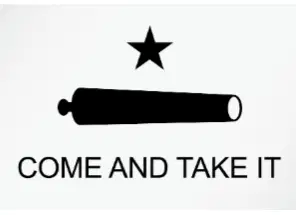
The flag above served as the battle cry for the --
American Revolution
Mexican Revolution
Texas Revolution
Texas Rebellion
Why is the battle at the Alamo referred to as a siege?
The defenders were surrounded in hopes they would be forced surrender.
The defenders surrounded the enemy in hopes of forcing a surrender.
The enemy brought too few weapons for it to be a fair battle.
The defenders were victorious almost immediately.
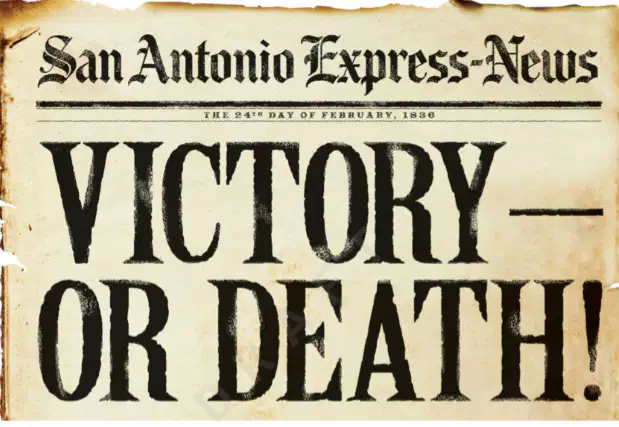
This is a headline from February 24, 1836. [Image Caption: San Antonio Express-News - VICTORY OR DEATH!] The headline above is a reference to the events surrounding the –
Battle of Gonzales
Battle of Lexington and Concord
Battle of the Alamo
Battle of San Jacinto
Which of the following is the CORRECT order for the four key events of the Texas Revolution listed below? I. Fall of the Alamo II. Battle of San Jacinto III. Goliad Massacre IV. Battle of Gonzales
I, II, III, IV
III, IV, I, II
IV, I, III, II
II, IV, III, I
Which event first inspired Texas to rebel?
Mexico had become an independent nation and approved its very first Constitution by 1824.
President Bustamante did not honor the rights that citizens and residents of Mexico were granted by the Constitution.
Stephen F. Austin even went to Mexico to try to convince the Mexican government to give Texans more freedom.
Santa Anna proved to be dishonest by not upholding his promise so Texans continued their rebellion.
One of the results of the Anahuac Disturbance of 1832 was --
Tension that led to the Mexican-American War
Tension that led to the Texas Revolution
Tension that led to the American Revolution
Tension that led to the Battle of the Alamo
Which group would be most OPPOSED to the provisions in the Law of April 6, 1830?
Mexican leaders
Empresarios
Spanish leaders
Clergy
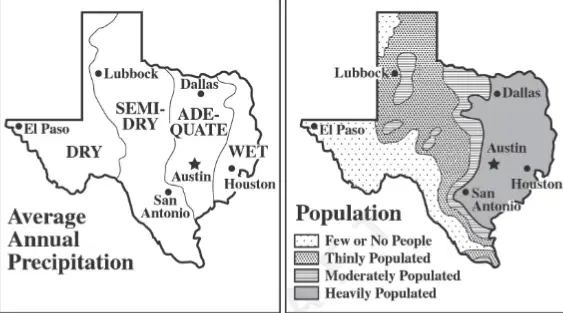
The cities noted on the map with the LARGEST population are primarily located in what two precipitation areas?
Semi-Dry and Wet
Semi-Dry and Dry
Adequate and Wet
Adequate and Dry
Which event marked the final victory for Texas in its fight for independence from Mexico?
Battle of Gonzales
Battle of San Jacinto
Battle of Goliad
Battle of the Alamo
Who was responsible for leading the Texas forces to victory at the Battle of San Jacinto?
James Fannin
Sam Houston
Juan Seguín
Stephen F. Austin
What was the main reason the defenders at the Alamo were unable to hold out against Santa Anna's army?
They had superior numbers.
They were supported by the Mexican government.
They surrendered immediately.
They lacked sufficient supplies and reinforcements.

