
 Worksheets
Integumentary Theory Review
Total questions: 40
Worksheet time: 28mins

Stage this pressure injury
Stage 2
Stage 3
Stage 4
Unstageable

What is the most ideal treatment plan for this type of wound to aid in wound healing?
Negative Pressure Wound Therapy (NPWT)
Debridement
Leave it exposed
Hydrocolloid dressing

Stage this pressure injury
Stage 1
Stage 2
Stage 3
This is not Pressure Injury!
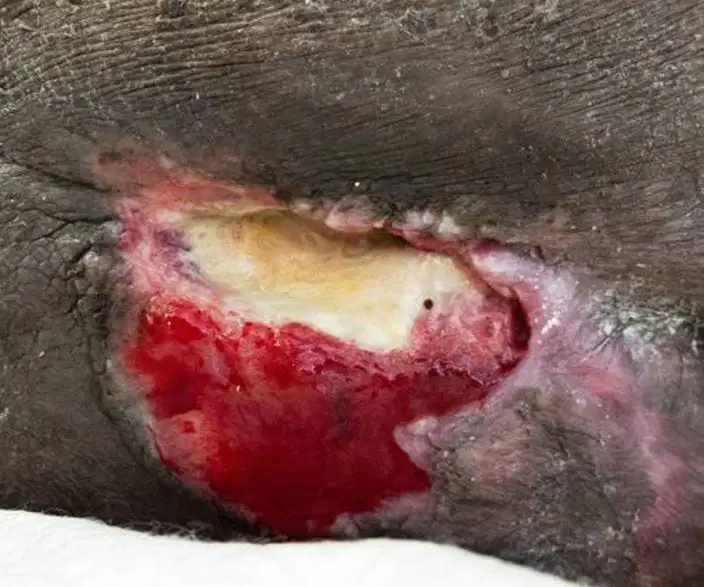
What stage is this pressure injury?
Stage II
Stage III
Unstageable
Deep tissue injury (DTI)

What stage is this pressure ulcer?
Unstageable
Stage IV
Deep tissue injury (DTI)
Stage III

What stage is this pressure ulcer?
Stage I
Stage II
Stage III
Stage IV

What stage is this pressure ulcer?
Stage III
Stage IV
Unstageable
Stage I

Which of the following is not an appropriate nursing intervention for pressure ulcer treatment?
Reposition patient Q 2 hrs
Use a special mattress to reduce pressure
Encourage ambulation
Strict bedrest
A postoperative patient arrives at an ambulatory care center and states, "I am not feeling well." upon assessment, the nurse notes an elevated temperature. An indication that the wound is infected would be.
There is no odor
The wound is approximated
The wound is draining purulent exudate
The are two stitches missing
Which body system forms a protective barrier between the external environment and the internal organs, keeping germs out and keeping hydration/water in?
Integumentary System
Muscular System
Skeletal System
Circulatory System
To maintain a stable internal environment (inside the body); balance/equilibrium
Homeostasis
Transportation
Melanin
Voluntary
The outer layer of skin, the epidermis, is a layer of tissue that covers and acts as a protective barrier. If this layer of skin was burned, the biggest risk would be:
Dry Skin
Acne/Pimples
Infections in uncovered tissue
Muscle cramping
Skin, made of several different tissues, is the largest organ of the human body.
organ
cell
tissue
organism
The body eliminates waste such as salt through which of the following? This process makes the skin part of two systems: the integumentary system and the excretory system.
Sensory receptors
Nails
Sweat glands
Hair
Which structures in the integumentary system are made of nervous tissue, are part of the nervous system, and provide your sense of touch?
Sensory Receptors
Nails
Hair
Sweat glands
Thickest layer of skin. Glands located here.
Dermis
Top layer of skin. Made mostly of dead cells.
Epidermis
The lowest layer of skin. Fat deposits stored here.
Hypodermis
Function is cooling the skin.
Could happen because of fever or exercise
Sweat
Main function of the integumentary system
Protection
Reorder the following: Top most layer of skin to deepest layer of skin.
Epidermis
Dermis
Hypodermis
What are the three main organs of the integumentary system?
(Select three answers)
Skin
Hair
Nails
Stomach
What is the name of the body system that includes skin, hair, nails, blood vessels, sensory receptors, and glands?
Integumentary System
Solar System
Respiratory System
Digestive System

Position of lying on stomach
lateral
supine
prone
Fowler's position

Position of lying on side
Trendelenberg
lateral
supine
prone

Position of lying on back
reverse-Trendelenberg
prone
lateral
supine
You move on the count of "3" to
save time
distract the person from the move
move the person smoothly
move the person slowly
Patients are repositioned at least every
Which prevents the hip from turning outward?
a cane
a foot-board
a trochanter roll
leg brace
A doctor has ordered restraints for Mr. Smith. Which of the following is true?
Mr. Smith will be at lower risk for developing Respiratory problems.
Mr. Smith will be at greater risk of developing decubitus ulcers.
Mr. Smith will become hungry and thirsty.
Mr. Smith's need for range of motion will be decreased.
Why is proper positioning important for patients in a healthcare setting?
Proper positioning is only important for aesthetic reasons
Patients should be allowed to choose their own positioning
Proper positioning has no impact on patient health
Proper positioning helps prevent pressure ulcers, promotes circulation, and ensures patient comfort and safety.
Explain the importance of turning patients regularly and the potential complications of immobility.
Turning patients regularly helps prevent complications of immobility and promotes overall health.
Complications of immobility are not serious
Patients should not be turned regularly as it can cause more harm
Turning patients regularly has no impact on their health
What are the best practices for positioning and turning patients to prevent pressure ulcers?
Using hard and uncomfortable surfaces for the patient
Leaving the patient in one position for long periods of time
Regularly repositioning the patient, using support surfaces, and maintaining skin integrity
Neglecting to check the patient's skin for any changes
The main purpose of positioning and turning is to _____.
avoid low blood pressure
provide daily exercise
decrease pressure on body parts
create stimulation
Which of the following helps to prevent decubitus ulcers when positioning a patient?
changing any wet or creased dressings and bandages
keeping pressure points dry and clean
making sure bed linens are smooth and free from crumbs
All are correct.
What should you NOT do if you find a new area of skin breakdown on your patient?
Document the finding
Rub the area
Remove sources of moisture
Consult the facility's wound care nurse
Which of these are methods to prevent skin breakdown? (select all that apply)
Turn your patient every 2 hours
Use lift equipment to prevent shearing/friction injuries
Assess skin every 8 hours or per the facility's protocol
Provide adequate nutrition
Which of the following is NOT a risk for a pressure injury?
Age
Gender
Moisture
Poor nutrition
What is the most concerning sign of a mole that may indicate skin cancer?
A mole that is symmetrical
A mole that is irregularly shaped and has changed in size
A mole that is small and round
A mole that is light in color
What is a key sign of early pressure injury in the sacral area?
Dry skin
Erythema
Bruising
Swelling
What is a characteristic of a Stage 1 pressure injury?
Non-blanchable erythema of intact skin over a bony prominence
Full-thickness skin loss exposing subcutaneous fat
Partial-thickness loss of the epidermis and dermis
Presence of a blister or shallow open ulcer
Which stage of pressure ulcer involves full-thickness skin loss that exposes subcutaneous tissue?
Stage 1
Stage 2
Stage 3
Stage 4
A person runs into the corner of a table and has a superficial discoloration of the skin that is bluish in color. The person has a ______________.
hemotoma
contusion
edema
pyrexia
During an evaluation the doctor notes a localized warm spot on the patients forearm. Which might be a potential cause?
inflammation
decreased circulation
cyanosis
ecchymosis

