
 Worksheets
Y9 Bonding Questions
Total questions: 157
Worksheet time: 2hrs 35mins

Look at the diagram. How many covalent bonds does each carbon atom form in graphite?
(a)

Look at the diagram. How many covalent bonds does each carbon atom form in diamond?
(a)
Tick the properties of diamond
Very hard
Slippery
Conducts electricity
Soft
Does not conduct electricity
Tick the properties of graphite
Very hard
Slippery
Conducts electricity
Soft
Does not conduct electricity
What type of bonding involves metals ONLY?
Ionic
Covalent
Metallic
What type of bonding involves non-metals ONLY?
Ionic
Covalent
Metallic
What type of bonding involves metals and non-metals?
Ionic
Covalent
Metallic
What type of bonding would you expect to see in SODIUM CHLORIDE?
Ionic
Covalent
Metallic
What type of bonding would you expect to see in CARBON DIOXIDE?
Ionic
Covalent
Metallic
Which statement correctly explains why metals conduct electricity?
Metals contain delocalised electrons which can move throughout the structure
Metals contain ions which are free to move throughout the structure
Metals contain an electrical current
Metals are magnetic
Which statement correctly explains why ionic compounds conduct electricity as a LIQUID?
Ionic compounds contain delocalised electrons which can move throughout the structure
Ions are free to move
Ions are fixed in position
Ionic compounds contain an electrical current
Which statement correctly explains why ionic compounds DO NOT conduct electricity as a SOLID?
Ionic compounds contain delocalised electrons which can move throughout the structure
Ions are free to move
Ions are fixed in position
Ionic compounds are not magnetic

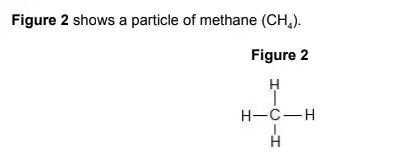
How many bonding pairs are present in this covalent molecule?
1
2
3
4
How are covalent bonds formed?
Pairs of electrons are shared
Electrons are transferred from one atom to another
Strong attraction between negative delocalised electrons and positive ions
How are ionic bonds formed?
Pairs of electrons are shared
Electrons are transferred from one atom to another
Strong attraction between negative delocalised electrons and positive ions
Which statement correctly explains why metals are easily bent and shaped?
The metal ions can be squashed
The metal ions can move
The metal ions are in layers which can slide over each other
The metal ions are all the same size
Which statement correctly explains why alloys are harder to shape than pure metals?
The metal ions can be squashed
The metal ions cannot move
The metal ions are in layers which can slide over each other
Different size metal ions disrupt the layers
What is an alloy?
Mixture of elements
Mixture of metals
Pure metal
Mixture of metal and plastic
What is a smart alloy?
An alloy that can change colour
An alloy that returns to its original shape
An alloy that can be used for different purposes
Which are examples of alloys?
Stainless steel
Iron
Copper
Brass
Nitinol
Which ONE is an example of a smart alloy?
Stainless steel
Iron
Copper
Brass
Nitinol
Which statement correctly explains why most covalent substances have low melting/boiling points?
There are strong electrostatic attractions
There are weak intermolecular forces
Covalent bonds are weak
There are no strong bonds
Which statement correctly explains why ionic compounds have high melting/boiling points?
There are strong electrostatic attractions
There are weak intermolecular forces
Ionic bonds are weak
There are strong intermolecular forces
What type of structure do ionic compounds have?
Small, simple molecules
Giant molecule
Giant lattice
Which ion is formed by sodium (Na)?
Na-
Na+
Na+7
Na-7
Which ion is formed by magnesium (Mg)?
Mg-
Mg+
Mg2+
Mg2-
Which ion is formed by oxygen (Mg)?
O-
O+
O2+
O2-
Which ion is formed by Chlorine (Cl)?
Cl-
Cl+
Cl2+
Cl2-
Choose the correct words to complete the sentence:
Ionic compounds can conduct electricity when ____________ or ____________.
solid
aqueous (dissolved)
powdered
squashed
molten
Choose the correct words to complete the sentence:
Metals are excellent conductors of ___________ and _____________.
heat
water
electricity
light
What is the charge of a magnesium ion after it loses two electrons?
-1
+2
-2
+1
How many valence electrons does sulfur have before it gains two electrons to form a sulfide ion?
2
4
8
6
What is the final electron configuration of a sodium ion after it loses its valence electron?
2,8
2,8,2
2,7
2,8,1
What type of bond forms between sodium and chlorine to create sodium chloride?
Hydrogen bond
Ionic bond
Covalent bond
Metallic bond
What is the overall charge of an ionic compound?
-1
Varies
0
+1
How many chloride ions are needed to balance the charge of one magnesium ion?
3
2
1
4
What is the charge on a sulfide ion?
-2
+1
+2
-1
What happens to the ions in an ionic compound when it is dissolved in water?
They form covalent bonds
They lose their charge
They become immobile
They are free to move
What is the correct formula for magnesium chloride?
Mg2Cl3
Mg2Cl
MgCl2
MgCl
What is the principle behind the formation of ionic bonds?
Movement of neutrons
Sharing of electrons
Transfer of electrons
Exchange of protons
Which element typically does not form an ionic bond with chlorine?
Sodium
Magnesium
Carbon
Potassium
In a dot and cross diagram for sodium chloride, what does a dot represent?
An electron from sodium
An electron from chlorine
A shared electron pair
A neutron
How does the electron configuration of an oxygen atom change when it forms an oxide ion?
It loses two electrons
It gains two electrons
It shares two electrons
No change
What is the electron configuration of a chloride ion?
2,8,7
2,8,8
2,8,6
2,8
Which of the following elements is most likely to form an ionic bond with fluorine?
Oxygen
Lithium
Carbon
Nitrogen
What is the correct formula for potassium oxide?
K2O
KO2
K2O2
KO
Surname
First name
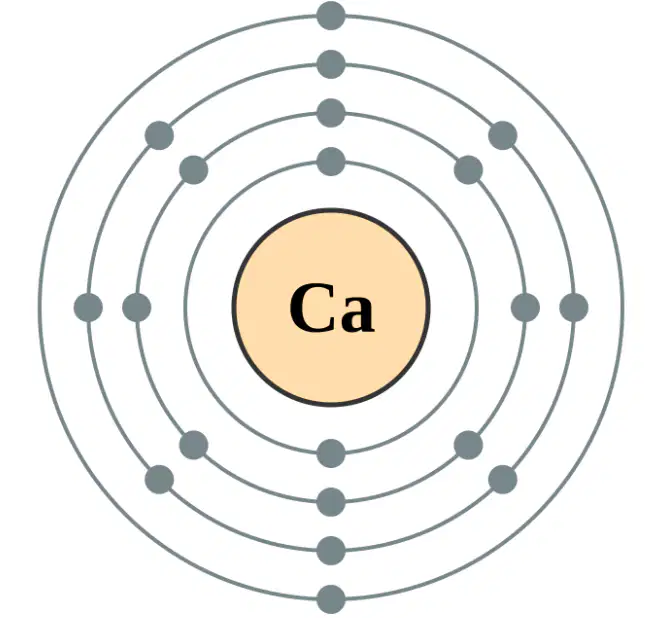
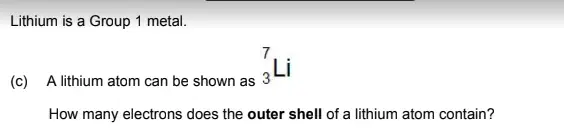
Electrons are ____________ charged.
positively
neutrally
negatively
When atoms lose or gain electrons and become charged, we call them:
an isotope
a new atom
an ion
a bond
An atom that loses an electron forms a positive ion.
a positive
a negative
neither
Sodium forms an ionic bond with Chlorine. What is the charge on the Sodium ion?
-2
+1
-
+
Ionic bonding happens between a metal and a non-metal.
metals
non-metals
a metal and a non-metal
Covalent bonding happens between:
metals
non-metals
a metal and a non-metal
Metallic bonding is a bond between a metal and ________.
a non-metal
a metal

What type of bonding is present in calcium oxide?
Covalent
Ionic
Macromolecular
Metallic
What kind of force attracts oppositely charged ions to each other?
electrostatic
magnetic
intermolecular
attractive
Ionic bonds are:
Strong
Weak
Neither
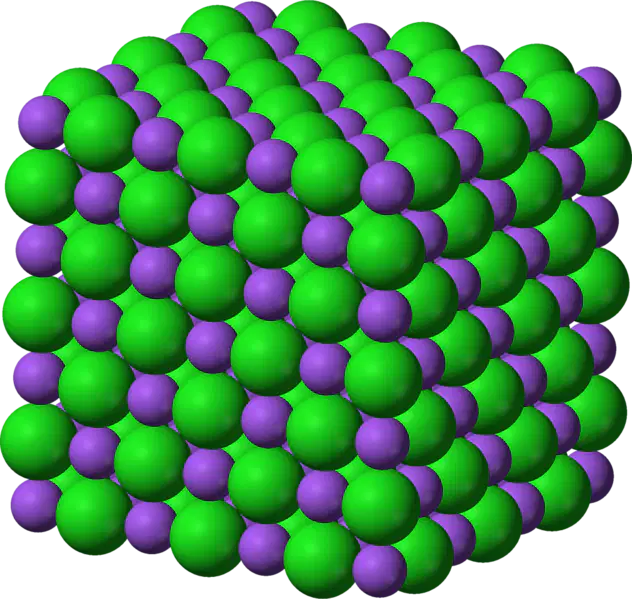
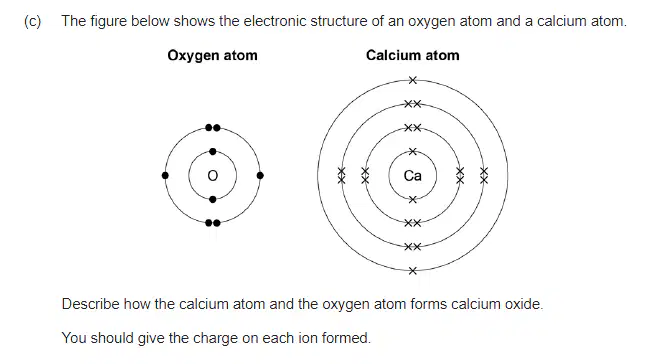
Describe how the calcium atom and the oxygen atom form calcium oxide (4 marks)
Ionic compounds have a high melting and boiling point.
High
Mid range
Low
Copper conducts electricity because of the movement of delocalised ___________.
atoms
electrons
ions
molecules
Explain why a sodium chloride solution conducts electricity.
Having only 3 bonds between carbon atoms in graphite means that there are:
free atoms
empty bonds
delocalised electrons
inter-molecular forces
Graphene and diamond are allotropes of carbon.
true
false
Nanotubes can be used for medicine delivery.
true
false
Diamond has: a high melting point, a high boiling point, strong covalent bonds, all the above.
a high melting point
a high boiling point
strong covalent bonds
all the above
Buckminster fullerenes can be used as lubricant oils for engines. What element are they made of?
calcium
nitrogen
copper
carbon
Diamond can conduct electricity.
true
false
I don't know

Balance the equation for the reaction of lithium with oxygen.
2
3
4
6
What shape are carbon nanotubes?
Pyramidal
Cubic
Cylindrical
Spherical
What is a limitation of the particle model?
The particle model assumes that particles have no forces between them
The particle model assumes that particles should be square
The particle model assumes that there are more particles than in real life
The particle model assumes that there are fewer particles than in real life
In graphite, how many covalent bonds does each carbon atom form?
1
2
3
4
Which one of these is NOT a property of a fullerene?
A hollow shape
Hexagonal carbon rings
A molecule of carbon atoms
Short length and large diameter
Metals consist of giant structures of arranged in a regular pattern.
atoms
neutrons
molecules
protons
Non-metal atoms become negatively charged ions by…
gaining electrons
sharing electrons
losing electrons
gaining protons
Which of these is NOT an example of a giant covalent substance?
Graphite
Sodium chloride
Diamond
Silicon dioxide
Ionic bonding is the bonding between…
metals and non-metals
metals and metals
non-metals and non-metals
gold and silver
Which of these statements is NOT true?
Ionic compounds can conduct electricity when…
they are melted
they are dissolved in water
electrons are free to move
ions are free to move
In metallic bonding, the electrons are…
stationary
delocalised
donated
gained
Simple covalent molecules have…
weak intermolecular forces
strong intermolecular forces
weak electrostatic forces
strong electrostatic forces
In pure metals, atoms are arranged in…
no order
groups of 3
layers
circles
Covalent bonding is the bonding between…
metals and non-metals
metals and metals
non-metals and non-metals
metals and gases
What takes place at the boiling point?
Freezing and boiling
Melting and freezing
Condensing and melting
Boiling and condensing
In a simple covalent bond diagram, a single covalent bond is represented using…
a double line
a dotted line
a squiggle
a single line
Define the term 'alloy'.
Non-metal and metal chemically bonded together
More than one metal chemically bonded together
A metal and rock
Two non-metals chemically bonded together
What is a nanometre?
A billionth of a metre
A hundredth of a metre
A thousandth of a metre
A millionth of a metre
How many carbon atoms are there in a molecule of Buckminsterfullerene?
60
50
40
30
In diamond, how many covalent bonds does each carbon atom form?
3
4
2
5
A substance has a boiling point of 220 degrees Celsius and a melting point of −120 degrees Celsius.
What state will it be at room temperature?
Solid
Liquid
Gas
Aqueous
What property does graphite have in common with most metals?
It can conduct electricity
It is magnetic
It is hard
It is ductile
In covalent bonding, electrons are…
swapped
donated
shared
received
At room temperature and pressure, what are the state symbols for hydrogen (H2) and sodium hydroxide (NaOH)?
(g) & (s)
(s) & (aq)
(g) & (l)
(l) & (s)
When magnesium bonds with oxygen, the magnesium loses two electrons. What ion will be formed?
[Mg]+
[Mg]2-
[Mg]2+
[Mg]-
What takes place at the melting point?
Melting and freezing
Freezing and boiling
Boiling and condensing
Condensing and melting
In a molecule of ammonia, how many electrons need to be shared for nitrogen to have a full outer shell?
5
3
1
2
[Mg]2+ and [O]2- ionically bond to form magnesium oxide. What is the correct empirical formula for this compound?
MgO2
2MgO
Mg2O
MgO
Why are metals good conductors of electricity?
Because delocalised electrons carry the charge
Because atoms carry the charge
Because they are arranged in layers of atoms
Because ions carry the charge
At room temperature, polymers are what state?
Solid
Liquid
Gas
Aqueous
Which of these statements is INCORRECT?
The amount of energy needed to change state from a solid to liquid depends on…
the type of bonding
the strength of forces between particles
the colour of the substance
the structure of a substance
What happens during reduction?
Electrons are gained
Electrons are shared
Protons are lost
Electrons are lost
Atoms in a polymer are linked together by…
strong ionic bonds
strong covalent bonds
weak ionic bonds
weak covalent bonds
What is graphene?
A hollow shape
A single layer of graphite
A double layer of graphite
A spherical shape
Which of these statements is NOT characteristic of most metals?
Able to conduct electricity
High melting and boiling points
Malleable
Insulating
Ionic compounds have a regular structure that is called a…
giant ionic lettuce
giant ionic lattice
simple ionic structure
simple ionic lattice
Positive ions and negative ions are attracted by…
intermolecular forces
electrostatic forces
strong covalent bonds
sticky bonds
Electrons are shared in…
pairs
triads
groups of 3
groups of 4
Electron transfer can be shown using…
dot diagrams
cross diagrams
dot and cross diagrams
circle diagrams
Why are alloys harder than metals?
They have more ions
The layers of atoms cannot be distorted
The delocalised electons can move more freely
The atoms are bigger
Which one of these is INCORRECT?
The repeating unit of a polymer is drawn using…
brackets
single bonds
the letter 'n'
double bonds
Complete the sentence. Nanoparticles have a…
small surface area to volume ratio
large surface area to volume ratio
small surface area to length ratio
large surface area to length ratio
[Li]+ and [O]2- would ionically bond to form lithium oxide.
What is the correct empirical formula for this compound?
LiO
Li2O
2LiO
LiO2
Why do ionic compounds have high melting and boiling points?
Lots of energy is needed to break strong electrostatic bonds
Lots of energy is needed to break strong intermolecular forces
Lots of energy is needed to break weak electrostatic bonds
Lots of energy is needed to break weak intermolecular forces
Atoms are most stable when…
they move around
the electrons move
they become charged
they have full outer shells
Which one of these properties of diamond is NOT correct?
High melting point
Hard
Does not conduct electricity
Malleable
What is a polymer?
A chain of monomers
A chain of carbon atoms
A large ionic compound
A metal
When metal atoms lose electrons they become…
elements
negatively charged ions
positively charged ions
chemical bonds
In graphite, how many electrons from each carbon atom are delocalised?
1
2
3
4
What happens during oxidation?
Electrons are gained
Electrons are shared
Protons are lost
Electrons are lost
Most metals have high melting and boiling points because…
they have strong ionic bonds
they have strong intermolecular forces
they have strong covalent bonds
they have strong metallic bonds
What is the process of ionic bonding?
Sharing of electrons
Transfer of electrons
Loss of protons
Gain of neutrons
What is the charge of a nonmetal atom after gaining electrons?
Neutral
Negative
Variable
Positive
How can the number of electrons in an ion be calculated?
By multiplying the atomic number and mass number
By using the charge of the ion
By subtracting the atomic number from the mass number
By adding the atomic number and mass number
Which group of elements forms negative ions with the electronic structure of a noble gas?
Group 5 and 6
Group 1 and 2
Group 3 and 4
Group 6 and 7
What does the ending -ide indicate in the names of compounds?
Contains oxygen
Contains a halide ion
Contains at least 3 elements
Contains a nonmetal negative ion
Which ion is involved in the formation of sodium oxide?
OH- ion
O²- ion
Cl- ion
NO3- ion
What holds together the ions in an ionic compound?
Hydrogen bonds
Ionic bonds
Covalent bonds
Metallic bonds
What is the structure of an ionic compound?
Single ion structure
Random arrangement of ions
Linear arrangement of ions
Regular arrangement of ions
What is the charge of Na+ ion?
+1
+2
-1
0
What is the force that acts in all directions in the lattice of an ionic compound?
Dipole-dipole forces
Covalent bonding
Ionic bonding
Van der Waals forces
What type of bonding occurs between non-metal atoms?
ionic bonding
metallic bonding
covalent bonding
What type of bonding occurs between non-metal AND metal atoms?
ionic bonding
metallic bonding
covalent bonding
What type of bonding occurs between metal atoms?
ionic bonding
metallic bonding
covalent bonding
Are covalent bonds strong or weak?
strong
weak

Covalently bonded substances consist of either simple molecules or giant covalent structures. What are simple molecules?
molecules that contain only a few atoms held together by covalent bonds
structures that contain many atoms, each joined to adjacent atoms by covalent bonds

True of false? Simple molecular substances have low melting and boiling points.
True
False
Why do simple molecular substances have low melting and boiling points?
The intermolecular forces between simple molecules are weak.
The covalent bonds holding the atoms together in a simple molecule are strong. A large number of covalent bonds hold the atoms together in simple molecules.

What happens when a simple molecular substance melts or boils?
The weak intermolecular forces between the molecules break.
Strong covalent bonds between the atoms of the molecule break.
Why do weak intermolecular forces between simple molecules result in low melting and boiling points?
Little energy is needed to break the strong covalent bonds.
Little energy is needed to break the weak intermolecular forces.
Lots of energy is needed to break the weak intermolecular forces.
Simple molecular substances are often ________ or ________ at room temperature because they have low melting and boiling points.
solid
liquid
gas
Do simple molecular substances conduct electricity?
Select yes or no and a reason.
yes
no
Simple molecular substances are held together by weak intermolecular bonds that are easily broken, enabling the molecules to flow and carry charge.
Simple molecular substances don't have any free electrons or an overall electric charge.

Which of the following simple molecular substances conduct electricity?
water
oxygen
carbon dioxide
all of these simple molecular substances
none of these simple molecular substances

Covalently bonded substances consist of either simple molecules or giant covalent structures. What are giant covalent structures?
molecules that contain only a few atoms held together by covalent bonds
structures that contain many atoms, each joined to adjacent atoms by covalent bonds

Which two of the following are examples of giant covalent structures?
graphite
silicon dioxide
oxygen
water
True of false? Giant covalent structures have low melting and boiling points.
true
false
Why do giant covalent structures have very high melting and boiling points?
Giant covalent structures are held together by a large number of strong covalent bonds that require a lot of energy to break them.
Giant covalent structures are held together by a large number of weak intermolecular forces that require a lot of energy to break them.

