wayground logo

Free Printable Worksheets

Font size

S
M
L
XL
Worksheets

KS3 SCIENCE: CHEMISTRY REVISION

Total questions: 154

Worksheet time: 2hrs 4mins

Name
Class
Date
1.
What happens when the motion of particles slows?
a)
The particles split.
b)
The particles move further apart.
c)
The particles move closer together
d)
The particles no longer move randomly.
2.
Which phrase best describes the particles in a solid?
a)
not moving
b)
very far apart
c)
vibrating in place
d)
able to slip past one another
3.
What causes surface tension?
a)
gaps between particles
b)
rapid movement of particles
c)
attractive forces between particles
d)
crystalline arrangement of particles
4.
Which grouping lists the states of matter in order of increasing distance between particles?
a)
gas, liquid, solid
b)
liquid, solid, gas
c)
solid, gas, liquid
d)
solid, liquid, gas
5.
A gas has a no definite shape and ________.
a)
a definite shape
b)
a definite volume
c)
no definite shape
d)
no definite volume
6.
A solid has ________ and a definite volume.
a)
a definite shape
b)
a definite volume
c)
no definite shape
d)
no definite volume
7.

The energy an object has due to its motion

a)

thermal energy

b)

temperature

c)

kinetic energy

8.

Measure of the average kinetic energy of the particles in an object

a)

thermal energy

b)

temperature

c)

kinetic energy

9.

Changing from a liquid to a gas

a)

condensation

b)

vaporization

c)

sublimation

d)

melting

10.

Changing from a gas to a liquid

a)

condensation

b)

vaporization

c)

sublimation

d)

melting

11.

Changing directly from a solid to a gas

a)

condensation

b)

vaporization

c)

sublimation

d)

melting

12.

Evaporation and boiling are two kinds of _______

a)

condensation

b)

vaporization

c)

sublimation

d)

melting

13.

Deposition is a change from a __________

a)

gas to a solid.

b)

solid to a gas.

c)

liquid to a gas.

d)

gas to a liquid.

14.

Vaporization that occurs within a liquid is _________

a)

boiling.

b)

evaporation.

c)

sublimation.

d)

condensation.

15.
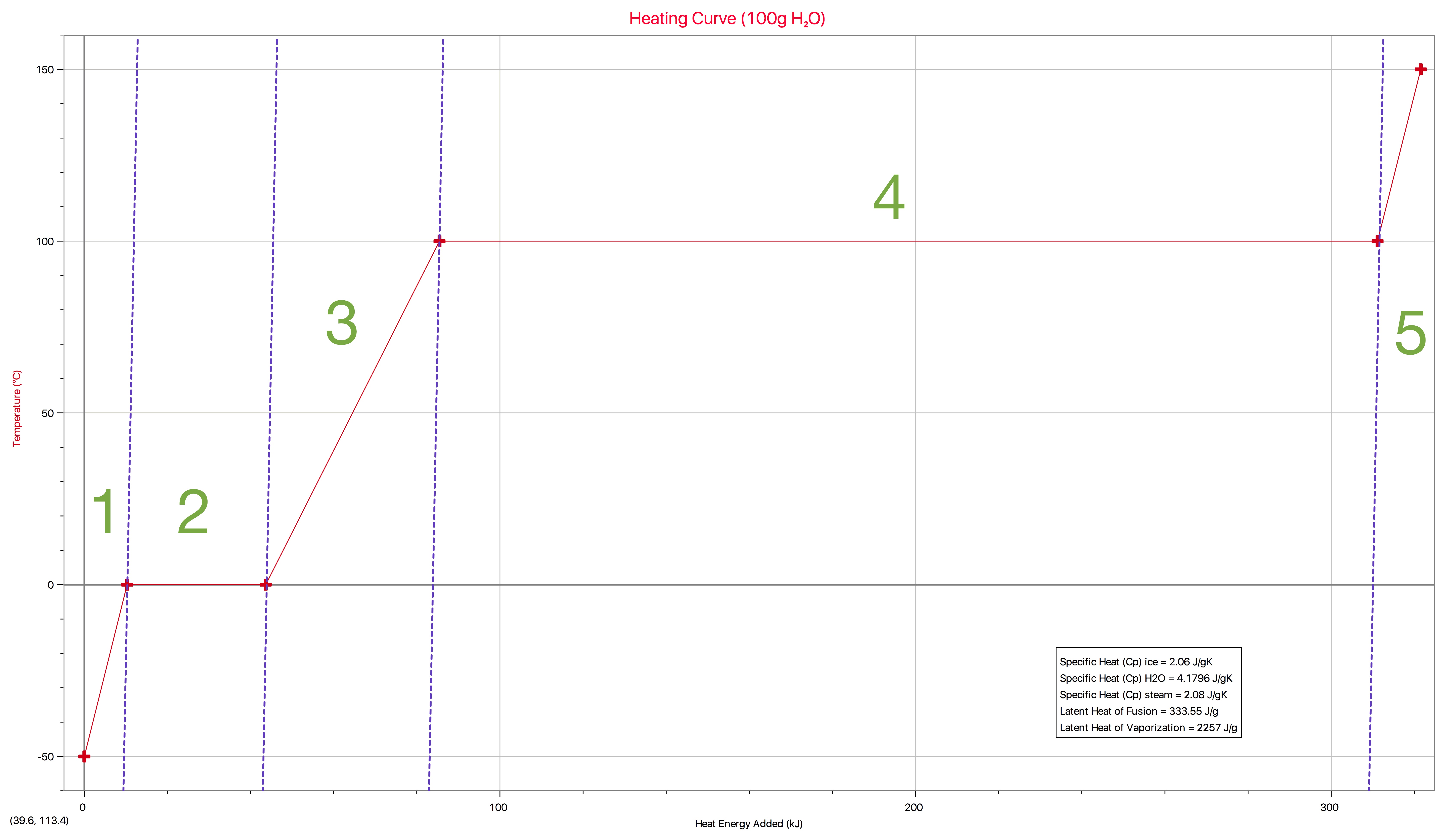
In which region(s) does temperature remain constant?
a)
Region 1, 3, & 5
b)
Region 2 & 4
c)
Region 1 only
d)
Region 1 & 2
16.
In which region(s) does temperature increase?
a)
Region 1, 3, & 5
b)
Region 2 & 4
c)
Region 1 only
d)
Region 1 & 2
17.
In which region(s) of the graph does a phase change occur?
a)
Region 1, 3, & 5
b)
Region 2 & 4
c)
Region 1 only
d)
Region 1 & 2
18.
In which region(s) of the graph would the substance only be in one phase?
a)
Region 1, 3, & 5
b)
Region 2 & 4
c)
Region 1 only
d)
Region 1 & 2
19.
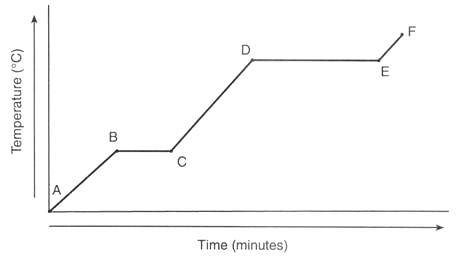
Describe the substance between letters C and D. 
a)
Gas
b)
Liquid
c)
Melting
d)
Evaporating
20.
Between which points is the temperature of the substance remaining constant?
a)
A-B only. 
b)
A-B, C-D, E-F
c)
B-C only. 
d)
B-C, D-E
21.
Between which points is the substance changing its state of matter?
a)
A-B only. 
b)
A-B, C-D, E-F
c)
B-C only. 
d)
B-C, D-E
22.

What is holding molecules in a solid close to each other?

a)

Intermolecular forces

b)

Chemical Bonds

c)

Heat

d)

Cold

23.

What does heat do to intermolecular forces?

a)

strengthens them

b)

Weakens them

c)

reverses them

24.

As matter cools what happens to the intermolecular forces?

a)

they strengthen

b)

they weaken

c)

they reverse

25.

What is true about intermolecular forces in gases

a)

they have been broken by heat

b)

They are very strong

c)

They cannot be put back together

d)

they represent a chemical change

26.

Transparent and brittle (breaks easily)

a)

Metal

b)

Sponge

c)

Glass

d)

Plastic

27.

Shiny and conducts electricity

a)

Glass

b)

Plastic

c)

Rubber

d)

Metal

28.

Flexible and elastic

a)

Fabric

b)

Glass

c)

Rubber

d)

Wood

29.

Transparent and flexible

a)

Rubber

b)

Plastic

c)

Fabric

d)

Metal

30.

Weak and absorbent

a)

Fabric

b)

Cardboard

c)

Plastic

d)

Glass

31.

Waterproof material

a)

Plastic

b)

Wood

c)

Fabric

d)

Paper

32.
The ability of a material to withstand a force without breaking or bending
a)
durability
b)
hardness
c)
toughness
d)
strength
33.
The ability of a material to conduct heat or electrical energy
a)
conductivity
b)
ductility
c)
malleability
d)
fusibility
34.

Neutralization is a reaction between

a)

Two acids

b)

Two bases

c)

One acid and one base

d)

None of them

35.

Common salt is

a)

Acidic

b)

Neutral

c)

Basic

d)

all of them

36.

Taste of acid is

a)

Bitter

b)

Soupy

c)

Sour

d)

Sweet

37.

Lemon drop turns

a)

Red litmus into blue

b)

No reaction

c)

Blue Litmus into red

d)

All of them

38.

Which is not the product of neutralization process

a)

Water

b)

Heat

c)

Salts

d)

Sugar

39.

How many type of Litmus is there

a)

One

b)

zero

c)

Five

d)

two

40.

Name the acid present in our stomach.

a)

Sulphuric acid

b)

Hydrochloric acid

c)

Nitric acid

d)

Carbonic acid

41.

When the soil is too basic, plants do not grow well in it. To improve its quality what must be added to the soil?

a)

Slaked lime

b)

Quick lime

c)

Calamine solution

d)

Organic matter

42.

Methyl orange is an _________

a)

acid

b)

indicator

c)

base

43.

Which of the following values would represent the pH of a strong base?

a)

1

b)

8

c)

7

d)

13

44.
an aqueous soln turns red lithmus blue . excess addition of which of the following would reverse the change
a)
baking powder
b)
lime
c)
ammonium hydroxide solution
d)
HCL
45.
If a few drops of concentrated acid accidentally spills over the hand of a student,what should be done
a)
wash the hand with saline solution
b)
wash the hand immediately with plenty of water and apply a soln of sodium hydrogen carbonate
c)
after washing apply soln of sodium hydroxide
d)
neutralise the acid wih a strong alkali
46.
Why does vinegar help preserve things like pickles? 
a)
It keeps moisture in. 
b)
It preserves flavors and crispness
c)
It kills bacteria that break down foods. 
d)
It keeps the cells alive
47.
An extremely strong acid would have a pH of...
a)
1
b)
7
c)
9
d)
14
48.
A neutral substance would have pH of...
a)
8
b)
7
c)
6
d)
14
49.
If a solution is neither acidic or basic it has a pH of _____________.
a)
1
b)
13
c)
6
d)
7
50.
Indicators change color in the presence of a(n) _______________.
a)
acid or base
b)
buffer
c)
water molecule
d)
ester
51.
A base has a _________________.
a)
sour taste
b)
positive ion
c)
slippery feel
d)
pH of 5
52.
If an acid is combined with a base of equal strength, the result will most likely be
a)
a neutral solution.
b)
a stronger acid.
c)
impossible to tell without testing the pH.
d)
a stronger base
53.

What is the meaning of the above hazard warning symbol?

a)

Corrosive

b)

Explosive

c)

Toxic

d)

Radioactive

54.
What is the hazard shown in this hazard sign?
a)
Fire
b)
Goku
c)
Flammable
d)
Inflammable
55.
What is the hazard shown in this hazard sign?
a)
Fireworks
b)
Broken Glass
c)
Explosive
d)
Corrosive
56.
What is the hazard shown in this hazard sign?
a)
Corrosive
b)
Irritant
c)
Danger
d)
Caution
57.
What is the hazard shown in this hazard sign?
a)
Explosive
b)
Corrosive
c)
Irritant
d)
High level Irritant
58.
What is the hazard shown in this hazard sign?
a)
Death
b)
Pirates
c)
Corrosive
d)
Toxic
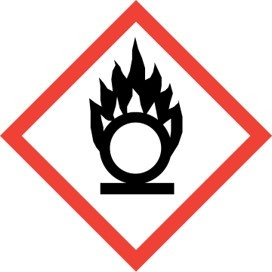
59.

What does this symbol stand for?

a)

Flammable

b)

Oxidising

c)

Non-flammable

d)

Explosive

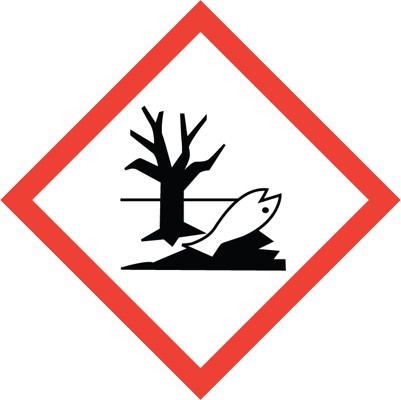
60.

This symbol tell us the chemical it is labelling is:

a)

Harmful to the environment

b)

Dangerous

c)

Toxic

d)

Poisonous

61.
What elements make up Copper sulphate? CuSO4
a)
copper, sulphate
b)
copper, sulphur
c)
copper, sulphur and oxygen
d)
copper and oxygen
62.
Magnesium and hydrochloric acid are mixed together in a beaker, hydrogen is produced as well as magnesium chloride.
Choose correct word equation
a)
magnesium chloride + hydrogen --> magnesium + hydrochloric acid
b)
magnesium + hydrochloric acid --> magnesium chloride + hydrogen
63.
Magnesium + Hydrochloric acid --> Magnesium chloride + hydrogen
Choose correct reactants
a)
Magnesium and hydrochloric acid
b)
Magnesium chloride and hydrogen
64.
Iron + Hydrochloric acid --> ?
a)
iron sulfate + water
b)
iron + hydrogen
c)
iron chloride + hydrogen
d)
iron chloride + water
65.

How can we prevent sodium from reacting?

a)

By keeping it under a layer of oil.

b)

By galvanising it.

c)

By keeping it cool.

d)

By heating it.

66.
Salts that are made with carbonic acid are called ______________.
a)
chlorides
b)
sulfates
c)
nitrates
d)
carbonates
67.
acid + metal ----->
a)
salt + hydrogen
b)
salt + water + carbon dioxide
c)
salt + water
d)
salt + carbon dioxide
68.

Acid + Carbonate ----->

a)

salt + hydrogen

b)

salt + water + carbon dioxide

c)

salt + water

d)

salt + carbon dioxide

69.
Magnesium + sulphuric acid --> ?
a)
magnesium sulfate + water
b)
magnesium sulfate + hydrogen
c)
magnesium chloride + hydrogen
d)
magnesium chloride + water
70.
Zinc + nitric acid --> ?
a)
zinc sulfate + water
b)
zinc sulfate + hydrogen
c)
zinc nitrate + hydrogen
d)
zinc chloride + water
71.
Salts produced by the reactions of hydrochloric acid are known as... 
a)
chlorines
b)
nitrates
c)
chlorides
d)
bromides
72.
What reactants are needed to prepare (make) magnesium nitrate?
a)
magnesium and hydrochloric acid
b)
magnesium and sulfuric acid
c)
magnesium and nitric acid
d)
magnesium and carbonic acid
73.

How do you know when a reaction between a metal and an acid is complete?

a)

All the metal is dissolved

b)

There is a color change in the acid

c)

Bubbles stop forming!

d)

All the acid evaporates

74.
Why is burning a salt one way to determine the metal used in preparing it?
a)
Each metal burns a different color.
b)
Some metals burn and some don't.
c)
Each metal has a different colored smoke.
d)
Burning salts is not will not help determine the metal.
75.
a)
Periods
b)
Groups
76.
a)
energy levels
b)
valence electrons
c)
protons
d)
neutrons
77.
a)
energy levels
b)
valence electrons
c)
protons
d)
neutrons
78.
a)
Same group
b)
Same period
79.
a)
Group 1
b)
Group 17
c)
Group 2
d)
Group 18
80.
a)
Group 1
b)
Group 17
c)
Group 18
d)
Group 2
81.
a)
Group 1
b)
Group 17
c)
Group 18
d)
Group 2
82.
a)
Metals
b)
Nonmetals
c)
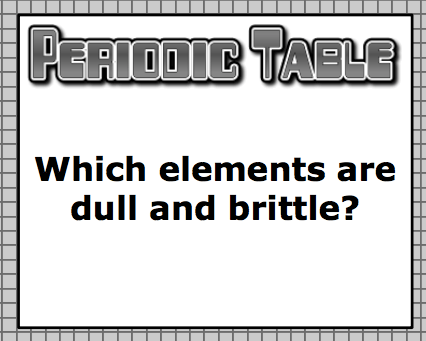
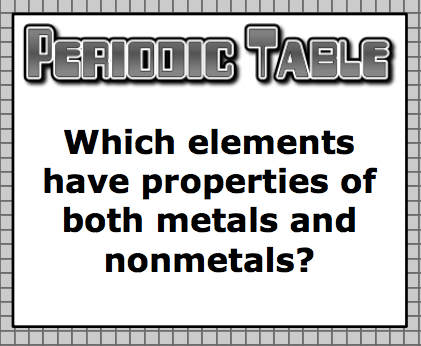
Metalloids
83.
a)
Metals
b)
Nonmetals
c)
Metalloids
84.
a)
Metals
b)
Nonmetals
c)
Metalloids
85.
a)
Metals
b)
Nonmetals
c)
Metalloids
86.
a)
Metals
b)
Nonmetals
c)
Metalloids
87.
a)
Metals
b)
Nonmetals
c)
Metalloids
88.

Who invented the Periodic Table?

a)

Mendeleev

b)

Bohr

c)

Lewis

d)

Democritus

89.

As you move left to right on a row or period what happens?

a)

Atomic number increases by 1

b)

Electrons decrease

c)

Number of shells decrease

d)

Nothing

90.

What happens to the number of shells as you move down a group?

a)

They decrease by 1

b)

They increase by 1

c)

Nothing

91.

The first energy shell can hold ______ electrons.

a)

2

b)

8

c)

18

92.

All elements in the same row have the same number of shells.

a)

True

b)

False

c)

Sometimes

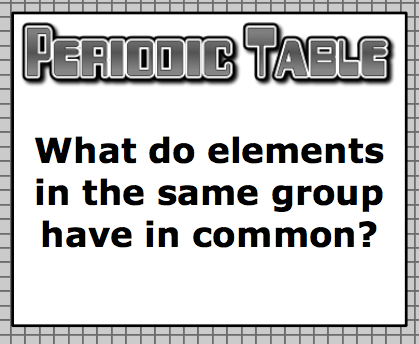
93.

Elements in the same group or column have the same ...

a)

# of valence electrons

b)

# of shells

c)

# of protons

d)

Mass Number

94.

Elements in the same group have __________

a)

Similar Properties

b)

Same number of shells

c)

Similar Mass

95.
Which of the following is the most metallic element in period 3?
a)
Boron (B)
b)
Sodium (Na)
c)
Argon (Ar)
d)
Silicon (Si)
96.
Which of these element is the least metallic?
a)
Potassium (K)
b)
Carbon (C)
c)
Sulfur (S)
d)
Neon (Ne)
97.
The number at the bottom of each square on the periodic table is the ...
a)
atomic number
b)
atomic mass
c)
chemical symbol
d)
element name
98.
The number at the top of each square on the periodic table is the ...
a)
atomic number
b)
atomic mass
c)
Chemical Symbol
d)
Element Name
99.
Pure forms of these elements are stored in oil so they won't react with oxygen and water in the air.
a)
Alkali Metals
b)
Alkaline-earth metals
c)
Halogens
d)
Noble Gases
100.
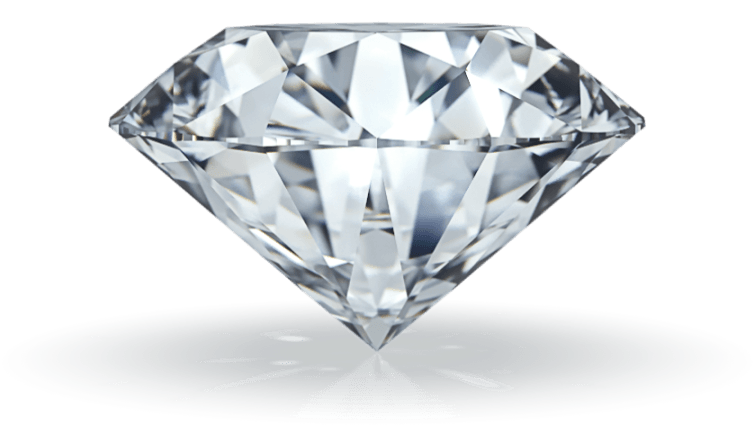
Diamonds are a pure form of what element?
a)
Carbon
b)
Oxygen
c)
Silicon
d)
Silver
101.
What element is used in light bulbs to help them last longer?
a)
Xenon
b)
Argon
c)
Helium
d)
Krypton
102.
Why do some elements have 3 letter chemical symbols?
a)
There are no elements with 3 letter symbols
b)
They are named after scientists
c)
They are named after places
d)
They have a temporary name until scientists agree on a new name.
103.
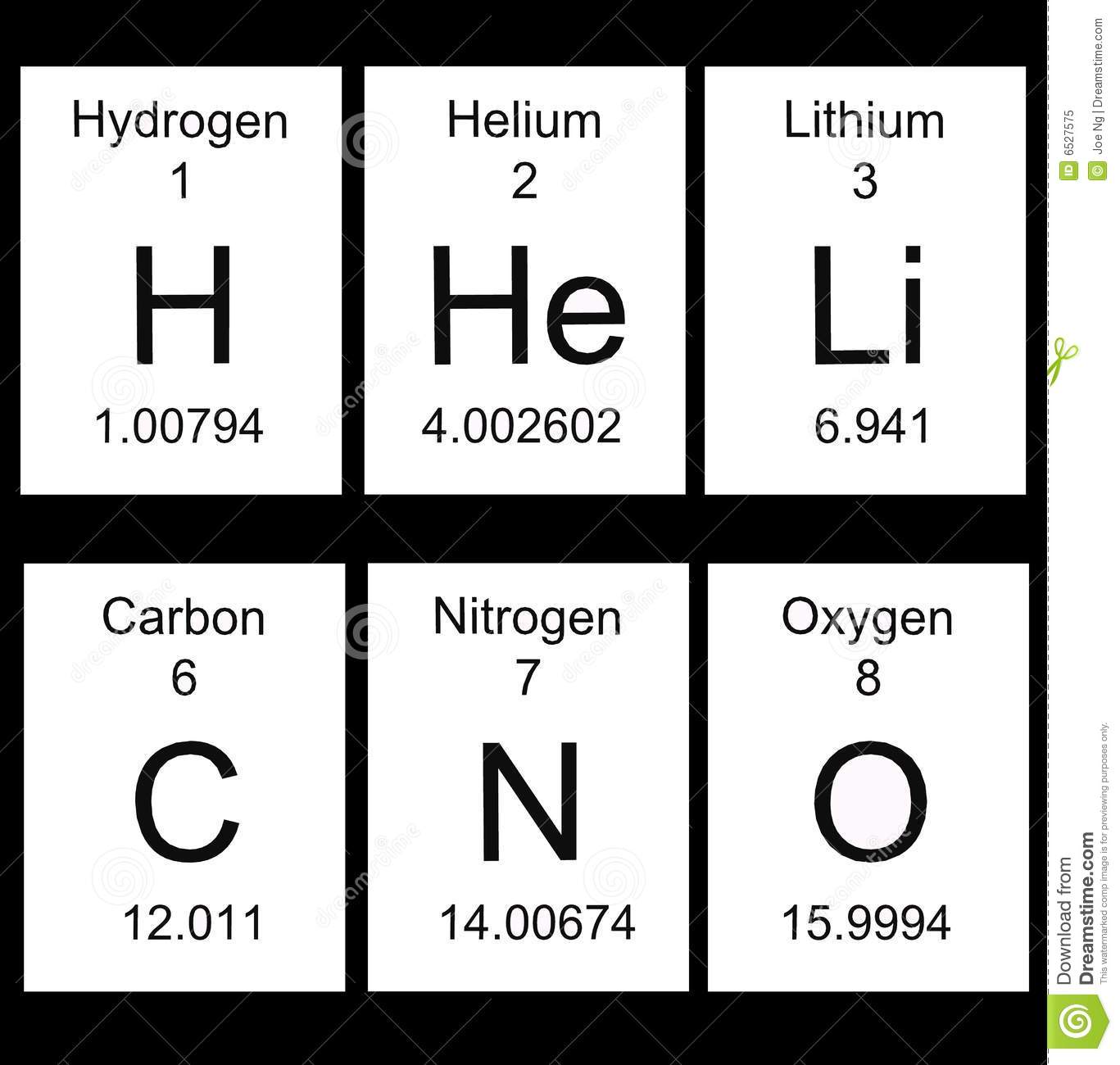
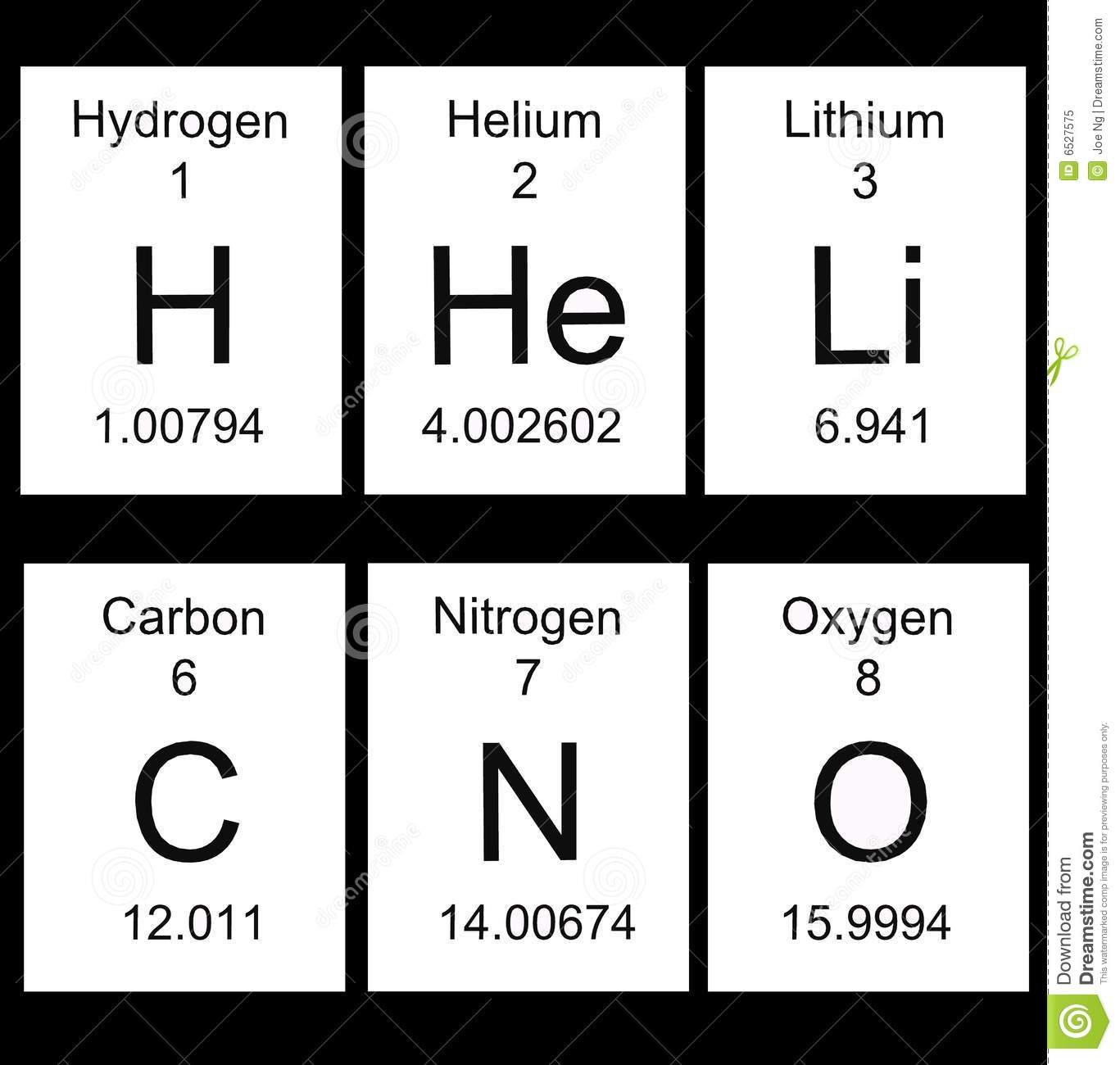
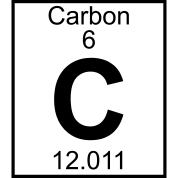
What does 12.011 represent?
a)
atomic mass
b)
atomic number
c)
element name
d)
chemical symbol 
104.
What does the 6 represent?
a)
atomic mass
b)
atomic number
c)
element name
d)
chemical symbol 
105.

the basic structural unit of matter

a)

atom

b)

matter

c)

element

d)

nucleus

106.

the positively charged subatomic particle contained in the nucleus of an atom

a)

proton

b)

neutron

c)

electron

d)

matter

107.

a subatomic particle, contained in the nucleus of an atom, having the same mass as a proton but no electrical charge

a)

proton

b)

neutron

c)

electron

d)

matter

108.

a negatively charged subatomic particle that orbits the nucleus of an atom

a)

proton

b)

neutron

c)

electron

d)

matter

109.

a unique number for each element that equals the number of protons in an atom of that element

a)

element name

b)

element symbol

c)

atomic number

d)

atomic mass

110.

the mass of an atom, calculated by adding the number of protons and neutrons in the nucleus of the atom

a)

element name

b)

element symbol

c)

atomic number

d)

atomic mass

111.
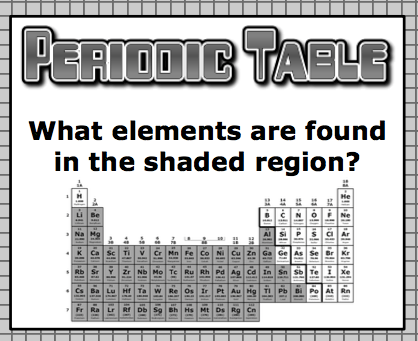
The atomic number of this pictured element is
a)
28
b)
58.6934
c)
Ni
d)
Nickel
112.
What is the atomic mass of Neon?
a)
10
b)
30
c)
10.18
d)
20.18
113.
How many protons are in this element?
a)
79
b)
196
c)
117
d)
Cannot be determined
114.
The atomic number tells you what?  READ THE ANSWERS CAREFULLY
a)
only the number of electrons
b)
 only the number of protons
c)
only the number of neutrons
d)
the number of both electrons and protons in an atom.
115.
What does the atomic mass tell you? 
a)
Basically,the number of electrons and protons
b)
The number of neutrons
c)
Basically, the number of protons and neutrons
d)
The number of protons.
116.

neutron

a)

A subatomic particle that has a positive charge and that is found in the nucleus of an atom

b)

not able to conduct heat or electricity, little to no metallic luster

c)

A subatomic particle that has a negative charge

d)

A small particle in the nucleus of the atom, with no electrical charge

117.

A subatomic particle that has a negative charge

a)

nobles gases

b)

protons

c)

electrons

d)

neutrons

118.
Alkali metals are found in which group of the periodic table?
a)
Group 1
b)
Group 2
c)
Group 7
d)
group 8 
119.
Which of the following is the most reactive in water?
a)
Lithium
b)
Sodium
c)
Potassium
120.
What is another name for the elements in group 7?
a)
The Halogens
b)
The Noble gases
c)
The Oxides
d)
The Alkali Metals
121.

Alkali metals have ___ valence electron(s).

a)

one

b)

two

c)

seven

d)

eight

122.

Chlorine can be tested with

a)

red litmus paper

b)

damp red litmus paper

c)

blue litmus paper

d)

damp blue litmus paper

123.

Which equation shows the displacement of bromine by chlorine?

a)

2NaBr + Cl2 → 2NaCl + Br-

b)

NaBr + Cl- → NaCl + Br2

c)

2NaBr + Cl2 → 2NaCl + Br2

d)

NaBr + 2Cl- → NaCl + 2Br-

124.

What is the trend for melting and boiling points of halogens?

a)

increases down the group

b)

decreases down the group

c)

increases up the group

d)

no change up the group

125.

What is the best prediction about the physical state and color of Astatine?

a)

Dark black solid

b)

Dark reddish brown liquid

c)

Light yellow gas

d)

Light green gas

126.

6.15: Which of these is not a property of noble gases?

a)

Colourless

b)

Odourless

c)

Flammable

d)

Gas at room temperature

127.

Which of these electron configurations is not that of a noble gas?

a)

2

b)

2.8

c)

2.8.8

d)

2.7

128.
Another term for being chemically inactive is...
a)
Inert
b)
Inbert
c)
Insert
d)
Inmert
129.
What is the difference between particles in a gas and a solid?
a)
gas particles are closer together
b)
solid particles move faster than gas particles
c)
solid particles expand on heating
d)
gas particles have more kinetic energy than solid particles
130.

If a hairspray can is heated, what can be expected of the pressure of the gas inside the can?

a)

The pressure will increase

b)

The pressure will decrease

c)

The pressure will remain constant

d)

The pressure will equalize

131.
In what direction(s) does air exert pressure?
a)
everywhere
b)
no where
c)
there is no pressure
d)
downward
132.

The pressure inside the balloon will:

a)

Decrease

b)

Increase

c)

Remain the same

d)

Not enough information to formulate an answer

133.

The pressure inside the syringe will decrease if we move the plunger in:

a)

Direction A

b)

Direction B

c)

We don't have to move the plunger as the pressure will change on its own.

d)

None of the above answers.

134.

Diffusion occurs only in solids

a)

True

b)

False

135.

How do the particles move in diffusion?

a)

From a region of low concentration to a region of high concentration

b)

From a region of high concentration to a region of low concentration

c)

From a region of low concentration to a region of low concentration

d)

From a region of high concentration to a region of high concentration

136.

How long does diffusion last?

a)

Until the concentration of particles in the system is equal

b)

(Select this answer and I swear i'll make it harder for you in the assessment task)

c)

Until a region in the system has a greater concentration of particles than the other

d)

Until the particles disappear from the system

137.
Diffusion is the _______________ movement of particles freely in all directions to occupy the whole space available
a)
constant orderly
b)
constant random
c)
continuous
d)
fixed
138.
What does ductile mean?
a)
electricity flows easily
b)
quacks like a duck
c)
can be drawn into a wire
d)
able to bend
139.
All of these properties describe metals EXCEPT...
a)
malleable
b)
conductors
c)
brittle 
d)
luster
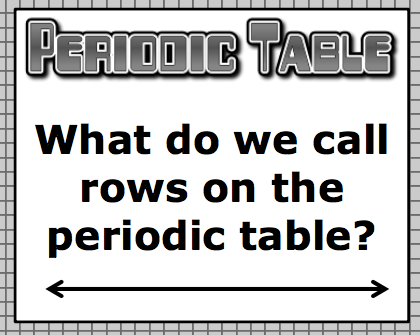
140.
Rows on the period table are called _____ while columns are called _____.
a)
groups, families
b)
groups, periods
c)
periods, groups
d)
families, groups
141.

When we investigate the rate of reaction we are looking at the...

a)

amount of product formed

b)

speed of reaction

c)

concentration of reacting particles

d)

combining reactants with products

142.
Increase in temperature of the reactants can do one of the following
a)
Slow collision frequency
b)
Allow less effective collision between the particles
c)
Neutralise the reaction
d)
increase collision between the particles thus increasing the rate.
143.
Why does a catalyst increase the rate of reaction?
a)
it produces extra energy for the reactants
b)
it increases the speed of the reactant particles
c)
it increases the frequency of particle collisions
d)
it reduces the activation energy of the reaction 
144.
Which of the following increase the reaction rate?
a)
less surface area
b)
lower temperature
c)
an inhibitor
d)
increased concentration
145.
Why don't all collisions between particles cause a reaction?
a)
the particles also need to collide with a catalyst
b)
not all the particles collide with enough energy
c)
not all the particles collide at a high enough temperature
d)
the particles need to collide with each other twice
146.
Why does a higher temperature increase the rate of a reaction?
a)
it increases both the frequency and energy of particle collisions
b)
it only increases the frequency of particle collisions
c)
it only increases the energy of particle collisions
d)
it reduces the activation energy of the reaction
147.
To slow down a chemical reaction you will do one of the following:
a)
Place the reactants in hot water
b)
Place the products in ice bath
c)
Place the reactants in a ice bath
d)
Keep stirring the reactants with a stirring rod
148.

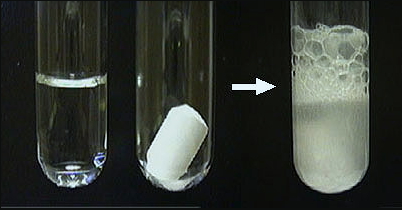
How could we make this reaction happen more quickly?

a)

Decrease the concentration of the acid

b)

crush the chalk to increase the surface area

c)

Put the test tube in an ice bath

149.

The major theory of reaction rate is called

a)

Collision theory

b)

Crash theory

c)

Newton's laws

d)

Thermodynamics

150.

Choose the least reactive metal

a)

calcium

b)

magnesium

c)

iron

d)

copper

151.

What does displacement mean?

a)

A chemical reaction where a less reactive metal takes the place of a more reactive metal in a compound.

b)

A chemical reaction where a more reactive metal takes the place of a less reactive metal in a compound.

c)

A more reactive metal is removed from a compound.

152.

Magnesium chloride + Sodium → ?

a)

Sodium chloride + Magnesium

b)

Magnesium chloride + Sodium (No change)

c)

Sodium magnesium + Chlorine

153.

Lithium chloride + Iron → ?

a)

Lithium chloride + Iron (No change)

b)

Iron chloride + Lithium

c)

Lithium oxide + hydrogen

154.
Which of the following is arranged according increasing reactivity?
a)
Mg > Li > Na > K
b)
Mg > Na > Li > K
c)
Na > Li > Mg > K
d)
K > Mg > Na > Li