
 Worksheets
Egypt Study Guide
Total questions: 31
Worksheet time: 16mins
Name
Class
Date
1.
A reed plant used to make paper
a)
Hieroglyphics
b)
Dynasty
c)
Papyrus
d)
Cataract
2.
Why was the Nile River important to ancient Egypt?
4 lines
3.
To learn how to obtain life after death, the Egyptians studied
a)
Book of Life After Dead
b)
Book of Prayers
c)
Book of Spells
d)
Book of the Dead
4.
A fan-shaped area of fertile marshland formed where the Nile River meets the Mediterranean Sea
a)
Cataracts
b)
Delta
c)
Nile River
d)
Papyrus
5.
The Nile River flows through two important regions in Egypt called
a)
Upper Egypt and Lower Egypt
b)
Mesopotamia
c)
Eastern Egypt and Western Egypt
d)
Nubia and Cairo
6.
Besides providing a stable food diet, what other advantages did Egypt's location provide for early Egyptians?
a)
It had temples in which to worship
b)
it had Sumerian artwork to use as decoration
c)
It had natural barriers to protect against invaders
d)
it had two dynasties to celebrate religious traditions
7.
Pyramids are
a)
warehouses where surplus food is stored
b)
temples where the people are allowed to come and pray.
c)
stone tombs with four rectangle-shaped sides that join a limestone roof
d)
royal tombs with four triangle-shaped sides that meet in a point on top
8.
Which of the following best defines dynasty
a)
a collection of queens
b)
a collection of kingdoms
c)
series of rulers from different families
d)
series of rulers from the same families
9.
Who would the people of Egypt blame if crops did not grow or if disease struck?
a)
the famers whose small villages were unclean
b)
the mummies whose ka was disturbed
c)
the pharaoh who was both ruler and god
d)
the dynasty that was in power
10.
What job employed the most people in Egypt?
a)
Merchant
b)
Scribe
c)
Farmer
d)
Architect
11.
Whose tomb, discovered in 1922, taught us much about Egyptian burial practices and beliefs
a)
King Tutankhamen
b)
Ramses the Great
c)
Queen Hatshepsut
d)
Ahmose
12.
I'm an important female pharaoh of the New Kingdom who expanded trade and built monuments.
a)
Hatshepsut
b)
Cleopatra
c)
Tutankamun
d)
Ramses
13.
The Rosetta Stone was important because
a)
It is a unique artifact
b)
It led to the decoding of Hieroglyphics
c)
It had Greek, Cuneiform, and Egyptian writing on it
d)
It represented peace
14.
A writing system made up of pictures and sound symbols
a)
Hieroglyphics
b)
embalming
c)
delta
d)
papyrus
15.
Ruler of ancient Egypt
a)
Pharaoh
b)
Delta
c)
Savanna
d)
cataract
16.
Like in Mesopotamia, the Nile River also flooded. However, the Nile floods were more
a)
Clean
b)
Rapid
c)
predictable
d)
unpredictable
17.
Who united the Lower and Upper Kingdoms
a)
Ahmose
b)
Hatshepsut
c)
Menes
d)
Thutmose III
18.
Egyptians believed the pharaoh was the son of ________, the Egyptian sun god.
a)
Hapi
b)
Osiris
c)
Thoth
d)
Ra
19.
What continent is Egypt on?
a)
South America
b)
Asia
c)
North America
d)
Africa
20.
The Nile River flows from
a)
South to North
b)
East to West
c)
West to East
d)
North to South
21.
The first pharaoh of the New Kingdom, Ahmose, was most famous for
a)
Nothing absolutely, nothing
b)
kicking the Hyksos out of Egypt and re-unifying Upper and Lower Egypt.
c)
Building the Great Pyramid of Giza
d)
Floating a boat down the Nile
22.
Tell me about the mummification process.
4 lines
23.
Which pharaoh built the step pyramid?
a)
Menes
b)
Khufu
c)
Djoser
d)
Cleopatra
24.
Name 2 major achievements from ancient Egypt.
(a)
25.
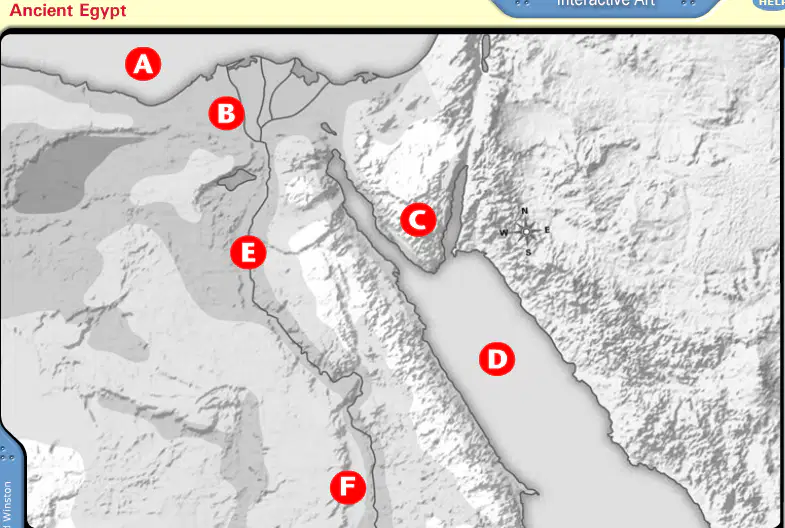
What does letter "A" represent on the map?
a)
Red Sea
b)
Mediterranean Sea
c)
Nile River
d)
Persian Gulf
26.
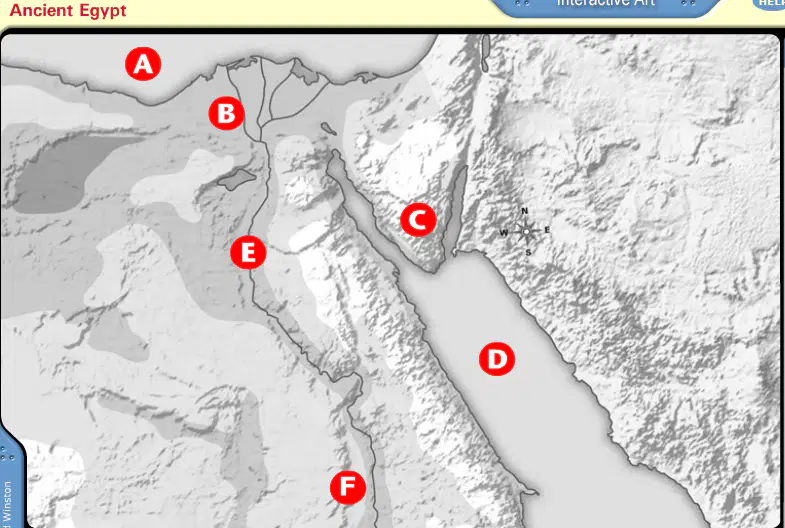
What does letter "C" represent on the map?
a)
Sinai Peninsula
b)
Sahara Desert
c)
India
d)
Memphis
27.
What was Osiris the god of?
a)
The underworld and the dead
b)
the sky and the wind
c)
knowledge and wisdom
d)
the moon and stars
28.
Why was ancient Egypt important?
4 lines
29.
How old was King Tut when he became pharaoh?
a)
19
b)
18
c)
9
d)
8
30.
What is the difference between polytheism and monotheism?
4 lines
31.
Ancient Egyptians were monotheistic.
a)
True
b)
False
100 %

