
 Worksheets
Review for 6th Grade Science Post-Assessment
Total questions: 31
Worksheet time: 3hrs 35mins
Wind is mainly caused by...
gravity moving air around in different directions
the uneven heating of Earth's surface by the sun
thunderstorms and tornados that create strong breezes
the fast movement of cars and planes
A rising barometer (high pressure) means...
snow will fall within 24 hours
storm clouds are probably on their way
clear skies are likely coming
unsure; barometers cannot be used to predict future weather
Which of the following does NOT influence a region's climate?
Elevation
Nearness to water
Winds and ocean currents
Longitude
What is the process of hotter, less dense fluids rising and colder, more dense materials sinking?
Conduction
Radiation
Convection
Circulation
Which TWO things power (cause) the water cycle?
gravity
plate tectonics
erosion
solar radiation
hurricanes
Global winds and ocean currents on Earth appear to curve rather than move in straight lines because of...
The way our eyes perceive movement when viewing a map
The tilt of the Earth (Law of Superposition)
Earth's rotation (Coriolis Effect)
The rapid movement of air and water in different directions
Which image is the MOST accurate scale model of our solar system? (Only consider size and distance).

Option 1
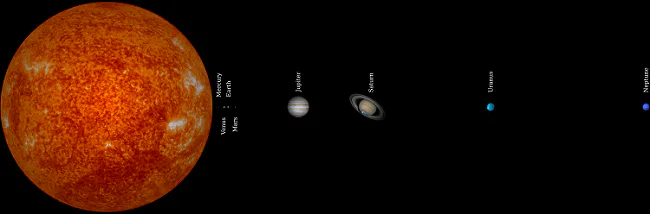
Option 2

Option 3

Option 4
What do moon phases, seasons, and eclipses have in common?
They are all caused by the rotation, revolution, and tilt of Earth and the moon.
They all happen due to natural forces from the sun as it shines on Earth.
They are all caused by the force of gravity on Earth and the moon.
They all happen four times a year.
Why is one day on Mercury equal to 58 Earth days?
Venus has a gravitational pull on Mercury
Mercury rotates very slowly on its axis
One revolution of Mercury around the sun takes the same time as one rotation on its axis
Mercury revolves very slowly around the Sun
Earth has seasons because...
Volcanic eruptions cause different types of weather.
Earth's axis is tilted as it moves around the sun.
The distance between the earth and the sun changes throughout the year
Heat energy from the sun disappears from December to March.
Which list correctly places the items in order of SMALLEST to LARGEST?
Planet, Star, Galaxy, Universe, Solar System
Universe, Galaxy, Solar System, Planet, Star
Star, Planet, Solar System, Galaxy, Universe
Planet, Star, Solar System, Galaxy, Universe
__________ is what keeps the solar system together and keeps Earth orbiting around the sun.
Gravity
Space radiation
Heat energy from the sun
Earth's size
Select TWO. Which of the following show evidence of continental drift and plate tectonics?
Land animal fossils of the same species were found on continents separated by oceans today.
Satellites have shown that the continents are moving 150 miles each year.
The continents fit together like puzzle pieces.
Earthquakes are creating cracks in Earth's crust.

Which fossil is the YOUNGEST based on this image of rock layers?
ammonite
trilobite
fern
gastropod
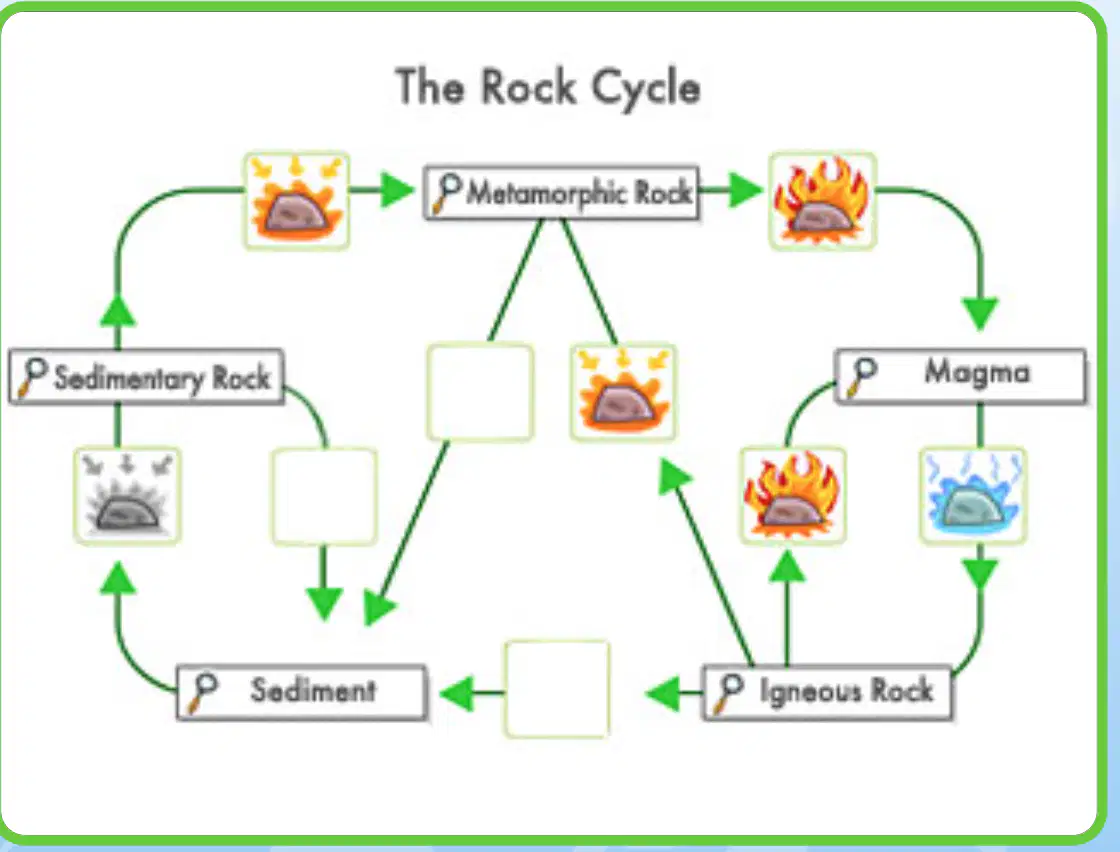
Which process is missing from the diagram below?
heat and pressure
compaction
weathering and erosion
melting
What is a common method scientists use to figure out what has happened in Earth's geologic past?
Reading stories from those who lived many years ago
Using the Official U.S. Geologic Time Machine
Looking at ancient writing from the Egyptians
Examining rock strata and fossils
Dissecting animals and plants
Convection in Earth's mantle causes _______
tectonic plates to slowly shift over time.
Earth's core to heat up as time passes.
tsunamis to occur in locations where convection happens.
cold magma to rise to Earth's surface.
At a Convergent (Continental/Oceanic Subduction) boundary, we get...
earthquakes; faults are formed
mountains
seafloor spreading; mid-ocean ridges or rift valleys form
volcanoes
At a Convergent (Continental/Continental Collision) boundary, we get...
earthquakes; faults are formed
mountains
seafloor spreading; mid-ocean ridges or rift valleys form
volcanoes
At a Divergent boundary, we get...
earthquakes; faults are formed
mountains
seafloor spreading; mid-ocean ridges or rift valleys form
volcanoes
What is the main cause of the global climate change we are seeing today?
Earth is getting closer to the sun each year, making the climate warmer.
Volcanic eruptions that release ash and dust into the atmosphere
Burning fossil fuels such as coal, oil, and natural gas which releases greenhouse gases
The ozone layer is being worn down due to chemical pollution
At a Transform boundary, we get...
earthquakes; faults are formed
mountains
seafloor spreading; mid-ocean ridges or rift valleys form
volcanoes
Carbon dioxide levels in the atmosphere...
have stayed about the same for the past 100 years
have been rising since at least since 1958
rose in the 1950s and 1960s, but are now stable
have been declining since around 1972
The greenhouse effect refers to...
the ability of the atmosphere to retain water vapor
greenhouses offering a steady, humid climate to grow healthy plants
gases in the atmosphere trapping the sun's heat and warming the planet
using greenhouses to quickly grow a wide variety of plants
Which of the following is NOT a part of the Engineering Design Process?
CAMPAIGN to convince others that there is a problem
IMAGINE possible solutions
IMPROVE your solution by redesigning as needed
CREATE by building a prototype
ASK QUESTIONS to identify the problem/need and constraints
Which of the following statements is FALSE?
Renewable resources are naturally replenished in our lifetime.
Fossil fuels are a sustainable natural resource because they can be replenished in a short amount of time.
Examples of renewable energy include wind, sunlight, and moving water.
Fossil fuels take millions of years to form.
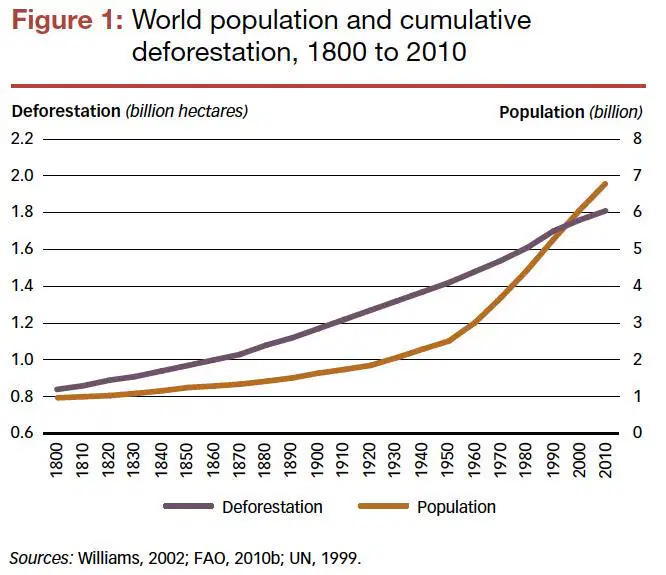
From this graph, we can conclude that...
As the human population has decreased, deforestation has increased.
As the human population has decreased, deforestation has also decreased.
As the human population has increased, deforestation has decreased.
As the human population has increased, deforestation has also increased.
Geology is the...
study of the universe
study of ancient life using fossils
study of the origin, history, and structure of Earth
study of the atmosphere, particularly weather and climate
Astronomy is the...
study of the universe
study of ancient life using fossils
study of the origin, history, and structure of Earth
study of the atmosphere, particularly weather and climate
Meteorology is the...
study of the universe
study of ancient life using fossils
study of the origin, history, and structure of Earth
study of the atmosphere, particularly weather and climate
Paleontology is the...
study of the universe
study of ancient life using fossils
study of the origin, history, and structure of Earth
study of the atmosphere, particularly weather and climate

