
 Worksheets
Heart & Lungs Quiz
Total questions: 26
Worksheet time: 9mins
Name
Class
Date
1.
How do the heart and lungs work together?
a)
The heart controls breathing
b)
The lungs pump blood
c)
The lungs add oxygen to the blood, and the heart pumps it
d)
The heart and lungs work separately
2.
Which of the three main chemicals in tobacco is described as a black, sticky residue and is a known carcinogen?
a)
Nicotine
b)
Tar
c)
Carbon Monoxide
d)
Formaldahyde
3.
Scenario:
Jordan spends a lot of time around people who smoke. They notice their heart is racing more than usual when walking up stairs, and they feel more tired during exercise.
a)
The chemicals in secondhand smoke are increasing the risk of heart problems and making the heart work harder
b)
The lungs are completely blocked
c)
The stomach is not digesting food properly
d)
The brain is producing extra oxygen
4.
What type of muscle is the heart?
a)
Skeletal
b)
Smooth
c)
Voluntary
d)
Cardiac
5.
Scenario: While giving CPR, the person suddenly starts coughing and breathing normally.
What should you do next?
a)
Continue chest compressions
b)
Stop CPR and monitor their breathing
c)
Use the AED immediately
d)
Move them to the floor
6.
1. What is the main job of the respiratory system?
a)
To digest food
b)
To pump blood
c)
To help you move
d)
To help you breathe and get oxygen
7.
What is the main purpose of an AED (Automated External Defibrillator)?
a)
To give oxygen to someone who is not breathing
b)
To stop bleeding
c)
To restart or help correct a dangerous heart rhythm
d)
To check blood pressure
8.
When you exhale, which gas do you release?
a)
Oxygen
b)
Carbon Monoxide
c)
Carbon Dioxide
d)
Nitrogen
9.
Scenario: Jamie has been running during gym class and starts to feel short of breath and wheezy.
What is most likely happening in Jamie’s lungs?
a)
The lungs are not taking in oxygen efficiently
b)
The lungs are producing extra blood
c)
The heart has stopped pumping
d)
The stomach is full of air
10.
When should you stop CPR?
a)
When you get tired.
b)
After one minute
c)
When help arrives or the person starts breathing
d)
When someone tells you to
11.
Scenario: Alex is running in a race and starts to feel their heart beating very fast and hard, and they feel dizzy.
What is most likely happening in Alex’s heart?
a)
The heart has stopped working
b)
The heart is pumping more blood to supply oxygen to the muscles
c)
The heart is shrinking in size
d)
The heart is pumping less blood
12.
What tube (windpipe) carries air from the throat to the lungs?
a)
Esophagus
b)
Trachea
c)
Bronchi
d)
Alveoli
13.
Which harmful substance in tobacco is very addictive?
a)
Oxygen
b)
Tar
c)
Nicotine
d)
Carbon Dioxide
14.
How many chest compressions should you aim for per minute when doing CPR?
a)
40-60 bpm
b)
80 - 100 bpm
c)
100 - 120 bpm
d)
150 - 180 bpm
15.
Scenario: You see a classmate collapse on the playground. They are not responding and not breathing normally. What should you do first?
a)
Give them water
b)
Start chest compressions immediately
c)
Move them another area
d)
Check the scene and call 911
16.
Which system works closely with the heart?
a)
Digestive
b)
Nervous
c)
Skeletal
d)
Respiratory
17.
When should CPR be given?
a)
When someone is not breathing and has no heartbeat
b)
When someone is choking
c)
When someone is responsive
d)
When someone is sleeping
18.
Scenario: A patient has a blocked coronary artery from years of smoking.
What effect might this have on the heart?
a)
It would increase oxygen in the blood
b)
It would stop the lungs from working
c)
It could reduce blood flow to the heart muscle, causing chest pain or heart attack
d)
It would make the heart pump less efficiently but have no symptoms
19.
Where should your hands be placed for chest compressions?
a)
On the stomach
b)
On the neck
c)
In the center of the chest
d)
On the back
20.
Scenario: Morgan is exposed to secondhand smoke at a party. Later, they start coughing, feel tightness in their chest, and have trouble taking deep breaths.
What is most likely happening in Morgan’s lungs?
a)
The lungs are producing extra blood
b)
The diaphragm is not working at all
c)
The alveoli are irritated, making it harder to exchange oxygen and carbon dioxide
d)
The heart has stopped pumping
21.
What is the first step you should take before starting chest compressions during CPR?
a)
Check the person for responsiveness
b)
Give water to the person
c)
Call their family
d)
Check for a pulse
22.
Which part of the respiratory system is responsible for exchanging oxygen and carbon dioxide?
a)
Esophagus
b)
Trachea
c)
Alveoli
d)
Bronchi
23.
What effect does nicotine have on the body?
a)
It increases heart rate and blood pressure
b)
It helps the lungs absorb more oxygen
c)
It reduces blood flow to the muscles
d)
It makes the heart stop
24.
How many chambers does the heart have?
a)
1
b)
2
c)
3
d)
4
25.
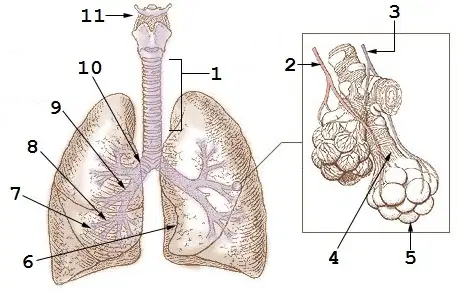
What is #10 on the diagram?
a)
alveoli
b)
bronchi
c)
bronchioles
d)
trachea
26.
What is #5 on the diagram?
a)
alveoli
b)
bronchi
c)
bronchioles
d)
trachea
100 %

